
Library Optimization
Library Optimization streamlines a DJ's library and prep workflow so tracks are organized, searchable, and performance-ready fast.
Library Optimization Tutorials
Optimization is the discipline of shaping your library and prep workflow so you can find the right track in seconds and execute cleanly. Learn Optimization to reduce search time, lower stress, and turn scattered folders into a dependable system.
When Optimization is in place, crates populate themselves, analysis is accurate, and your hottest cuts sit one keystroke away. You will practice transitions more, scroll less, and enter the booth with a plan you can bend to the room.
What Is Optimization?
Optimization is a repeatable method for organizing, analyzing, and surfacing tracks using smart rules. In Serato these are Smart Crates. In Rekordbox they are Intelligent Playlists. Both update based on tag, BPM, key, and other metadata rules.
Smart lists are standard in pro workflows. See the Serato Smart Crates guide for criteria and rule logic, the Serato Analyzing Files overview for analysis benefits, and the Serato Beatgrids explanation for accurate grids that make syncing predictable.
Rekordbox offers comparable rule sets through Intelligent Playlists. A step-by-step tutorial shows how to build lists that auto-populate by BPM, key, rating, or My Tag. Third-party manuals note cross-app limitations and how smartlists convert between ecosystems.
Optimization supports musical choices, not just filing. It strengthens timing and phrasing by keeping compatible tracks together so you can practice transitions instead of hunting. Pair it with master beat matching fundamentals to hear the impact quickly.
Why Master This Technique
- Cut selection time so you mix more and scroll less.
- Reduce errors with accurate analysis and locked beatgrids.
- Move from crates to context, choosing by energy, key, and function.
- Arrive at gigs with slimmer, sharper playlists you trust.
Core Technique Breakdown
1) Analyze first. Run BPM, key, and beatgrid analysis on import. This prepares waveforms, lowers CPU load, and creates a consistent tempo map. Serato documents that pre-analysis reduces performance load and keeps tracks ready when you need them.
2) Lock the beatgrid. After quick checks and any grid edits, lock to prevent accidental changes. Accurate grids keep phrasing stable and make sync behavior consistent across devices, as covered in Serato’s Beatgrids explanation.
3) Design smart rules. Build rule-based lists for BPM ranges, key families, and tags. Serato’s Smart Crates and Rekordbox’s Intelligent Playlists both allow conditions like Contains, Is, and date-based filters to keep lists fresh and targeted.
4) Tag for use, not trivia. Use a small, durable tag set that reflects how you actually play: Energy, Function, Mood. Keep it to four categories if you rely on Rekordbox My Tag for CDJ filtering, and prefer words that will not change next month.
5) Curate shortlists before gigs. Start with broad smartlists, then audition and flag a tight playlist of 60–120 tracks for a two-hour slot. A MusicRadar report on Serato DJ 4.0 highlights new library tools like favorites, crate colors, and emoji ratings that speed this curation.
6) Export and test. Push to USB or performance mode and rehearse transitions in order. Fix outliers, then re-export. Smartlists continue updating as you add new tracks, keeping your prep current without manual filing.
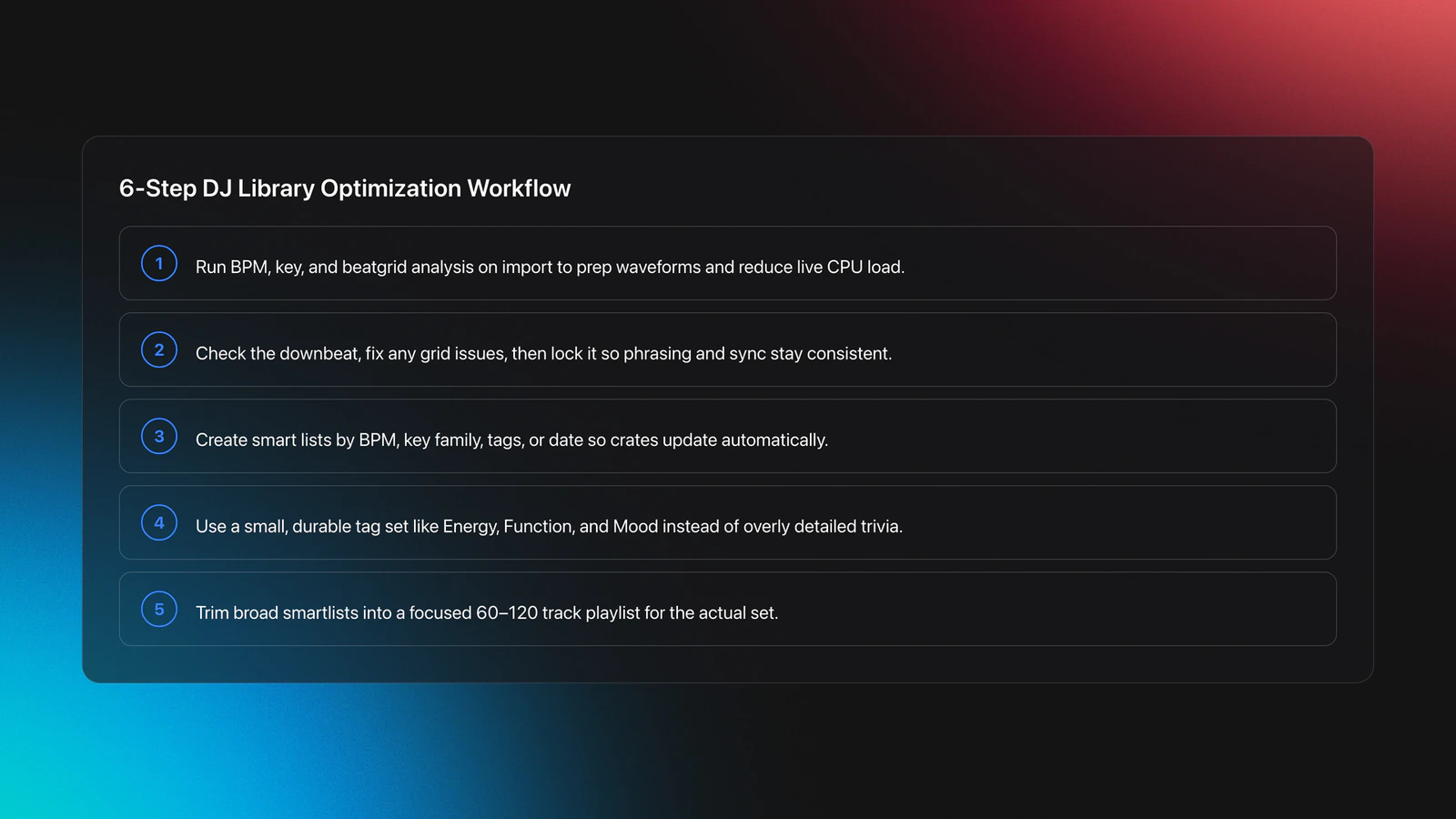
| Step | Action | Key Point |
|---|---|---|
| Analyze | Run BPM, key, waveform builds on import | Reduces CPU load and prepares grids |
| Grid | Check downbeat, adjust, then lock | Accurate phrasing and tighter transitions |
| Rules | Create BPM and key smartlists | Auto-populate practice and gig crates |
| Tag | Apply small, durable tags | Reflect real use like Energy and Function |
| Curate | Narrow to a show-ready shortlist | Less scrolling, more mixing |
| Export | Test on target gear and refine | Catch issues before the room does |
References: Serato Smart Crates guide, Serato Analyzing Files overview, Serato Beatgrids explanation, Rekordbox Intelligent Playlists tutorial, and the Lexicon smartlists manual on app limitations and conversion.
Practice Drills
Through daily 15–30 minute sessions, I found that building a single BPM-range smartlist and rehearsing two-track swaps across it accelerated selection speed more than browsing giant crates. Short, focused loops create durable habits that hold up under pressure.
If you prefer organized practice materials, load a small reference library by energy and function, then export that structure with Vibes once so your routine is consistent across weeks.
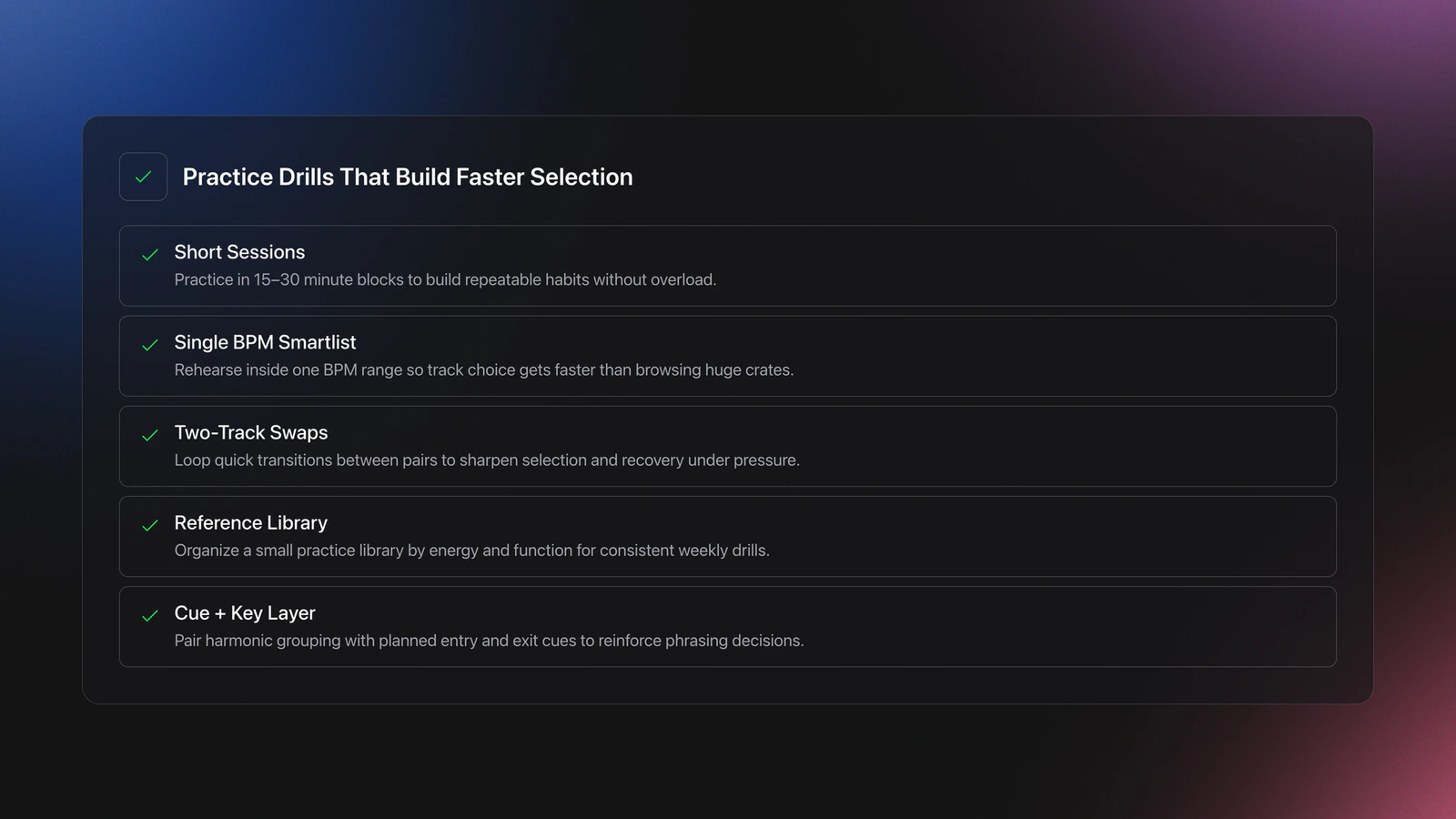
Add depth with learn harmonic mixing to refine which keys you group together. Tie drills to cue work by planning entry and exit markers, then set reliable performance cues that match your phrasing strategy.
Common Mistakes
| Mistake | Why It Happens | Solution |
|---|---|---|
| Skipping analysis | Assuming auto analysis will catch up while playing | Analyze on import and verify grids. See Serato Analyzing Files overview and Beatgrids explanation. |
| Too many tags | Tagging trivia that does not affect selection | Limit to small sets like Energy, Function, Mood. Prefer durable words. |
| Over-broad crates | One crate covers a whole genre or year | Use BPM and key rules to split into practical smartlists. |
| Unlocked grids | Accidental edits or re-analysis shifts timing | Lock grids after edits. Re-check before export. |
| Not testing exports | Assuming laptop behavior equals USB players | Rehearse from the device you will use on stage and fix issues early. |
Equipment and Setup
Any modern laptop with Rekordbox or Serato DJ works. Use local files on a fast SSD, and dedicate an external drive or USB for exports. Keep software versions current and confirm analysis options before bulk imports.
Serato documents analysis, BPM-range settings, and beatgrid behavior in its support articles. Rekordbox tutorials cover building Intelligent Playlists and practical rule design. Lexicon’s manual outlines smartlist conversions and rule limits when moving between apps.
Cited resources: Serato Smart Crates guide, Serato Analyzing Files overview, Serato Beatgrids explanation, Rekordbox Intelligent Playlists tutorial, Lexicon smartlists manual, and MusicRadar’s coverage of the latest Serato library features.
The visual way to organize your DJ library
Tag tracks by vibe. See everything at once. Export to any DJ software.
14-day free trial. Full access, no strings attached.
or see how it works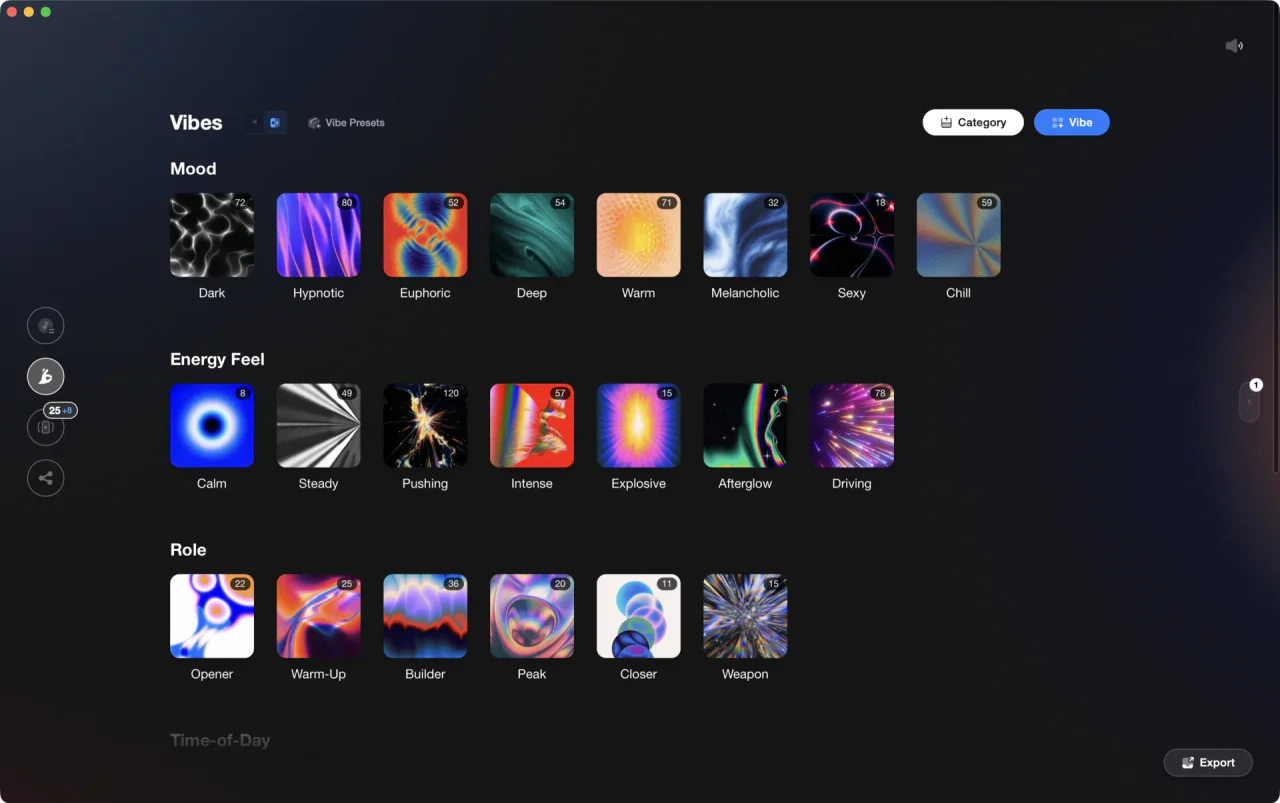
More Tutorials

DJ Setup Guide: Wire a Reliable Rig From Bedroom to Club

How to DJ With Just a Laptop (No Controller Needed)

Music Library Management for DJs: Tags, Folders & Backups
Deep House: Sound, Structure, and Flow

How to Set Up Your First DJ Controller and Mix Two Tracks
Transition DJ Online: Browser Mixer Workflow
Virtual DJ Library Setup That Sticks
Mixed In Key Manual for DJs
Professional DJ Controller: Battle vs Club Layout, Jogs, and I/O

Best House Music Songs for DJ Sets: Tracks That Work
DJ Transitions: The Three-Layer Handoff for Beginners
Beginner DJ Equipment: What You Need
How To Mix In Key Live: Worked Transitions And Failure Fixes
DJ Decks: 2 vs 4 Channel Buying Guide
Rekordbox Library Setup and Backup

Starter DJ Controller Buying Guide
How to DJ: First Mix, Step by Step
Progressive House Music: How It Works

DJ City Song: What You Actually Get

How Can I Be a DJ and Start Strong
DJ Record Pool Guide for Working DJs
Portable DJ Controller Buying Guide
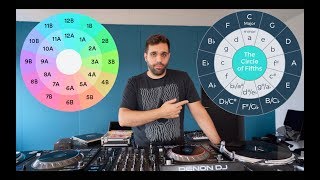
Mix and Key: Practical Guide to Melodic DJ Mixing
Beginner DJ Setup: Wire Your Controller, Then Play Your First Mix
DJ Starter Equipment: What to Buy First (and What to Skip)

How to Mix and Edit Songs Together
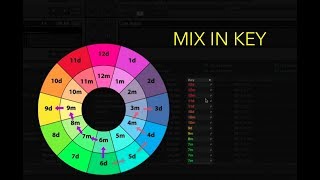
Camelot Wheel DJ: Layered Deck Mixing With EQ and Phrase

House DJs: What Sets the Best Apart
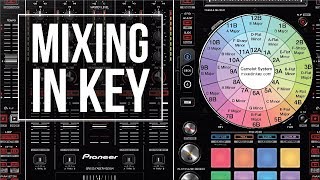
When Mix and Key Actually Matters: A DJ's Guide to Harmonic Decisions
Mixed In Key Database Guide

Best DJ Controller: How to Choose
DJ Library Organization System: Tags, Crates, Keys
Equipment You'll Need
iTunes
optionalApple iTunes is a Windows media library, playback, device sync, and store application for managing music, video, podcasts, and Apple purchases.
Novation Launchpad X
optionalThe Novation Launchpad X is a 64-pad MIDI grid controller built for live clip launching and DJ performance. Trigger stems, loops, and one-shots in Ableton Session View or map to Traktor Remix Decks. RGB feedback keeps you oriented during high-energy sets.
VirtualDJ
optionalDJ software for Windows and macOS that handles audio mixing, video mixing, karaoke, stems, and broad hardware support.
MIDI Controller
optionalA MIDI Controller is an input device that sends performance data to software instruments, hardware synths, drum machines, and DAWs. If you need hands-on control for playing notes, triggering clips, or automating parameters, a MIDI Controller is the tool that ties your setup together. It does not generate audio on its own.
Serato DJ Pro
optionalProfessional DJ software for mixing, performance, library management, recording, and hardware-integrated club workflows.
Image-Line Soundgoodizer
optionalA simple stereo maximizer-enhancer plugin for FL Studio that applies one-knob processing based on the Maximus engine.
Ableton Live
optionalAbleton Live is the go-to DAW for hybrid DJ sets and live electronic performance. Session View enables non-linear clip launching perfect for DJs transitioning from decks. Use it alongside CDJs, with controllers like Push and Launchpad, or as your complete performance rig.
Pioneer DJ DDJ-1000
optionalA 4-channel rekordbox DJ controller with full-size jog wheels, onboard displays, and club-style mixer controls.
Mixed In Key 11
optionalStandalone harmonic-mixing and library-prep software that detects keys, energy levels, cue points, and tags for DJ sets.
Mixed In Key
optionalDJ library preparation software that analyzes key, BPM, energy level, and cue points to speed up harmonic mixing and set planning.
FL Studio
optionalA pattern-based digital audio workstation for beatmaking, recording, arrangement, mixing, and music production on Windows and macOS.
Traxsource
optionalTraxsource is a digital music download store focused on house and underground dance music for DJs.
rekordbox DJ
optionalCloud-connected DJ software for music management, performance, export prep, and club-standard hardware integration.
AlphaTheta rekordbox
optionalProfessional DJ software for library management, USB export, cloud sync, and live performance tightly integrated with Pioneer DJ/AlphaTheta hardware.
Pioneer DJ DDJ-400
optionalA compact 2-channel USB DJ controller built for rekordbox with a club-style layout aimed at new and progressing DJs.
Mixed In Key Camelot Wheel
optionalA numeric key notation system for DJs that labels musical keys 1A–12A (minor) and 1B–12B (major) to simplify harmonic mixing.
Pioneer DJ DDJ-FLX4
optionalA compact 2-channel DJ controller with built-in audio interface, USB-C connectivity, and beginner-friendly smart mixing features.
VirtualDJ 7
optionalA legacy DJ software platform for audio and video mixing, controller mapping, and DVS playback on Windows and Mac.
Hercules DJControl Inpulse 500
optionalA 2-channel USB DJ controller with built-in audio interface, performance pads, and guided mixing features for home practice and small public sets.
FileZilla
optionalA cross-platform FTP, FTPS, and SFTP client for transferring files between local machines and remote servers.
Serato DJ Lite
optionalFree two-deck DJ software for Mac and Windows that introduces Serato’s workflow, controller support, and basic mixing tools.
Camelot Wheel
optionalA harmonic mixing notation system that maps musical keys into simple 1A to 12B codes for DJs.
Universal Audio Starlight Echo Station
optionalA stereo DSP delay pedal that combines vintage tape, analog bucket-brigade, and modern digital delay sounds in one compact stompbox.
Native Instruments Traktor Pro 4
optionalA professional 4-deck DJ software platform with stem separation, flexible beatgrids, effects, DVS support, and broad controller integration.
Pioneer DJ CDJ-3000
optionalProfessional flagship DJ media player with a 9-inch touchscreen, advanced MPU processing, and club-standard Pro DJ Link workflow.
Native Instruments FM8
optionalNative Instruments FM8 is a powerhouse FM synthesizer for hybrid DJ sets and live performance. Its low CPU usage and bright, cutting tones make it ideal for layering over tracks in a live mix. Bounce FM8 basslines as audio loops for Traktor Remix Decks or Ableton clips.
Pioneer CDJ-400
optionalA discontinued digital DJ media player that plays CDs and MP3 files from USB storage, and can also work as a MIDI controller and USB audio interface.
Beatport
optionalBeatport is a DJ-focused electronic music store and streaming platform for discovering, buying, and streaming tracks into supported DJ software and hardware.
Yamaha REV5
optionalThe Yamaha REV5 is a 2U rackmount digital **reverberator** built for studios and live rigs. If you want hardware ambience with surgical control, the Yamaha REV5 still delivers. Its balanced I/O, per‑program parametric EQ, and MIDI backup make it a reliable problem solver as well as a creative reverb. This page covers Yamaha REV5 features, specifications, pricing context, and the best alternatives.
DJControl Inpulse 200 MK2
optionalCompact 2‑deck USB DJ controller with built‑in audio, Beatmatch Guide LEDs, and Serato DJ Lite/DJUCED integration.
Cockos REAPER
optionalA lightweight, deeply customizable digital audio workstation for recording, editing, mixing, MIDI production, and post work on Windows, macOS, and Linux.
Pioneer DJ DDJ-SB
optionalA compact 2-channel USB DJ controller designed for Serato DJ Intro and later supported with Serato DJ Lite and Serato DJ Pro.
Numark Mixtrack Pro II
optionalA two-channel USB DJ controller with a built-in audio interface, touch-activated jog wheels, and performance pads for Serato-compatible mixing.
Numark Mixtrack Pro FX
optionalA 2-deck USB DJ controller with a built-in audio interface, capacitive jog wheels, performance pads, and Serato DJ Lite support.
Pioneer CDJ-1000
optionalA discontinued professional CD-based DJ player that helped define the modern club-standard jog-wheel workflow.
Traktor MX2
optionalA 2-channel DJ controller with integrated audio interface and tight Traktor Pro 4 integration for mixing, stems, effects, and performance pads.
Platinum Notes 10
optionalPlatinum Notes 10 evens loudness, repairs clipped peaks, and prepares DJ files for more consistent playback in Serato, rekordbox, and Traktor.
Frequently Asked Questions

Hey, it's Ben Modigell 👋
I DJ and produce as so I so — downtempo, minimal, dub house, tech house, and techno (releases on Spotify and SoundCloud, links above). Everything I write here comes from my own gigs, studio sessions, and library cleanups: the rules I follow, the failure modes I've actually hit, and the workflow I use when nobody's watching. If a technique didn't earn its place in my own sets, it doesn't make it into a tutorial.