Watch Karl Thomas’s tutorial above (57K views on YouTube).
This is for DJs comparing a DJ City song download workflow against other record pool options. If you are stuck wondering what DJcity actually gives you, how the catalog works, and whether it is enough for real gigs, this will make the tradeoffs clear.
The short version is simple. A DJ City song usually means a downloadable track from the DJcity record pool, often alongside edits, intro versions, clean versions, and other DJ-focused variants. The real question is not whether DJcity has music. It is whether its catalog matches your genre, your gigs, and your buying habits.
If you are still building your system, it also helps to understand how DJ library organization, record pool workflows, open format DJing, and set preparation methods connect before you subscribe.
DJ City Song Meaning and Context
A DJ City song is not a separate file format or a special genre label. It usually refers to a track available inside the DJcity music pool.
That matters because DJs often search for a single song when the real decision is bigger. You are not only asking whether one track is there. You are asking whether the whole DJ city record pool is worth paying for.
A record pool is a subscription library for DJs. You pay recurring access, browse the catalog, and download tracks for DJ use instead of buying every file one by one.
According to DJcity support, record pools are built around genre libraries, DJ edits, and curated discovery for working DJs. DJcity also positions itself as a licensed DJ record pool rather than a random download site. Official support materials describe access to multiple regional catalogs through one subscription and frame the service around DJ performance use.
In practice, that gives you three things. First, volume. Second, DJ-ready edits. Third, faster access to playable versions than you would get from piecing together purchases track by track.
It does not give you everything.
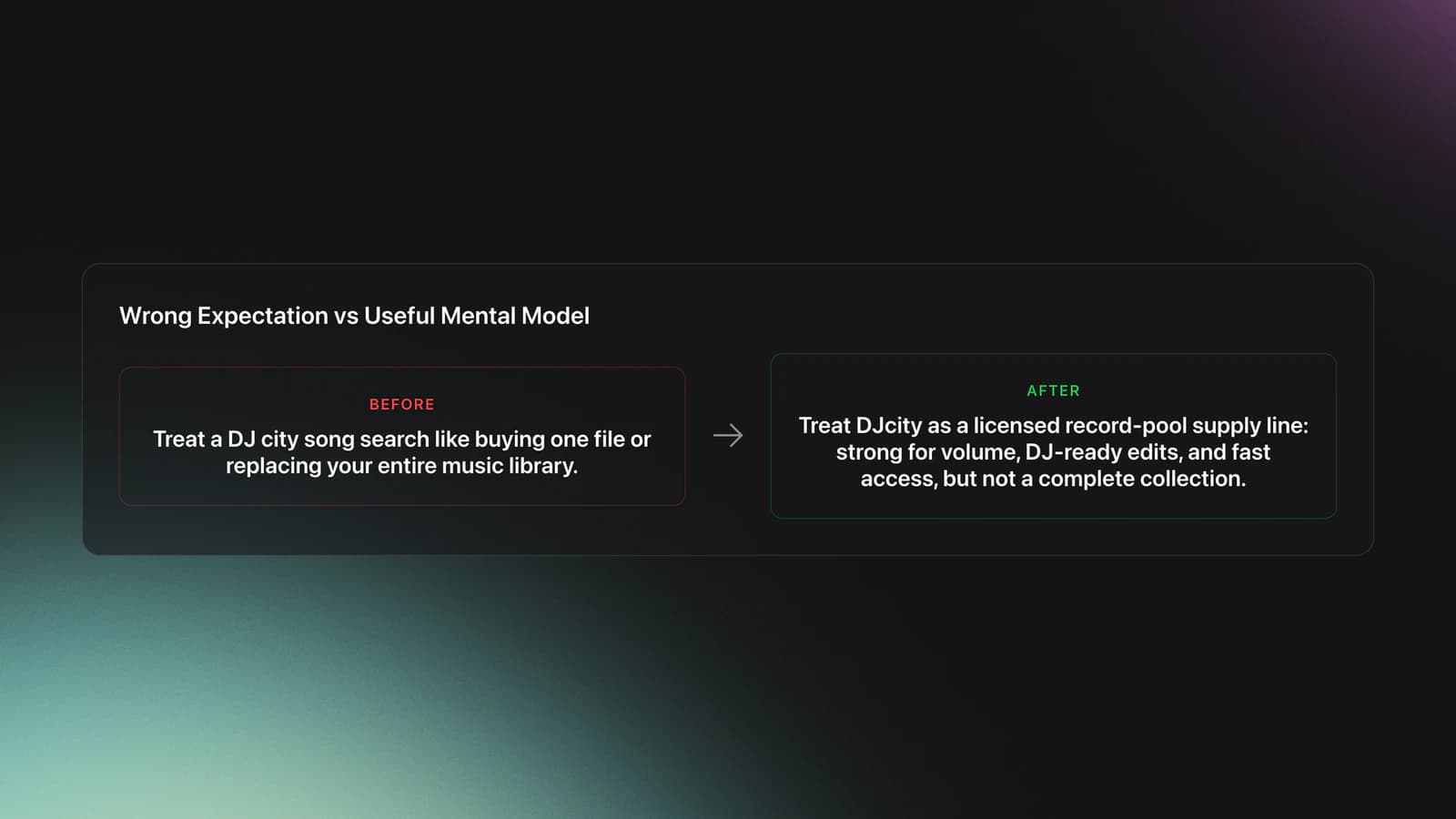
That is the first mental model to keep in mind. A record pool is a base layer, not a complete music collection.
Experienced DJs usually end up combining sources. They use a pool for current releases and edits, then top up missing tracks through direct stores or existing archives.
That distinction prevents disappointment. If you expect DJcity to replace every store, every genre source, and every back-catalog need, you will judge it too harshly. If you treat it as a working supply line for a specific kind of set, the value becomes easier to measure.
How To Check a DJ City Song Before You Pay
You should not subscribe blind. The right move is to test the catalog against your actual workflow before spending money.
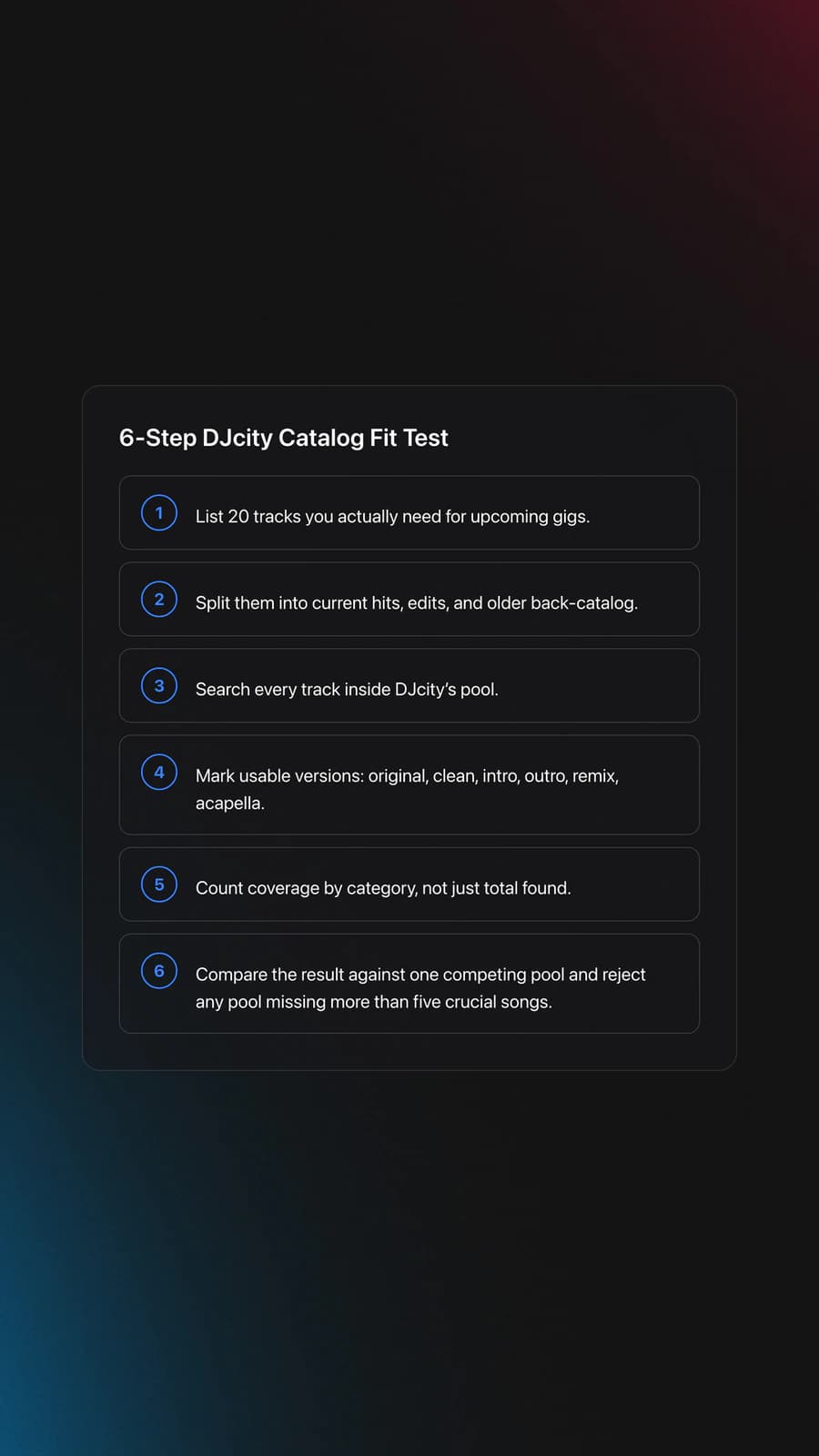
This is the fastest way to evaluate a DJ city song search in context:
- List 20 tracks you actually need for upcoming gigs.
- Split them into current hits, edits, and older back-catalog tracks.
- Browse DJcity’s record pool and search every track.
- Note which versions appear: original, clean, intro, outro, remix, acapella.
- Count coverage by category, not just total songs found.
- Compare that result against one competing pool.
This process is better than browsing casually. Casual browsing makes almost any pool look useful. A controlled test shows whether the library serves your real gigs.
Current DJcity support pages say subscribers can browse a global catalog with one subscription, while DJcity’s pricing page explains the service now uses monthly or six-month billing rather than the older three-month structure described in many legacy reviews. As of April 2026, DJcity support lists a 1-month plan and a 6-month plan, and notes that trial pricing can roll into the chosen plan after 30 days. That means older videos about quarterly-only billing are now dated.
That version check matters because pricing changes affect the risk of testing the pool. A monthly plan lowers commitment. A longer plan raises the burden on catalog fit.
If your workflow is built around open-format gigs, this test should include chart tracks, hip-hop, R&B, house remixes, and emergency requests. If your workflow is narrower, test the narrow lane hard.
You will know the pool is viable when at least two thirds of your real-world test list is covered, and when the missing third is not business-critical. If the missing tracks are your warm-up anchors, request tracks, or transition staples, the raw percentage does not matter.
A common failure mode is overvaluing quantity. You find thousands of songs, but not the specific usable versions you need. The symptom is constant last-minute topping up from stores right before gigs.
Another failure mode is testing only this week’s chart. That hides weak back-catalog depth and can mislead mobile, wedding, or mixed-format DJs.
Try this now. Build a 15-song shortlist for your next two gigs. Search every title in DJcity, mark which files are actually set-ready, and flag the missing ones. If more than five crucial songs are absent, do not treat the pool as your main source.
What Music Is on DJcity?
DJcity is strongest when you need mainstream, club-facing, and DJ-edited music rather than deep archival digging. That is the practical answer to the common question, "What music is on DJcity?"
The transcript’s comparison points in the same direction. DJcity performed better on current chart coverage than the competing pool in that snapshot, but underperformed badly on Beatport-led electronic selections and older back catalog.
So the useful framing is not broad versus narrow. It is front-line versus depth.
Front-line coverage means current, visible, crowd-recognizable music plus DJ edits. Depth means older originals, specialist subgenres, and long-tail crate-building.
If you mostly play open-format rooms, mainstream bars, student nights, and mixed commercial sets, DJcity may cover the songs you reach for most. If you regularly need decades of originals, niche electronic releases, or event-specific requests, coverage can thin out fast.
Either way, the point is the same. Your sourcing method only works if you can find the track under pressure.
A worked example makes this clearer. Imagine you play a Friday commercial club set. You need 10 recent chart tracks, 5 hip-hop staples, 5 house remixes, and 5 transition-friendly edits. DJcity may cover most of the first group and a useful share of the edits, but you may still need outside purchases for missing remixes or older originals.
Now flip the scenario. You are playing a 40th birthday party. You need 80s hooks, 90s singalongs, 2000s crossover tracks, and safe clean versions. A pool with weaker back-catalog support becomes much less useful, even if the headline price looks fine.
You will know DJcity fits your lane when it reduces your weekly music-buying workload instead of adding another search step. If every prep session ends with a second buying round, the fit is weak.
This is also where honesty helps. Underground and club contexts are not the same. A pool that feels strong for broad commercial work may feel thin for more specialist electronic programming.
That is not a flaw in itself. It is a scope question.
DJcity vs BPM Supreme: Selection Guide
If you are comparing DJcity against BPM Supreme, stop asking which one is objectively best. Ask which one fails less often for your exact gigs.
That is the cleaner decision model. Record pools are not judged by theory. They are judged by misses.
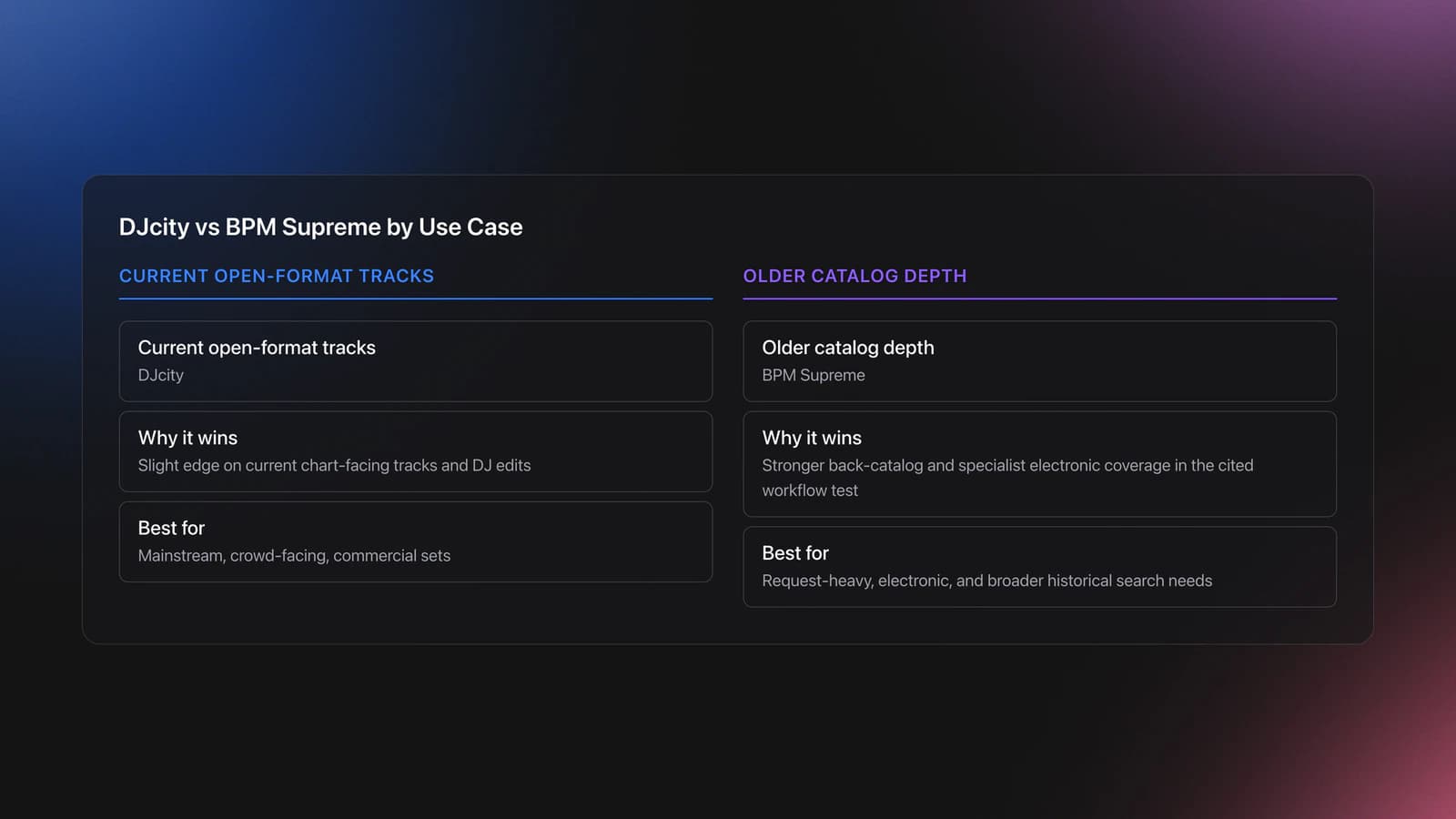
The transcript offers a useful practitioner comparison. In that test, BPM Supreme looked stronger on specialist electronic coverage and older catalog depth, while DJcity had a slight edge on current chart tracks. Both were roughly even on edits and mashups.
Current official pricing has also shifted since many older reviews. DJcity support now lists monthly and six-month plans, while BPM Supreme support announced a March 2026 pricing update and promotes different tiers including All-Access and related product bundles. That means any comparison from 2023 or 2024 should be treated as a time-stamped snapshot, not a permanent rule.
| Scenario | Best Choice | Why | Next Action |
|---|---|---|---|
| You play mainstream open-format sets | DJcity | Strong fit for current, crowd-facing tracks and DJ edits | Test 20 current songs and 10 edits before subscribing |
| You need older originals and broad back catalog | BPM Supreme | Back-catalog depth matters more than current edit culture | Run a request-heavy search list from the last four decades |
| You play house and Beatport-driven sets | BPM Supreme | Electronic coverage was stronger in the transcript’s workflow test | Search your top 20 genre tracks, then compare usable versions |
| You want one pool only for emergency prep | Whichever pool misses fewer essentials | Failure rate matters more than headline catalog size | Score both pools against one real gig folder |
| You mix commercial with specialty genres | Combination workflow | One pool rarely covers both lanes well enough | Choose a base pool, then budget for top-up purchases |
Quick decision guide for DJcity and BPM Supreme
The comparison also exposes a bigger workflow lesson. The more varied your gigs, the less likely one pool will solve everything.
That is normal. Many self-taught DJs start by downloading a handful of tracks and making it work on whatever setup they have. Over time, the problem changes. The issue stops being access and becomes consistency.
A lot of DJs learn that the hard way. You start with the DIY energy, share music with friends, play what you love, and improve by doing. That approach works well early on. Later, bigger collections and more varied gigs force you to become systematic.
You need both instincts. Curiosity gets you started. Structure keeps you reliable.
If you are comparing multiple sources, keep your library grouped by use case, not by where the track came from. Some DJs handle that with folders and naming rules. Others use tools like Vibes to build hierarchical categories for mood, function, or energy, then export that structure into DJ software. Either method is better than mixing record-pool downloads into one giant unsorted intake folder.
You will know your comparison process is sound when your test result points to a workflow choice, not just a winner. A winner without a workflow still leaves you searching for songs before the set starts.
DJ City Song Limits Most DJs Miss
The biggest mistake is assuming a DJ city song search reflects total catalog strength. It does not.
A pool can look strong because it has the song title. Then you realize it lacks the version you need, the clean edit, or the older original.
This is where it gets practical. You need to separate song presence from song usefulness.
Use this four-part check when evaluating any pool:
- Presence. Is the track there at all?
- Version fit. Is there a clean, intro, outro, or remix you can actually use?
- Context fit. Does it serve your venue, crowd, and set length?
- Retrieval fit. Can you find it fast inside your library?
That framework cuts through most record-pool marketing. Catalog size sounds impressive, but DJs perform songs, not song counts.
Take two examples. Example one: you find a current pop track in DJcity, plus a clean intro edit and an extended version. That is high usefulness. Example two: you find only a remix of a classic request song, while the original is missing. That is low usefulness for private events.
The common symptom of low usefulness is prep friction. You keep saying, "I know I downloaded it somewhere," but still end up buying another copy or swapping plans.
Another overlooked limit is platform confusion. Searches like dj city serato or dj city online often imply users are trying to understand whether the pool is a DJ app, an online locker, or a direct performance platform. It is not. It is a source library. You still need your DJ software and your own file-management habits.
You should also ignore bait terms like dj city free download unless you are looking for official trial terms. Record pools are subscription services. If a site promises random free access to a premium DJ city song library, treat that as a red flag.
Official DJcity support says the service offers licensed record-pool access, and its help center frames the subscription around legal DJ use. That does not mean every performance-rights question disappears in every country or venue. It means the pool itself is not the same thing as an obvious piracy site.
| Mistake | Why It Happens | How to Avoid |
|---|---|---|
| Testing only one song | A single hit says nothing about catalog depth | Search a 20-track list across multiple use cases |
| Ignoring version types | Original track presence feels enough at first | Check clean, intro, outro, and remix availability |
| Assuming all pools cover all genres | Marketing language sounds broad | Test your specific genre lane before paying |
| Treating the pool as a full archive | Subscription value feels like full replacement | Budget for top-up stores and legacy tracks |
| Dumping all downloads into one folder | Fast intake feels efficient in the moment | Sort by set use, energy, or context immediately |
Common mistakes when evaluating DJcity and other record pools
Is DJcity Legal to Use?
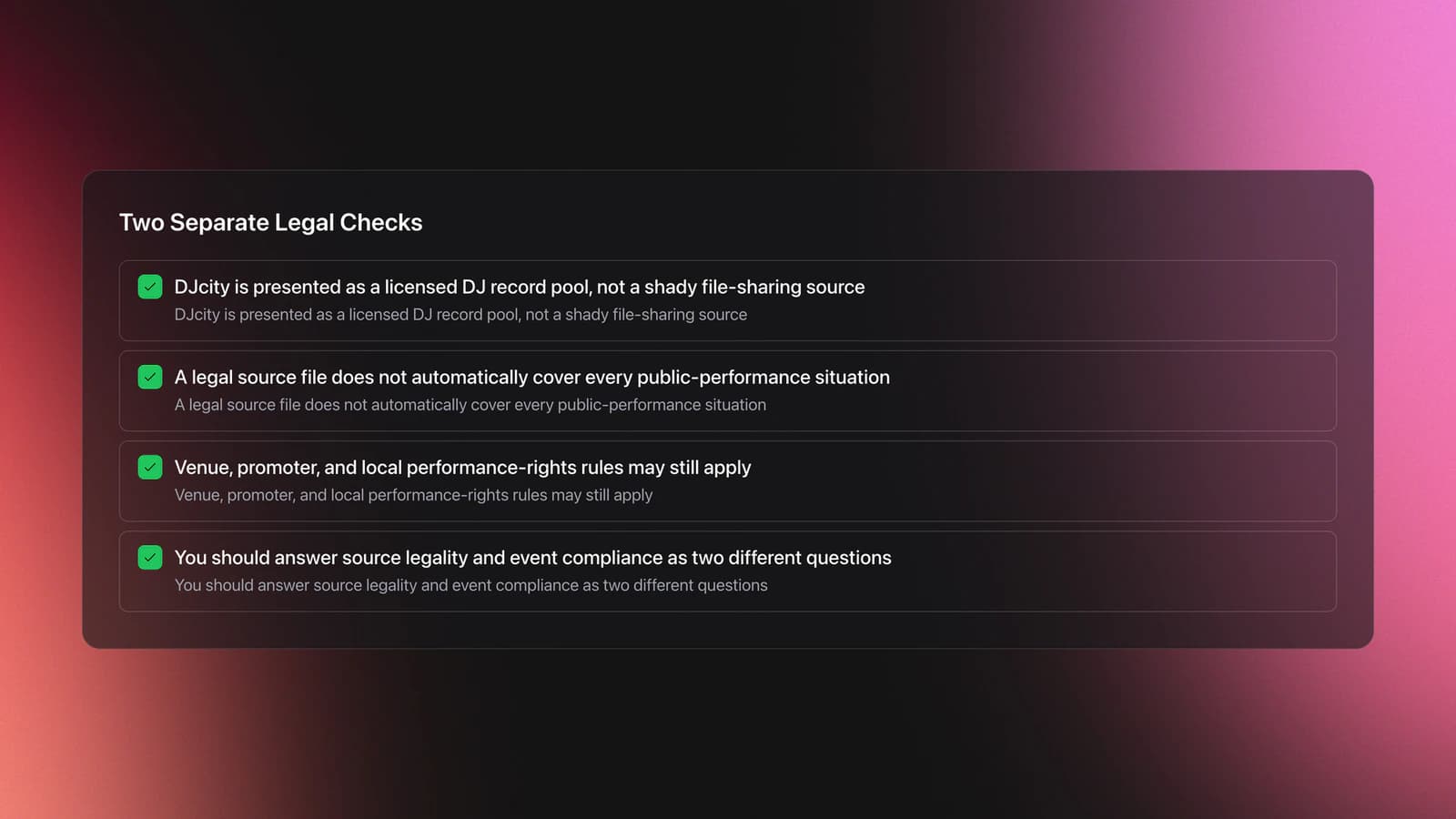
In normal terms, yes. DJcity presents itself as a licensed DJ record pool rather than an unauthorized download source.
That is the practical answer most users need. But it helps to separate two different legal questions.
Question one is whether subscribing to DJcity is the same as using a shady file-sharing site. Based on official support and product positioning, no. DJcity describes the service as a legitimate DJ record pool with licensed access.
Question two is whether every public performance use case is automatically covered everywhere. That depends on local venue licensing, performance rights, and event context. A legal source file does not replace venue-level music licensing rules.
In other words, source legality and public performance compliance are related, but not identical.
You will know you are handling this correctly when you can answer both questions separately: the pool is legitimate, and the venue or promoter is handling the event’s performance-rights obligations where required.
How Much Is DJcity Per Month?
As of April 2026, DJcity support says the service has two plans billed in 1-month or 6-month increments, and notes that new users may start with a trial period before moving to the chosen plan. That is different from older reviews that described DJcity as quarterly-only.
The exact price can vary by offer and region, so you should verify it on the live pricing page before subscribing. The useful takeaway is the billing model. You now have a lower-commitment monthly option, which changes the risk calculation for testing the DJ city music pool.
BPM Supreme pricing has also changed. Its support center published a March 2026 subscription pricing update, and the service now promotes different tier structures and bundled access options.
That is why old head-to-head videos age quickly. Pool comparisons are partly about catalog fit, but they are also about current billing structure.
If you only need one month of heavy prep before a season, monthly billing is flexible. If you are running a steady weekly schedule and know the catalog fits, a longer term may be cheaper.
What you should not do is compare transcript-era prices to today’s support pages as if both are current. The transcript is still useful for workflow analysis. It is no longer reliable for exact 2026 pricing.
Next Step: Test DJcity Like a Working DJ
Do one controlled test this week. Build a 20-track list from your next two gigs, including five current songs, five older requests, five edits, and five genre-specific tracks. Search DJcity and one alternative pool. Score each result for presence, usable version, and set relevance. Choose the service that removes the most prep friction, not the one with the loudest marketing.
The visual way to organize your DJ library
Tag tracks by vibe. See everything at once. Export to rekordbox, Serato, Traktor or Engine DJ.
14-day free trial. Full access, no strings attached.
or see how it works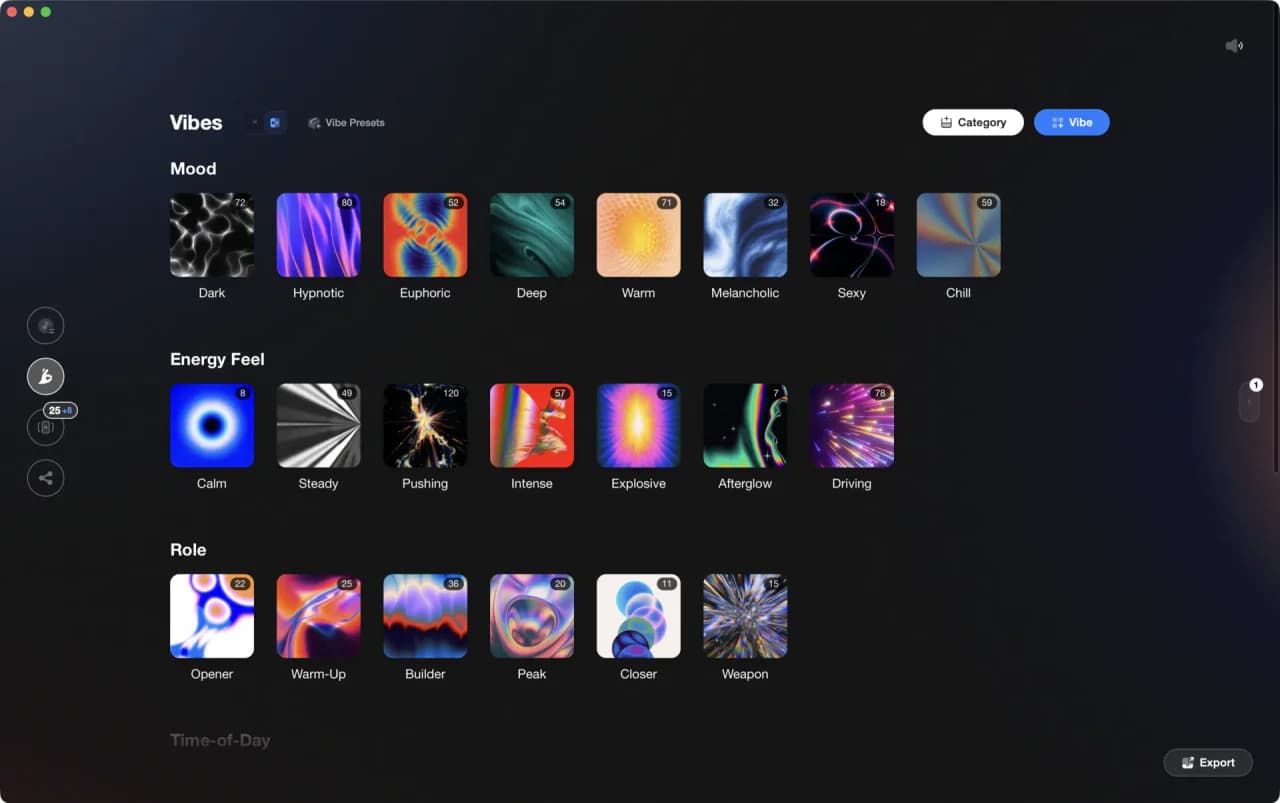
Techniques Covered

Equipment & Software
Featured Gear
Continue Your Learning Journey
Start Here First


Related Content
DJ Record Pool Guide for Working DJs
intermediate
DJ Playlist Spotify: Mixing With Streaming Inside Rekordbox
intermediate
DJ Library Organization System: Tags, Crates, Keys
intermediate
Transition DJ Online: Browser Mixer Workflow
intermediate
DJ Transitions: The Three-Layer Handoff for Beginners
intermediate
How To Mix In Key Live: Worked Transitions And Failure Fixes
intermediateFrequently Asked Questions

Hey, it's Ben Modigell 👋
I DJ and produce as so I so: downtempo, minimal, dub house, tech house, and techno (releases on Spotify and SoundCloud, links above). Everything I write here comes from my own gigs, studio sessions, and library cleanups: the rules I follow, the failure modes I have actually hit, and the workflow I use when nobody is watching. If a technique did not earn its place in my own sets, it does not make it into a tutorial.