Set Composition
Set composition is the process of arranging tracks, transitions, and energy flow into a coherent DJ journey.
Set Composition Tutorials
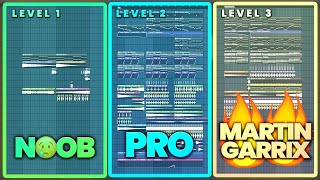


Set Composition is the skill of turning separate tracks into one clear musical journey. If your mixes sound technically fine but still feel flat, rushed, or random, Set Composition is usually the missing layer. Good set composition helps you control energy flow, shape tension, and make each transition feel intentional.
For DJs, Set Composition matters because the crowd remembers the overall arc more than any single blend. A strong sequence can make average transitions feel purposeful, while a weak sequence can make clean mixing feel forgettable. Once you understand set composition, you can open with confidence, build momentum, create contrast, and land the closing section without losing the room. This guide assumes you can already master beat matching fundamentals and learn phrase mixing for cleaner entries; with those in place, your composition choices translate cleanly in the booth.
What Is Set Composition?
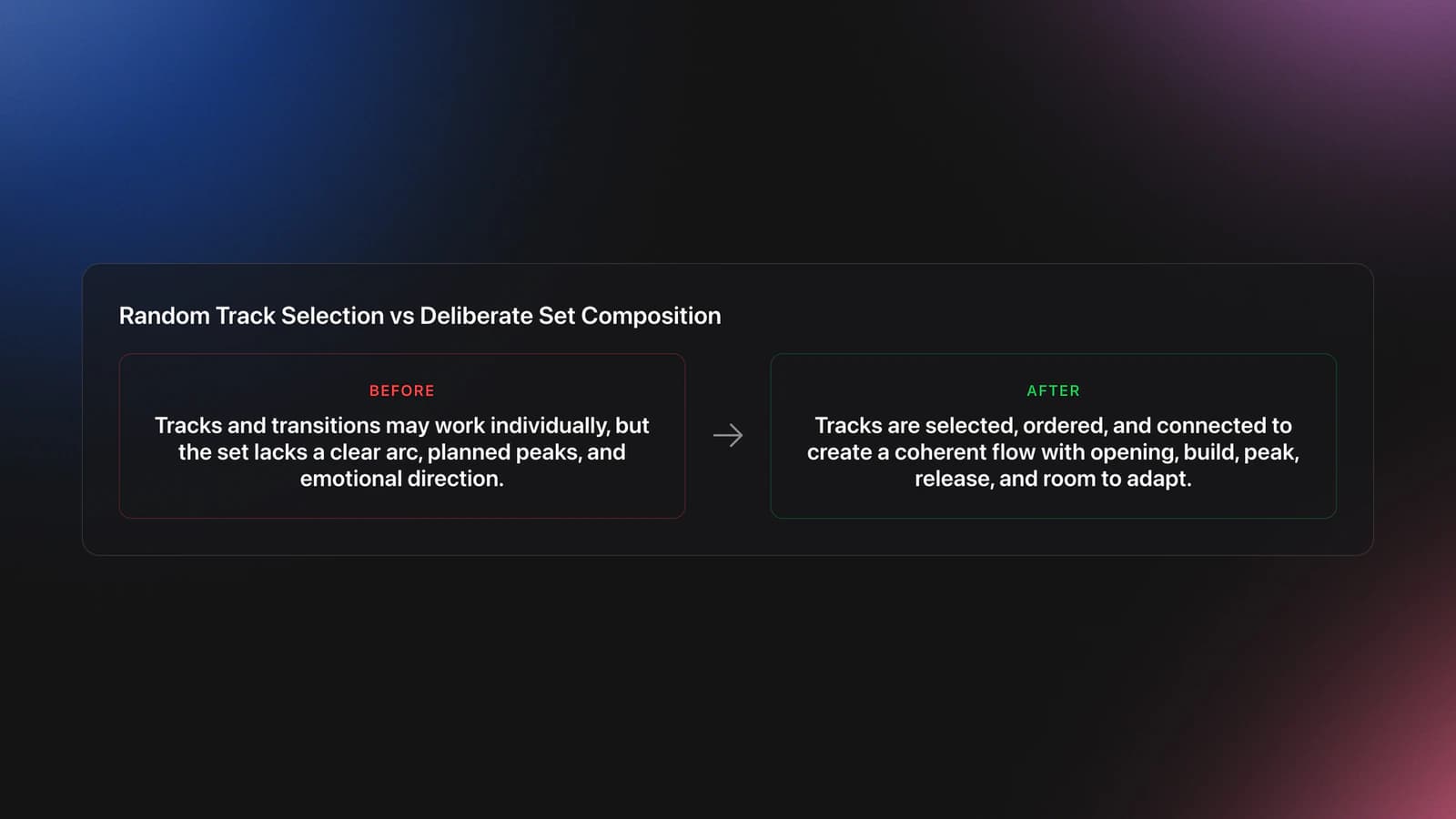
Set Composition is the process of selecting, ordering, and connecting tracks so a DJ set develops with clear direction. It combines track choice, pacing, phrasing, BPM movement, key compatibility, and emotional contrast to create a set that feels coherent rather than random.
In practice, set composition sits above individual transitions. A transition is one move. Set composition is the larger plan that decides why that move belongs there.
Most current DJ planning guides converge on the same core idea: start with an intended arc, place high-impact moments carefully, and leave room to adapt. The Mixgraph DJ set planning guide, Musicianstool set building article, and DJ TechTools DJ mix crafting guide all emphasize some version of opening, build, peak, and release.
That does not mean every set needs a rigid script. It means the listener should feel a deliberate shape. In other words, good set composition balances preparation with flexibility.
Why Set Composition Matters
Set composition matters because audiences respond to contrast, pacing, and payoff more than technical perfection alone. A well-composed set gives each track context, so even simple blends feel stronger.
- It creates a clear emotional arc instead of a pile of unrelated tracks.
- It helps you place peak tracks where they have maximum impact.
- It reduces abrupt BPM, key, and mood clashes.
- It makes recovery easier when the room shifts unexpectedly.
- It improves recorded mixes, club sets, and practice sessions alike.
This is also why set composition improves faster when you think in groups of tracks, not isolated songs. SoundCollective's course overview frames song structure, cue strategy, harmonic compatibility, and longer story-driven mixes as connected skills rather than separate tricks, which matches standard practice in DJ education.
Core Elements of Set Composition
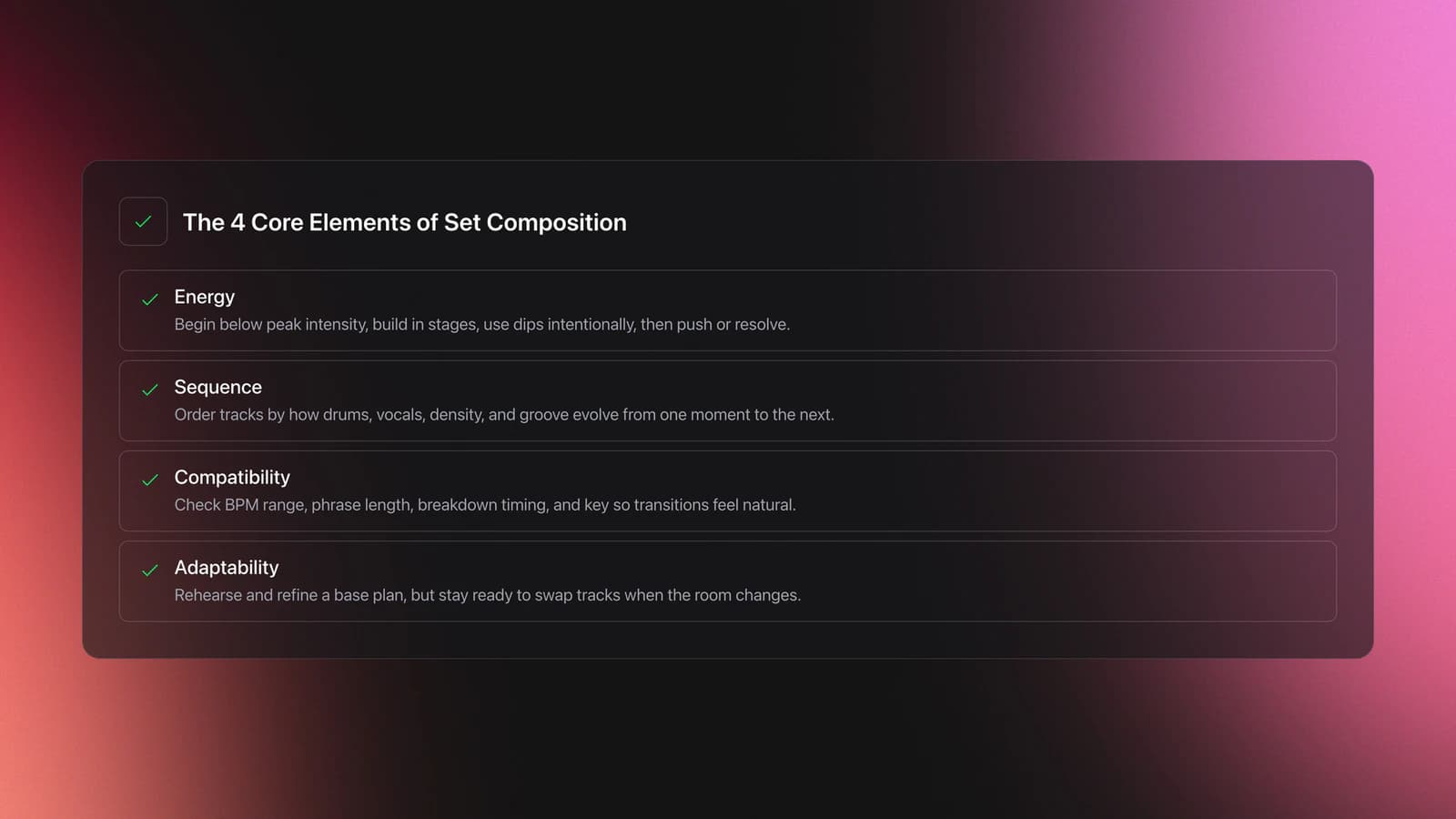
The core elements of set composition are energy, sequence, compatibility, and adaptability. If one of those is missing, the set usually feels either chaotic or overly stiff.
Start with energy. Several recent guides suggest beginning below peak intensity, building in stages, then using an intentional dip or release before a final push or closing stretch. That wave shape appears clearly in the Mixgraph DJ set planning guide and the DJ TechTools DJ mix crafting guide.
Next comes sequence. Track order should reflect how drums, vocals, density, and groove evolve. A track may be great on its own and still be wrong for that moment.
Compatibility is the technical layer. BPM range, phrase length, breakdown timing, and key all affect whether the set feels smooth. The Native Instruments phrase mixing guide explains why phrase-aware alignment makes transitions feel natural, while the Native Instruments cue points tutorial shows how markers support mix-in and mix-out decisions.
Then comes adaptability. Club Ready DJ School recommends building the base of a playlist, rehearsing it, recording it, and refining it. That approach matters because planned sets often change in the room. If Rekordbox is your prep tool, build a DJ set in Rekordbox walks through that exact loop.
If you want cleaner musical movement inside those choices, use harmonic mixing to reduce clashes. It will not fix weak programming, but it can make good track order sound more polished.
How to Build Set Composition Step by Step
To build set composition, define the room, choose anchor tracks, map the arc, and test transitions in context. The goal is not to predetermine every second. The goal is to make strong options obvious.
| Step | Action | Key Point |
|---|---|---|
| 1 | Define the slot | Warm-up, peak-time, afterhours, and promo mixes need different pacing |
| 2 | Choose 3–5 anchor tracks | Pick likely opener, peak moment, and closer first |
| 3 | Group by energy and mood | Build lanes of compatible options before ordering everything |
| 4 | Check BPM and phrase structure | Small tempo moves and aligned phrases feel more natural |
| 5 | Test key and vocal compatibility | Avoid transitions that clash even if the BPM works |
| 6 | Rehearse full runs | Transitions behave differently inside a sequence than in isolation |
| 7 | Add backup routes | Prepare alternates for early crowd lift or controlled reset |
Start by defining the job of the set. A 60-minute opening slot needs restraint. A 30-minute showcase mix needs faster identity. A late club slot can hold tension longer.
Then pick anchor tracks. Recent planning articles recommend starting with one track you know you want to play and planning around key moments. That is useful because anchors reduce decision fatigue.
From there, sketch the energy path. Many DJs think too linearly and try to rise forever. In practice, sets often feel better when they breathe. One controlled dip can make the next lift hit harder.
Now pressure-test the transitions. Do not only check BPM and key. Listen for vocal overlap, clashing percussion density, overlong breakdowns, and repeated arrangement shapes.
Finally, rehearse the set like a performance. The Club Ready DJ School set preparation guide specifically recommends recording full run-throughs because they reveal pacing problems that short transition drills hide.
Track Selection and Energy Flow
Track selection in set composition should serve the arc, not just your favorites list. A strong track is only strong if it supports the moment before it and the moment after it.
A practical way to choose is to rate each track by energy, groove type, vocal intensity, and role. Some tracks are bridges. Some are tension builders. Some are payoff records. When you know the role, ordering gets easier.
This is one place where organized crates help. If you sort tracks by mood, function, and energy in Vibes, you can build practice pools that make set composition faster without locking yourself into one playlist. That is useful for comparing two possible middle sections or finding a lower-energy reset track before the next climb.
Keep BPM shifts believable. Musicianstool recommends opening slightly below your main peak range and increasing gradually. That pattern works because the crowd feels momentum without hearing a forced jump.
Also watch arrangement fatigue. Four tracks in a row with long atmospheric intros may feel elegant in headphones and sleepy on a floor. Four tracks with constant maximal drops may feel powerful at first and exhausting later. If you want to go deeper on that longer arc, shape energy flow across a longer set.
Practice Drills for Set Composition
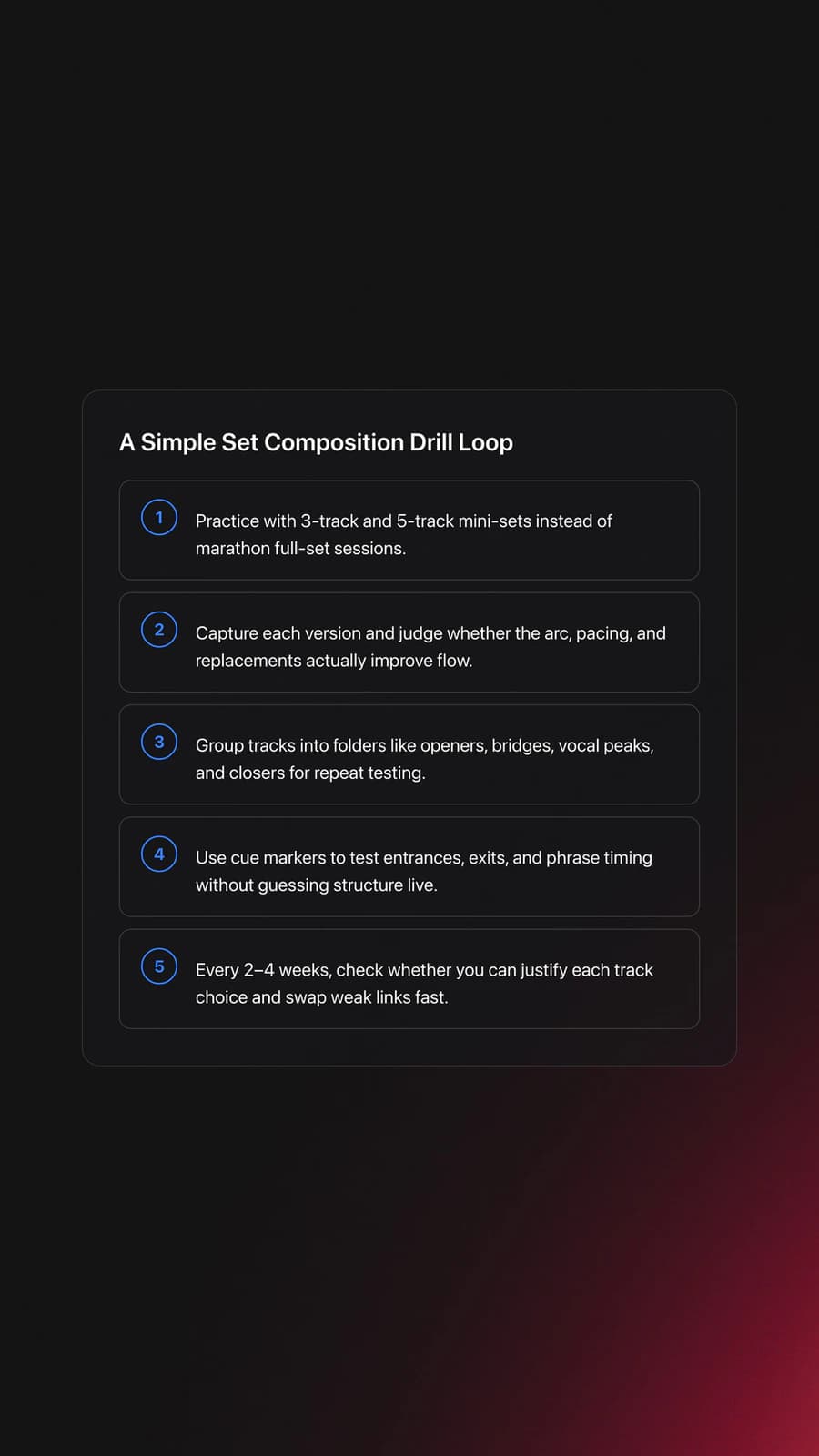
Practice set composition by training decisions, not just transitions. The fastest way to improve is to compare short sequences, record them, and judge the arc honestly.
In practice, working on 3-track and 5-track sequences accelerated set composition faster than marathon full-set attempts. Short cycles make mistakes obvious. They also make progress measurable.
Track your results in 2–4 week cycles. The checkpoint is simple: can you explain why each track is where it is, and can you replace one weak link quickly without breaking the arc?
Vibes can help here in a neutral way by keeping drills organized into reusable folders such as warm-up openers, bridge tracks, vocal peaks, and closers. That kind of structure makes repeated comparison practice easier, especially when you want to test multiple versions of the same section.
Use cue points during these drills. According to the Native Instruments cue points tutorial, cue markers help DJs map structural changes and improvise more effectively. For set composition, they let you test entrances and exits without guessing every phrase in real time.
Common Mistakes in Set Composition
Most set composition mistakes come from either overplanning or underplanning. The fix is usually better structure, not more complexity.
| Mistake | Why It Happens | Solution |
|---|---|---|
| Opening too hard | The DJ wants instant impact | Start 10–20% below peak energy and leave room to rise |
| Only checking BPM | Tempo is easy to sort quickly | Also review phrase length, vocals, density, and key |
| No recovery tracks | The set is planned as one straight line | Keep 20–30% extra options for dips, resets, or crowd shifts |
| Too many similar arrangements | Tracks were chosen by genre alone | Alternate track roles and structural shapes |
| Practicing transitions but not sequence | The DJ drills isolated blends | Record 3-track and 5-track runs to hear the full arc |
Why do most DJs struggle here? Because technical mixing gives fast feedback, while programming quality shows up later. A blend can be clean and still damage the larger story.
Another mistake is treating harmonic compatibility as the whole answer. Good key movement helps, but weak pacing still feels weak. That is why set composition should sit above technique, not be replaced by it.
Troubleshooting Set Composition
If your set composition feels wrong, isolate the specific failure point first. Was the issue energy, compatibility, timing, or context? Each problem needs a different fix.
If the set loses momentum, check whether you stacked too many low-impact sections together. If the set feels rushed, your BPM or intensity may be rising too fast. If transitions sound awkward despite matching tempo, review phrase position and vocal overlap with the Native Instruments phrase mixing guide.
If you cannot find a replacement track quickly, your library structure may be the real bottleneck. Grouping backups by role, not just genre, often solves this. That is why many working DJs build folders for opener, bridge, pressure, reset, and closer functions instead of one oversized crate.
Equipment and Preparation Needs
Set composition does not require exotic gear, but it does require preparation tools that let you compare tracks quickly and rehearse accurately. The essential needs are a stable DJ setup, reliable cue monitoring, and a library you trust.
Optional tools can speed the process. Key analysis helps with compatibility. Cue points help with structure. Tags for mood, role, and energy make alternatives easier to find. Native Instruments also notes that cue preparation supports improvisation, which is especially relevant when your planned route stops fitting the room.
For long sessions, protect your ears. Keep headphones at the lowest useful level and watch for hidden loudness differences between masters, old rips, and newer files.
Real-World Use Cases
Set composition changes depending on the job. A warm-up set aims to support the room. A peak-time set aims to control pressure and release. A recorded mix usually needs a tighter identity because it cannot react to the floor.
For underground club contexts, shorter daily planning cycles often beat huge preparation marathons. Through years of focused 15 to 30 minute sessions, I found that compact rehearsal blocks translated better to gig reality because they trained decision-making under mild pressure rather than perfection inside endless editing.
Open-format DJs may use sharper contrast and faster resets. House and techno DJs often rely more on subtle energy grading and long-form sequencing. Hip-hop and bass DJs may place greater value on vocal timing, impact moments, and abrupt but intentional switches.
Set Composition Takeaways
Set composition is what turns track knowledge into a real performance arc. It helps you control pace, place impact records with intention, and stay flexible when the room asks for something different.
- Think in roles and sequences, not isolated tracks.
- Rehearse short arcs before polishing full sets.
- Prepare backup paths so adaptation stays musical.
Start with one 5-track sequence this week. Map the opening, one lift, one dip, and one closing move. Then compare versions, refine the weak bridge, and build from there. Once that feels stable, expand into longer sets with clearer intent.
The visual way to organize your DJ library
Tag tracks by vibe. See everything at once. Export to rekordbox, Serato, Traktor or Engine DJ.
14-day free trial. Full access, no strings attached.
or see how it works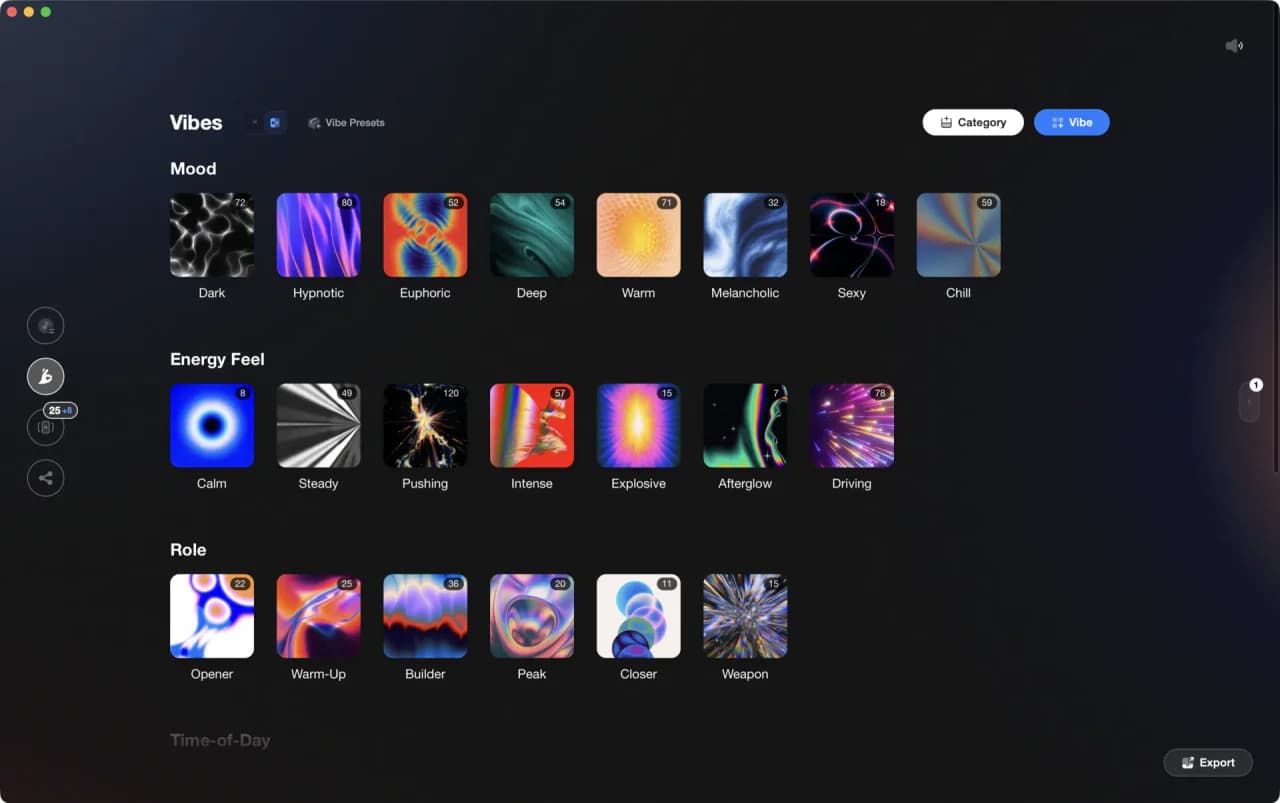
Equipment You'll Need
rekordbox
optionalCloud-connected DJ software for music management, performance, export prep, and club-standard hardware integration.
Mixed In Key 11
optionalStandalone harmonic-mixing and library-prep software that detects keys, energy levels, cue points, and tags for DJ sets.
Serato DJ Pro
optionalProfessional DJ software for mixing, performance, library management, recording, and hardware-integrated club workflows.
Beatport
optionalBeatport is a DJ-focused electronic music store and streaming platform for discovering, buying, and streaming tracks into supported DJ software and hardware.
Image-Line Soundgoodizer
optionalA simple stereo maximizer-enhancer plugin for FL Studio that applies one-knob processing based on the Maximus engine.
FL Studio
optionalA pattern-based digital audio workstation for beatmaking, recording, arrangement, mixing, and music production on Windows and macOS.
Traxsource
optionalTraxsource is a digital music download store focused on house and underground dance music for DJs.
Serato DJ Lite
optionalFree two-deck DJ software for Mac and Windows that introduces Serato’s workflow, controller support, and basic mixing tools.
Frequently Asked Questions

Hey, it's Ben Modigell 👋
I DJ and produce as so I so: downtempo, minimal, dub house, tech house, and techno (releases on Spotify and SoundCloud, links above). Everything I write here comes from my own gigs, studio sessions, and library cleanups: the rules I follow, the failure modes I have actually hit, and the workflow I use when nobody is watching. If a technique did not earn its place in my own sets, it does not make it into a tutorial.