Arrangement
Arrangement is the skill of understanding and using track structure so your selections, transitions, and set flow make musical sense.
Arrangement Tutorials

Frankie Knuckles: House Music Pioneer
Arrangement is one of the most useful DJ skills that beginners often overlook. In a DJ context, Arrangement means understanding how a track is built, where its sections change, and how that structure affects your transition timing. When you can read arrangement clearly, your mixes sound intentional instead of accidental.
This matters because great transitions are not only about tempo. They depend on when a vocal enters, when drums drop out, and when tension releases. Learn arrangement well and you can predict those moments, choose better mix points, and shape a set that feels coherent from first track to last.
For most DJs, arrangement sits between lock in steady beatmatching skills and practice phrase mixing with clean entry points. Beatmatching keeps tracks in time. Arrangement tells you when each move should happen.
What Is Arrangement?
Arrangement is the way musical sections are ordered and layered inside a track, and for DJs it functions as a map for transitions. Standard teaching from educator and DJ sources describes phrase mixing as using song structure and arrangement to decide logical mix-in and mix-out points.
In practice, arrangement includes intros, grooves, breakdowns, builds, drops, outros, and smaller phrase changes inside those sections. Many dance tracks still follow 4, 8, 16, or 32 bar groupings, which is why counting bars remains such a reliable skill.
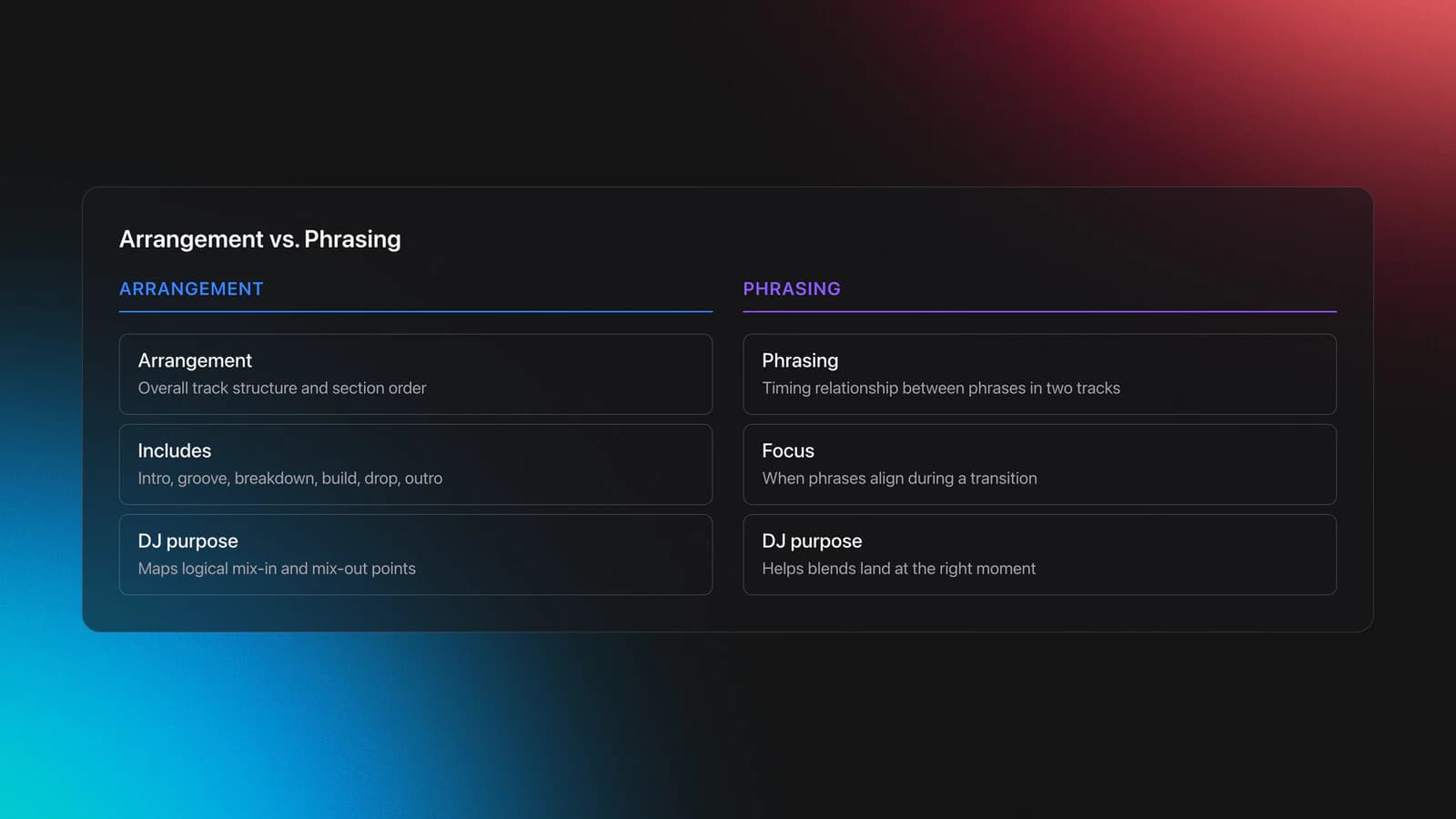
Arrangement is close to phrasing, but they are not exactly the same. Phrasing is the timing relationship between phrases in two tracks. Arrangement is the larger structural picture that tells you what those phrases are doing and why one transition works better than another.
Educational resources like the Native Instruments phrase mixing guide, the DJ TechTools phrasing tutorial, and the UpTrack arrangement tips article all point to the same idea: smooth mixing depends on reading structure, not only matching BPM.
Why Arrangement Matters
Arrangement matters because it lets you control expectation. When you mix at the right structural moment, the incoming track feels like the next chapter of the same story rather than a sudden interruption.
It also improves track selection. Once you know how one track opens, peaks, and exits, you can pair it with another track that solves a specific problem. You may want a longer drum intro, a cleaner breakdown, or a safer vocal handoff.
This is where arrangement becomes a creative tool, not just a corrective one. It helps you control energy, preserve groove, and avoid crowd-killing clashes between drops, vocals, or breakdowns.
- It shows where transitions will feel natural.
- It helps you preserve energy across multiple tracks.
- It reduces vocal, breakdown, and drop collisions.
- It improves set planning before a gig.
- It gives you more confidence under pressure.
Arrangement Fundamentals
The fastest way to understand arrangement is to stop seeing tracks as long files and start seeing them as sections with jobs. One section creates entry room. Another raises tension. Another releases it.
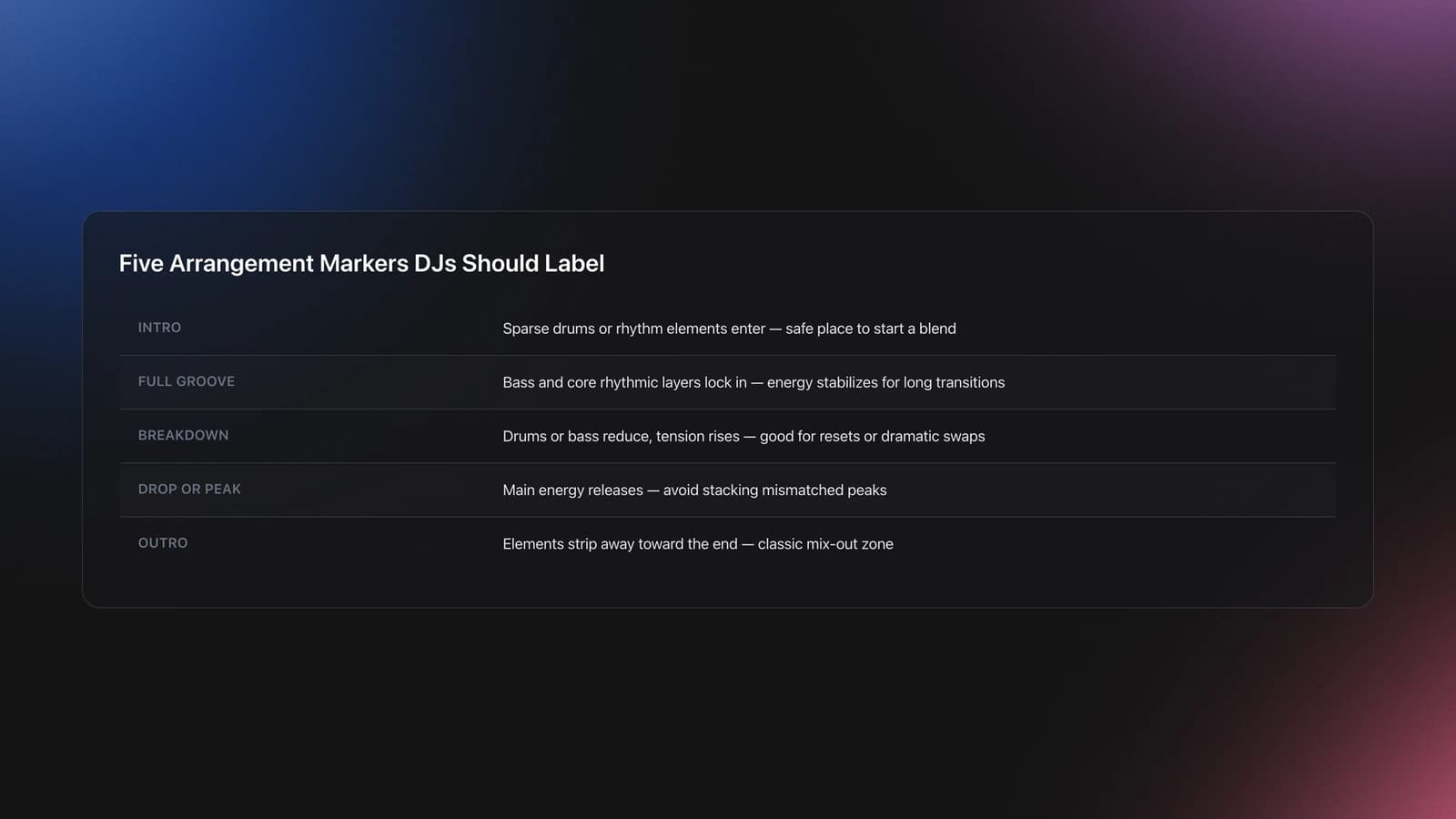
Most DJs should first identify five practical markers: intro, first full groove, breakdown, main peak, and outro. You do not need perfect music theory language to do this. You need repeatable labels that help you decide when to start and finish a transition.
Listen for subtraction as much as addition. Many strong transition windows appear when a track removes drums, bass, or vocals. That creates space for the incoming track to claim attention without sounding crowded.
Waveforms can help, but your ears should confirm everything. Bright visual changes often suggest a breakdown or drop, yet arrangement decisions still need listening because two tracks with similar waveforms may behave very differently.
A practical habit is to count 32 bars from a clear phrase boundary, then check what changes. If the answer is almost always predictable, you are starting to read arrangement correctly.
| Section | What Usually Happens | DJ Use |
|---|---|---|
| Intro | Sparse drums or rhythm elements enter | Safe place to start a blend |
| Full groove | Bass and core rhythmic layers lock in | Energy stabilizes for long transitions |
| Breakdown | Drums or bass reduce, tension rises | Good for resets or dramatic swaps |
| Drop or peak | Main energy releases | Avoid stacking mismatched peaks |
| Outro | Elements strip away toward the end | Classic mix-out zone |
How to Practice Arrangement
To practice arrangement, map track sections, count phrase lengths, and test transition points against real musical changes. The goal is simple: predict structure before it happens, then use that prediction to mix cleanly.
Start with tracks that have obvious intros and outros. House and techno often make this easiest because repeated 16 and 32 bar structures are easier to hear than dense open-format edits.
Step one is section marking. Take ten tracks and label their main structural points. Mark where drums enter fully, where vocals start, where the breakdown begins, and where the outro starts.
Step two is phrase counting. Count bars from one change to the next. You are not chasing theory for its own sake. You are training your ear to expect changes before they arrive.
Step three is transition testing. Try mixing the same two tracks at three different entry points. One will usually feel early, one late, and one natural. That comparison teaches faster than passive listening.
In practice, repeating the same pair of tracks with different entry bars builds arrangement awareness faster than constantly loading new music. Short, focused loops create better judgment than marathon sessions.
Step four is context practice. Once your ear improves, move from isolated transitions into 20 to 30 minute mini-sets. Arrangement becomes much clearer when you hear how one structural choice affects the next two tracks.
If you want this work to stay organized, build a small reference library in Vibes with categories such as Intro-Friendly, Long Breakdown, Vocal Entry, and Fast Exit. That kind of structure makes arrangement drills easier to repeat because your examples stay easy to find.
Equipment and Prep
You do not need advanced gear to learn arrangement, but you do need reliable access to cueing, looping, and clear track navigation. Headphones and repeatable track markers matter more than flashy effects.
Hot cues help because they let you jump directly to structural landmarks. Loops help because they give you extra time when the arrangement window is shorter than expected. Waveforms help because they offer a quick visual check, but they should support your ear, not replace it.
Preparation also matters. The Native Instruments library management guide emphasizes clear folder and prep playlist structure for set building, and the Mixgraph DJ set planning guide frames preparation as the foundation of set flow.
A practical workflow is to keep one crate or playlist for arrangement drills, another for gig-ready transitions, and another for tracks you still need to map. If you already organize locally in Vibes, you can sort by transition role before exporting, which keeps phrase-aware practice separate from general library browsing.
Common Mistakes in Arrangement
Most arrangement mistakes come from reacting too late or trusting tempo alone. If two tracks are perfectly beatmatched but structurally mismatched, the audience still hears the transition as messy.
| Mistake | Why It Happens | Fix |
|---|---|---|
| Mixing into a breakdown too early | The DJ counts beats but misses larger phrase changes | Count full phrases and mark the last stable groove section |
| Stacking two vocals | Section roles are not identified before mixing | Mark vocal entry points and mix during instrumental space |
| Clashing drops | Both tracks peak at once without intention | Let one track resolve before the next peak lands |
| Depending only on waveform color | Visuals replace listening | Preview section changes in headphones before committing |
Why do most beginners struggle with arrangement? They focus on the mechanics of the blend and forget the narrative of the track. Structure is slower than beatmatching, so it is easier to miss until the transition already feels wrong.
Another common issue is assuming all genres use the same phrase length. Many do not. Edits, intros, and crossover tracks may bend the usual 16 or 32 bar logic, so you need to listen for actual changes instead of forcing every track into one template.
Troubleshooting Arrangement Problems
If your transitions keep feeling awkward, shorten the problem. Work with two tracks only. Identify one transition goal, such as vocal handoff or breakdown replacement, and solve that before returning to full-set practice.
If you lose track of the phrase count, use a cue marker at the start of the outgoing phrase and count in groups of eight bars. That keeps your attention on larger structure instead of every individual beat.
If the incoming track feels late, start by checking whether you waited for a dramatic change instead of the setup phrase before it. Strong arrangement often depends on entering one phrase earlier than your instincts suggest.
If everything is technically clean but the set still feels flat, arrangement may not be the only issue. At that point, combine structure with harmonic mixing choices and broader energy programming so the sequence has both structural logic and tonal flow.
Examples and Real-World Use
Arrangement shows up most clearly in long blends, patient warm-up sets, and genres where gradual energy shaping matters. Tech house, techno, progressive house, and melodic genres reward structural awareness because transitions often live across full phrases instead of fast cuts.
It also matters in shorter transition styles. Even if you cut quickly in hip-hop or open format, you still need to know where choruses, verses, drops, and vocal hooks land. The timing window is shorter, but the structural logic is still there.
Most instructors and platform guides agree that arrangement awareness improves set flow because it lets you place tracks according to function, not just compatibility. In other words, you stop asking only, "Can these two tracks mix?" and start asking, "What role should this track play next?"
That shift is what turns arrangement from theory into performance judgment.
Practice Drills for Arrangement
A good arrangement drill isolates prediction. Listen to 60 seconds of a track, pause it, and say what should happen next. Then press play and check your answer. If you are wrong, note why.
Another strong drill is the 32-bar swap. Load two tracks, beatmatch them, and force yourself to enter the second track exactly 32 bars before the outgoing section changes. Then repeat at 16 bars and compare the result.
I have seen the best progress come from 2 to 4 week cycles with one narrow focus. One cycle may be intros and outros. The next may be vocal timing. The next may be breakdown replacement in higher-energy transitions.
If you record these sessions, review only one question after each run: did the transition happen at the right structural moment? That single filter makes improvement much easier to track than general self-critique.
Bring It Together
Arrangement gives your DJ sets shape. It helps you see where tracks open up, where they become crowded, and where they naturally hand off to the next record. Once that map becomes familiar, your transitions sound calmer, cleaner, and more musical.
Keep these takeaways in mind:
- Count full phrases, not just beats.
- Mark section roles before you trust a transition.
- Practice the same pair repeatedly before changing tracks.
Start with ten clearly structured tracks, map their sections, and rehearse one reliable transition between each. Once that feels natural, move forward to practice phrase mixing with clean entry points and longer sequencing work.
The visual way to organize your DJ library
Tag tracks by vibe. See everything at once. Export to rekordbox, Serato, Traktor or Engine DJ.
14-day free trial. Full access, no strings attached.
or see how it works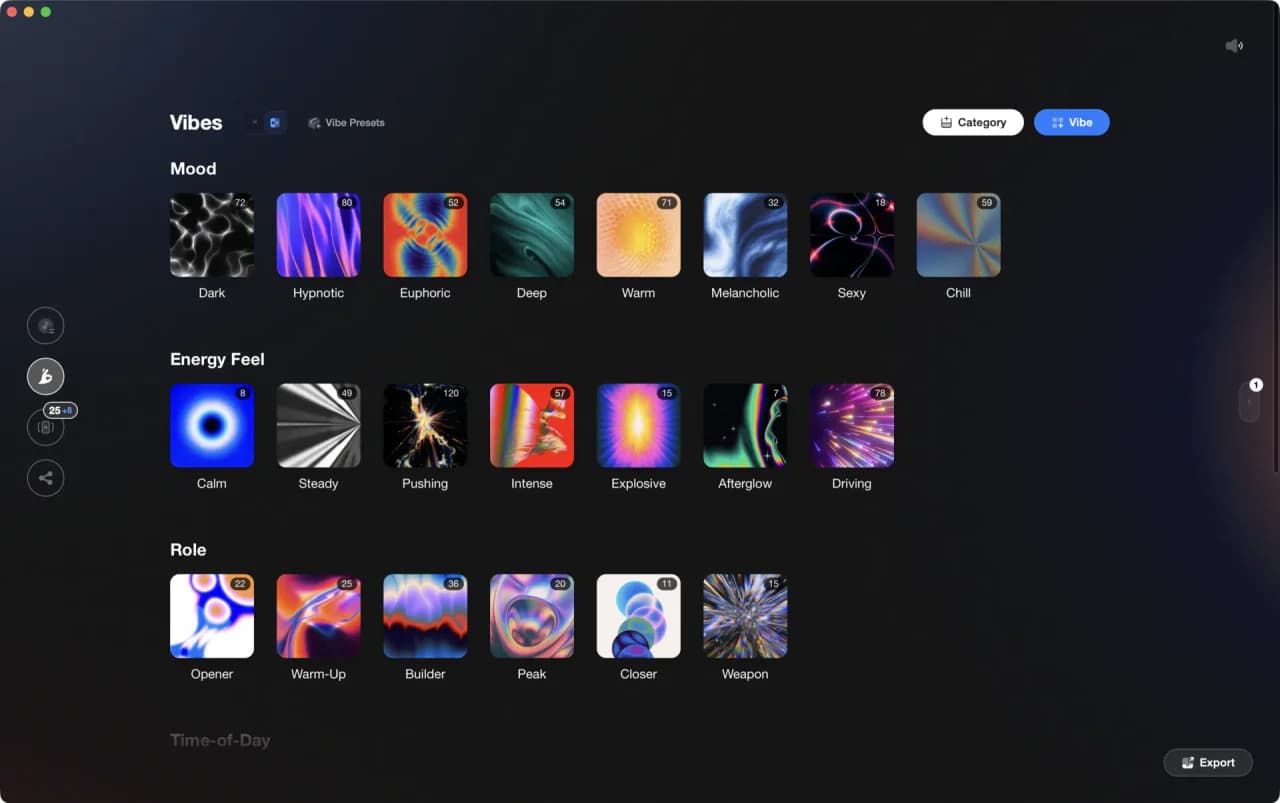
Frequently Asked Questions

Hey, it's Ben Modigell 👋
I DJ and produce as so I so: downtempo, minimal, dub house, tech house, and techno (releases on Spotify and SoundCloud, links above). Everything I write here comes from my own gigs, studio sessions, and library cleanups: the rules I follow, the failure modes I have actually hit, and the workflow I use when nobody is watching. If a technique did not earn its place in my own sets, it does not make it into a tutorial.