1980s House Music: Origins, Tracks, DJs
Watch Channel 4’s tutorial above (886K views on YouTube).
This guide is for DJs, selectors, and dance music listeners trying to understand 1980s house music beyond a loose playlist tag. If you know the famous names but not how the sound formed, this will give you the timeline, the core records, and the listening framework you need. By the end, you will be able to hear where 1980s house music came from, spot its key traits, and build a stronger DJ 80s house music playlist.
The short version is simple. 1980s house music grew out of Black, gay, and underground club culture, first in New York loft spaces and then in Chicago clubs, where DJs extended disco, Eurodisco, synth-driven dance records, and drum-machine rhythms into a new club language.
If you also want the practical side, pair this history with DJ playlist organization, how to build better set flow, and Rekordbox playlist structure. Those pieces help when you move from listening to playing.
The visual way to organize your DJ library. Tag by vibe, export to any DJ app.
1980s House Music: Definition and Core Traits
At its core, 1980s house music is club music built for continuous movement. It keeps a steady four-on-the-floor pulse, favors repetition over song-form drama, and uses DJs, edits, and machine rhythm to stretch tension and release.
That description matters because early house was not one fixed sound. In the early 1980s, “house” often meant whatever Frankie Knuckles played at Chicago’s Warehouse. Later in the decade, the term narrowed into a clearer production style with drum machines, bass lines, synth stabs, raw arrangements, and tracks made specifically for club play.
Britannica traces house music to Chicago in the early 1980s, with roots in disco, Eurodisco, and club culture shaped by Black and Latino gay communities. GRAMMY’s timeline also points to The Warehouse and Frankie Knuckles as central early forces in that shift. Britannica’s house music overview and GRAMMY’s house music timeline both support that broad picture.
- Steady kick drum and dance-floor-first rhythm
- Long grooves with fewer abrupt changes
- Disco, soul, and synth-pop DNA
- DJ edits, tape manipulation, and extended breakdowns
- Drum-machine textures, especially the Roland TR-808
- A club context built around all-night movement
A useful mental model is this: disco supplied the body, underground club culture supplied the social space, and Chicago DJs supplied the operational method. The result became house.
New York Clubs to Chicago Clubs: The Early Timeline
To understand 1980s house music, start before Chicago. The transcript points back to David Mancuso’s Loft and the Gallery, where dancers experienced records as immersive, emotional, and communal rather than disposable party filler.
That matters because house did not appear from nowhere. It inherited listening values from loft and disco culture: long-form sets, careful record selection, sonic detail, and a dance floor where different communities could share space.
The transcript also connects that club culture to broader social movements. Women’s liberation, gay liberation, Black power, and other forms of cultural self-assertion shaped who these clubs served and why they felt different from mainstream nightlife.
From there, Frankie Knuckles carried a New York-informed dance sensibility into Chicago. GRAMMY notes that by 1980 The Warehouse was already central to this shift, and Britannica identifies Knuckles as one of the creators of house. Britannica’s Frankie Knuckles biography and GRAMMY’s timeline align on that point.
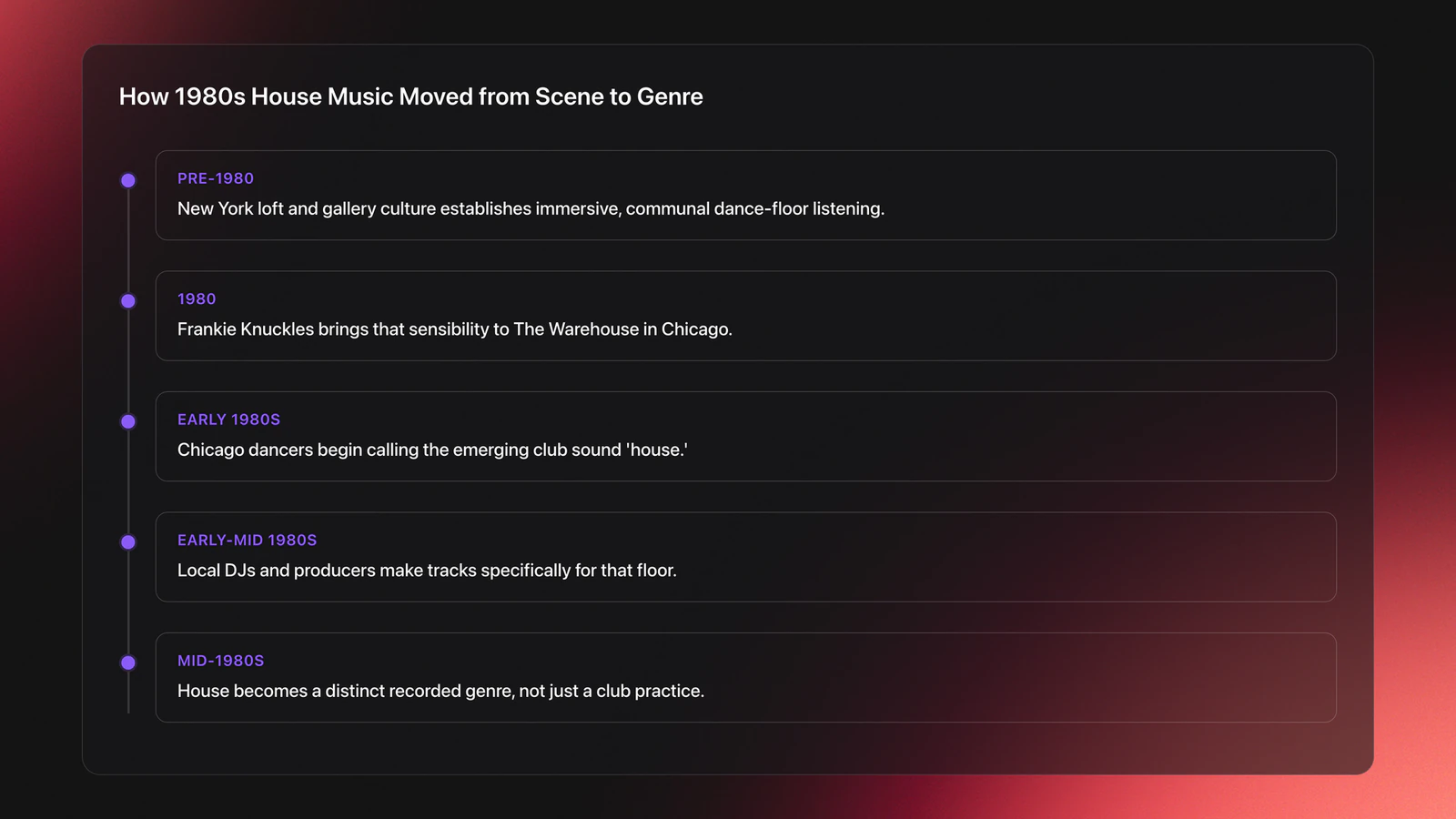
The timeline in practice looks like this.
- New York loft and gallery culture establishes the listening model.
- Frankie Knuckles brings that approach to The Warehouse in Chicago.
- Chicago dancers start calling that sound “house.”
- Local DJs and producers begin making tracks for that exact floor.
- By the mid-1980s, house becomes a distinct recorded genre.
This is where the genre’s social meaning and sonic meaning meet. The clubs were not just venues. They were filtering systems. They selected for records, moods, and crowds that mainstream radio and mainstream nightlife often rejected.
That is also why the transcript’s stories feel so specific. The space mattered. The sound system mattered. The after-hours timing mattered. House was a scene before it was a catalog category.
Warehouse, Music Box, and the House Method
If you want to hear 1980s house music properly, do not start by asking for one perfect template track. Start by understanding the method the early DJs used.
Frankie Knuckles built long journeys out of records from Europe, Philadelphia, New York, disco, synth-pop, and underground dance cuts. The transcript describes a floor where different textures could coexist as long as they worked inside the set.
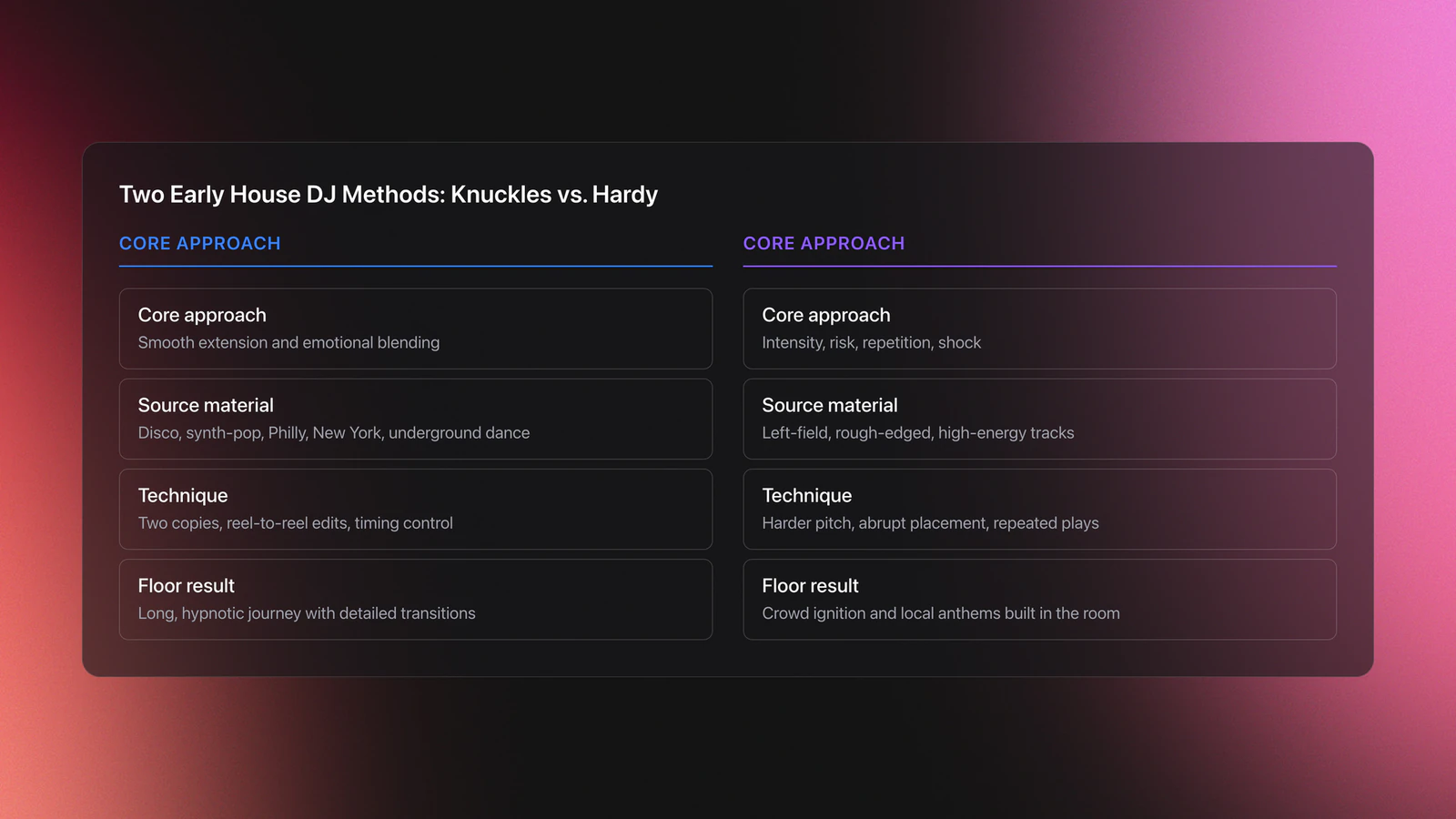
That is the first worked example. A DJ could take a short record, buy two copies, extend the breakdown, repeat the strongest section, and remove the weak section. Input: a strong but limited disco or dance single. Process: live editing with two copies, tape edits, and timing control. Output: a track that functions like a longer, more hypnotic club tool.
GRAMMY notes that Knuckles used reel-to-reel edits as disco singles dried up. That supports what the transcript describes from the dance floor side. The goal was not archival purity. The goal was to keep the floor locked in.
Then came Ron Hardy at the Music Box. The transcript paints a different but related picture. Hardy pushed records harder, pitched them up, played unpredictably, and treated the room like a pressure chamber.
That gives you the second worked example. Input: a left-field track with unusual energy or rough edges. Process: harder pitch, abrupt placement, repeated plays, and extreme room pressure. Output: a local anthem created by crowd response rather than radio consensus.
These are two different house methods.
- Knuckles method: smooth extension, emotional build, detailed blending
- Hardy method: intensity, risk, repetition, shock, and crowd ignition
A common failure mode is hearing old records as static artifacts. If you listen only for pristine production, you miss the point. Early house often makes more sense as functional dance-floor engineering than as polished headphone composition.
You will know you are hearing the method correctly when the repetitions start feeling structural instead of repetitive. The track stops sounding simple and starts sounding useful.
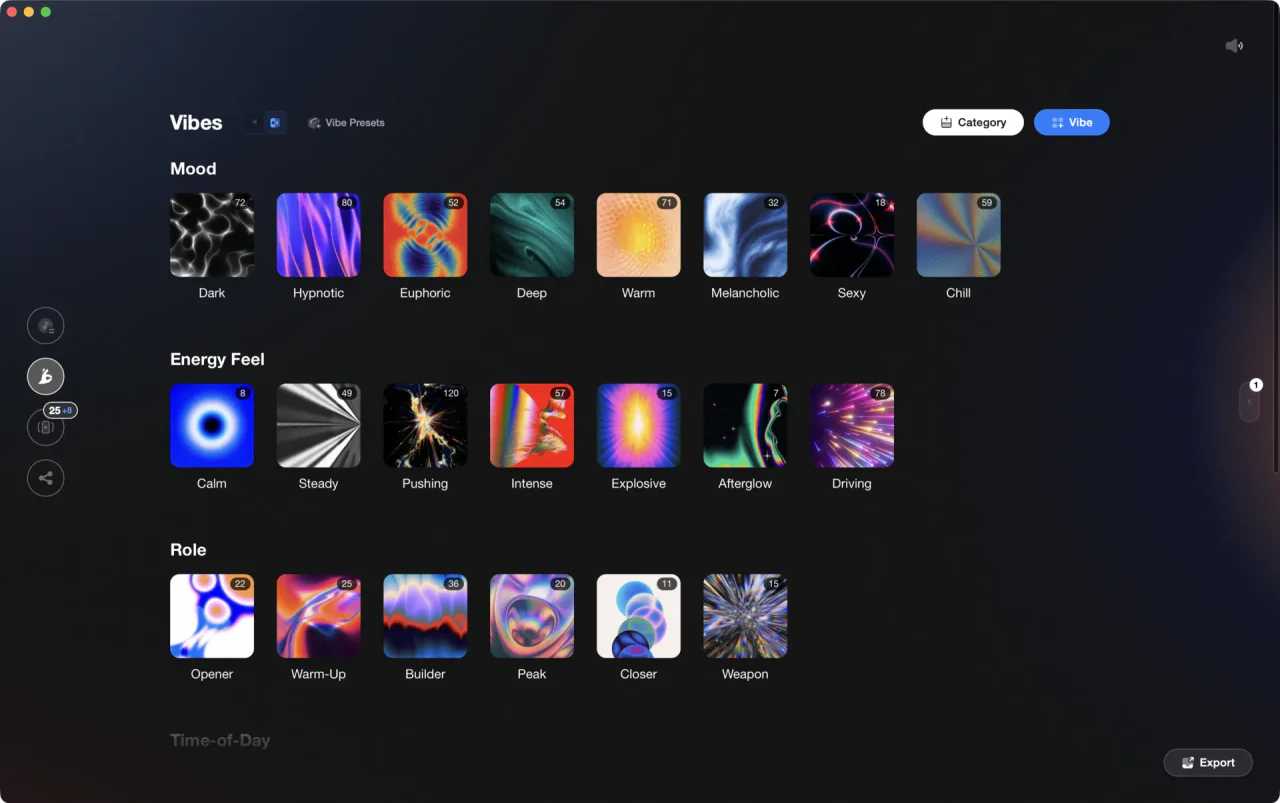
For DJs, this is also where library friction begins. Once you stop tagging old cuts only by year or genre and start tagging by job, energy lift, vocal warmth, drum pressure, or breakdown length, your selection speed improves fast. Some DJs do that with folders and notes. Others use tools like Vibes to build custom categories such as mood or function, then keep those groupings export-ready for performance software. The principle matters more than the tool. Pre-sorting by role is what makes old house playable in real sets.
In intimate underground contexts, that matters even more than technical perfection. The transcript’s community angle makes this clear. The point was musical storytelling and shared release, not showing off sterile precision.
1980s House Music Production: From Edits to Original Tracks
A turning point came when Chicago DJs and producers stopped relying only on hard-to-find imports and edits. They began making their own records at home.
The transcript gives a clear example in Jesse Saunders and Vince Lawrence. Saunders lost a favorite bootleg, decided to make his own version, and built a track in a bedroom setup with a four-track recorder, a Korg Poly-61, and an 808.
That track was “On and On.” It is widely treated as a foundational early house record, even if arguments remain about who was first or what counts as the first true house record. The important fact is practical: pressing locally made club tracks changed the scene from DJ culture to production culture.
Britannica places house’s origin in early-1980s Chicago, and multiple historical summaries identify locally pressed records on labels such as Trax and DJ International as crucial to the genre’s spread. The transcript’s “home-made record becomes citywide catalyst” story fits that larger history.
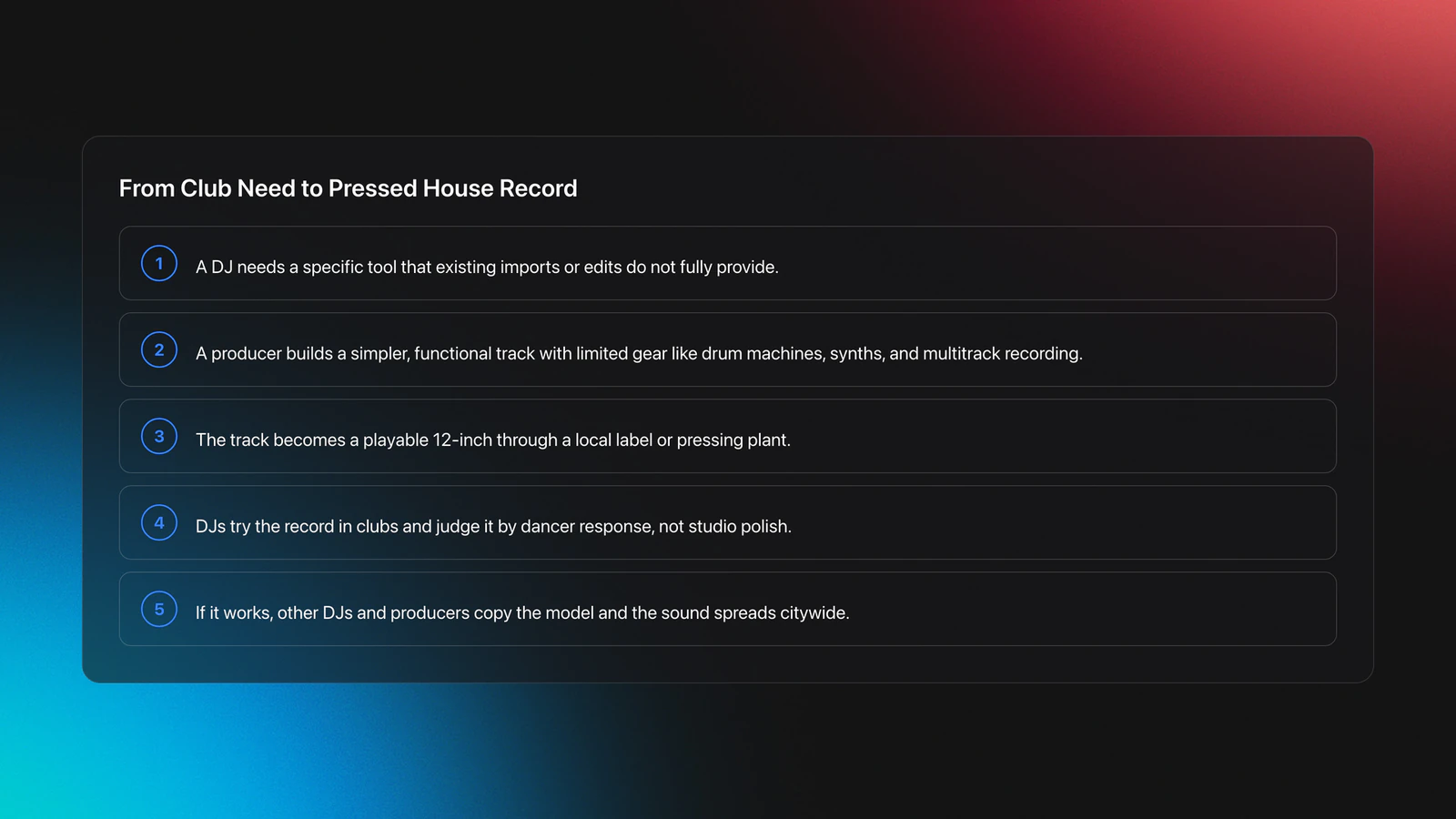
Here is the production chain in plain terms.
- DJ needs a specific floor tool.
- Existing record does not fully solve the problem.
- Producer builds a simpler, more functional version at home.
- Local pressing plant turns the idea into a playable 12-inch.
- DJs test it in clubs.
- If dancers respond, the whole city copies the model.
That chain explains why early house can sound stripped down. Minimalism was not always aesthetic theory. Sometimes it was the direct result of limited gear, limited budget, and a very clear dance-floor brief.
The Roland TR-808 sits inside that story. Roland says the TR-808 was introduced in 1980 as a songwriting tool, and later artists pushed it far beyond that original role. Roland’s TR-808 history page and Roland’s product history notes both confirm the 1980 launch and its later impact.
A second worked example helps here. Input: limited studio gear and a need for a hypnotic club rhythm. Process: program a simple machine groove, layer a bass line or synth figure, and structure the track around entry, pressure, breakdown, and release rather than verse and chorus. Output: a record designed to be mixed, looped, and felt physically on a floor.
The failure mode is over-romanticizing “rawness.” Not every rough record is effective. The best early house records still solved a dance-floor problem clearly. They gave DJs grip points.
You will know a track works in the early house sense when one or two elements carry the entire room without needing constant arrangement changes. Usually that means the drums, bass movement, vocal phrase, or a short synth hook does the heavy lifting.
If you are building a best 80s house music crate for DJ use, organize the records by playable behavior. A central library can help here if your collection is spread across old rips, digital purchases, and folder dumps. Some DJs use Vibes to create hierarchical groups such as openers, warehouse-style rollers, vocal lifts, and late-set pressure cuts, then export that structure into their DJ software. Even if you stay manual, the same rule applies: sort by function before gig day.
Classic 1980s House Music Tracks and Artists
Readers searching for 1980s house music usually want names fast. The mistake is treating this as a random “old dance songs” list. What you want is a starter map.
Begin with the figures named or strongly implied in the transcript: Frankie Knuckles, Ron Hardy, Jesse Saunders, Vince Lawrence, and Jamie Principle. From there, expand into the broader Chicago ecosystem.
A practical starter list includes these records and artists.
- Jesse Saunders. “On and On”
- Jamie Principle and Frankie Knuckles. “Your Love”
- Steve “Silk” Hurley. “Music Is the Key”
- Marshall Jefferson. “Move Your Body”
- Farley “Jackmaster” Funk. “Love Can’t Turn Around”
- Mr. Fingers. “Can You Feel It”
Not all of these records sound identical. That is the point. 80 house music includes raw club tools, crossover vocal records, jack tracks, and deeper, more introspective cuts.
If you are comparing house music 80s 90s, the 1980s side usually feels sparer, more skeletal, and more directly tied to club function. By the 1990s, many house styles became cleaner, fuller, and more segmented into subgenres.
This is also where historical memory gets messy. Ask five DJs for the most important 1980 house music hits and you may get five different lists, because many early tracks spread first through clubs, tapes, acetates, and local circulation before broader canonization.
That tape culture matters. The transcript describes Frankie mix tapes passing through thousands of hands by copied cassettes. In practical terms, that means influence often moved before formal release data caught up.
How Do You Build a DJ 80s House Music Playlist?
A good DJ 80s house music playlist is not a museum shelf. It is a sequence of jobs.
Start by splitting your crate into functional lanes. Do not throw every classic into one folder and hope memory will save you at 1:15 a.m.
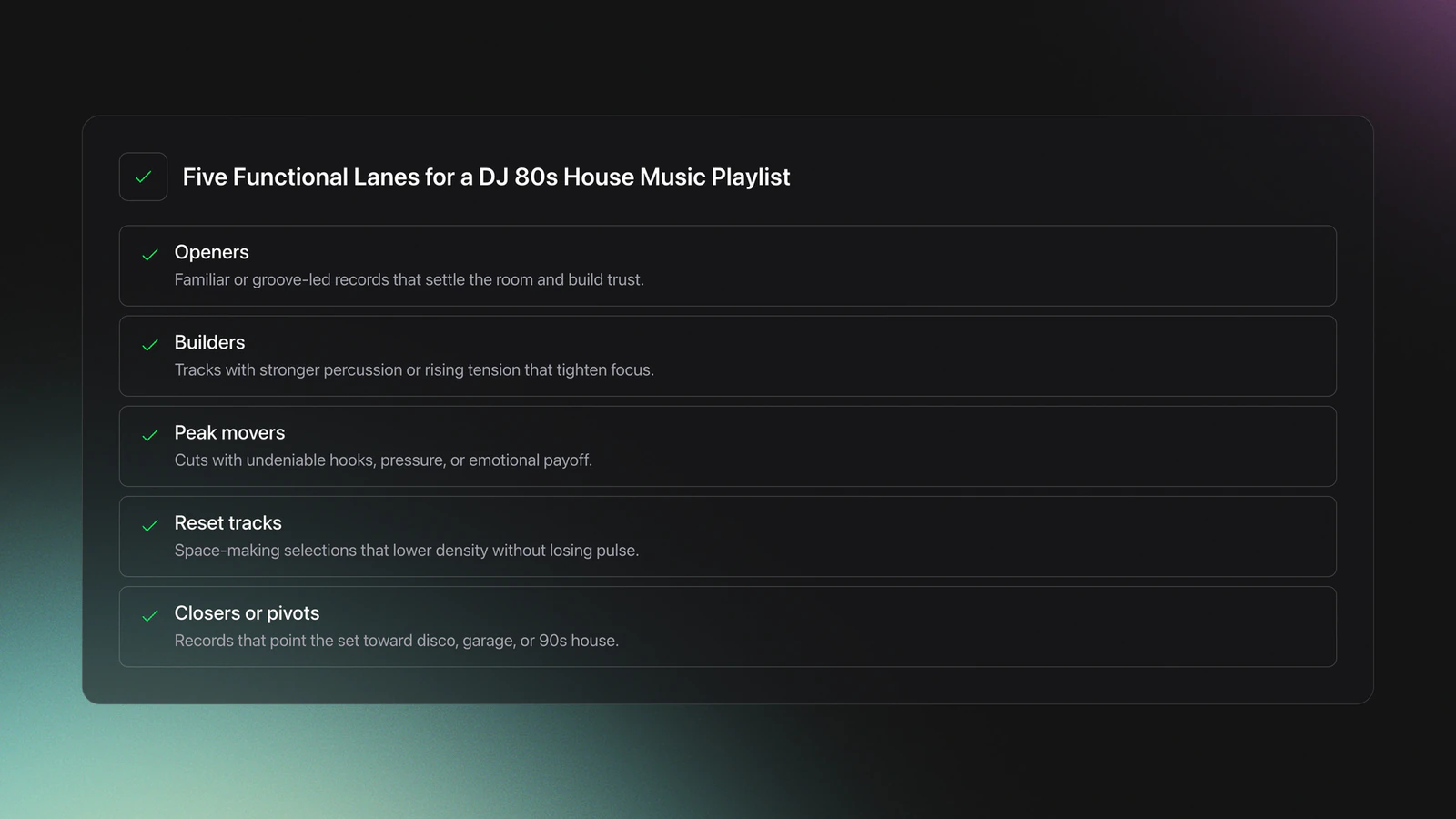
Use a five-part structure.
- Openers. Familiar or groove-led tracks that settle the room.
- Builders. Tracks with stronger percussion or tension.
- Peak movers. Records with undeniable hooks or pressure.
- Reset tracks. Space-making cuts that lower density without losing pulse.
- Closers or pivots. Tracks that point into disco, garage, or 90s house.
Worked example one. If your room is mixed-age and not deeply specialist, you might open with vocal warmth and recognizable disco residue, then move into stricter Chicago rhythm. Input: cautious crowd. Process: start with access, then tighten. Output: room trust before harder selections.
Worked example two. If the room is already locked in, you can start with a tougher groove and reserve the vocal anthem for the emotional peak. Input: committed dance floor. Process: pressure first, release later. Output: stronger arc and bigger payoff.
The failure mode is front-loading every famous track. You get a fast early reaction, then nowhere to go. A better set uses recognition in waves.
You will know your playlist is balanced when each next record has a clear reason to exist. It should raise, deepen, widen, or reset the floor.
For deeper prep, see energy flow for DJ sets and how to tag tracks by mood. Those are the missing operational pieces for a house music 80s dance club music set.
What Was House Music in the 80s?
House music in the 80s was underground dance music shaped by DJs, dancers, and club spaces rather than by radio formats first. Early on, it described the sound associated with The Warehouse and related Chicago scenes. By the middle and late 1980s, it also described a more defined production style built around drum machines, bass lines, and repetitive club structure.
That is why the phrase 80's house music can refer to both a scene and a sound. In the first sense, it means the culture around clubs like The Warehouse, Power Plant, and Music Box. In the second, it means the records that came out of that environment.
This dual meaning explains a lot of confusion in search results. Some pages list only songs. Others talk only about history. You need both to get the full answer.
Common Mistakes When Exploring 1980s House Music
| Mistake | Why It Happens | How to Avoid |
|---|---|---|
| Treating house as one fixed sound | The genre was still forming and scenes varied by club and DJ | Study clubs, DJs, and production periods, not just a playlist label |
| Starting with crossover hits only | Canonical lists often favor later, cleaner records | Mix known tracks with rougher local cuts and DJ-led records |
| Ignoring the club context | Streaming encourages track-by-track listening | Listen in sequence and pay attention to buildup, repetition, and release |
| Confusing disco with house entirely | The transition period shares grooves, vocals, and dancers | Listen for machine rhythm, looping structure, and DJ-tool logic |
| Building a flat crate | Tags are often too broad to support real set decisions | Sort by function, pressure, vocal role, and transition use |
The most common errors come from hearing the records outside their original use.
Practice Routine: Learn 1980s House Music Faster
Use a short listening routine instead of passive browsing. It works better.
- Week 1. Spend 20 minutes a day with one DJ lineage: Mancuso to Knuckles to Hardy.
- Week 2. Build a 15-track crate and label each track by function, not just artist or year.
- Week 3. Record a 30-minute practice set and note where the energy stalls or jumps too hard.
If you learned DJing the self-taught way, this method will feel familiar. Many DJs did not start with formal training. They started with borrowed gear, downloaded tracks, house parties, and long trial-and-error sessions until selection and flow began to make sense.
Measuring Progress With 1980s House Music
You do not need a perfect historical memory test. You need better listening outcomes.
- You can explain the difference between disco roots and house function in two sentences.
- You can name at least five key artists and what each contributed.
- You can group 15 tracks by opener, builder, peak, reset, and closer.
- You can hear why one early record works better in a set than another.
In other words, progress is not just recognition. It is usable understanding.
Conclusion
1980s house music makes more sense when you hear it as a chain. New York loft culture shaped the listening model. Chicago clubs sharpened the method. Local producers turned DJ needs into records. From there, a scene became a genre.
Keep these takeaways in mind.
- House began as a club practice before it became a tidy genre label.
- The key DJs were shaping time, tension, and crowd movement, not just playing songs.
- The best way to learn old house is to sort tracks by function and sequence, not only fame.
Next, build a small crate, test a 30-minute mix, and listen for function. That is where history turns into DJ skill.
The visual way to organize your DJ library
Tag tracks by vibe. See everything at once. Export to any DJ software.
A visual system for organizing your DJ library.
Techniques Covered
Equipment & Software
Documentation
Continue Your Learning Journey
Start Here First
Frequently Asked Questions

Hey, it's Ben Modigell 👋
I DJ and produce as so I so — downtempo, minimal, dub house, tech house, and techno (releases on Spotify and SoundCloud, links above). Everything I write here comes from my own gigs, studio sessions, and library cleanups: the rules I follow, the failure modes I've actually hit, and the workflow I use when nobody's watching. If a technique didn't earn its place in my own sets, it doesn't make it into a tutorial.