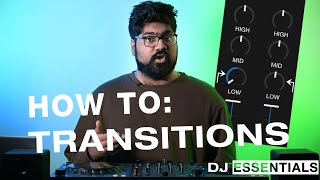
Watch SYNTHO’s tutorial above (32K views on YouTube).
This guide is for listeners, DJs, and producers who know the term house music but want a clearer handle on what it actually means. If you are stuck between broad genre labels and shallow definitions, this will help. After reading, you will be able to identify the core traits of house music and trace where it came from.
At its core, house music is a club-focused electronic genre built around a steady 4/4 pulse, strong kick drum, repetition, groove, and gradual change. It emerged in Chicago in the early 1980s, then spread globally and split into many branches. If you need a broader map of dance genres, start with electronic music genres. If you want to tell the branches apart by ear, see the house subgenre field guide.
House Music: Definition and Core Traits
House music is easier to hear than to define. Most tracks sit on a steady four-on-the-floor kick pattern. The groove is constant. Small changes matter more than big melodic swings.
That is why house music can sound simple on first listen, yet feel deep on a dance floor. The genre is built for motion, patience, and tension control. It rewards repetition that develops over time.
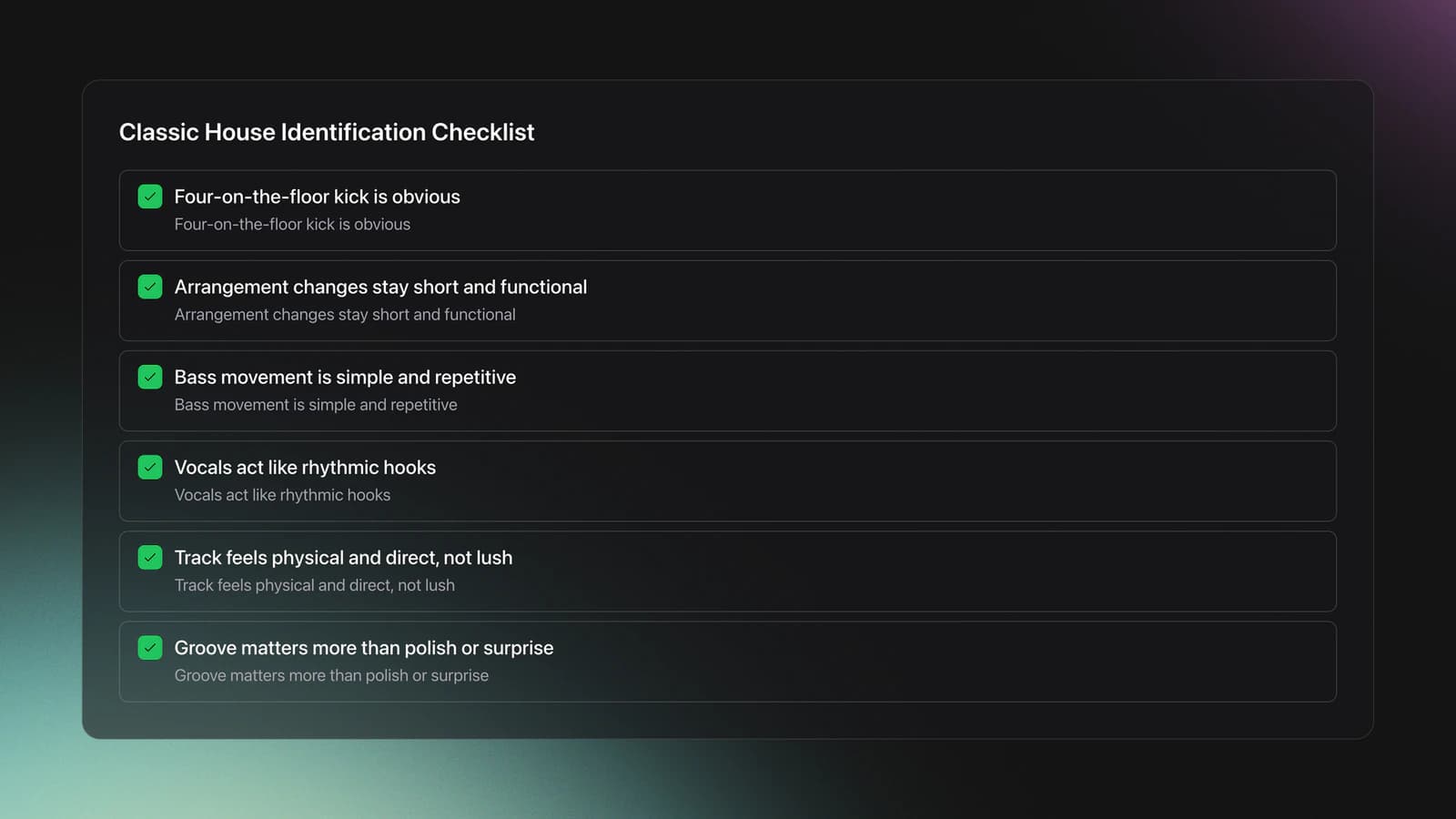
Experienced listeners usually identify house music through a few signals:
- A steady 4/4 kick drum
- Groove-driven bass movement
- Loop-based structure with gradual changes
- Drum machine and sampler textures
- Soulful, disco, gospel, or funk influence
- Arrangement designed for DJs and dancers
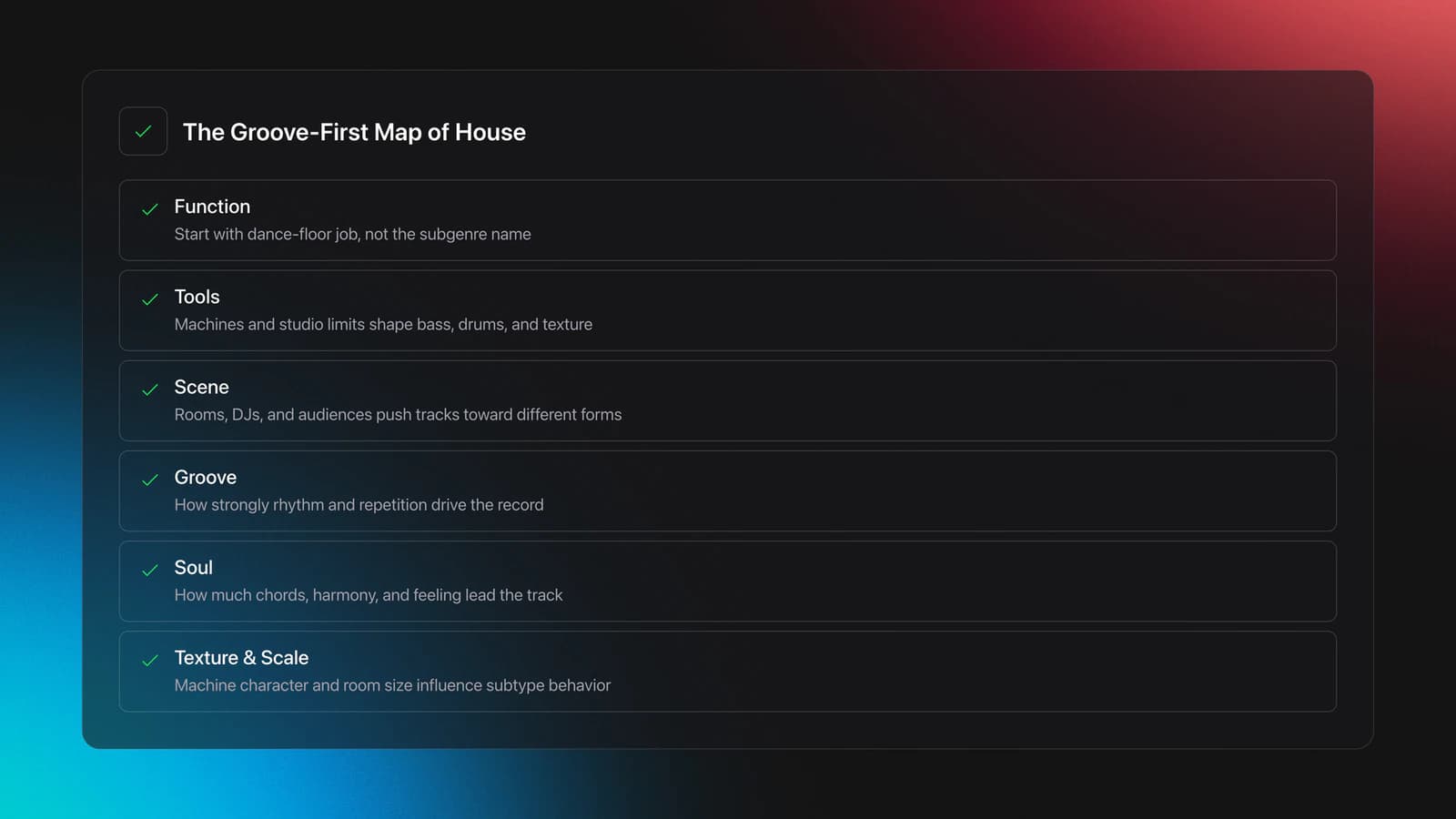
This means house music is not defined by one synth, one tempo, or one mood. Some tracks are warm and soulful. Others are stripped, dark, tribal, or aggressive. The constant is the groove logic.
For the exact tempo ranges of house and its subgenres like deep house, tech house, and progressive house, see the house BPM chart.
A useful mental model is this: house music is less about dramatic songwriting and more about controlled evolution. The track gives you a stable rhythmic center, then shifts texture, harmony, and energy around it.
Example one. A classic deep house track might hold one bass figure for roughly 16 bars, then add chords, hats, and a short vocal line. The input is minimal material. The output is a fuller emotional arc, because the groove stays locked while everything else slowly fills in.
Example two. A tougher club track may keep the same kick across most of the arrangement, but swap clap density, open-hat timing, and filter movement every eight bars. The musical content barely changes. The dance-floor effect changes a lot.
A common failure mode is confusing any upbeat electronic track with house music. The symptom is hearing a festival anthem, a pop-dance crossover, or a bass-heavy EDM track and labeling it house just because it is danceable.
You will know you are hearing house music when the groove feels central, transitions feel incremental, and the track seems built for mixing rather than for a single dramatic chorus.
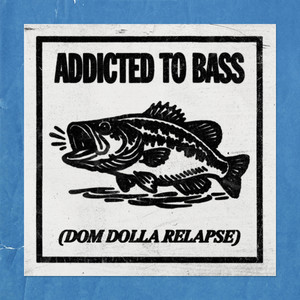
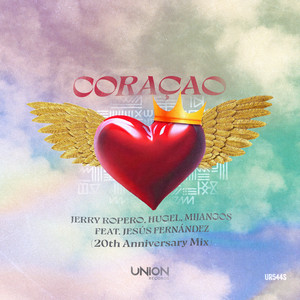
House reference tracks
A starting crate of house, pulled from our DJ track index with live BPM and Camelot keys (these run roughly 113-135 BPM). Beatmatch to each track's tempo, use the long intros and outros to blend, and swap on the phrase. Click any row to open its full sonic profile.







Chicago Origins of House Music
House music did not appear out of nowhere. It came from a specific social and club context. Britannica traces house music to Chicago in the early 1980s, and links the name to the Warehouse, the club where Frankie Knuckles shaped the sound. According to Britannica, the genre grew from disco, club culture, and electronic production techniques.
That history matters because it explains both the sound and the culture. House music was not just a production style. It was a dance-floor system built inside Black and queer nightlife spaces in Chicago.
WTTW's history of house music makes this clearer. It places the genre in Chicago's Black and gay underground club scene, where DJs, dancers, and local producers built a new musical language from disco, drum machines, edits, and club demand.
In other words, early house music was local, functional, and communal. Producers made tracks because dancers needed them. DJs extended ideas that records from other genres did not fully provide. Long intros, locked kick drums, repeated hooks, and clean rhythmic structure all make more sense once you understand that DJ use was part of the design.
This is one reason the genre feels so practical. House music was shaped by what worked in a room, not by what looked impressive on paper.
The prehistory matters too. Before Chicago, New York loft culture set the listening model. At David Mancuso’s Loft and clubs like the Gallery, dancers experienced records as immersive, emotional, and communal rather than disposable party filler. House inherited those values: long-form sets, careful record selection, sonic detail, and a dance floor where different communities could share space.
Frankie Knuckles carried that New York-informed dance sensibility into Chicago. GRAMMY notes that by 1980 The Warehouse was already central to this shift, and Britannica identifies Knuckles as one of the creators of house. Britannica’s Frankie Knuckles biography and GRAMMY’s timeline align on that point.
The timeline in practice looks like this.
- New York loft and gallery culture establishes the listening model.
- Frankie Knuckles brings that approach to The Warehouse in Chicago.
- Chicago dancers start calling that sound “house.”
- Local DJs and producers begin making tracks for that exact floor.
- By the mid-1980s, house becomes a distinct recorded genre.
Black and Queer Roots: Why the History Is Not Optional
Black creative communities were central to the genre's formation, so black house music is not a side note. Treating that as optional context strips the music of its real history. The DJs, dancers, and producers who built the early Chicago scene were overwhelmingly from Black and Latino communities, and the records they made carried gospel, soul, disco, and funk forward into a new form.
The LGBTQ question in house music comes from the same place. House is not owned by one identity group, but queer Black communities were foundational to its early spaces, audiences, and cultural meaning. The clubs were sanctuaries first and music venues second. The dance floor was a place to be free in rooms that the wider world was hostile toward.
A failure mode here is reducing house music history to one hero, one machine, or one anthem. The symptom is a flattened story that ignores scenes, dancers, local labels, and the communities that made the music viable. The shift from disco records to purpose-built club tracks happened because DJs needed grooves that hit harder, lasted longer, and fit local dance floors, and a whole community built those grooves together.
You will know you understand the roots of house music when Chicago, Black nightlife, queer club culture, disco afterlife, and DJ functionality all fit together as one story rather than separate facts.
The name itself comes from this scene. Record stores around Chicago started fielding requests for "Warehouse music," the sound people heard at Frankie Knuckles' club, and that phrase was soon shortened to "house music." So the genre was named after a room before it was named after a style, which is a clean reminder that house began as something you went somewhere to feel, not a label producers chose for themselves.
The Warehouse, the Music Box, and the Early House Method
If you want to hear early house music properly, do not start by asking for one perfect template track. Start by understanding the method the early DJs used.
Frankie Knuckles built long journeys out of records from Europe, Philadelphia, New York, disco, synth-pop, and underground dance cuts. A DJ could take a short record, buy two copies, extend the breakdown, repeat the strongest section, and remove the weak section. Input: a strong but limited disco or dance single. Process: live editing with two copies, tape edits, and timing control. Output: a track that functions like a longer, more hypnotic club tool.
GRAMMY notes that Knuckles used reel-to-reel edits as disco singles dried up. The goal was not archival purity. The goal was to keep the floor locked in.
Then came Ron Hardy at the Music Box. Hardy pushed records harder, pitched them up, played unpredictably, and treated the room like a pressure chamber. Input: a left-field track with unusual energy or rough edges. Process: harder pitch, abrupt placement, repeated plays, and extreme room pressure. Output: a local anthem created by crowd response rather than radio consensus.
These are two different house methods.
- Knuckles method: smooth extension, emotional build, detailed blending
- Hardy method: intensity, risk, repetition, shock, and crowd ignition
A common failure mode is hearing old records as static artifacts. If you listen only for pristine production, you miss the point. Early house often makes more sense as functional dance-floor engineering than as polished headphone composition. You will know you are hearing the method correctly when the repetitions start feeling structural instead of repetitive.
From DJ Edits to Original Tracks
A turning point came when Chicago DJs and producers stopped relying only on hard-to-find imports and edits. They began making their own records at home. A clear example is Jesse Saunders and Vince Lawrence. Saunders lost a favorite bootleg, decided to make his own version, and built a track in a bedroom setup with a four-track recorder, a Korg Poly-61, and an 808.
That track was “On and On.” It is widely treated as a foundational early house record, even if arguments remain about who was first. The important fact is practical: pressing locally made club tracks changed the scene from DJ culture to production culture. Locally pressed records on labels such as Trax and DJ International were crucial to the genre’s spread.
Here is the production chain in plain terms.
- DJ needs a specific floor tool.
- Existing record does not fully solve the problem.
- Producer builds a simpler, more functional version at home.
- Local pressing plant turns the idea into a playable 12-inch.
- DJs test it in clubs.
- If dancers respond, the whole city copies the model.
That chain explains why early house can sound stripped down. Minimalism was not always aesthetic theory. Sometimes it was the direct result of limited gear, limited budget, and a very clear dance-floor brief. The Roland TR-808 sits inside that story. Roland says the TR-808 was introduced in 1980 as a songwriting tool, and later artists pushed it far beyond that original role. Roland’s TR-808 history page confirms the 1980 launch and its later impact.
You will know a track works in the early house sense when one or two elements carry the entire room without needing constant arrangement changes. Usually that means the drums, bass movement, vocal phrase, or a short synth hook does the heavy lifting.
How House Music Went Global
House music did not stay a Chicago secret for long. By the late 1980s it had crossed the Atlantic and reshaped club culture abroad, and that spread is part of what the genre is today. Acid house, the squelchy 303-driven branch, exploded in the United Kingdom in 1988 and fueled the rave era often called the Second Summer of Love. Once the sound landed in Europe, local scenes began bending it to their own rooms and tastes.
That global phase is where much of the wider house family tree comes from. New York's Paradise Garage scene, built around DJ Larry Levan, kept more of disco's piano-driven warmth and fed the garage house lineage. European cities produced Italo and Euro house. Through the 1990s, the UK incubated tech house and progressive house, and later waves brought Afro house out of Southern Africa into one of the genre's most influential modern strains.
The takeaway for the definition is simple. House music is not only a Chicago artifact. It is a Chicago invention that became a worldwide language, which is exactly why the genre keeps splitting into new branches. If you want to hear how those branches differ, that identification work lives in the house subgenre field guide.
How House Music Works on the Dance Floor
Why does house music feel so effective in clubs, even when the arrangement looks sparse on paper? Because it manages energy through groove stability. The track keeps one physical anchor, then rotates detail around it.
That anchor is usually the kick drum. Around it, house tracks shape movement with hi-hats, claps, bass placement, chord stabs, vocal fragments, filter sweeps, and mute-unmute contrast.
This is where a lot of genre confusion starts. People often listen for melody first. House music asks you to listen for motion first. The main event is often rhythmic feel, not harmonic complexity.
A good way to hear this is to track one loop over time. Start with the first eight bars. Then compare bars 17 to 24 and 49 to 56. You may hear the same core idea, but with altered hat emphasis, bass pressure, vocal texture, or effects depth. That is not filler. That is the form.
I think of this as the groove contract. Once a house track establishes its pulse, every new layer either supports that contract or weakens it. Strong house production keeps adding information without breaking the contract.
Example one. A vocal house track adds a piano stab on beat two and an open hat offbeat. The kick pattern and chord loop stay the same. The result is more lift and forward pull, even though the harmony barely moved.
Example two. A minimal track removes the bass for eight bars before a drop. Nothing about the kick changes. The result still feels bigger because subtraction sharpened the groove contract instead of replacing it.
A failure mode is over-arranging. The symptom is a track that adds too many melodic ideas, too many fills, or too many section changes. The groove stops feeling inevitable and starts feeling interrupted.
Validation Check
House Music Styles and Subgenres
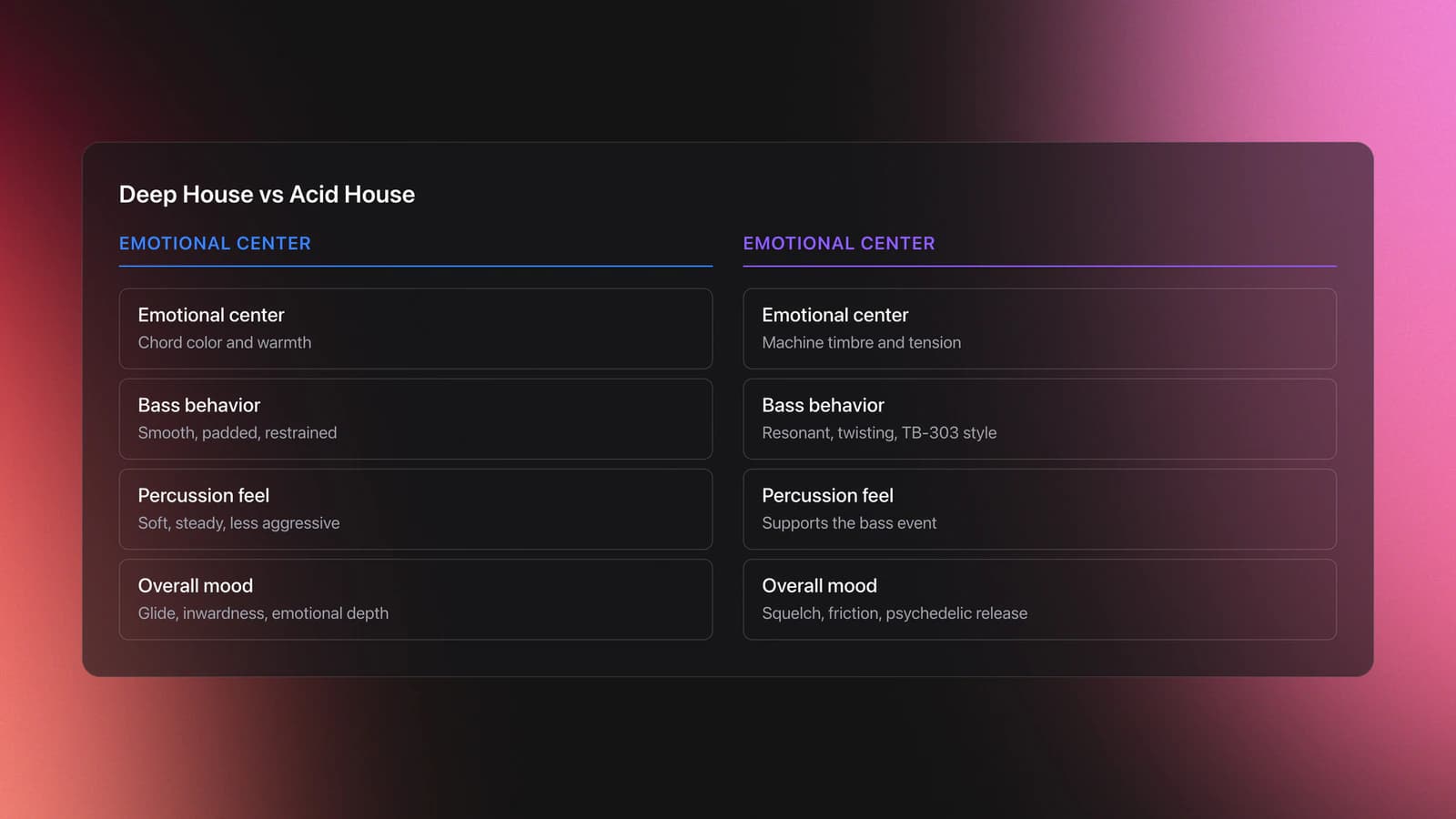
The phrase house music style covers a lot of ground. Not every branch emphasizes the same elements. Some prioritize soul and warmth. Some prioritize machine funk. Some prioritize peak-time force. Some lean into cultural crossover and regional rhythm.
Here is the short map:
- Classic house: disco-informed grooves, drum machines, vocal and piano influence
- Deep house: warmer chords, softer edges, more introspective atmosphere
- Acid house: squelching basslines shaped by the Roland TB-303
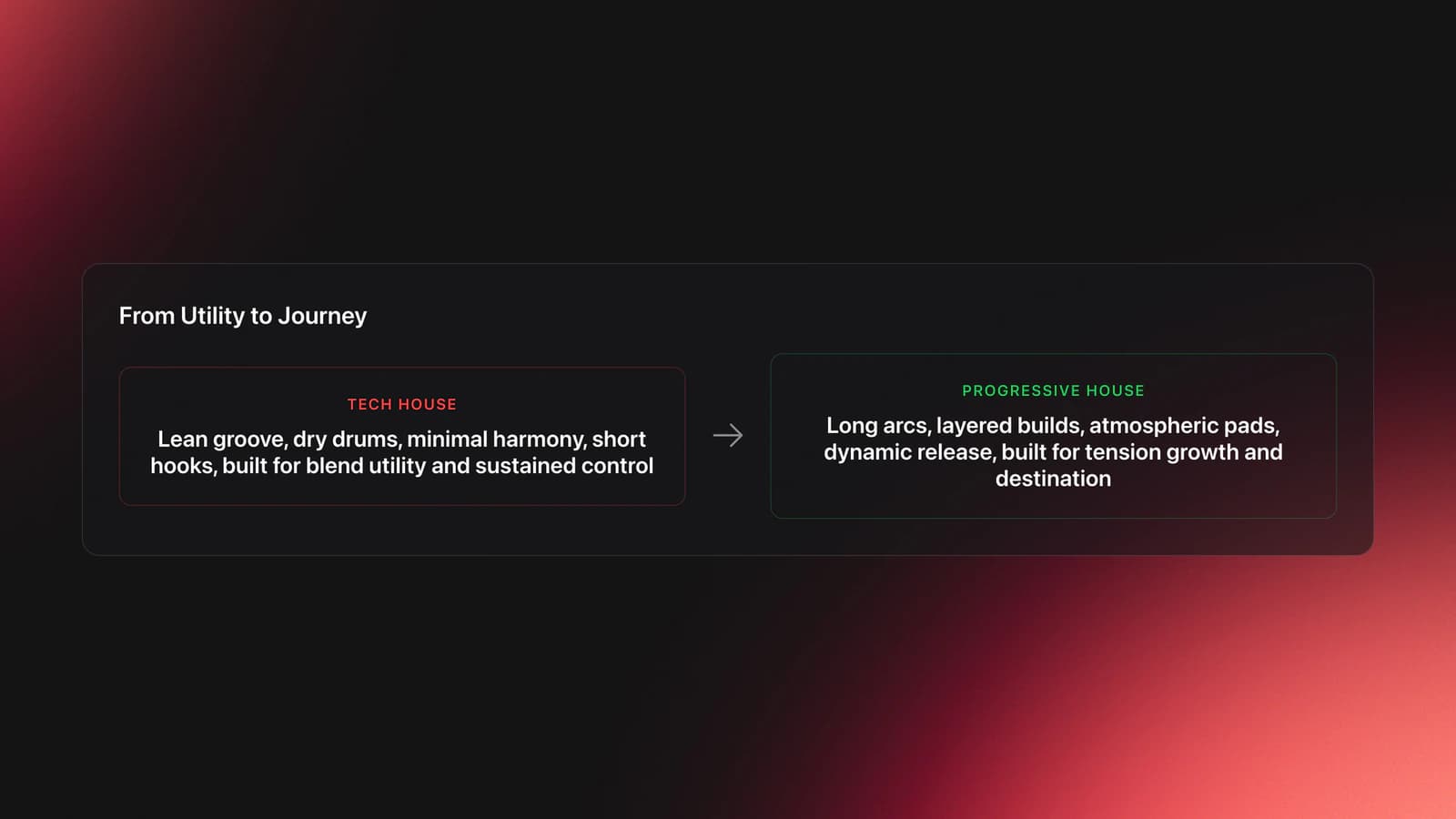
- Tech house: tighter, more stripped, more percussive, often club-functional
- Soulful and Afro house: gospel, jazz, vocal richness, and percussion-heavy regional hybrids
The acid branch is the clearest case of gear shaping a style. Roland's history ties the TB-303 directly to acid house, and Roland's TR-909 history links that drum machine to early house and techno development too. The machines did not create the genre on their own, but they gave producers repeatable tools that scenes then made meaningful.
Guitar house music is worth a quick note for the same reason. It is not defined by the guitar itself. It is house structure with a guitar texture laid on top, so the groove logic and arrangement still decide whether it reads as house.
This is a teaser, not a manual. For full breakdowns, signature-sound checklists, and worked examples that let you tell deep from acid and tech from progressive by ear, see the house subgenre field guide.
What Is Considered House Music?
What is considered house music depends on function more than purity tests. A track usually counts as house when groove is the organizing principle, the pulse stays stable, and the arrangement supports mixing and dancing through repetition and gradual change.
This body test is more reliable than surface details. One record may have piano chords. Another may be sparse and percussive. Another may use vocal chops. If they share house logic, they can sit in the same broad family.
Use a three-part filter when you are unsure:
- Check the beat. Does the kick establish a steady dance-floor pulse?
- Check the structure. Does the track evolve through layers more than verse-chorus writing?
- Check the purpose. Does it feel built for mixing and sustained movement?
This is why not all EDM is house, and not all house is EDM. EDM is a broad umbrella term. House is one branch within that larger world, with its own history, rhythmic priorities, and scene traditions. If you only use tempo or sound design to classify tracks, you will misfile a lot of music.
Listening Framework for House Music
If you want to understand house music faster, stop chasing definitions alone. Build a listening framework you can repeat.
Five passes work on any track:
- Pass 1: Hear the kick and clap relationship
- Pass 2: Track the bass entry and bass role
- Pass 3: Note chord or stab function
- Pass 4: Mark energy changes every eight or sixteen bars
- Pass 5: Decide the track's set function
This turns vague genre knowledge into usable judgment. You stop saying a track feels house-like. You start saying it is a warm-up deep house record with restrained low end, delayed vocal punctuation, and a slow energy curve.
That kind of precision matters. It helps listeners understand taste. It helps DJs build better sets. It helps producers hear why tracks work. Once you can label a record by its set function, it pays to file it that way too, which is where a DJ library tool like Vibes earns its place by letting you sort tracks by mood and energy so the right house cut is one search away when the room shifts.
The self-taught route matters here too. Many people did not learn this from formal music education. They learned by listening with friends, trying records, and slowly building pattern recognition. That path is valid. House culture has always had room for intuitive learning alongside technical depth. I came up that way myself, mostly playing dub house and tech house out in the Cologne scene with the bTbT collective, and the groove logic above is what I actually listen for in a booth.
How DJs Sort House Music Songs
A house record lasts when it does one job extremely well. Usually that job is groove, tension, release, vocal recall, or emotional color. Experienced DJs rarely judge a track by its first drop alone. They listen for usable intros, phrase clarity, bassline discipline, and whether the energy curve gives them options. A strong record is not only good to hear. It is good to play.
- Foundation track. Stable drums and bass. Holds the room together.
- Energy-shift track. Adds punch with a new groove or stronger bassline.
- Vocal-layer track. Gives you a memorable hook over an instrumental bed.
- Peak record. Delivers the biggest emotional or physical response.
You can use this four-part framework to sort both classics and new finds. It also stops you from overloading a set with tracks that all demand the same moment.
Common Mistakes When Defining House Music
| Mistake | Why It Happens | How to Avoid |
|---|---|---|
| Calling all EDM house music | Umbrella terms get treated like genres | Classify by groove, structure, and scene context |
| Ignoring Chicago roots | Streaming tags flatten history | Learn the genre through origin, not just playlists |
| Sorting only by tempo | Tempo is easy to measure | Use function, texture, and arrangement as filters too |
| Using subgenre names loosely | Marketing labels spread faster than musical detail | Name the feature that justifies the label |
| Treating cultural context as optional | People separate sound from scene | Keep Black and queer roots inside the definition |
Common classification mistakes around house music
House Music vs EDM: Selection Guide
When people compare house music and EDM, they usually mix up category level and style level. EDM is a broad umbrella for electronic dance music. House is a specific genre inside that umbrella.
| Scenario | Best Choice | Why | Next Action |
|---|---|---|---|
| You need a precise genre label | House music | It names a specific groove tradition | Describe the subgenre next |
| You mean dance music broadly | EDM | It covers many electronic genres | Narrow by rhythm and function |
| You are building a DJ crate | House music | Set prep needs tighter classification | Tag warm-up, peak, and closers separately |
| You are explaining festival mainstage sound | EDM | That context often spans multiple genres | Name the exact house branch if relevant |
Quick framework for house music versus EDM
Conclusion: What House Music Really Means
House music is not just a beat pattern or a playlist label. It is a Chicago-born dance genre shaped by Black and queer club culture, built around groove continuity, and expanded through decades of local scenes and subgenres.
Keep these takeaways in mind:
- Start with groove, not just genre tags
- Keep the Chicago and Black and queer roots in the definition
- Use function to sort tracks, and use the field guide to sort subgenres
If you want to go deeper, learn to tell the subgenres apart by ear, study DJ set structure, and refine your music library organization so your genre knowledge becomes usable in practice.
The visual way to organize your DJ library
Tag tracks by vibe. See everything at once. Export to rekordbox, Serato, Traktor or Engine DJ.
14-day free trial. Full access, no strings attached.
or see how it works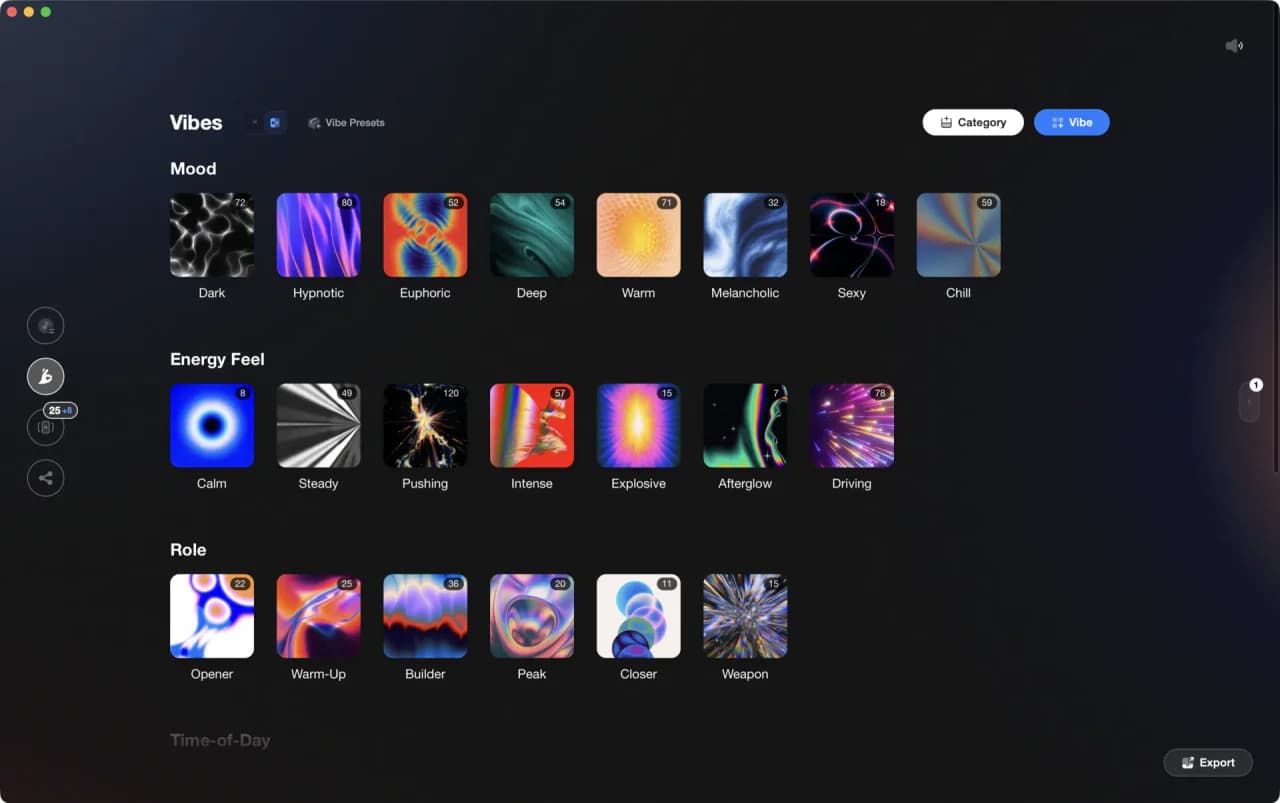
Techniques Covered
Equipment & Software
Featured Gear
Documentation
Continue Your Learning Journey
Related Content
Frequently Asked Questions

Hey, it's Ben Modigell 👋
I DJ and produce as so I so: downtempo, minimal, dub house, tech house, and techno (releases on Spotify and SoundCloud, links above). Everything I write here comes from my own gigs, studio sessions, and library cleanups: the rules I follow, the failure modes I have actually hit, and the workflow I use when nobody is watching. If a technique did not earn its place in my own sets, it does not make it into a tutorial.