
Watch MOONBOY’s tutorial above (57K views on YouTube).
This guide is for producers who like tech house but struggle to turn the idea into a usable groove. You will learn what makes tech house work, how to build its core parts, and how to shape a track that feels lean, rhythmic, and club-ready.
Tech house is a style of house music built around a simple drum grid, a deep grooving bass line, and a memorable vocal or hook. The sound stays minimal on purpose. That leaves more room for rhythm, movement, and small production choices that make people dance.
If your tracks feel busy, flat, or generic, the fix is usually not adding more layers. It is choosing stronger core elements and making them interact better. That same logic also helps when you organize reference tracks, DJ edits, and set ideas inside a structured library like DJ library organization systems, because minimal genres punish messy choices fast.
Tech House Explained
What exactly is a tech house? Tech house sits between classic house and more stripped, technical club music. It keeps the swing and accessibility of house, then removes excess harmony and arrangement clutter so groove becomes the main event.
That is the first mental model worth keeping. In tech house, less content demands better timing. If you only have drums, bass, and a vocal phrase, every sound must carry weight.
This is also why tech house changes shape so often. One producer leans European and dry. Another goes funkier. Another pushes harder, with bass house or trap influence. The outer styling moves, but the center stays stable.
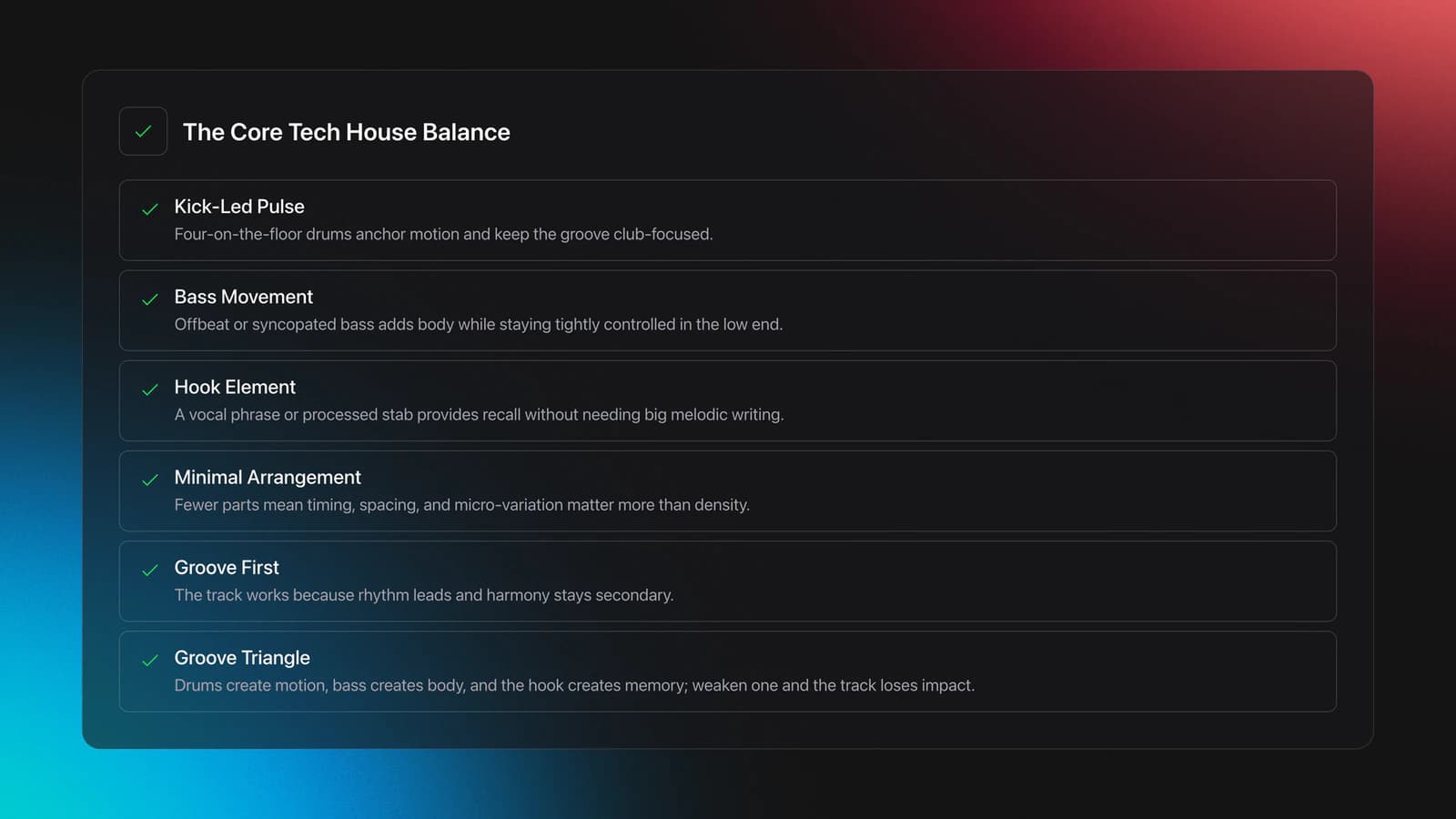
- A kick-led four-on-the-floor drum pattern
- An offbeat or syncopated bass line with low-end control
- A hook element, often a vocal phrase or processed stab
- Minimal arrangement with constant micro-variation
- Strong groove before melodic complexity
A common mistake is treating tech house like a genre defined by one preset pack or one bass patch. It is better understood as a balance system. I call it the groove triangle: drums create motion, bass creates body, and the hook creates recall. If one side is weak, the whole track collapses.
You can hear that difference clearly when comparing tech house with broader house music structure and with tougher hybrids linked to bass house sound design. The overlap is real, but the center of gravity changes.
Tech house reference tracks
A starting crate of tech house, pulled from our DJ track index with live BPM and Camelot keys (these run roughly 120-138 BPM). Beatmatch to each track's tempo, use the long intros and outros to blend, and swap on the phrase. Click any row to open its full sonic profile.





House Vs Tech House: Key Differences
What is the difference between house and tech house? Standard house often gives more room to chords, disco influence, or fuller melodic progression. Tech house strips that back and puts more attention on drum pocket, bass timing, and short vocal hooks.
In practice, the difference is not just sound selection. It is arrangement pressure. A fuller house track can survive a weaker hi-hat pattern because harmony carries interest. A tech house track cannot. The drum and bass relationship has to do the storytelling.
Example one. Imagine a 126 BPM house groove with piano stabs, open hats, a wide pad, and a round bass line. The energy comes from stacked midrange and harmonic repetition. Now remove the piano and pad, shorten the bass, tighten the clap, and leave one chopped vocal line. The groove now needs sharper spacing. That second version lives much closer to tech house.
Example two. Take a funky house loop with a busy percussion top line. If you low-cut some clutter, narrow the percussion role, and let the bass answer the kick instead of filling every gap, the result gets more technical and more minimal. That does not automatically make it good tech house, but it moves in the right direction.
The failure mode here is obvious. Producers hear the word minimal and remove too much. The symptom is a loop that feels empty instead of focused. You will know you got the balance right when muting any one main part makes the groove noticeably worse.
| Aspect | House | Tech House |
|---|---|---|
| Main focus | Harmony and feel | Groove and space |
| Bass role | Supportive or melodic | Rhythmic and central |
| Drum detail | Moderate | Critical |
| Hooks | Often melodic | Often vocal or rhythmic |
| Arrangement density | Fuller | Leaner |
| Energy method | Layering | Tension through movement |
A practical comparison of standard house and tech house production priorities.
Build Tech House Drums
The fastest way to write better tech house is to stop starting with melody. Start with drums. If the drums do not move well on their own, the rest of the track will turn into compensation.
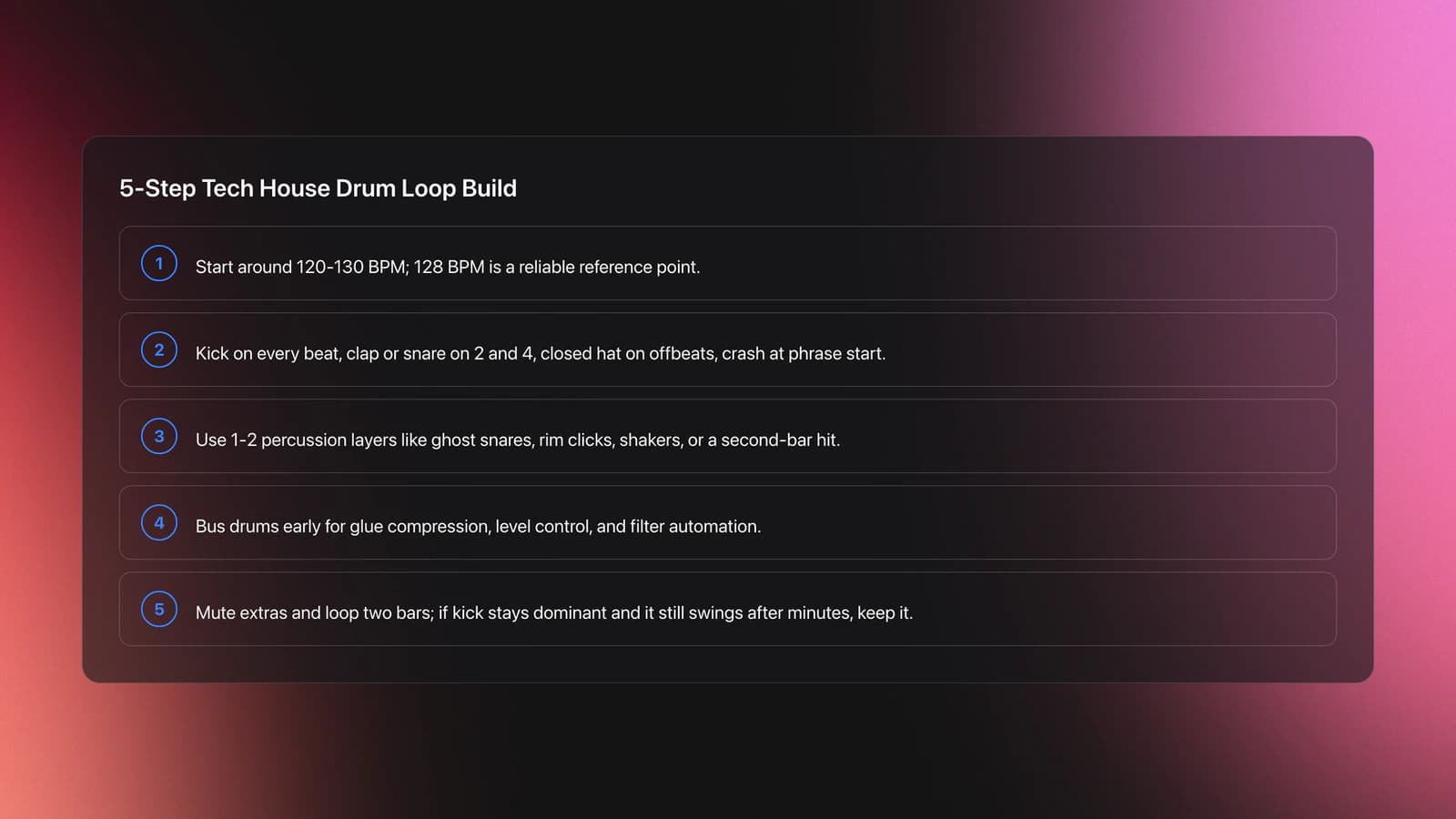
Set your tempo first. Most tech house sits comfortably from 120 to 130 BPM. A cleaner, more driving feel often appears in the upper part of that range.
For a straightforward example, build a two-bar loop at 128 BPM. Put a kick on every beat. Add a clap or snare on beats two and four. Place a closed hat on the offbeats. Then add one impact sound, like a crash, at the start of the phrase.
That is the skeleton. Do not decorate it too early.
Now add one or two percussion elements to create forward pull. Short snares, rim clicks, shakers, and tiny fills work well because they create motion without crowding the loop. The point is not complexity. The point is controlled asymmetry.
Example one. If your loop feels stiff, add a low-level ghost snare just before beat four. That small push can make the clap feel more intentional. Example two. If the loop feels predictable, add a short percussion hit only in the second bar. You create a phrase without changing the core pulse.
Quality matters here. Weak samples force you to over-process. Strong samples need less fixing and preserve more headroom. A lot of beginners think mixing will rescue a bad clap. Usually it just makes the problem louder.
Group your drums early. This is not glamorous, but it solves two problems at once. First, it keeps the session readable. Second, it gives you one place to apply glue processing, level control, and performance automation.
This same discipline matters outside production. DJs dealing with large folders of tech house edits and references often need category-level structure before gig prep starts. Some use manual folder systems. Others use tools like Vibes to build custom hierarchical categories for mood, function, or energy, then keep that structure consistent when preparing sets. Either way, the key is making groove-based material easy to retrieve under pressure.
On the processing side, keep it simple. Gentle bus compression can make the drums feel unified. Soft clipping or controlled limiting can increase perceived loudness, but only if your balance is already right. If the snare is thin, saturation or limiting may help. If the levels are wrong, no plugin will solve that.
A useful tech house trick is group filtering. Put a filter on the drum bus, then automate it during intros, fills, or drops. This creates movement from the loop itself instead of from extra arrangement clutter.
Validation Check
Build Tech House Bass
The bass is where many tech house tracks either lock in or fall apart. A good bass line does not just add low end. It creates the second half of the groove.
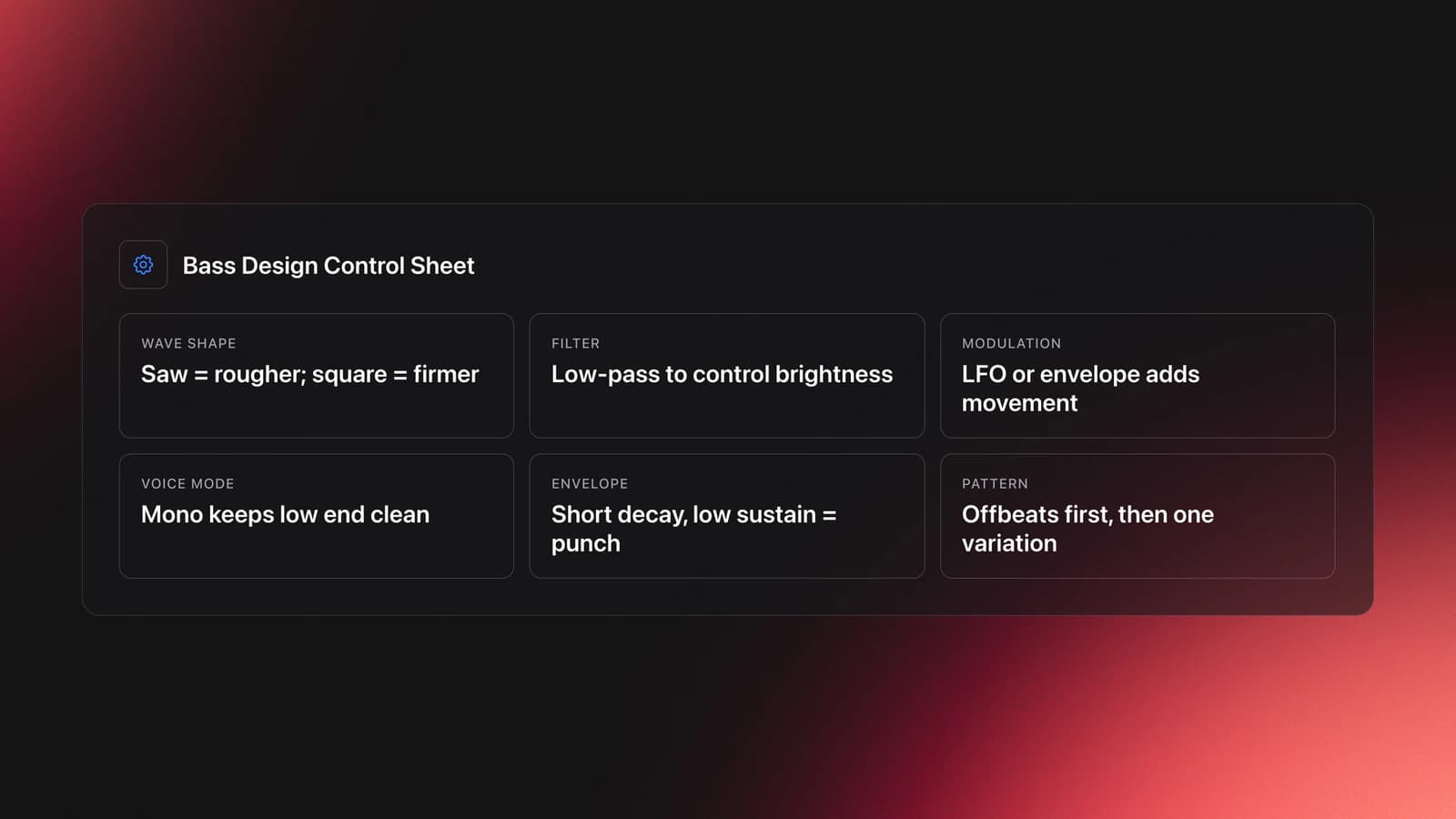
Start with three controls. Wave shape sets character. Filter sets range. Modulation sets movement. That is enough to make a surprising number of basses.
For a clean starting point, use a saw or square-based source, then run it through a low-pass filter. A saw tends to feel rougher and fuzzier. A square tends to feel firmer. Sine and triangle options can work, but they often need extra harmonics to read clearly on smaller systems.
Example one. Build a plucky bass at 128 BPM. Use a saw wave, low-pass the highs, shorten the decay, lower sustain, and keep the voice mode mono. Place notes mainly on the offbeats. The result is compact and club-friendly.
Example two. Build a more robotic bass. Start from the same wave source, then automate cutoff with an LFO. Set a short rhythmic shape. Adjust depth until the movement feels obvious but not cartoonish. This works well when the drums are simple and the hook is sparse.
Mono mode matters because overlapping bass notes blur low-end definition. In dance music, that blur becomes mud fast. This is basic synthesis, but it has a real physical effect. Low frequencies contain longer wave cycles, so competing notes smear together more easily than short bright transients do.
That is the technical reason behind a common production rule. Keep the sub relationship simple.
You can then shape the bass envelope. More release makes the note trail longer. Less sustain and tighter decay make it punchier. Small changes matter here because tech house leaves so much space around the bass.
Pattern writing comes next. The easy starting move is an offbeat pattern. Put the bass between kicks, not on top of them. From there, add one doubled note, one octave jump, or one shifted hit per phrase. That keeps the pattern alive without destroying its dance function.
A third example helps. Write a two-bar pattern in D sharp minor. Use the root note on the offbeats in bar one. In bar two, repeat the first half, then raise the final note by an octave and shorten it. The listener hears continuity first, then surprise second.
Validation Check
This is also where reference management matters for working DJs and producers. If you test many bass feels across edits, sketches, and set ideas, you need fast ways to sort by energy or function. Some artists do that with spreadsheets. Others use Vibes to tag tracks into custom category systems, then map those categories into playlists for preparation and export to DJ software. The specific tool matters less than having bass-driven use cases organized before a set or session.
If you want to go further, compare your bass choices against DJ harmonic mixing basics. Tech house is not mainly a harmony genre, but key relationships still shape how bass and vocal samples sit together.
Process Tech House Vocals
Vocals give tech house identity. They are often short, repeated, and heavily processed. The goal is not a full verse-chorus narrative. The goal is a phrase people remember after one listen.
Start by choosing the role of the vocal. It can carry attitude, rhythm, or texture. That decision tells you how aggressively to process it.
Five common moves cover most practical cases. Tune the vocal to the track key. Manually retune for more control. Shift formants to change character. Vocode it into a synthetic layer. Compress it so it stays present in a sparse mix.
Example one. Take a dry spoken line and tune it lightly so the pitch centers better, then compress it and cut some low end. This keeps the phrase human but cleaner. Example two. Take the same phrase, shift the formant downward, then run it into a vocoder fed by simple chords. Now the vocal behaves more like a hook synth.
That range of options matters because tech house often uses vocals as architecture, not decoration. A chopped line can mark the drop. A robotic line can replace a synth lead. A compressed phrase can glue the track's midrange together.
If you are learning this from scratch, do not assume formal training is required. Many producers come up through trial, imitation, and repetition. A common self-taught path starts with borrowed gear, rough downloaded tracks, and hours of simply trying ideas until something clicks. That intuitive, flow-first approach still works, as long as you pair it with deliberate listening and cleaner decision-making over time.
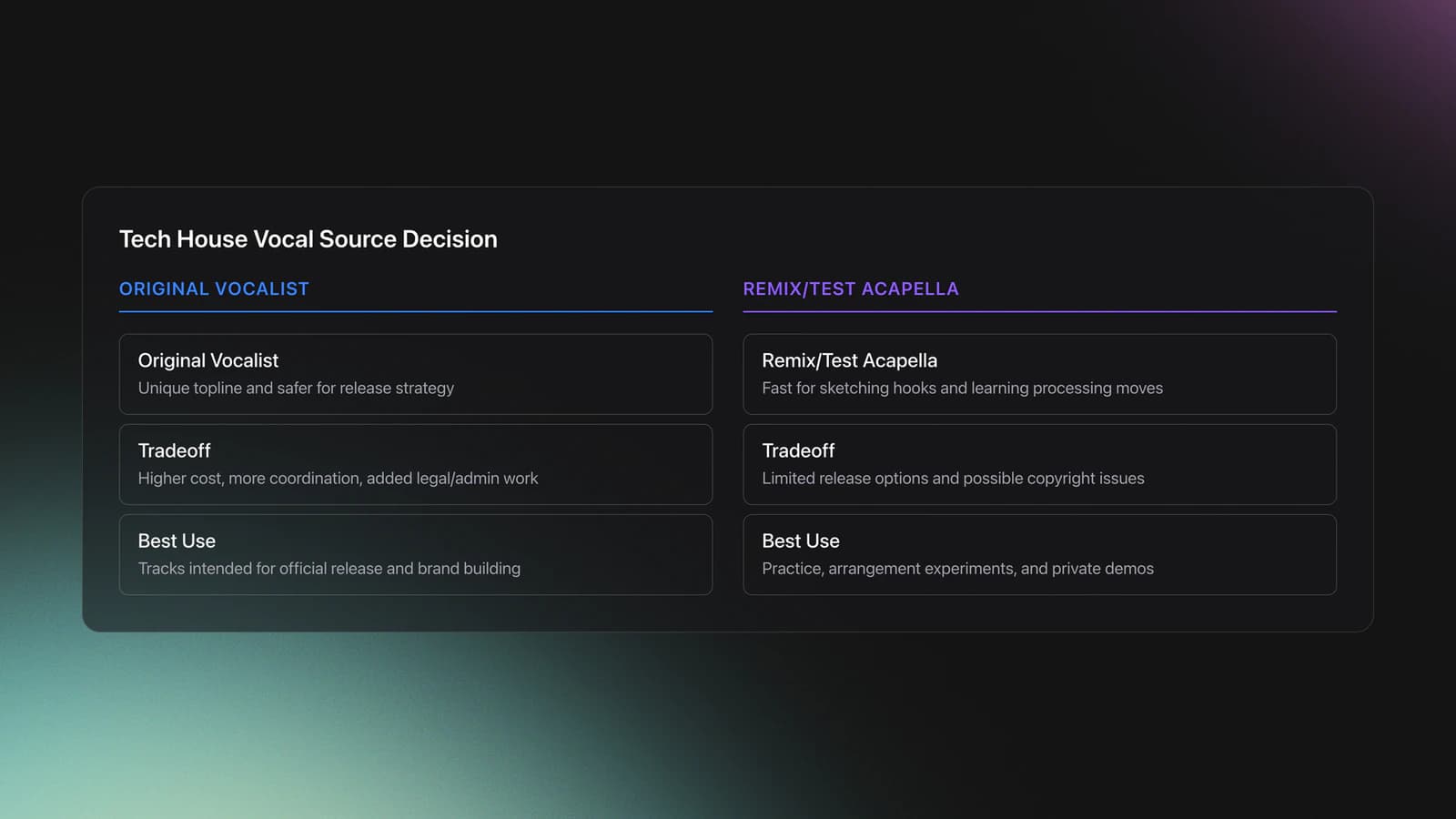
Where do the vocals come from? The transcript points to two realistic paths. You can hire a vocalist, which gives you originality but adds cost, coordination, and legal overhead. Or you can remix an existing song idea, which is fast for sketching but limits release options and can create copyright problems on platforms.
Use that tradeoff as a decision filter. If you are practicing arrangement and processing, remixes and test acapellas can help you learn fast. If you are building a release strategy, original toplines are safer.
Validation Check
Arrange a Tech House Track
Once drums, bass, and vocals work, arranging tech house becomes a game of controlled reveal. You are not trying to write constant new material. You are deciding when each core element becomes more visible.
A simple structure works well: intro groove, expanded loop, breakdown or filtered reset, drop, second variation, and outro. The details can change, but the emotional arc should stay easy to follow in a club.
Think in terms of contrast levels. Level one is no change. Level two is filter or mute automation. Level three is adding or removing one core element. Level four is a hook event, like a vocal re-entry or bass variation. Most tech house arrangements live on levels two through four.
Example one. In the intro, keep the kick and hats stable while filtering the drum bus upward over eight bars. When the bass enters, remove the filter and mute the crash. This feels like a handoff instead of a hard restart. Example two. Before the main drop, cut the bass for half a bar and let the vocal repeat alone. The return of low end then feels larger than it actually is.
This is where DJs think like arrangers. Tracks that are easy to mix usually expose transitions clearly. The same principle helps when planning sets. If you prepare folders or playlists around energy, mood, and function, you can match arrangement behavior to live context more quickly. That is one reason structured export workflows matter in tools built for DJ preparation, especially when moving from local library management into software such as Rekordbox.
Do not overrate giant breakdowns unless the track truly asks for one. In many tech house tracks, too much empty drama kills momentum. Small transitions, repeated with precision, often work better.
As a practical reference, modern DJ platforms document how playlist and collection structures support preparation workflows. Pioneer DJ's Rekordbox support documentation is useful if you want to understand how export-ready organization affects performance prep.
Common Tech House Mistakes
Most weak tech house tracks fail for obvious reasons once you know where to listen. The genre exposes timing, sample choice, and arrangement discipline very quickly.
| Mistake | Why It Happens | How to Avoid |
|---|---|---|
| Too many layers | The producer mistakes fullness for energy | Limit the loop to core elements and add variation later |
| Weak drum samples | Poor source material forces over-processing | Choose stronger one-shots before reaching for plugins |
| Bass fighting the kick | Notes overlap and envelopes are too long | Use mono bass, shorten decay, and move notes off the kick |
| Overprocessed vocals | Interesting effects are pushed too far | Keep one job per vocal layer: hook, texture, or rhythm |
| Big breakdowns with no payoff | Arrangement copies festival templates | Use smaller transitions unless the track earns a larger reset |
Specific production mistakes that make tech house feel flat, crowded, or unfocused.
Practice Tech House in 30 Minutes
If you want faster improvement, shorten the loop and shorten the session. Long sessions often produce more options, not better decisions.
- Minutes 0–10. Build one two-bar drum loop with kick, clap, hat, and one percussion layer.
- Minutes 10–20. Write one bass patch and two bass patterns. Keep only the stronger groove.
- Minutes 20–30. Add one vocal phrase, process it two different ways, then choose the cleaner role.
Repeat this three times in one week. Save every version. Compare which loop still works at low volume and which one survives after a short break. That review habit is more useful than endlessly polishing one bad idea.
How to Know Your Tech House Works
Good feedback for tech house is often physical before it is verbal. The loop should feel steady, directional, and memorable even when played quietly.
- The kick remains the anchor after five minutes of looping
- The bass adds motion without masking the kick
- The vocal phrase is memorable after one pass
- Muting any core part makes the groove noticeably worse
- Arrangement changes feel deliberate, not decorative
For broader production context, Ableton's synthesizer and filtering lessons are useful for understanding envelope, filter, and modulation behavior in plain language. If you want the technical side of voice handling, iZotope's vocal processing education is a solid reference for compression and tuning concepts.
Tech House Takeaways
Tech house works when a few parts do very specific jobs well. Drums create motion. Bass creates body. Vocals or hooks create recall. Minimalism is not emptiness. It is pressure on your choices.
Keep these takeaways in mind:
- Start with a loop that grooves before you arrange anything
- Write bass around the kick, not against it
- Use vocals for identity, not for constant saturation
If you can build one two-bar section that still feels good after repeated listening, you already have the hard part. From there, expand carefully, compare against your references, and keep the groove triangle intact.
The visual way to organize your DJ library
Tag tracks by vibe. See everything at once. Export to rekordbox, Serato, Traktor or Engine DJ.
14-day free trial. Full access, no strings attached.
or see how it works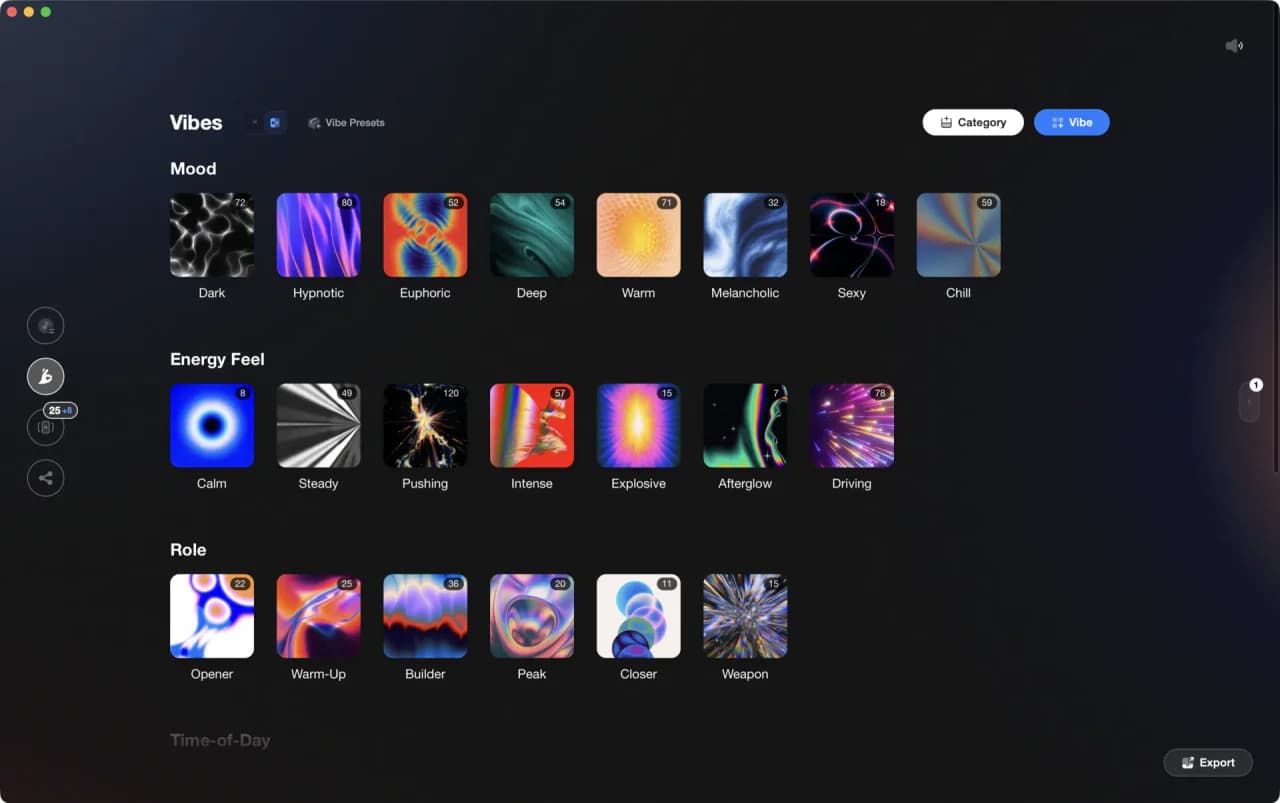
Techniques Covered

Equipment & Software
Featured Gear
Documentation
Continue Your Learning Journey
Start Here First

Deep House: Sound, Structure, and Flow
beginner
Swedish House Music: Sound, Artists, Key Tracks
beginner
How to DJ: First Mix, Step by Step
beginner
How Can I Be a DJ and Start Strong
beginner
DJ Setup Types
beginner
How to Choose a DJ Controller for Your Workflow
beginner
DJ Starter Equipment: What to Buy First (and What to Skip)
beginnerRelated Content

House Trance: Sound, Structure, Mixing
intermediate
House Music Explained
intermediate
90s House Music: Origins, Sound, Key Tracks
intermediate
How To Mix In Key Live: Worked Transitions And Failure Fixes
intermediate
Harmonic Mixing Guide for DJs: Energy & Workflow
intermediate
Transition DJ Online: Browser Mixer Workflow
intermediate
DJ Transitions: The Three-Layer Handoff for Beginners
intermediateFrequently Asked Questions

Hey, it's Ben Modigell 👋
I DJ and produce as so I so: downtempo, minimal, dub house, tech house, and techno (releases on Spotify and SoundCloud, links above). Everything I write here comes from my own gigs, studio sessions, and library cleanups: the rules I follow, the failure modes I have actually hit, and the workflow I use when nobody is watching. If a technique did not earn its place in my own sets, it does not make it into a tutorial.