Watch Michael Stein’s tutorial above (6K views on YouTube).
This is for listeners, DJs, and diggers trying to understand 90s house music beyond loose nostalgia. If you keep finding playlists that lump house, trance, eurodance, and pop together, this will give you a cleaner frame. You will leave with a working map of the sound, the main branches, and a practical way to build or refine a 90s house music playlist.
Key Takeaway
If you are building broader context around dance-floor history, it helps to connect this period to house music origins, Chicago house essentials, deep house selection, and DJ crate organization.
90s House Music: Definition and Core Traits
90s house music is the 1990s phase of house that grew from Chicago roots into several club-ready branches. The constant is a steady four-on-the-floor pulse, groove-led arrangement, and a DJ-first design built to keep dancers locked into one continuous flow.
That last point matters. In the transcript, DJs describe the job as keeping one long groove alive. That is the right mental model for this decade. A good 90s house set does not feel like separate songs. It feels like controlled momentum.
House began in Chicago in the early 1980s, with Frankie Knuckles at the Warehouse helping define the sound and the dance-floor logic around it, according to Britannica and GRAMMY's house timeline. By the 1990s, the style had split into club-specific variants including garage, deep house, progressive house, and harder rave-adjacent forms. Britannica's house music history and GRAMMY's house timeline both outline that progression.
So when someone says 1990 house music or 90 house music, they may mean different things. Some mean early-90s New York vocal house. Some mean UK progressive house. Some mean a broad club era. You need a tighter filter than the label alone.
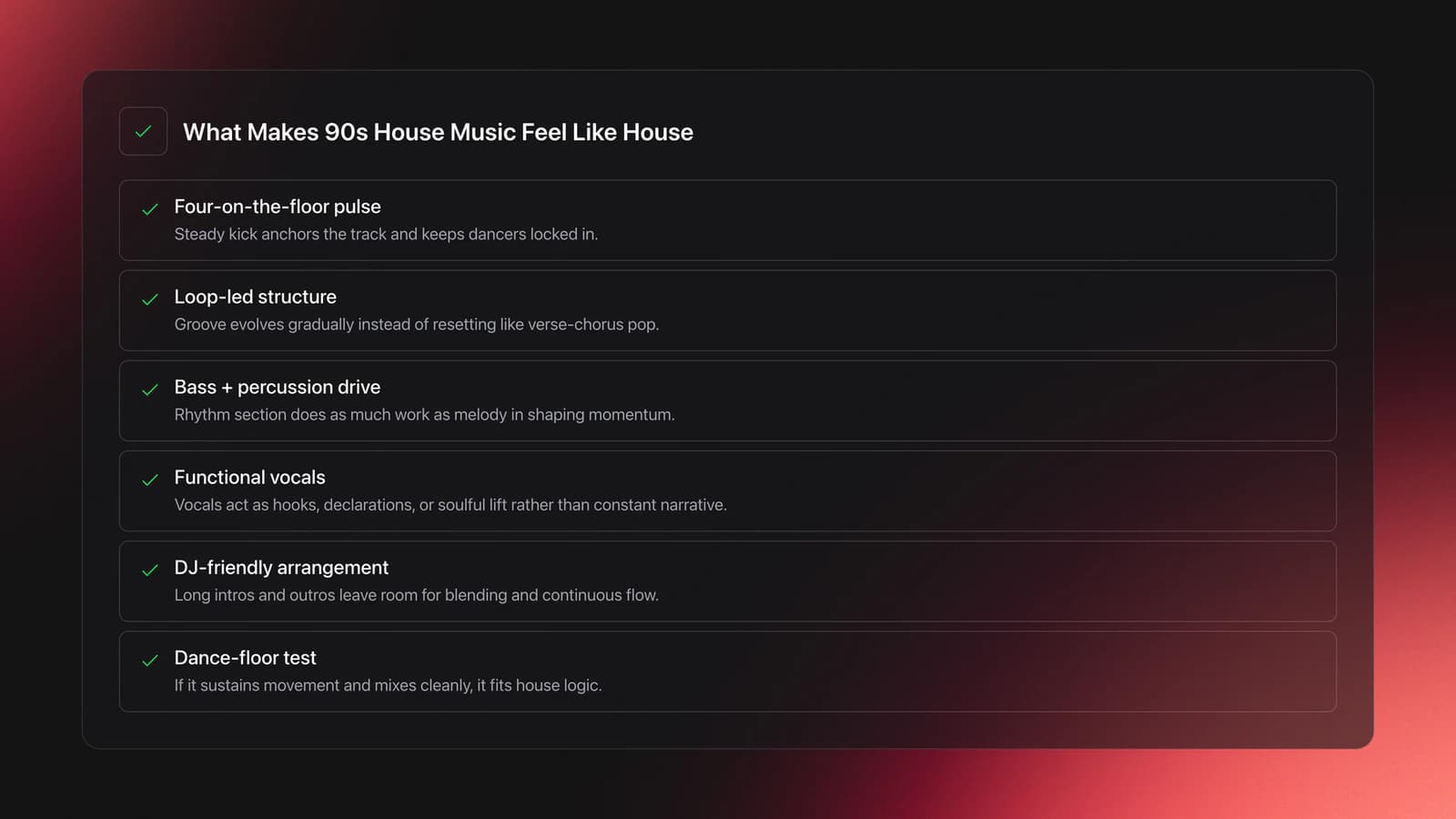
- Steady kick pattern that anchors the whole track
- Loop-based groove with gradual changes, not constant verse-chorus resets
- Bassline and percussion doing as much work as melody
- Vocals used as hooks, declarations, or soulful lift
- Mix-friendly intros and outros for continuous DJ flow
This means the genre is best understood by behavior on a dance floor. Does the track sustain movement? Does it give a DJ room to steer energy? Does it sound built for blending rather than interruption? If yes, you are probably still inside house logic.
A simple frame helps here: groove, lift, and memory. Groove is the drum and bass engine. Lift is the piano, vocal, chord, or filter movement that opens the track up. Memory is the hook that makes the record stick after one play. Most enduring 90s house records balance all three. If one is missing, the track may still work, but it usually feels more functional than timeless.
Tempo sits in a practical dance range. House commonly lands around 115 to 130 BPM, with many enduring classics sitting near the middle because that range keeps the groove relaxed without losing drive.
90s house reference tracks
A starting crate of 90s house, pulled from our DJ track index with live BPM and Camelot keys (these run roughly 110-136 BPM). Beatmatch to each track's tempo, use the long intros and outros to blend, and swap on the phrase. Click any row to open its full sonic profile.



Chicago Roots and Why They Still Matter
You cannot make sense of 90s house music without Chicago. The word itself is closely tied to the Warehouse and to Frankie Knuckles' edits and programming style, where older disco, soul, and machine rhythm were reshaped into a new club language. Britannica notes that house originated in Chicago in the early 1980s, and its roots remained central even as the sound spread internationally.
The transcript adds an important detail. Early people in the scene used the term “house cut” for records associated with what was played at the Warehouse. That is useful because it shows house was first a DJ culture and selection method before it became a rigid genre box.
This history also explains why 90s house songs often carry disco, gospel, soul, and club-engineering DNA at the same time. The music was never just about minimal machine repetition. It was also about release, uplift, and social space.
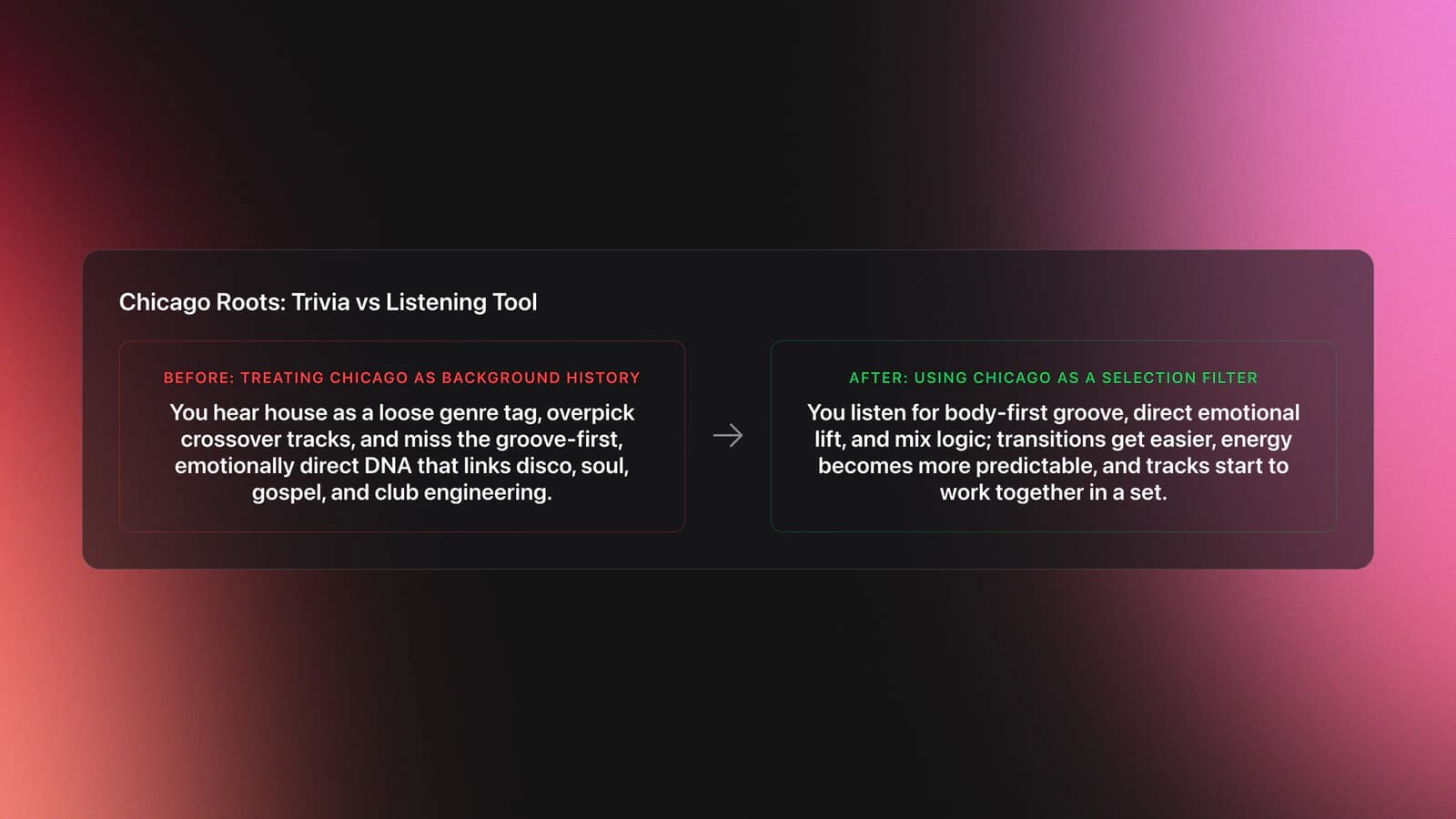
In practice, Chicago gives you two filters. First, listen for groove before ornament. Second, listen for emotional directness. Even the harder records usually keep a body-first logic.
One worked example is Frankie Knuckles' “The Whistle Song” from 1991, highlighted in GRAMMY's timeline. It is not huge in the modern EDM sense. It is light, rolling, and patient. The output is movement through feel, not shock.
A second example is Jamie Principle and Frankie Knuckles' “Your Love,” which sits on the bridge between foundational Chicago house and the 1990s listening habit. The process is simple. Repeated motif, emotional vocal presence, long-form groove. The output is a track that still teaches how house tension works.
A common failure mode is treating Chicago roots as trivia instead of a listening tool. The symptom is a playlist full of tracks that are dance-pop adjacent but do not preserve the sustained groove or mix logic of house.
You will know your selection is improving when transitions feel easier and the room's energy curve becomes more predictable. The tracks start talking to each other.
For DJs, this is also where organization friction starts. Once you move past a few obvious classics, the hard part is separating soulful vocal cuts, tougher late-night rollers, and crossover anthems. Some use folders and notes. Others use a library tool like Vibes to build custom categories around mood, function, or energy so 90s house tracks are easier to pull by feel before a set. The method matters more than the software, but the separation has to exist before you play.
Subgenres Inside 90s House Music
This is where most playlist labels get messy. The transcript names several adjacent sounds that sat around the same scene. Not all of them are house. Some are neighboring rave genres. Your job is to separate core house branches from nearby styles without pretending the borders were clean.
Britannica notes that by 1990 the British scene had already split between rave-oriented sounds and more mature, club-oriented soulful house, often called garage. It also points to progressive house, tech-house, and other mutations that expanded the field in the 1990s.
- Deep house. Warmer chords, subtler swing, often more inward.
- Garage house. More soulful and vocal-led, with stronger lift.
- Progressive house. Longer builds, hypnotic structure, more tension shaping.
- Tribal house. Percussion-forward tracks with patterned drum emphasis.
- Harder rave-adjacent forms. Faster, rougher, sometimes no longer really house.
Use function to sort them. Deep house is often your warm-up or lock-in zone. Garage house can carry the emotional center. Progressive house controls long tension arcs. Tribal records can reset physical energy without needing a huge vocal payoff.
Worked example one. Compare a soulful vocal house cut like Robin S.' “Show Me Love,” cited in GRAMMY's 1990s overview, with a more hypnotic progressive track. The input difference is obvious. One resolves through vocal hooks. The other resolves through gradual structural pressure. The output on the floor is different, even when BPM sits close.
Worked example two. Compare Masters at Work productions from the mid-1990s with a harder late-1990s club tool. Masters at Work records often use percussion, vocals, and arrangement detail to create lift. A tougher tool may strip that away and focus on drive. Both belong in 90s house music, but not in the same moment of a set.
In underground and intimate settings, this distinction matters even more than technical perfection. The point is musical storytelling. If the room wants tension and release through emotional arc, a soulful or deep record will often do more than a bigger, flatter anthem.
The failure mode here is decade-first sorting. People tag every four-on-the-floor club track from the 1990s as house. The symptom is whiplash. A playlist jumps from garage to trance to eurodance without any shared logic.
You will know your categories are working when each group suggests a clear use case. Warm-up. Peak lift. Rolling transition. Vocal reset. After-hours drift.
How to Build a Better 90s House Music Playlist
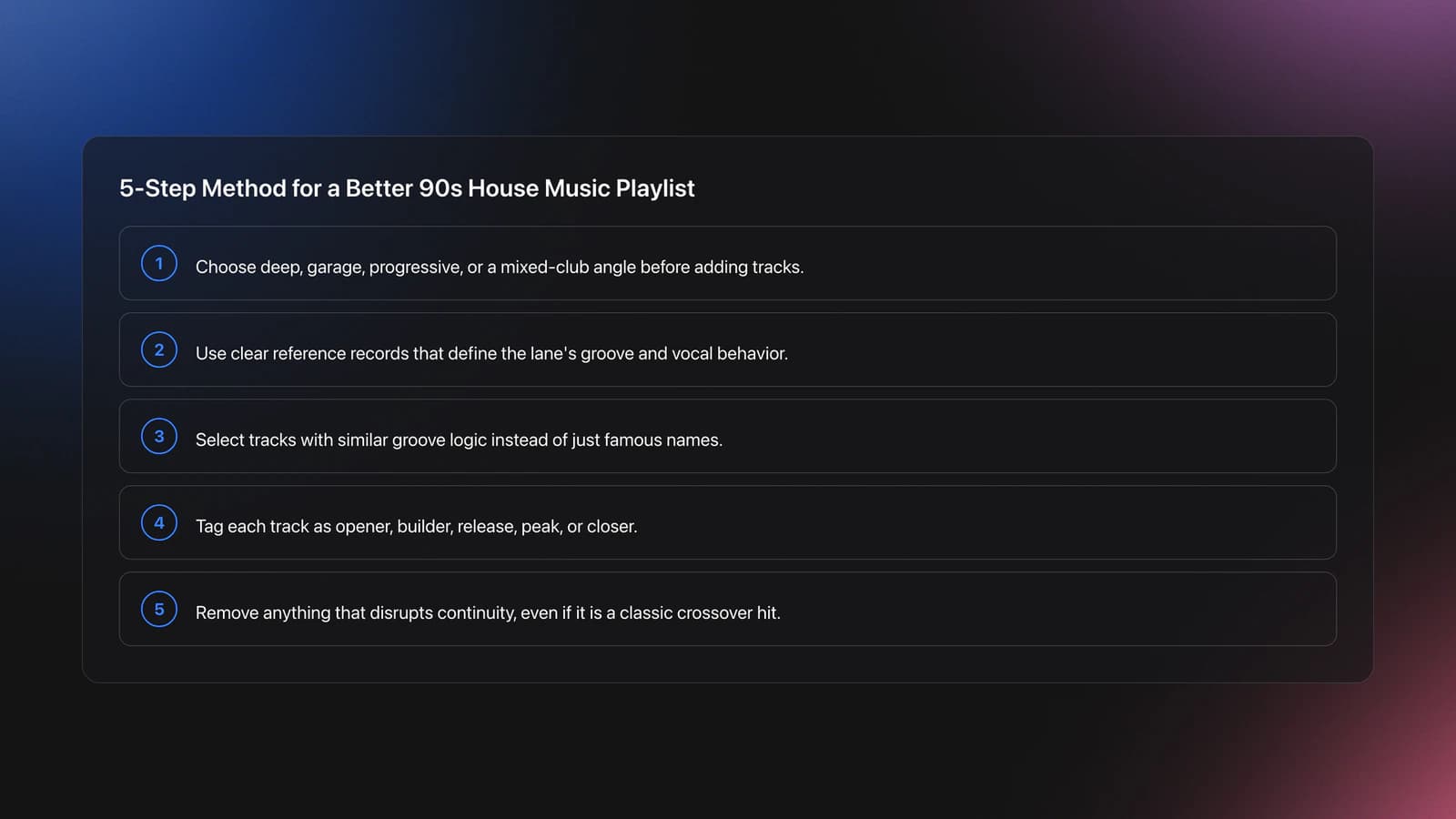
If you want a strong 90s house music playlist, do not start with a top 100 list. Start with listening roles. That gives you a playlist that works, not just one that signals taste.
Use this five-step method.
- Pick one lane first. Deep, garage, progressive, or mixed-club.
- Choose 5 anchor tracks that define your lane.
- Add 10 supporting tracks with similar groove behavior.
- Sort by function: opener, builder, release, peak, closer.
- Remove anything that breaks flow, even if it is famous.
Anchor tracks should be obvious reference points. GRAMMY's timeline is useful here because it names several durable 1990s records and producers, including Robin S., Ultra Naté, Masters at Work, and Armand Van Helden. Those are not the whole genre, but they are stable markers.
Worked example one. Suppose your anchors are “Show Me Love,” “Free,” “The Bomb!,” “Deep Inside,” and “U Don't Know Me.” The process is to map what each one is doing. Vocal anthem, soulful uplift, disco-sample lift, driving groove, crossover late-90s hook. The output is a playlist with variety inside a shared house framework.
Worked example two. Suppose you want a deeper lane. Start with Frankie Knuckles, Kerri Chandler, Mood II Swing, and Masters at Work-adjacent material from the decade. Then reject tracks that are too pop-forward or too hard-edged. The output is a set of records that can actually mix for an hour.
A useful ratio for many DJs is roughly 40% functional grooves, 40% strong identity tracks, and 20% unmistakable anthems. That keeps the sequence moving without sounding like a greatest-hits compilation.
A useful checkpoint is sequencing by energy, not alphabet or release year. This is where crate structure matters. If you manage a large local library, a category system can save time. Some DJs build separate folders manually. Others use Vibes to assign tracks to hierarchical groups such as mood, function, and energy, then export that structure to DJ software. Either way, the win is the same. You stop searching by memory alone.
A common failure mode is overvaluing famous crossover tracks. The symptom is a playlist with hits but no continuity. Good selections survive front-to-back listening, not just single-track recall.
You will know your playlist works when three things happen. The energy rises without forcing it. The vocal records feel earned. The last third sounds like a destination, not leftovers.
What Were the Top 40 Songs in 1990?
This question comes up often, but it is only partly useful for 90s house music. The top 40 in 1990 reflects mainstream chart behavior, not the full club ecosystem. House culture often moved through DJ circulation, imports, regional scenes, and specialist dance charts before crossing into pop.
So if you are looking for 90s house songs, do not use pop chart success as your main filter. A track can be central to house history without being one of the biggest general-pop hits of the year.
A better approach is combining broad cultural markers with scene markers. Use big crossover cuts as entry points, then trace producers, remixers, labels, and adjacent artists outward.
That is also why community databases matter. Discogs treats style as a subgenre layer under broader genre classification, which makes it useful for tracing how a release sits inside electronic music categories. Discogs' genre and style guidelines explain that hierarchy.
What Was Played in Clubs in the 90s?
Clubs in the 1990s did not run one universal soundtrack. What was played depended on city, venue size, crowd, promoter taste, and time of night. The transcript itself moves between Chicago roots, rave culture, harder techno forms, soulful house, and progressive trends. That mix reflects scene reality.
For house rooms, the common thread was still groove continuity. DJs selected records to keep motion stable, then adjusted intensity in small steps. A good selector knew whether the next record should hold, raise, or reduce energy.
This gives you a cleaner answer than any genre list. In house-driven clubs, records were chosen less by brand label and more by what they did to the room over time.
| Mistake | Why It Happens | How to Avoid |
|---|---|---|
| Treating all 90s dance music as house | The decade label is broader than the genre | Sort by groove behavior and arrangement, not just year |
| Building from hits only | Famous tracks are easier to remember than functional ones | Start with anchor tracks, then add connectors and builders |
| Ignoring subgenre role | Deep, garage, and progressive can seem similar at first | Tag tracks by use case such as warm-up, lift, or peak |
| Using chart position as quality control | Pop success and DJ usefulness are not the same | Follow producers, remixers, and labels as well as singles |
| Organizing by artist only | That works for casual listening but not for set flow | Build categories around mood, energy, and function |
Common mistakes when learning or collecting 90s house music
What Is the Biggest House Song of All Time?
There is no single objective winner. The answer changes depending on whether you mean chart reach, DJ use, cultural memory, or genre influence.
If you mean crossover visibility, Robin S.’ “Show Me Love” is one of the safest answers. It became a mainstream hit in 1993 and is still treated as a major dance record decades later. If you mean foundational importance, many DJs would argue for “Your Love” or “Move Your Body.” If you mean emotional anthem status, Joe Smooth’s “Promised Land” belongs in the conversation.
This is also the difference between popular house music and classic house music. Popular means broad recognition. Classic means lasting importance inside the genre. Some records are both. Inner City’s “Good Life” crossed beyond club culture while keeping strong house identity, which is rare. Many foundational records were never the biggest mainstream songs. They mattered because DJs played them, producers copied them, and scenes built around them.
The practical takeaway is better than the ranking debate. Learn three kinds of giants: the foundational giant, the crossover giant, and the anthem giant. That gives you better ears and better crates than chasing one definitive winner.
Classic Artists and Tracks to Start With
If you need a practical starting list, focus on artists and producers who show different sides of the decade. GRAMMY and Britannica both point to Frankie Knuckles, Masters at Work, Armand Van Helden, and the broader Chicago-to-New York line as central reference points.
A balanced starter pool for 90s house songs would include Frankie Knuckles, Robin S., Masters at Work, Harddrive, Bucketheads, Ultra Naté, Kerri Chandler, Mood II Swing, David Morales, and Armand Van Helden. That gives you soulful, vocal, disco-cut, and tougher club angles without flattening them into one bucket.
- Frankie Knuckles - bridge from Chicago roots into the 1990s
- Robin S. - crossover vocal house benchmark
- Masters at Work - arrangement-rich New York house
- Harddrive - tougher groove with house discipline
- Ultra Naté - uplifting vocal house reference
- Armand Van Helden - late-90s crossover edge
If you want song-level anchors as well, start with records that shaped the genre, crossed scenes, or still get referenced by DJs decades later. Several are late-80s Chicago and Detroit foundations that the 90s sound grew directly out of:
- “Your Love” by Frankie Knuckles and Jamie Principle. Deep, hypnotic, foundational.
- “Move Your Body” by Marshall Jefferson. Piano-house blueprint and festival-level lift.
- “Promised Land” by Joe Smooth. House with a clear message and anthem structure.
- “Good Life” by Inner City. Detroit crossover with warmth and uplift.
- “Show Me Love” by Robin S. A house-pop landmark with lasting DJ value.
- “The Bomb! (These Sounds Fall Into My Mind)” by The Bucketheads. A mid-90s staple in classic house playlists.
Do not read this as a fixed canon. A serious 90s house playlist will branch quickly into labels, cities, and sub-styles. These titles show up again and again because each defines a durable part of the sound.
From there, follow production and remix credits. That is often more revealing than artist names alone because house culture is full of aliases, collaborative projects, and version-specific classics.
If you want to expand beyond basics, build outward into classic vocal house, progressive house history, and DJ set planning.
Why 90s House Music Still Works
90s house music still works because it solves two problems at once. It gives you clear physical rhythm, and it leaves room for emotional movement. The tracks are functional enough for DJs and expressive enough for listeners.
That balance is why the decade keeps feeding new playlists, reissues, edits, and reference points. Even when production ages, the structural logic still makes sense. Groove first. Tension second. Release only when it is earned.
The simpler way to say it is this. Good 90s house music does not just sound old. It still knows what a room needs.
- Hear house as groove continuity, not just a decade tag
- Sort by subgenre function before making big playlists
- Use anchor tracks, then add connectors that preserve flow
Next step. Pick one lane tonight. Build a 12-track sequence around it. Listen front to back without skipping. Then cut three tracks that break the groove and replace them with better connectors. That single edit will teach you more than reading another generic top-100 list.
The visual way to organize your DJ library
Tag tracks by vibe. See everything at once. Export to rekordbox, Serato, Traktor or Engine DJ.
14-day free trial. Full access, no strings attached.
or see how it works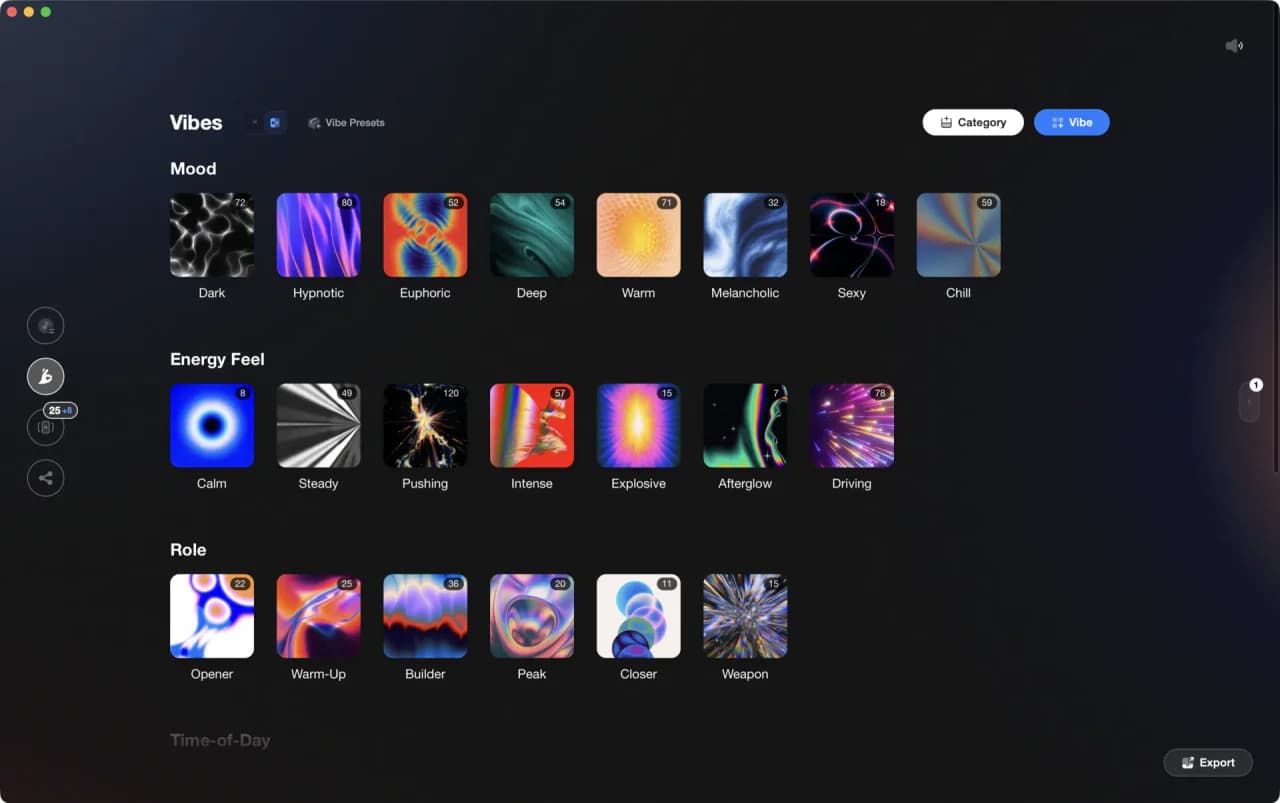
Techniques Covered
Equipment & Software
Documentation
Continue Your Learning Journey
Frequently Asked Questions

Hey, it's Ben Modigell 👋
I DJ and produce as so I so: downtempo, minimal, dub house, tech house, and techno (releases on Spotify and SoundCloud, links above). Everything I write here comes from my own gigs, studio sessions, and library cleanups: the rules I follow, the failure modes I have actually hit, and the workflow I use when nobody is watching. If a technique did not earn its place in my own sets, it does not make it into a tutorial.