Watch Club Ready DJ School’s tutorial above (68K views on YouTube).
This guide is for DJs who already know the basics but want better dj set preparation. If your sets feel random, drag in the middle, or lose impact at transitions, the problem is usually not technique alone. After reading, you will be able to choose stronger tracks, decide how much of each track to play, and prepare transitions that keep the room moving.
A good set is not a pile of good songs. It is a sequence of decisions about tension, release, familiarity, and timing. That is why dj set preparation matters more than most DJs admit.
If you are still tightening your foundations, it also helps to build a repeatable workflow around DJ library organization, harmonic mixing basics, and how to set cue points.
DJ Set Preparation Starts With Intent
The first step in dj set preparation is getting clear on the job of the set. Are you warming a room, holding a groove, or pushing toward a peak? Until that is clear, track selection is guesswork.
This is the core mental model. I call it the energy path. The energy path is the planned shape of the set over time, not just the average intensity of the tracks.
Many DJs build a playlist by asking, “Do I like this track?” Better DJs ask, “What job does this track do in this position?” That shift changes everything.
The transcript makes this point clearly. Track choice depends on intention. If you are playing for yourself, your choices can be more personal. If you are playing for a scene, a venue, or a time slot, your selection has to reflect what that floor will actually respond to.
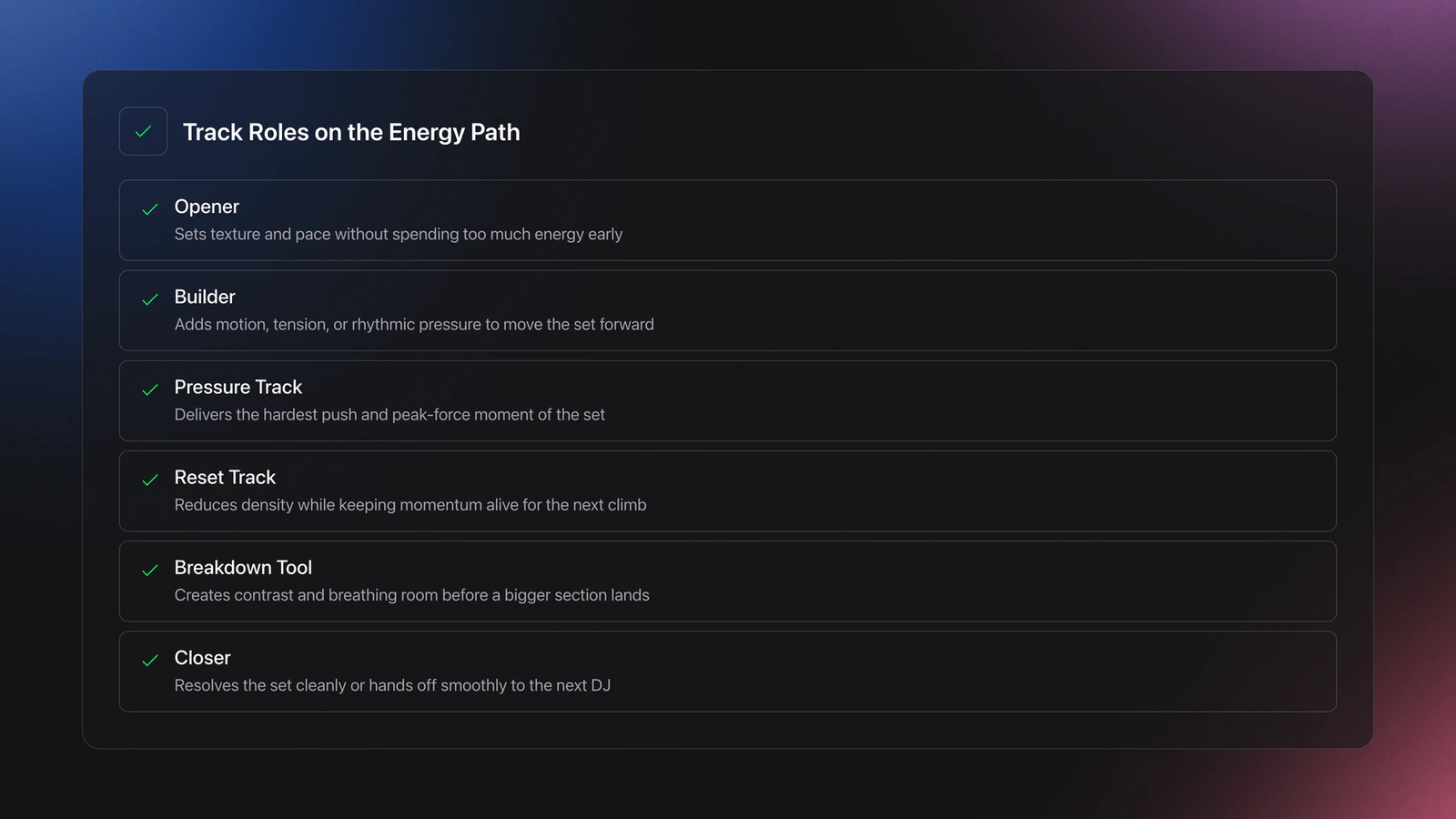
In practice, that means separating tracks into roles before you worry about final order. Common roles include opener, builder, pressure track, reset track, breakdown weapon, and closer.
- Openers: establish texture and pace without overspending energy.
- Builders: add motion, tension, or rhythmic pressure.
- Pressure tracks: deliver the set's hardest push.
- Reset tracks: reduce density without killing momentum.
- Breakdown tools: create contrast before a bigger section.
- Closers: resolve the set or hand off cleanly.
This is where research helps. Beatport's genre charts are still a practical way to check what is currently connecting in a style, and tracklist archives can show how established DJs sequence records across a full hour rather than in isolated clips. Beatport's genre browsing and charts give you a fast read on active releases, while the official rekordbox ecosystem is built around advance prep workflows such as hot cues and memory cues. According to rekordbox feature documentation, current rekordbox 7 tools also lean hard into preparation before performance.
Do not copy another DJ's tracklist line for line. Use it to understand pacing. How quickly do they reach peak material? How long do they sit in a groove? Where do they allow breathing room?
Example one. You are playing a 90-minute warm-up in a small room. Your job is not to prove range. Your job is to make later tracks feel earned. That means longer blends, fewer sudden jumps, and more patience with tracks that establish atmosphere.
Example two. You are playing a 60-minute late slot at a genre-specific event. Here, planning a dj set usually means front-loading confidence. You still need flow, but you can reach signature material sooner because the room already expects intensity.
A common failure mode is false ambition. DJs plan too many peaks, too many tricks, and too little room for tracks to breathe. The symptom is obvious. The set feels busy but not memorable.
Validation Check
Building a DJ Set With Better Track Selection
Building a dj set starts with selection, but not all selection problems are taste problems. Often the real issue is having no filter beyond “good track.” A playable set needs tracks that are good together.
The transcript suggests a practical three-part selection process. First, check current genre signals. Second, study what respected DJs are actually playing. Third, compare that against your own instincts and what you genuinely trust in a room.
Experienced DJs often improve fastest when they treat music curation as daily maintenance, not occasional inspiration. That means listening constantly, saving candidates early, and judging tracks by how they support musical storytelling rather than by technical novelty alone.
This is also where genre knowledge matters. In dense styles, two strong tracks can still clash because both demand attention at the same moment. You are not only selecting by quality. You are selecting by compatibility of arrangement, texture, and pressure.
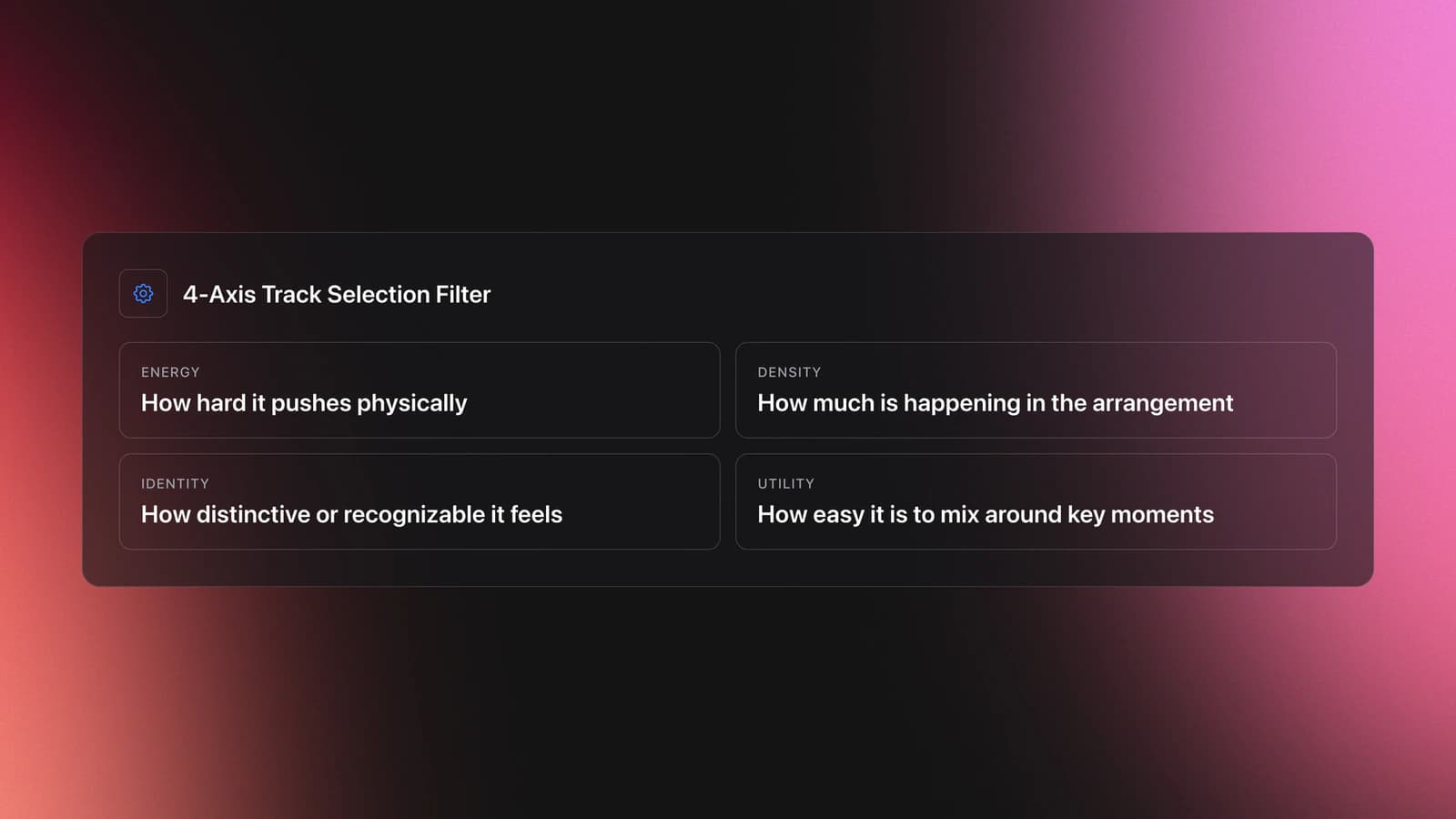
A useful filter is to score every candidate track on four axes:
- Energy: how hard it pushes physically.
- Density: how much is happening in the arrangement.
- Identity: how recognizable or distinctive it feels.
- Utility: how easy it is to mix around key moments.
Example one. Track A is a big-room weapon with a memorable vocal, wide synths, and a huge drop. Track B is equally strong but busier, with less room in the mids and no stable handoff section. If you play them back to back without planning, the second record can feel smaller even if it is objectively excellent.
Example two. Track C has a long, plain groove in the first half and a brilliant second-half lift. That track may be weak as a standalone play but excellent as a mid-set builder if you enter at the right point.
This is why full-track listening still matters. You cannot make smart selection decisions from drops alone. You need to know where tension rises, where arrangement thins, and where a track gives you room to move.
If you use harmonic planning, keep it practical. Mixed In Key's official Camelot guide describes the most common compatible moves as staying in the same key, moving one step up or down, or switching between relative major and minor positions such as 8A to 8B. That is useful because it reduces avoidable clashes without forcing the whole set into one color of emotion. See the official harmonic mixing guide for the base compatibility model.
Do not turn key data into a prison. Key compatibility supports track selection. It does not replace your ears.
A common failure mode here is chart addiction. DJs overfill playlists with current top sellers, then wonder why the set feels generic. The symptom is a sequence with no personal identity and too many tracks that solve the same problem.
Validation Check
Planning a DJ Set Means Deciding Track Length
Planning a dj set is not only about order. It is also about duration. How much of each track you play changes the energy path more than most DJs realize.
The transcript makes the tradeoff simple. Mix too fast all night and the set feels frantic. Play full tracks all night and the set can go flat unless every record is carrying unusual emotional weight.
The right answer is usually variation. Let strong tracks breathe. Cut weak sections. Enter where the useful information starts. Leave before the track begins repeating what the room already understood.
That is the second core model in this article. I call it section value. Section value asks whether this part of the track earns its place in the live context.
A section has high value when it does one of four things:
- Introduces a new groove or motif.
- Builds expectation toward a change.
- Provides a clean platform for a transition.
- Delivers a payoff the room still wants.
A section has low value when it repeats information, drains momentum, or forces you to wait too long for a usable handoff.
Example one. You have a seven-minute track with a compelling three-minute middle and a thin final breakdown. In dj set preparation, you might set a cue point 16 or 32 bars before the useful middle, then another cue before the breakdown fade. In performance, that gives you a cleaner entry and exit.
Example two. You have a track that absolutely works as a full play because the groove deepens over time and the floor is locked in. Here, shortening it would damage the atmosphere. Section value stays high for longer, so you let the record run.
This is where cue prep becomes practical instead of decorative. According to AlphaTheta support, rekordbox performance mode supports up to 16 hot cues per track, while export mode still handles 8 hot cues A through H for external devices. That matters because your prep strategy should match how you actually perform, not just what the software allows on screen. See the AlphaTheta hot cue support note for the current limitation.
In other words, if you rely on exported media for club gear, do not build a prep system that depends on cue slots you will not actually have at the venue.
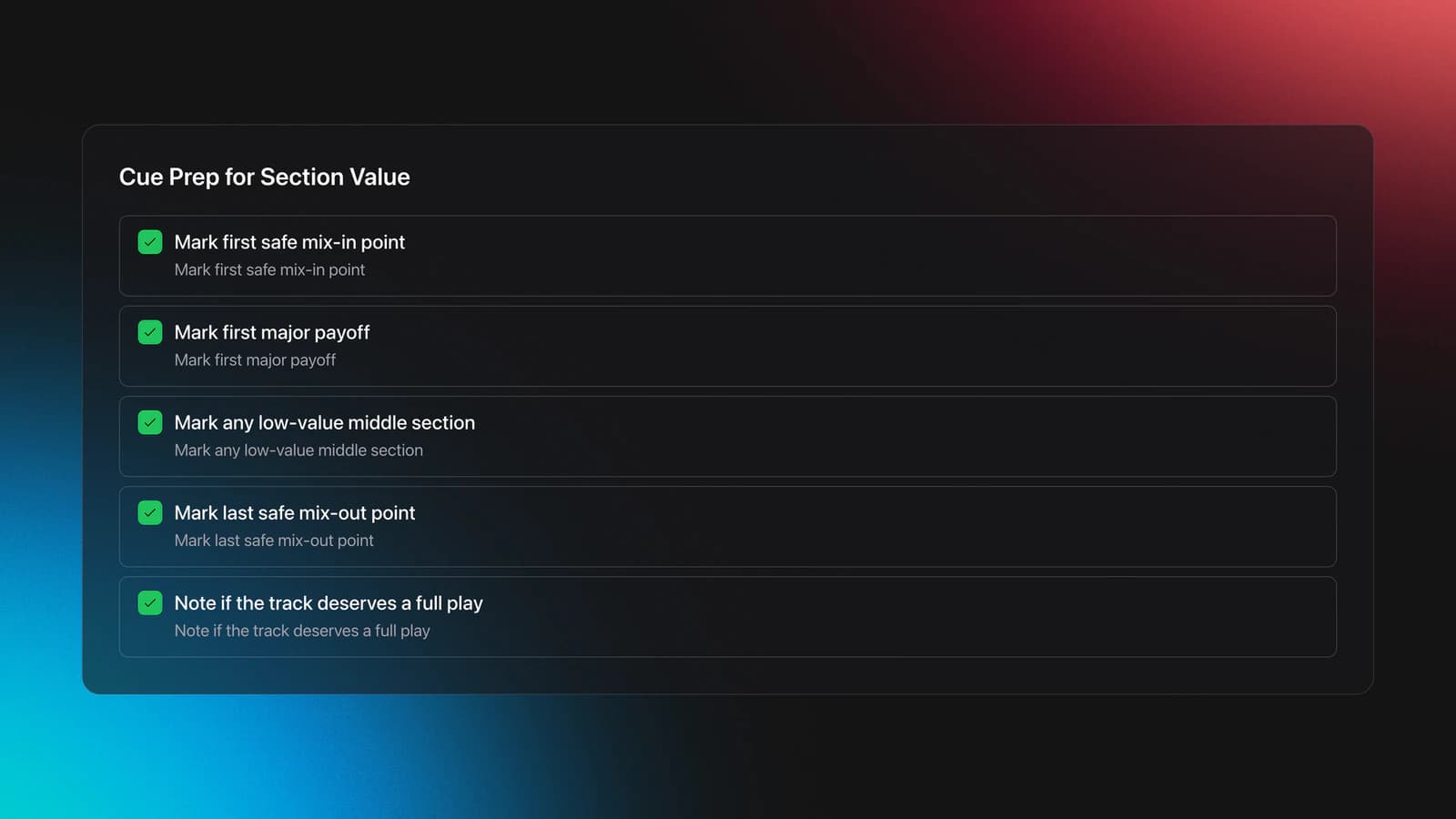
A useful prep pass looks like this:
- Mark first safe mix-in point.
- Mark first major payoff.
- Mark any boring or low-value middle section.
- Mark last safe mix-out point.
- Add a note if the track deserves a full play.
DJs who organize deeply often connect this prep to retrieval. Instead of one giant preparation crate, they separate tracks by energy, function, or mood so they can find a replacement quickly when the room shifts. That can be done manually, or in Vibes by building custom hierarchical categories and using progress tracking to finish sorting the library before gig day. Either way, the win is the same. You stop guessing under pressure.
After seven years of changing practice rhythms, one lesson tends to hold up: response time improves when the library stops feeling scattered. The room changes fast. Your preparation has to let you change with it.
A common failure mode is cue point vanity. DJs set many cue points but never assign a reason to any of them. The symptom is hesitation at the decks. You have markers everywhere and no decision confidence.
Validation Check
Transition Control Keeps DJ Set Preparation Coherent
Strong dj set preparation still fails if transitions are crowded. This matters even more in busy genres, where layering two full arrangements can quickly sound blurred.
The transcript highlights two practical transition methods. One is controlled EQ blending, where the incoming track stays low until the handoff. The other is a simpler bass swap and volume-fader approach, where the transition point is tighter and more explicit.
Description before prescription: dense tracks create overlap problems because their important information lives in similar frequency ranges. When both records fight for mids, leads, or percussive detail, the transition sounds messy even if the beatmatch is perfect.
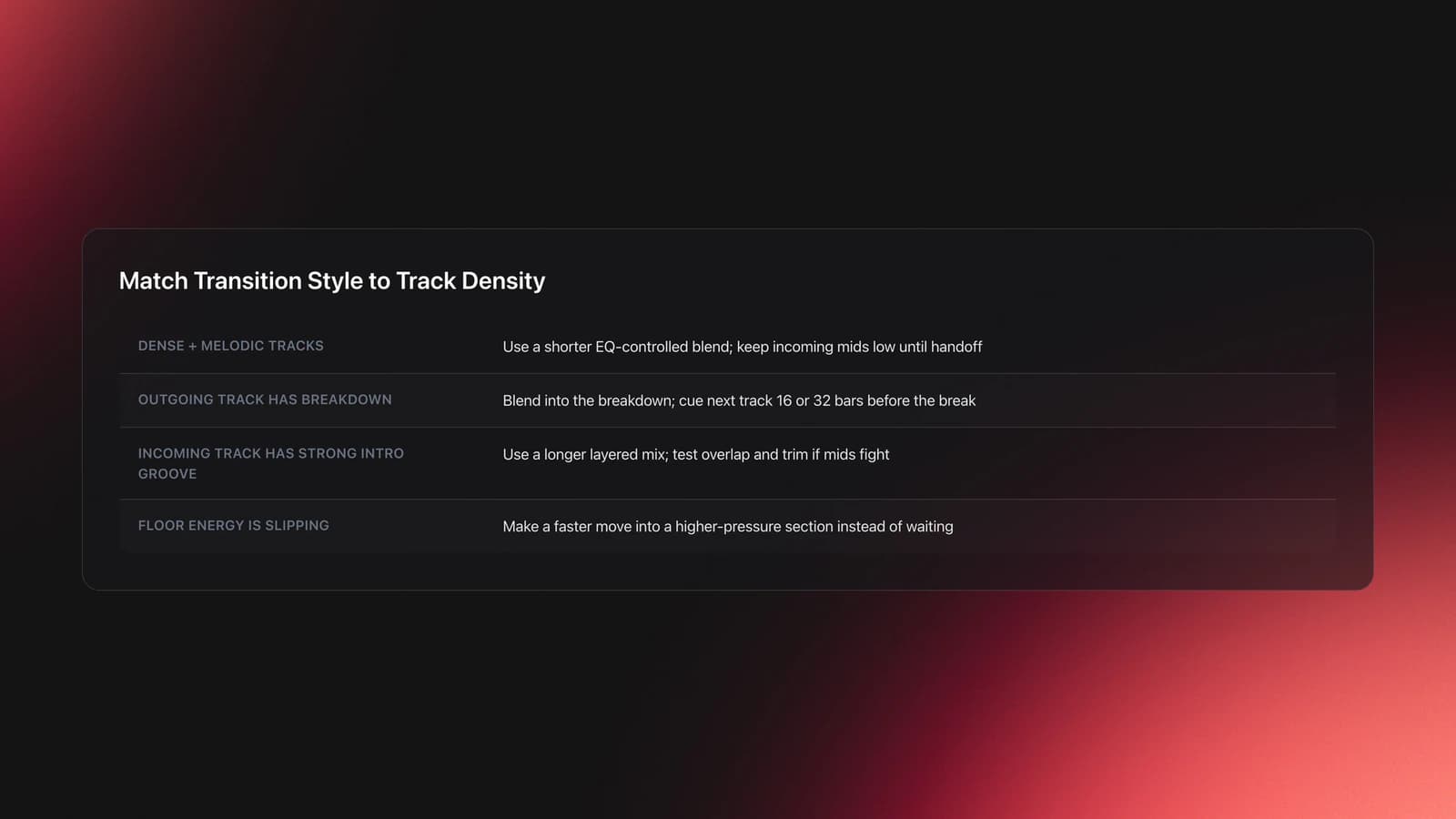
What that means for you is simple. Your transition style should match arrangement density.
| Situation | Best Transition Approach | Why | Next Action |
|---|---|---|---|
| Both tracks are dense and melodic | Shorter blend with controlled EQ | Too much overlap creates clutter | Keep incoming mids low until the handoff point |
| Outgoing track has a clear breakdown | Blend into the breakdown | Less information leaves space for the new record | Cue the next track 16 or 32 bars before the break |
| Incoming track has a strong intro groove | Longer layered mix | The intro supports gradual energy transfer | Test the overlap in practice and trim if the mids fight |
| Floor energy is slipping | Faster transition to a higher-pressure section | Long waits can feel indecisive | Jump from a low-value section into a stronger payoff |
Decision framework for choosing transition style during a set
Example one. Track A ends with a sparse breakdown. Track B opens with a rolling percussion bed. This is a textbook longer blend. The outgoing track creates space, and the incoming track can establish motion without fighting a lead line.
Example two. Track A and Track B both have big synth hooks and active percussion. Here, trying to show off with a long overlap is usually the wrong move. A shorter handoff with bass control will sound more intentional.
An advanced option is teasing. The transcript mentions testing patterns, vocals, or builds before committing fully to a new song. That works because teasing lowers commitment while raising audience information. You learn what the floor reacts to before you spend the whole transition.
If you work with key-aware prep, the harmonic side can support cleaner transitions too. Mixed In Key's official material describes adjacent Camelot moves and same-number major-minor switches as standard compatibility choices, which can reduce obvious clashes when layering melodies or vocals. The Camelot Wheel reference is useful here.
One practical lesson from underground and festival sets is that atmosphere often matters more than venue size. On a strong daytime system with the right crowd, a patient transition can feel bigger than a flashy one because the room has time to absorb the shift.
The main failure mode is transition ego. DJs keep layering because they can, not because the set needs it. The symptom is a room that stops moving with confidence and starts listening for the mix to end.
Validation Check
How Do You Prepare a DJ Set Without Overplanning?
You prepare a DJ set without overplanning by fixing the high-value decisions in advance and leaving the low-value decisions open. Prepare roles, cue points, likely transitions, and backup options. Do not script every minute unless the format truly requires it.
This is where many DJs get stuck. They hear “prepare” and assume it means “lock the set.” It does not. Good preparation creates options.
Think in layers:
- Fixed layer: must-play tracks, key transitions, opening direction.
- Flexible layer: alternate builders, resets, and pressure tracks.
- Emergency layer: safe records that can recover flow quickly.
In practice, overplanning shows up as fragility. One mistimed transition, one crowd shift, or one technical delay and the whole plan collapses.
Underplanning shows up differently. You spend too long browsing, repeat the same energy level, or miss the obvious next move because nothing is labeled well enough to find quickly.
You will know you have not overplanned when you can replace any one track in your first 10 with two alternatives and the energy path still makes sense.
Common DJ Set Preparation Mistakes
| Mistake | Why It Happens | How to Avoid |
|---|---|---|
| Choosing tracks only by personal taste | The DJ never defines the role of the set | Set an energy path and assign each track a job |
| Playing every track too long | The DJ confuses completeness with atmosphere | Mark low-value sections and plan earlier exits |
| Mixing too quickly all night | Fast transitions feel impressive in solo practice | Vary duration and let proven tracks breathe |
| Setting cue points without a purpose | Prep becomes visual clutter instead of decision support | Use entry, payoff, and exit cues only when they guide action |
| Overlapping dense tracks for too long | The DJ ignores arrangement density | Shorten the blend and control mids and bass more aggressively |
Observable mistakes that weaken set flow
What Good DJ Set Preparation Looks Like In Practice
A good prep process is boring in the best way. You listen closely. You label clearly. You remove weak options. You leave yourself room to react.
By the day of the set, you should know three things. First, what direction you want to open with. Second, which tracks can change the room quickly. Third, which records can rescue momentum if the plan misses.
That is the difference between building a dj set and hoping one appears while you scroll.
If you want the shortest possible checklist, use this:
- Define the job of the set.
- Choose tracks by role, not only by quality.
- Mark high-value entry, payoff, and exit points.
- Practice at least two routes through the first 20 minutes.
- Prepare fallback tracks for lift and reset.
Do that consistently and dj set preparation stops feeling abstract. It becomes a repeatable performance skill.
Conclusion
The point of dj set preparation is not control for its own sake. It is to make better decisions faster when the room is live.
If you remember only three things, remember these:
- Choose tracks by role in the set, not just by how good they are alone.
- Play only the sections that still add value to the room.
- Match your transition style to the density of the records.
That gives you both a mental model and a procedure. Start with intent, build an energy path, prepare key sections, and leave enough flexibility to react. From there, the next useful step is to test your prep in short recorded runs and fix the exact places where energy drops.
The visual way to organize your DJ library
Tag tracks by vibe. See everything at once. Export to rekordbox, Serato, Traktor or Engine DJ.
14-day free trial. Full access, no strings attached.
or see how it works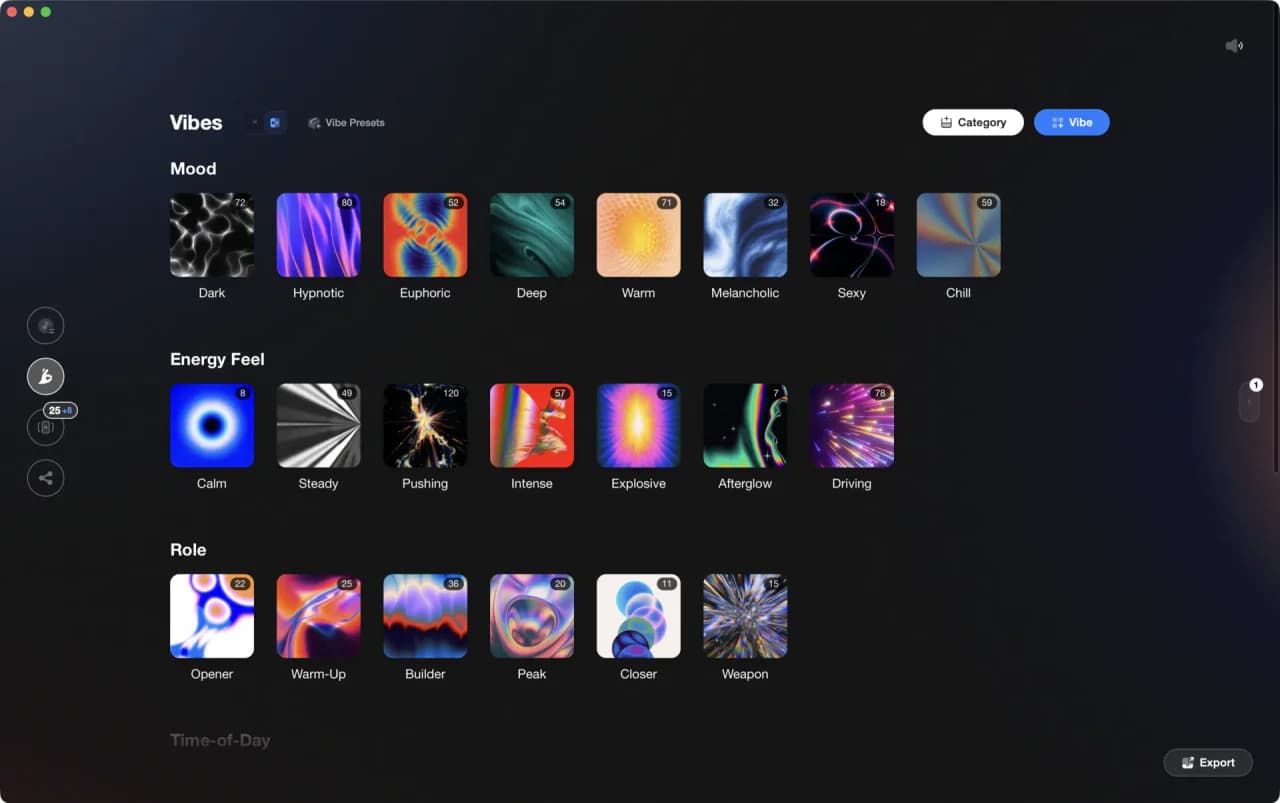
Techniques Covered
Equipment & Software
Frequently Asked Questions

Hey, it's Ben Modigell 👋
I DJ and produce as so I so: downtempo, minimal, dub house, tech house, and techno (releases on Spotify and SoundCloud, links above). Everything I write here comes from my own gigs, studio sessions, and library cleanups: the rules I follow, the failure modes I have actually hit, and the workflow I use when nobody is watching. If a technique did not earn its place in my own sets, it does not make it into a tutorial.