Energy Control
Energy Control is the DJ skill of raising, holding, or lowering dancefloor intensity through track selection, timing, transitions, and set structure.
Energy Control Tutorials
Energy Control is the skill of deciding when to lift the room, when to hold tension, and when to back off so the next peak lands harder. For DJs, Energy Control matters because a technically clean mix can still feel flat if the set has no contour. When you learn Energy Control, you stop thinking only about transitions and start thinking about momentum, timing, and emotional pacing.
In practice, Energy Control is not one trick. It is a combination of track selection, phrase timing, contrast, restraint, and crowd awareness. A DJ with strong Energy Control can make a warm-up feel purposeful, a peak-time stretch feel earned, and a reset feel intentional instead of accidental.
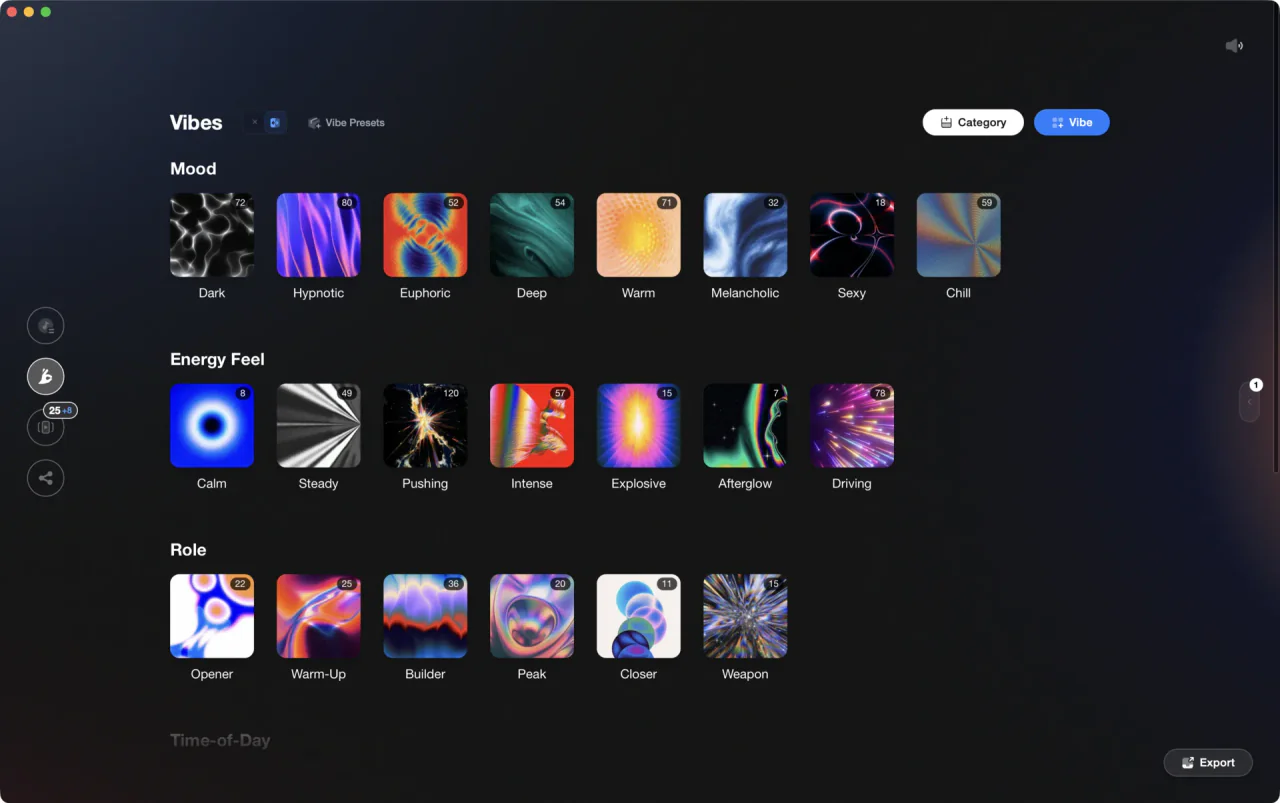
The visual way to organize your DJ library. Tag by vibe, export to any DJ app.
What Is Energy Control?
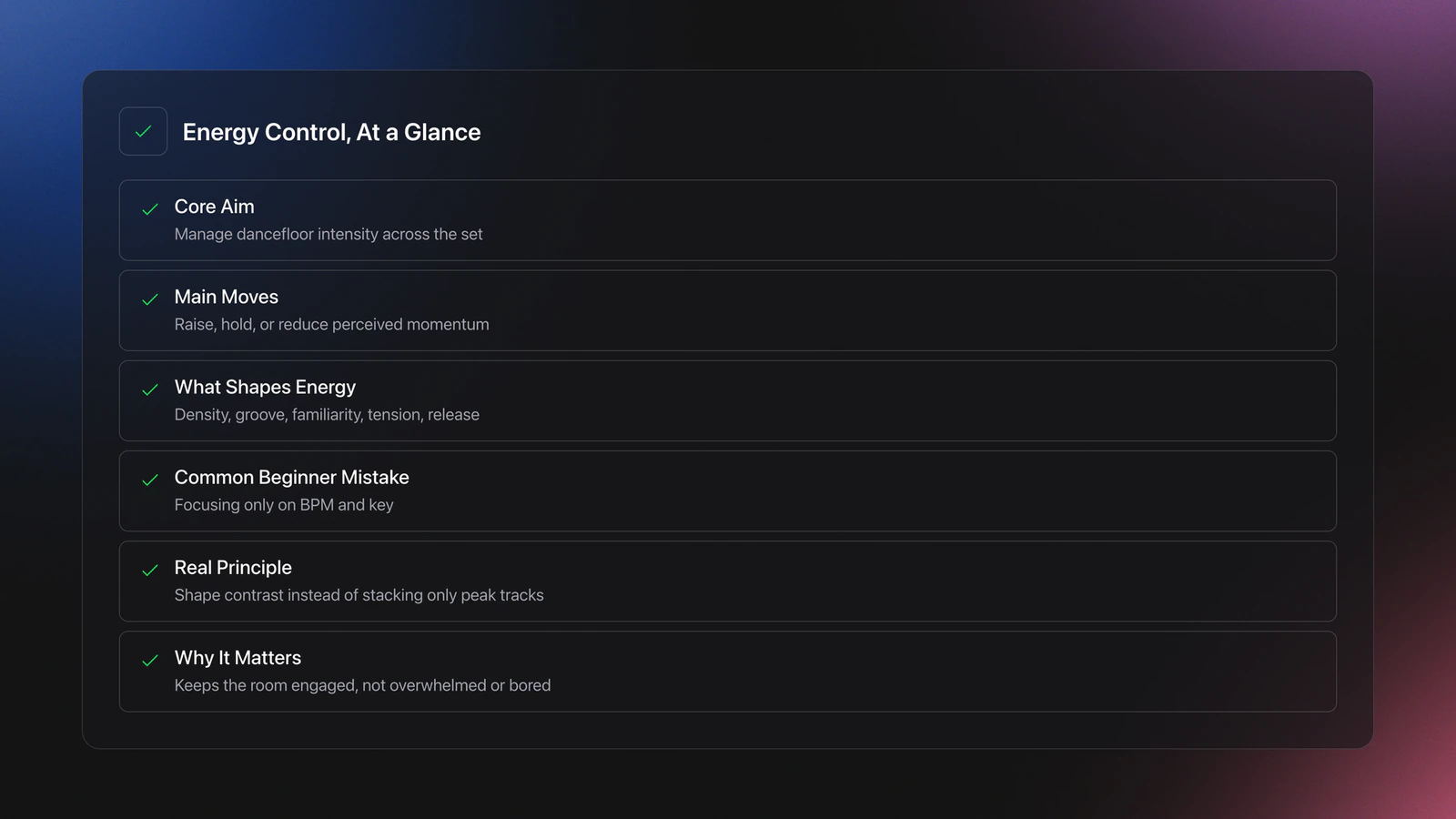
Energy Control is the DJ technique of managing dancefloor intensity across a set by choosing the right track, at the right moment, with the right transition. It includes raising, maintaining, or reducing perceived momentum so the room stays engaged instead of overwhelmed or bored.
This definition matches how DJ educators talk about set flow, next-track choice, and playlist energy. DJ TechTools frames energy movement as a core part of controlling the dancefloor, while Digital DJ Tips ties strong track choice to preparation, crowd role, and knowing what the room needs next. Mixed In Key approaches the same problem through relative energy levels and gradual movement between tracks.
That also explains why Energy Control feels hard at first. Beginners often focus on BPM and key, but the room reacts to something broader. Density, groove, vocal familiarity, tension, release, and how long you stay in one zone all affect perceived energy.
In other words, Energy Control is less about playing only big tracks and more about shaping contrast. If every song peaks, nothing peaks.
Why Learn Energy Control
Energy Control helps you sound more intentional because it turns a list of good tracks into a coherent set. It also improves confidence. When you understand energy flow, you are less likely to panic, force the next tune, or stay too long in one mood.
- It helps you pace a room instead of reacting late.
- It makes warm-up, support, and peak-time roles clearer.
- It improves next-track decisions under pressure.
- It creates stronger peaks because resets become purposeful.
- It makes prepared crates and freestyle choices work together.
Most instructors describe this as a selection skill first, not a flashy mixing skill. The result is simple. Better Energy Control usually leads to fewer wasted big tunes, smoother progression, and a dancefloor that trusts where you are taking it.
Energy Control Fundamentals
The basic rule of Energy Control is to change one thing on purpose. Raise pressure, hold pressure, or reduce pressure. Do not drift.
Start by assessing your role in the night. A warm-up set needs headroom. A peak-time slot needs sharper decisions. Digital DJ Tips stresses that role awareness changes what the right next song is, even before you read the room.
Then assess the current track. Ask four fast questions. How hard is it hitting? How familiar is it? How dense is the arrangement? Where is the room leaning right now?
From there, make a controlled move. If the crowd is engaged but not exploding, hold the level with a lateral transition. If they are ready for more, step up in intensity with a track that adds pressure without changing too many variables at once. Mixed In Key recommends gradual movement in relative energy rather than repeated big jumps, because large skips can feel abrupt.
If the room feels tired, a lower-energy track can still work if it preserves groove, emotional tension, or familiarity. Beatportal interviews with touring DJs often point to this idea: lowering energy intentionally can make a set more meaningful, not weaker.
Your transitions matter here too. A long blend usually smooths energy. A quicker handoff can sharpen it. A stripped breakdown can reset attention. A strong drop at the right phrase can create a lift. To execute those choices cleanly, it helps to build reliable beat matching control and learn phrase matching for cleaner transitions.
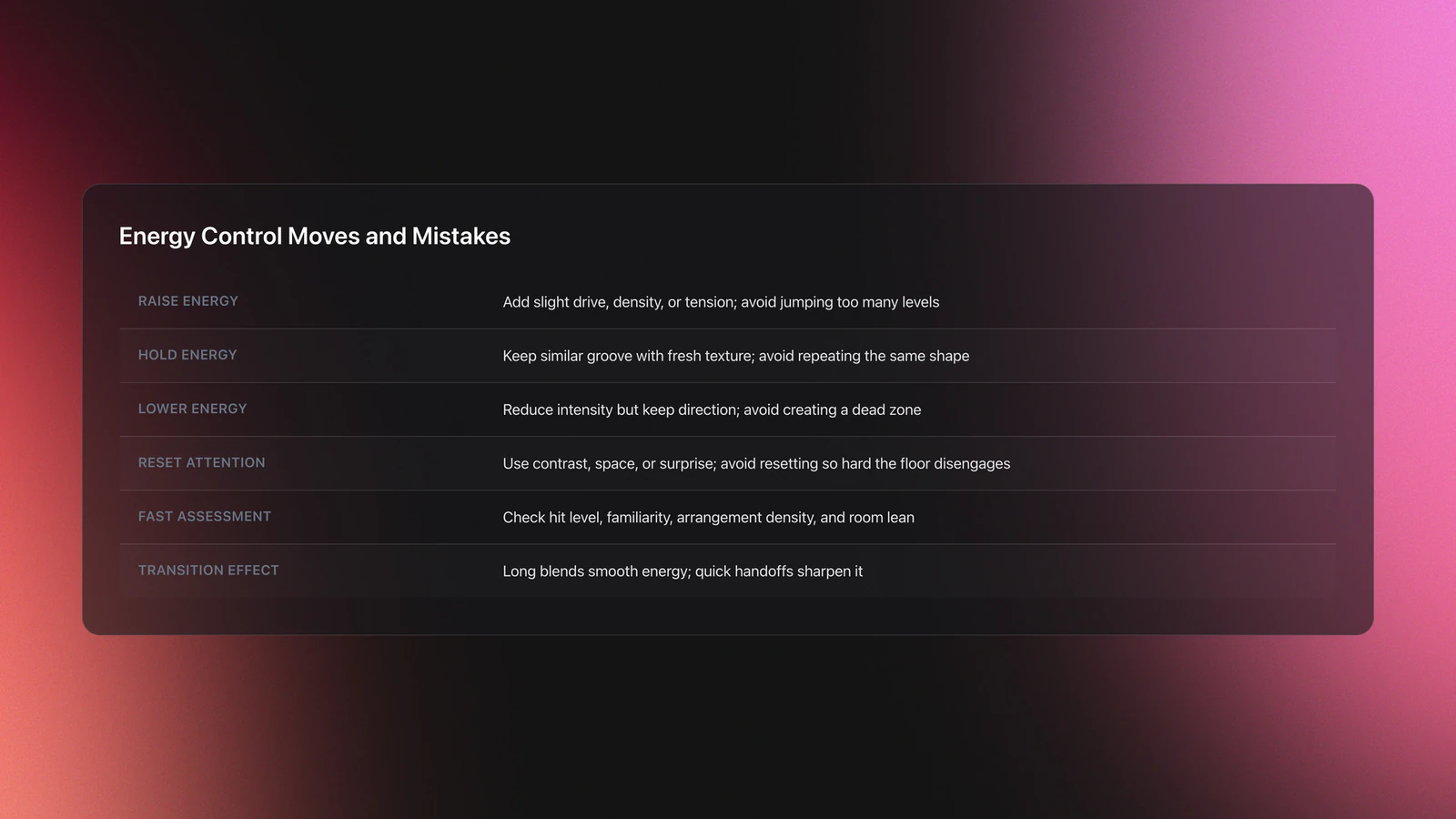
| Goal | What To Change | What To Avoid |
|---|---|---|
| Raise energy | Slightly higher drive, density, or tension | Jumping too many levels at once |
| Hold energy | Similar groove with fresh texture | Repeating the same track shape three times |
| Lower energy | Reduce intensity but keep direction | Dropping into a dead zone with no pulse |
| Reset attention | Use contrast, space, or surprise | Resetting so hard the floor disengages |
How To Practice Energy Control
To practice Energy Control, build short sets with a clear objective, record them, and listen for where momentum rises, stalls, or collapses. The skill improves fastest when you isolate one energy task at a time instead of trying to master full-length set storytelling immediately.
Use a simple five-step routine.
Through daily 15-minute practice sessions over several years, I found that short arc-based drills improve Energy Control faster than marathon free-mixing. A focused 20-minute recording gives you enough material to spot pacing mistakes without losing concentration.
A strong beginner drill is the one-step ladder. Choose tracks that feel adjacent in intensity and move up one notch at a time for five transitions, then back down one notch at a time for five more. This teaches restraint.
A second drill is the false peak test. Place an exciting track too early on purpose, record the mix, then replace it with a lower but driving track and compare the result. You will hear how early peaks can flatten the rest of a set.
A third drill is the recovery drill. Start with a track that feels slightly too intense, then recover the flow within two songs without killing the floor. This mirrors real gigs, where your last choice is not always perfect.
If you keep local files organized for practice, this is one place where Vibes can help without changing the technique itself. Building crates by function, such as warm-up tools, tension builders, resets, and closers, makes repeatable Energy Control drills much easier to run.
For track selection, educational resources like the DJ TechTools guide to organizing playlists by energy, the Digital DJ Tips guide to choosing the next track, and the Mixed In Key tutorial on sorting playlists by energy level all support the same core method: know your music, narrow your options, and move with intent.
Track Selection for Energy Control
Good Energy Control starts before the gig because the fastest live decision is a prepared decision. Pre-reading the crowd, packing a focused crate, and understanding your role all improve your odds of choosing the right next record.
That does not mean rigid planning. It means reducing chaos. Digital DJ Tips recommends bringing roughly twice the music you expect to need in a focused playlist, so you have flexibility without drowning in options.
Tag tracks by function, not just genre. Some records are bridges. Some are pressure builders. Some are emotional resets. Some are obvious peaks. These labels become more useful than genre names once the room is moving.
Also listen for hidden energy traits. A track can have a modest BPM but strong lift because of vocal hooks, snare build tension, bright percussion, or a bigger drop. Another track can be faster on paper but flatter in practice.
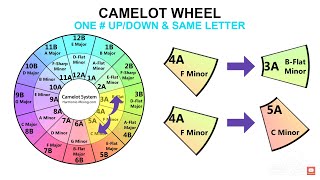
This is where key and energy tools can support, not replace, judgment. The Mixed In Key Energy Boost tutorial shows one way harmonic movement can create a burst of excitement, but even that works best in moderation. To deepen that side of the craft, use harmonic mixing to support energy shifts.
Common Mistakes in Energy Control
Most Energy Control mistakes come from impatience, not lack of taste. DJs often try to force a reaction before the room is ready, or they keep pushing after the room already gave them the answer.
| Mistake | Why It Happens | Fix |
|---|---|---|
| Peaking too early | Excitement overrides set role | Save obvious weapons until the room asks for them |
| Staying flat too long | Fear of making a bold move | Plan one clear lift every few transitions |
| Confusing loudness with energy | Booth sound feels intense | Watch body language, not just meter levels |
| Overjumping intensity | Track ratings replace listening | Move in smaller steps and compare recordings |
Another common problem is transition mismatch. The incoming track may be correct, but the handoff is wrong. A long blend can soften a track that needs impact, while an abrupt drop can feel cheap if the room needs continuity. This is a good reason to refine EQ mixing during handoffs.
Why do most beginners struggle here? Because they evaluate tracks in isolation. Energy Control only becomes clear when you hear one track after another, in context, with timing.
Practice Library Setup
A practice library for Energy Control should make contrast visible. Build folders or playlists for openers, steady builders, high-tension rollers, vocal lifts, resets, and closers. That structure helps you compare function instead of scrolling blindly through genre labels.
If you maintain local files, Vibes is useful here as a neutral organization layer because you can sort tracks by mood, function, and energy role, then export that structure into performance software later. The key benefit is not automation. It is making your practice decisions repeatable.
A simple starting structure is enough: warm-up, hold, lift, peak, reset. Once that feels natural, split those groups by genre or venue type. The goal is to practice Energy Control with enough order that your ears can focus on pacing.
How To Measure Progress
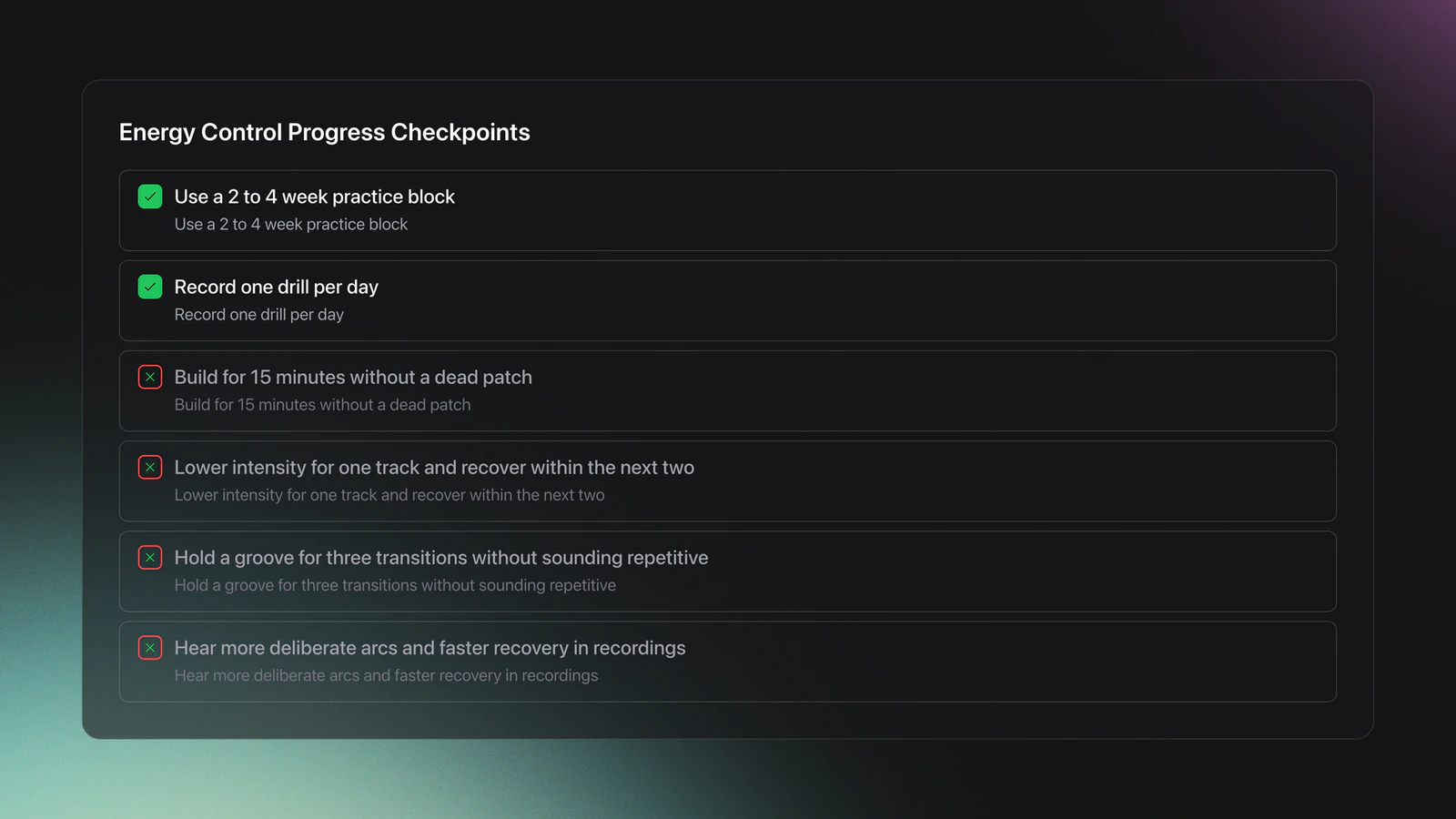
You are improving at Energy Control when your set arcs become deliberate, your recovery after a weak choice gets faster, and your recordings sound less random. Progress is audible.
Most practitioners improve fastest in short review cycles. Through 2 to 4 week practice blocks, I have found that one recorded drill per day reveals patterns quickly. You start noticing where you rush the lift, where you repeat the same shape, and where you should have held tension longer.
Use measurable checkpoints. Can you build for 15 minutes without a dead patch? Can you lower intensity for one track and recover within the next two? Can you hold a groove for three transitions without sounding repetitive?
Once you can do that, begin adding sharper tools. For example, explore quick mixing for faster momentum changes when the room needs a more immediate shift.
Energy Control in Real Sets
In real gigs, Energy Control depends on context. A warm-up crowd often needs groove and curiosity, not maximum impact. A peak-time crowd may need firmer statements, faster recovery, and less experimentation with long resets.
This means the same track can function differently depending on timing. A rolling track may feel like a lift at 10:30 PM and a reset at 1:30 AM. Do not assign permanent roles too rigidly.
The best live test is watching commitment. Are people leaning in, staying put, moving with purpose, and reacting to transitions? Or are they drifting, talking, and waiting for something clearer? Booth volume can mislead you. The floor usually tells the truth.
Final Takeaways
Energy Control is what turns a sequence of tracks into a convincing DJ set. It helps you choose better moments, create stronger peaks, and avoid the two biggest pacing errors: pushing too soon or flattening the room through indecision.
Keep these points in mind.
- Change energy intentionally. Do not drift between tracks.
- Tag tracks by function, not only by genre or BPM.
- Practice short arcs, record them, and review them often.
Start with a 20-minute set built from one genre lane and one clear arc. Once that feels stable, add more contrast, crowd-reading pressure, and live recovery drills. Energy Control keeps getting better as your music knowledge deepens.
The visual way to organize your DJ library
Tag tracks by vibe. See everything at once. Export to any DJ software.
A visual system for organizing your DJ library.
More Tutorials

Frequently Asked Questions

Hey, it's Ben Modigell 👋
I DJ and produce as so I so — downtempo, minimal, dub house, tech house, and techno (releases on Spotify and SoundCloud, links above). Everything I write here comes from my own gigs, studio sessions, and library cleanups: the rules I follow, the failure modes I've actually hit, and the workflow I use when nobody's watching. If a technique didn't earn its place in my own sets, it doesn't make it into a tutorial.