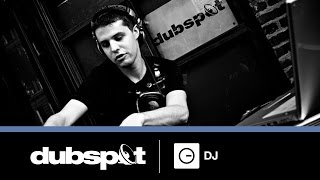
Watch Crossfader’s tutorial above (131K views on YouTube).
A house DJ is a DJ who selects, sequences, and mixes house music, holding a room inside one continuous groove using steady rhythm, phrase-aware transitions, and long-form energy control. The genre shapes the job: because house runs on a repeating 4/4 pulse, the best house DJs do not just match BPM. They align beats, bars, and phrases so each transition feels intentional instead of abrupt.
This guide is for listeners, promoters, and new DJs trying to understand what makes house DJs work. Many lists reduce house DJs to popularity, but that misses the real skill. After reading, you’ll be able to spot what top house DJs actually do in a set, how they control energy, and why phrasing matters so much.
If you are still learning fundamentals, it helps to pair this with DJ phrasing basics, beatmatching by ear, how to organize DJ music, and house music structure.
House DJs: Definition and Scope
House DJs work inside a genre built on repeatable rhythmic structure. Most house tracks use a 4/4 time signature, which means four beats per bar. That stable grid makes long blends possible, but it also exposes bad timing fast.
A competent house DJ does three jobs at once. They choose records that fit the room. They line tracks up in time. They move between phrases so new elements arrive when the outgoing track is naturally resolving.
This is why the job is harder than "press play on good tracks." A set can contain great songs and still feel clumsy if the phrasing is wrong. When a mix lands off-phrase, vocals collide, breakdowns stack badly, and the room loses momentum.
Official Serato library documentation also shows how crate-based organization supports faster track access during performance. That matters in house because long transitions give you time to think, but only if you can actually find the next record quickly.
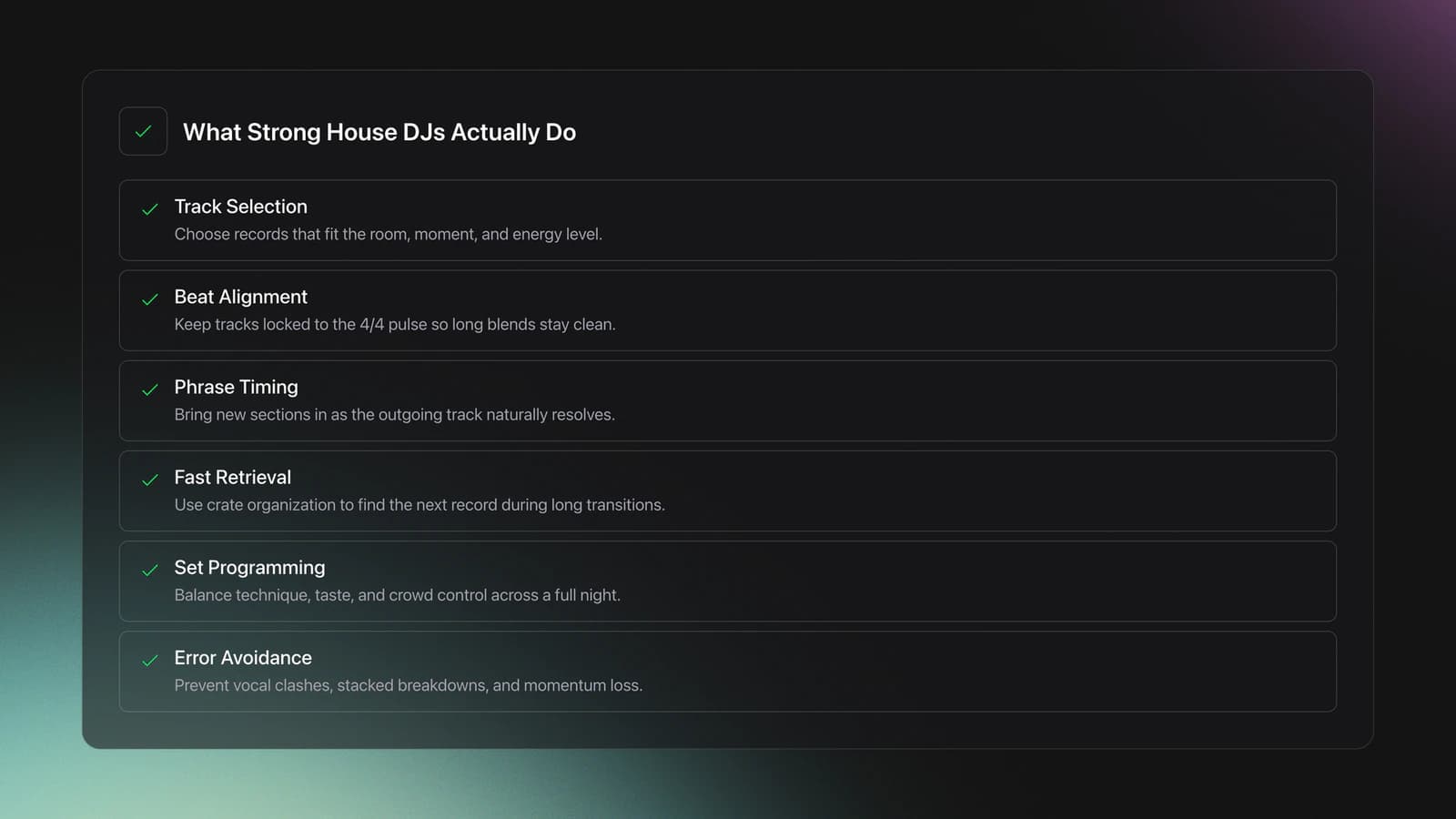
When people search for the best house DJ, top house DJs, or best house music DJs, they usually mean one of three things. Technical smoothness. Taste in track selection. Or crowd control over a full night.
Those are related, but they are not the same. A DJ can be technically clean and still program a flat set. Another can have strong taste but weak transitions. The strongest house DJs combine both.
House reference tracks
A starting crate of house, pulled from our DJ track index with live BPM and Camelot keys (these run roughly 113-135 BPM). Beatmatch to each track's tempo, use the long intros and outros to blend, and swap on the phrase. Click any row to open its full sonic profile.








What Do House DJs Actually Do?
House DJs listen for structure before they mix. They count beats, group them into bars, and track phrase changes. In most house music, something meaningful shifts every 8 or 16 bars.
That shift might be a hi-hat entering, a bassline dropping out, a clap pattern changing, or a breakdown opening. The point is not the exact sound. The point is that the track announces a new section.
Good house DJs use those section changes as alignment points. They launch the incoming track where the outgoing track is already turning over. That makes the blend feel natural because both tracks are speaking the same structural language.
Crossfader’s tutorial series on Serato DJ Lite explains this clearly: most beginner-friendly mixing starts with beats, bars, and phrases, then uses phrase changes to time the transition. Their overview of the free tutorial pack specifically lists essential music theory and performance basics as core early skills in the learning path in Crossfader’s Serato Lite tutorial page.
In practice, house DJs usually handle five repeatable tasks:
- Select a track that fits the current energy level.
- Match tempo or get close enough for a clean nudge.
- Align the kick drums and main transients.
- Start the next record on the right phrase.
- Shape the handoff so one track exits as the other opens.
That sounds simple on paper. It is not simple in a live room.
The hardest part is usually not beatmatching. It is energy judgment. House DJs need to know whether the room needs lift, release, tension, space, or familiarity.
This is where deep library organization becomes practical, not administrative. If you are managing a large local collection for gigs, a system that sorts tracks by mood, function, and energy can reduce bad choices under pressure. Some DJs do this with folders and notes. Others use tools like Vibes to build custom hierarchical categories, track sorting progress, and prep performance-ready collections before export to DJ software.
Either way, the method matters more than the app. House DJs need quick access to records that solve a specific moment in the room.
Phrase Control in House DJs
Why does phrase control separate average house DJs from top house DJs? Because house music is repetitive enough that errors stay audible. A bad phrase match does not hide behind complexity. It hangs there.
Use this mental model: beat = pulse, bar = count unit, phrase = section unit. House DJs who understand all three can predict where a track is going before the obvious breakdown arrives.
Start with the beat. One beat is the pulse you tap to. Four beats usually make one bar in house.
From there, stack bars into phrases. Eight-bar and 16-bar phrases are the most useful counting units for mixing because many arrangement changes land there.
This means the DJ is not waiting for random moments. They are counting toward likely transition windows.
Example one is a clean outro-to-intro mix. Track A has 16 bars left in its main groove before the outro strips back. Track B has a 16-bar intro with drums and light percussion. Start Track B at the phrase boundary and both records evolve together. The outgoing track simplifies as the incoming track builds. The output feels smooth because structure and energy agree.
Example two is a smaller turnaround. Track A reaches an 8-bar breakdown before the drop. Track B has a tight 8-bar drum intro. If the DJ launches Track B at the start of that breakdown, the sparse section creates room for the new groove. The blend is shorter, but it still feels intentional.
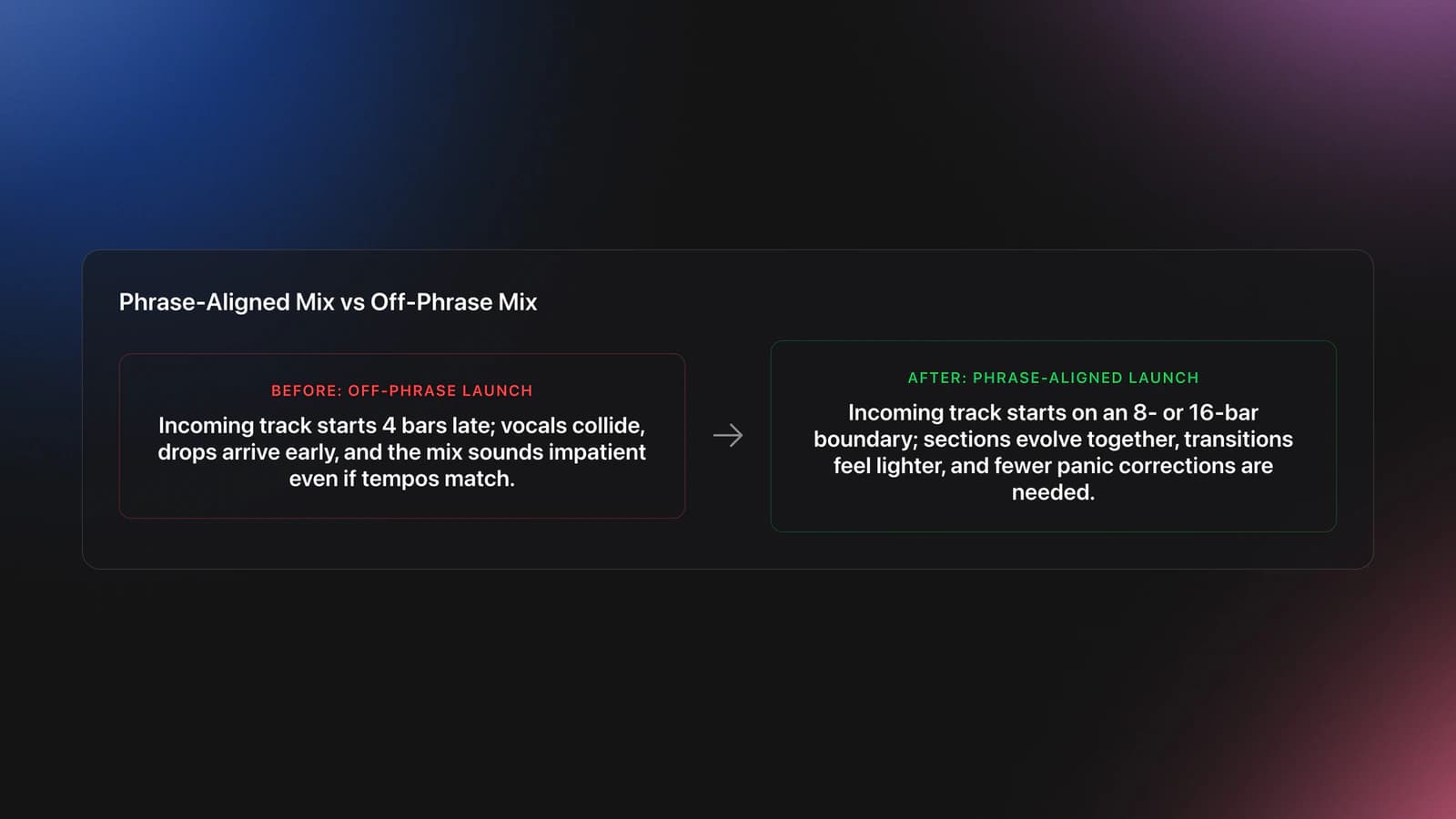
Failure mode: the incoming track is started four bars late. Symptom: a vocal hook enters while the outgoing track is still holding a build, or the drop lands while the old record has not resolved. The mix may still be in time, but it sounds impatient.
Another failure mode is over-trusting sync. Serato’s product and support materials make clear that beat alignment tools exist, but they do not replace listening. Even when tempos are matched, small timing corrections and phrase decisions still matter in performance, as shown across Serato DJ’s software overview and the Beat Matching Display support article.
You’ll know your phrase control is working when three signals show up at once. The transition feels less busy, the new section arrives where your ear expects it, and you do not need panic corrections after the handoff.
This is also where self-taught DJs often improve fastest. Many start by simply playing tracks with friends and listening for where things change. That intuitive exploration matters. Formal theory helps, but counting bars while listening to real records is what turns the idea into timing.
Among house DJs, this skill scales well. It helps in beginner bedroom sets, but it matters even more in longer club sets where each transition shapes the next ten minutes.
Top House DJs Build Energy, Not Just Mixes
A list of top house music DJs is usually really a list of DJs with strong energy control. House rewards patience. The room does not need a dramatic event every 30 seconds. It needs a believable arc.
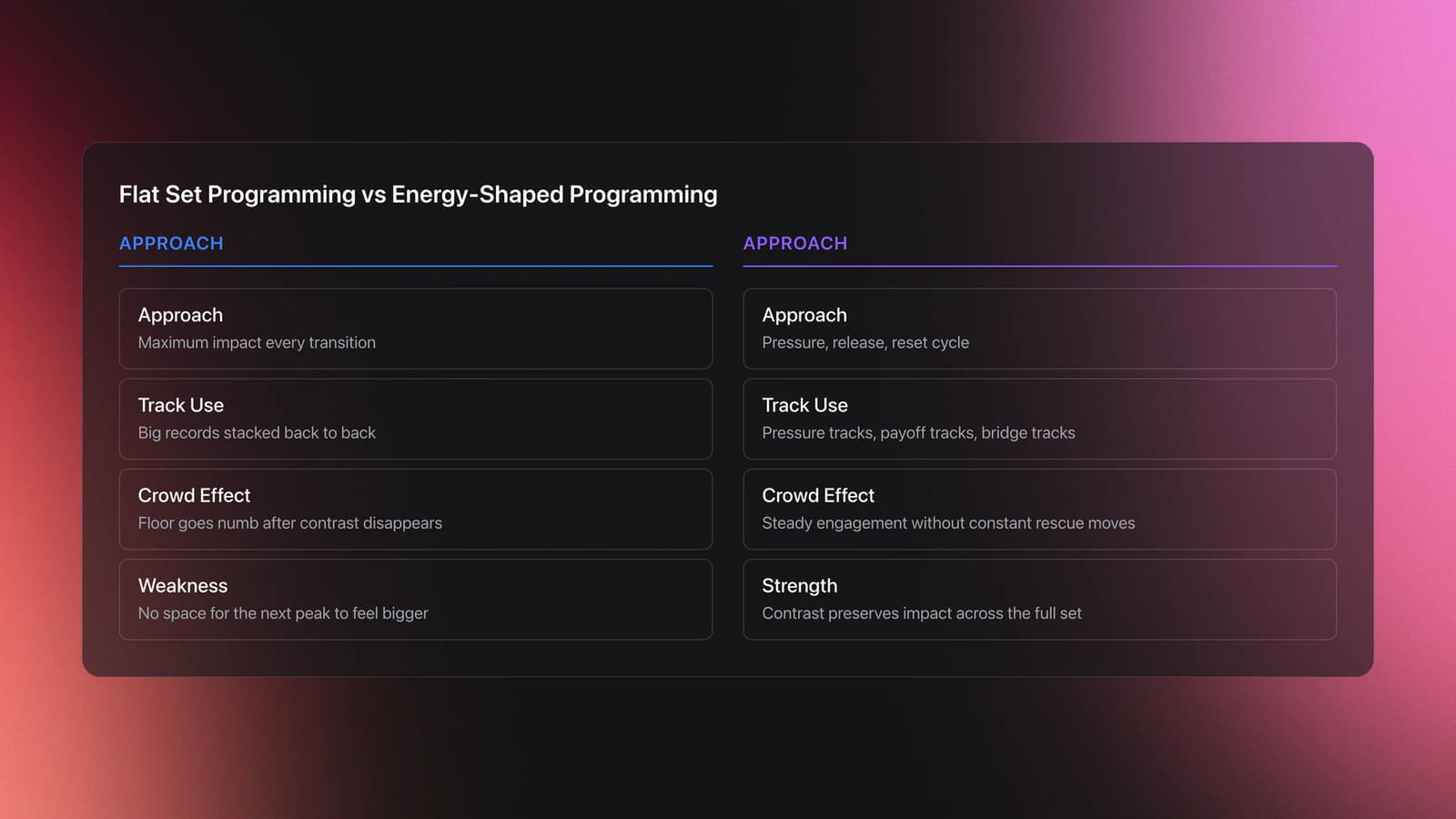
I use a simple framework here: pressure, release, reset. Pressure tracks add density or tension. Release tracks pay that off. Reset tracks clear space so the next climb means something.
House DJs who ignore that cycle often sound flat. Every record may be good, but the set feels one-speed. The crowd stops anticipating because nothing changes in a meaningful way.
Example one is early-night programming. A smart house DJ might begin with groove-led tracks that leave harmonic and rhythmic space. After 20 to 30 minutes, they introduce fuller percussion, stronger bass movement, and more obvious hooks. The process is gradual. The crowd feels pulled forward instead of pushed.
Example two is peak-time restraint. Instead of stacking the biggest records back to back, top house DJs often place one lower-density bridge track after a major payoff. That gives the next anthem room to feel large again.
Failure mode: every transition aims for maximum impact. Symptom: after 25 minutes, the floor feels numb. Energy has nowhere left to rise because the DJ already spent all the contrast.
A production background often sharpens this judgment. DJs who also make records tend to hear arrangement design more clearly. They notice where tension is built through filter movement, percussion layering, and breakdown length. That makes track selection less about genre labels and more about function inside the set.
This is also why the best house DJ for one room may not be the best for another. A sunset terrace, a warm-up slot, and a 2 a.m. basement all reward different pacing.
If you want to understand famous house DJs beyond brand recognition, listen to how they solve these energy problems. Do they increase density too fast? Do they leave enough negative space? Do they know when to hold back?
When a collection gets large, energy planning gets harder because memory becomes unreliable. A structured prep workflow helps. Some DJs keep notes in crates. Others prepare categories for mood, function, and energy, then sketch likely set paths on a visual planning tool like Vibes before exporting that structure to their performance software. The common principle is simple: separate track taste from track utility before the gig starts.
You’ll know energy control is working when the room stays engaged without constant rescue tactics. People keep moving, transitions feel earned, and bigger moments still feel big.
Who Are the Most Popular House DJs?
The most popular house DJs are usually the names with the widest reach across festivals, clubs, streaming platforms, and social clips. Popularity measures visibility. It does not always measure technical precision or long-set depth.
That distinction matters if you are trying to learn from them. A highly visible festival edit set can teach crowd communication and timing. A lower-profile club specialist may teach better pacing, restraint, and groove management.
So when people ask who the most popular house DJs are, the better follow-up is this: popular by what measure? Ticket sales, streaming numbers, influence on producers, consistency in clubs, or historical importance?
In other words, popularity is one filter. It is not the whole framework.
Female House DJs and Why Category Lists Fall Short
Searches for female house djs often mix two different goals. Some users want discovery. Others want representation in a scene where visibility has been uneven.
That is a valid reason to search, but the evaluation standard should stay the same. Strong house DJs are still judged on selection, timing, programming, and room reading.
The useful move is to expand the listening pool without lowering the analytical standard. When you compare sets, ask the same questions you would ask of anyone else. How well do they manage phrases? How well do they control energy? How distinct is their taste?
This avoids turning the category into a token list. It keeps the focus on craft.
Best House DJ: How to Evaluate One
The best house dj is not always the loudest, newest, or most followed. A better evaluation model uses four criteria: structure, taste, energy control, and adaptability.
| Scenario | Best Choice | Why | Next Action |
|---|---|---|---|
| You want to study transitions | Listen to long club sets | They expose phrase timing and patience | Pick one 60-minute set and map every major change |
| You want crowd-reading lessons | Watch live room footage | Audience response reveals pacing choices | Note where the DJ increases or releases tension |
| You want track selection ideas | Review tracklists and follow labels | Taste often shows up in sourcing habits | Build a crate from one label chain |
| You want technical inspiration | Study stripped-back mixes first | Simple records make timing errors obvious | Practice with two groove-led tracks at matching BPM |
Quick decision guide for evaluating house DJs
Structure means they understand phrases and transitions. Taste means they choose records with identity. Energy control means they know what to do next. Adaptability means they can change course without breaking the set.
Most top house DJs are strong in at least three of those four. The rare ones are strong in all four over long durations.
If you are learning, do not copy everything at once. Take one DJ for phrase control, another for track digging, and another for room pacing. That gives you a more realistic path than chasing a single hero model.
Common Mistakes When Judging House DJs
| Mistake | Why It Happens | How to Avoid |
|---|---|---|
| Equating popularity with skill | Big platforms amplify visibility, not always craft | Compare long-form sets, not just clips |
| Ignoring phrasing | Listeners focus on track choice first | Count 8 and 16 bar changes during transitions |
| Overrating constant intensity | Peak moments feel impressive in isolation | Listen for contrast and recovery space |
| Judging from one tracklist only | Selection looks strong on paper | Check sequencing and timing in an actual set |
| Assuming sync solves everything | Software tools reduce obvious tempo mismatch | Listen for nudging, handoff timing, and phrase alignment |
Common mistakes people make when assessing house DJs
How Much Should You Pay a House DJ?
There is no universal rate for house DJs because pricing depends on market, slot length, venue size, reputation, travel, and whether gear is included. A local opener playing two hours is priced on a different logic than a touring headliner.
The practical way to think about price is by replacement difficulty. How hard is it to find someone equally reliable, equally suitable for the room, and equally able to hold the floor?
Promoters should also separate three things in the budget. Performance fee. Travel and hospitality. Technical requirements.
DJs should separate three things too. Performance hours. Prep time. Opportunity cost.
That gives you a cleaner negotiation than vague "what do house DJs charge" discussions.
Practice Framework for Future House DJs
If you want to become one of the better house DJs in your local scene, start with repeatable listening drills. This genre rewards disciplined ears more than flashy shortcuts.
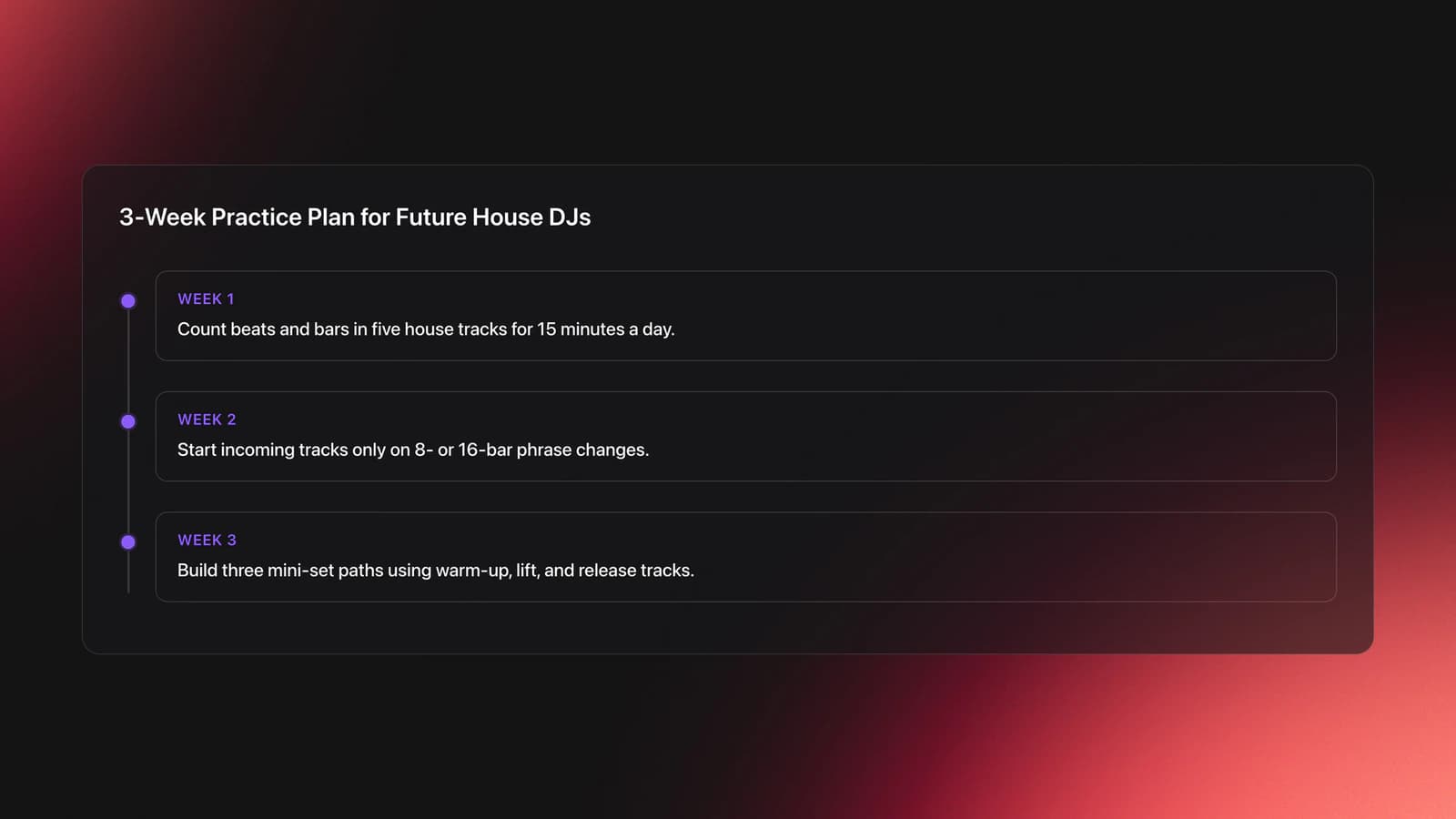
- Week 1: Count beats and bars in five house tracks for 15 minutes a day.
- Week 2: Start incoming tracks only on 8 or 16 bar phrase changes.
- Week 3: Build three mini-set paths with warm-up, lift, and release tracks.
Validation Check
For a deeper workflow, connect this with DJ set planning and crate organization for DJs.
Conclusion
House DJs are not defined by genre label alone. The good ones understand structure. The best ones turn structure into flow.
Keep these takeaways in mind:
- Phrasing matters as much as BPM matching.
- Energy control separates memorable sets from competent ones.
- The best house DJs solve room problems, not just technical ones.
If you study house DJs through beats, phrases, and energy arcs, their decisions become easier to hear and easier to apply. That is the next step. Stop judging only by names. Start listening for function.
The visual way to organize your DJ library
Tag tracks by vibe. See everything at once. Export to rekordbox, Serato, Traktor or Engine DJ.
14-day free trial. Full access, no strings attached.
or see how it works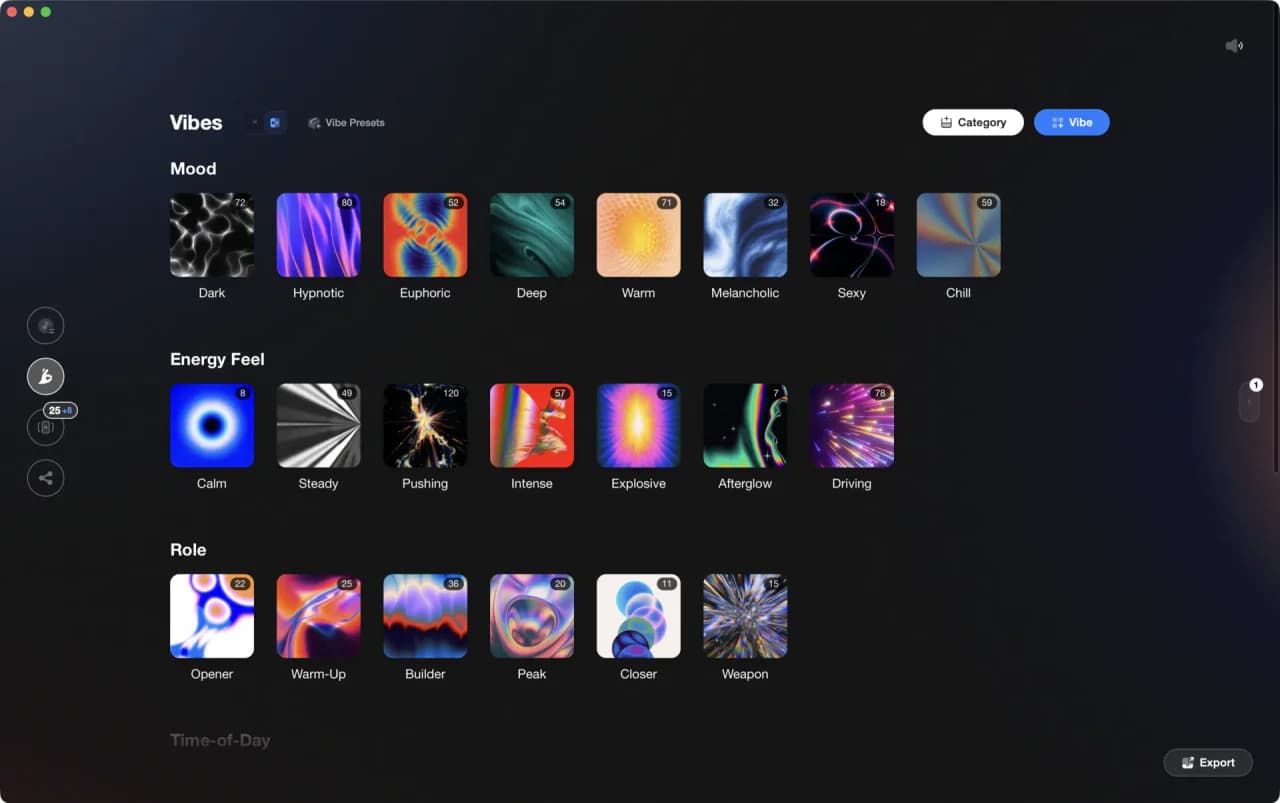
Techniques Covered
Phrasing
Track Selection
Types of DJ Transitions
Track Analysis
Set Composition
EQ Adjustments
Cueing Tracks

Curation

DJ Rig Setup
Platinum Notes 10 Processing Templates
Equipment & Software
Featured Gear
Continue Your Learning Journey
Start Here First
Deep House: Sound, Structure, and Flow
beginner
How to Choose a DJ Controller for Your Workflow
beginner
Swedish House Music: Sound, Artists, Key Tracks
beginnerDJ Starter Equipment: What to Buy First (and What to Skip)
beginnerHow Can I Be a DJ and Start Strong
beginner
Best DJ Controller: How to Choose
beginner
DJ Setup Types
beginnerRelated Content
House Music Explained
intermediate
House Trance: Sound, Structure, Mixing
intermediateProgressive House Music: How It Works
intermediate
Tech House: How to Build the Core Sound
intermediate
How to DJ With Just a Laptop (No Controller Needed)
intermediate
DJ Transitions: The Three-Layer Handoff for Beginners
intermediate
DJ Record Pool Guide for Working DJs
intermediateHow To Mix In Key Live: Worked Transitions And Failure Fixes
intermediate
Frankie Knuckles: House Music Pioneer
intermediateFrequently Asked Questions

Hey, it's Ben Modigell 👋
I DJ and produce as so I so: downtempo, minimal, dub house, tech house, and techno (releases on Spotify and SoundCloud, links above). Everything I write here comes from my own gigs, studio sessions, and library cleanups: the rules I follow, the failure modes I have actually hit, and the workflow I use when nobody is watching. If a technique did not earn its place in my own sets, it does not make it into a tutorial.