
Watch Memphy’s tutorial above (604K views on YouTube).
This guide is for producers who like progressive house music but keep ending up with flat drops, harsh leads, or cluttered mixes. You will learn what defines progressive house music, how the arrangement behaves, and how to build a track that feels wide, melodic, and controlled.
The core problem is not complexity. It is balance. In progressive house music, the best tracks keep the melody simple, the drums supportive, and the energy moving without sounding empty.
If you are also working on EDM arrangement basics, melodic drop design, or dance music mixing workflow, those topics connect directly to what follows.
Progressive House Music: Definition and Context
Progressive house music is a melody-driven form of dance music built on gradual tension, layered harmony, and emotional payoff. The style usually relies on evolving chords, controlled drum energy, atmospheric effects, and a drop that feels lifted rather than aggressive.
That last point matters. Many new producers confuse loudness with impact. Progressive house usually hits harder when each layer has a job and the arrangement opens in stages.
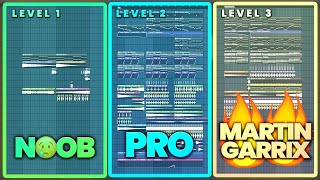
The transcript frames this clearly through three levels. The beginner version overuses stock sounds, pushes transitions too hard, and treats mastering like a rescue tool. The stronger versions improve because the layering, level balance, and automation become more intentional.
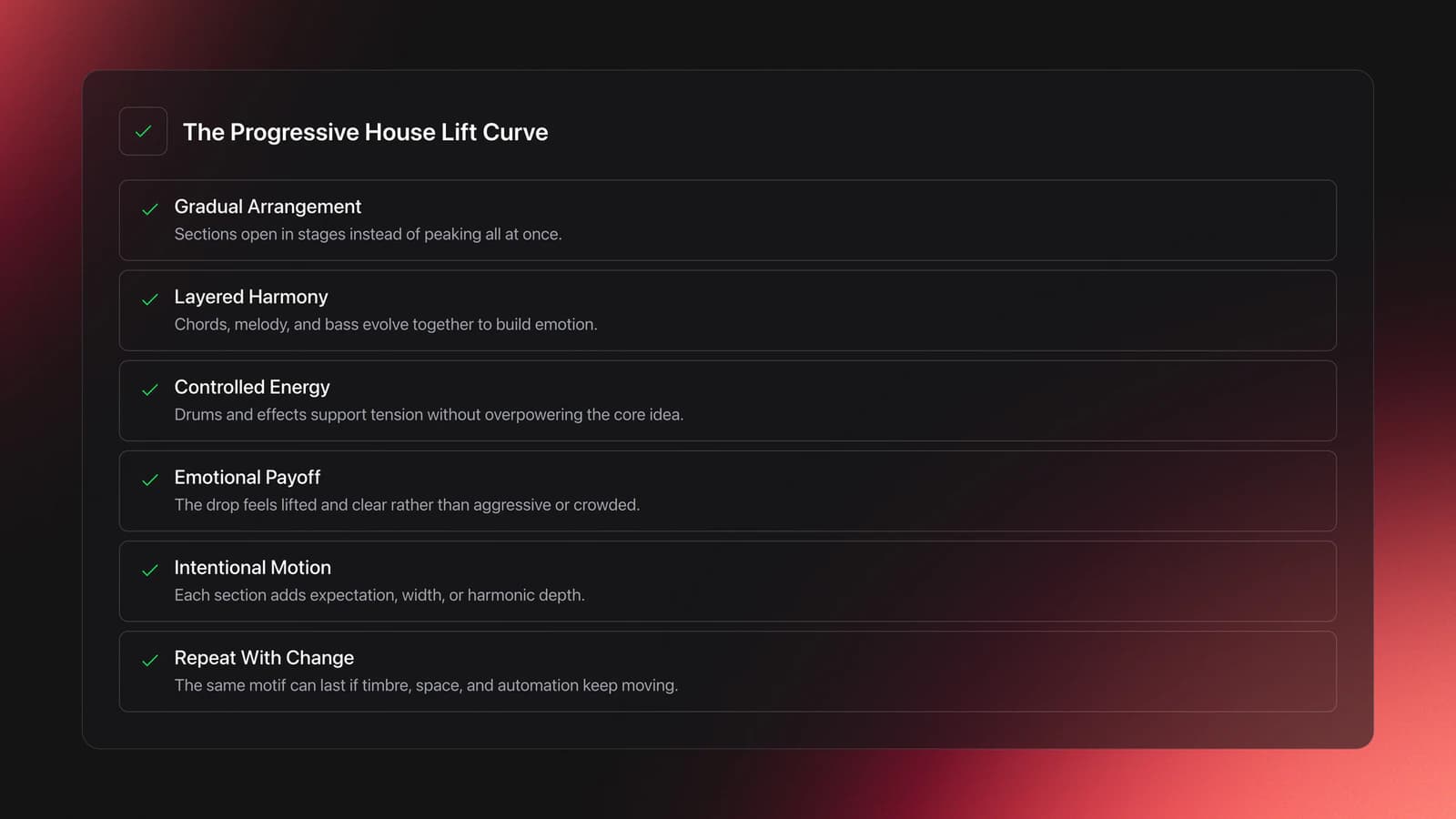
A useful mental model is the lift curve. I use that term for the way progressive house music rises over time without losing clarity. Every section should either add expectation, widen the image, or deepen the harmony.
This means the genre is less about constant novelty and more about controlled release. A good progressive house mix can repeat the same core idea for a while, as long as timbre, space, and motion keep changing.
If you study electronic music structure or how to build DJ-friendly intros, you already know why this works. Dancers react well to patterns they can predict, especially when the texture keeps evolving.
Progressive house reference tracks
A starting crate of progressive house, pulled from our DJ track index with live BPM and Camelot keys (these run roughly 116-130 BPM). Beatmatch to each track's tempo, use the long intros and outros to blend, and swap on the phrase. Click any row to open its full sonic profile.









What Defines Progressive House Music?
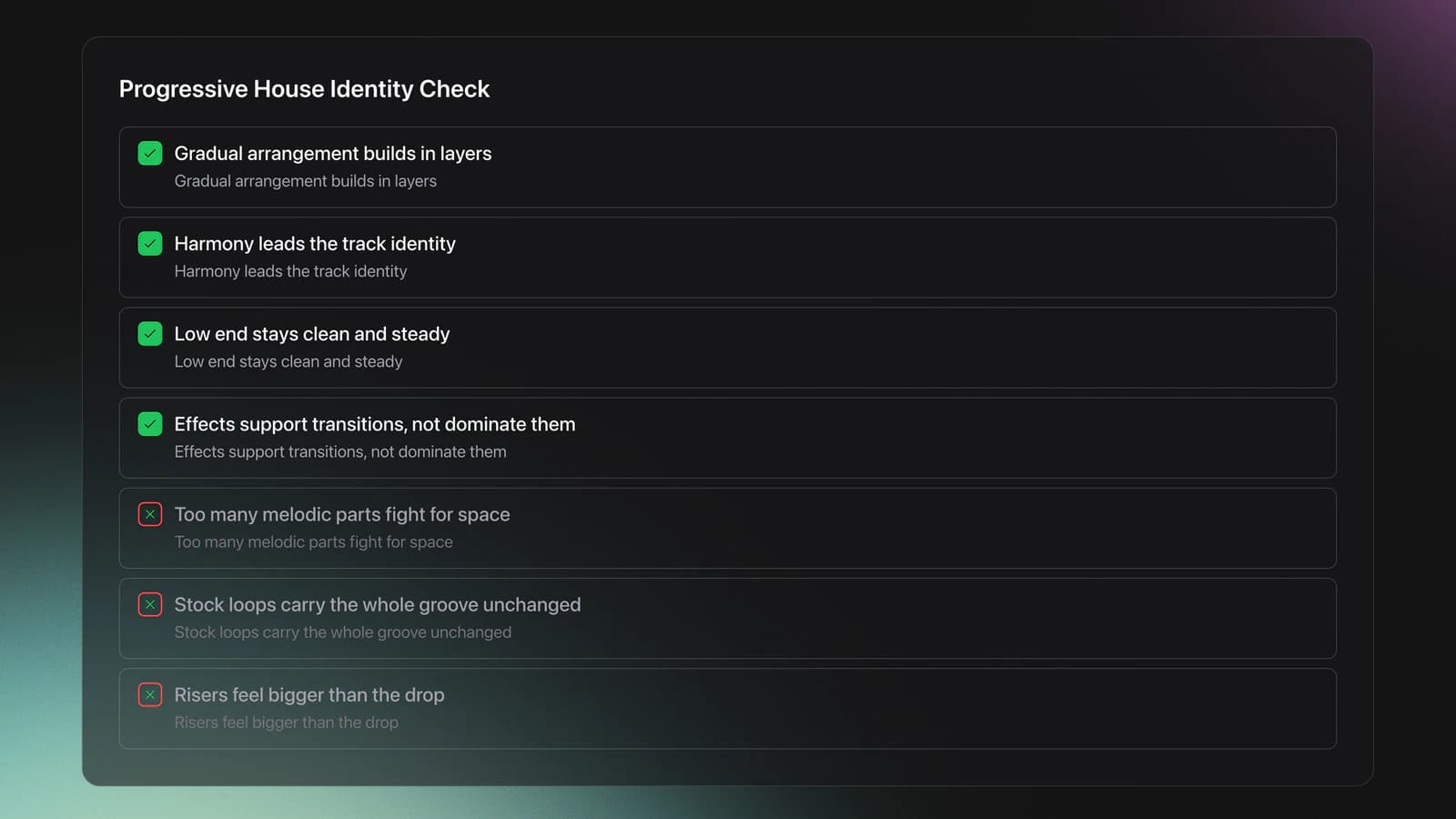
What defines progressive house music in practice is the combination of four things: gradual arrangement, emotional harmony, controlled effects, and a clean low end. Remove one of those, and the track often drifts toward generic festival EDM or thin melodic house.
Start with the harmony. The transcript repeatedly points to melody, chords, and bass as the center of the style. That tracks with how many producers write the genre. The drums support the idea, but the harmonic loop carries the identity.
A common beginner mistake is writing too many melodic parts at once. You hear a lead, supersaw chords, a bass, a pluck, a vocal chop, and several effects all fighting for the same space. The result feels loud but small.
A stronger method is to build one clear foreground element and two support layers. Example one: lead on top, wide saw chords in the middle, bass below. Example two: piano or pluck handles the chord attack, strings add sustain, and the lead only enters at the lift.
This is where the transcript's "simple" advice is easy to misunderstand. Simple does not mean thin. It means every part is legible. You can mute one layer and immediately hear what changed.
The drum pattern follows the same rule. New producers often rely on stock loops because they create instant momentum. That is fine at the sketch stage. It becomes a problem when the loop stays untouched and carries the whole groove.
In progressive house music, the drums usually work best when the kick is stable, the clap or snare is restrained, and the hats add forward motion without dominating the top end. If the groove distracts from the harmony, it is probably too busy.
Effects are another giveaway. The transcript jokes about risers being too loud, but that is a real production issue. When the riser feels bigger than the drop, the track peaks early and the payoff collapses.
Try this now: solo your lead, chords, bass, and effects bus. Lower every effect by 2 to 4 dB. Then play the build into the drop. If the transition feels clearer and the drop feels larger, your effects were masking the handoff.
Validation Check
That is also why many famous progressive house songs still hold up. They do not throw ideas at the listener. They commit to one emotional center and shape the arrangement around it.
For DJs and live performers, this same principle matters after production. A library full of melodic tracks becomes hard to navigate if every folder is just by genre name. Some use manual folder systems. Others use tools like Vibes to sort tracks into custom categories such as mood, function, and energy, then export that structure to performance software. Either approach helps you find the right progressive house songs faster when you need a specific emotional arc in a set.
Build Progressive House Music: Core Workflow
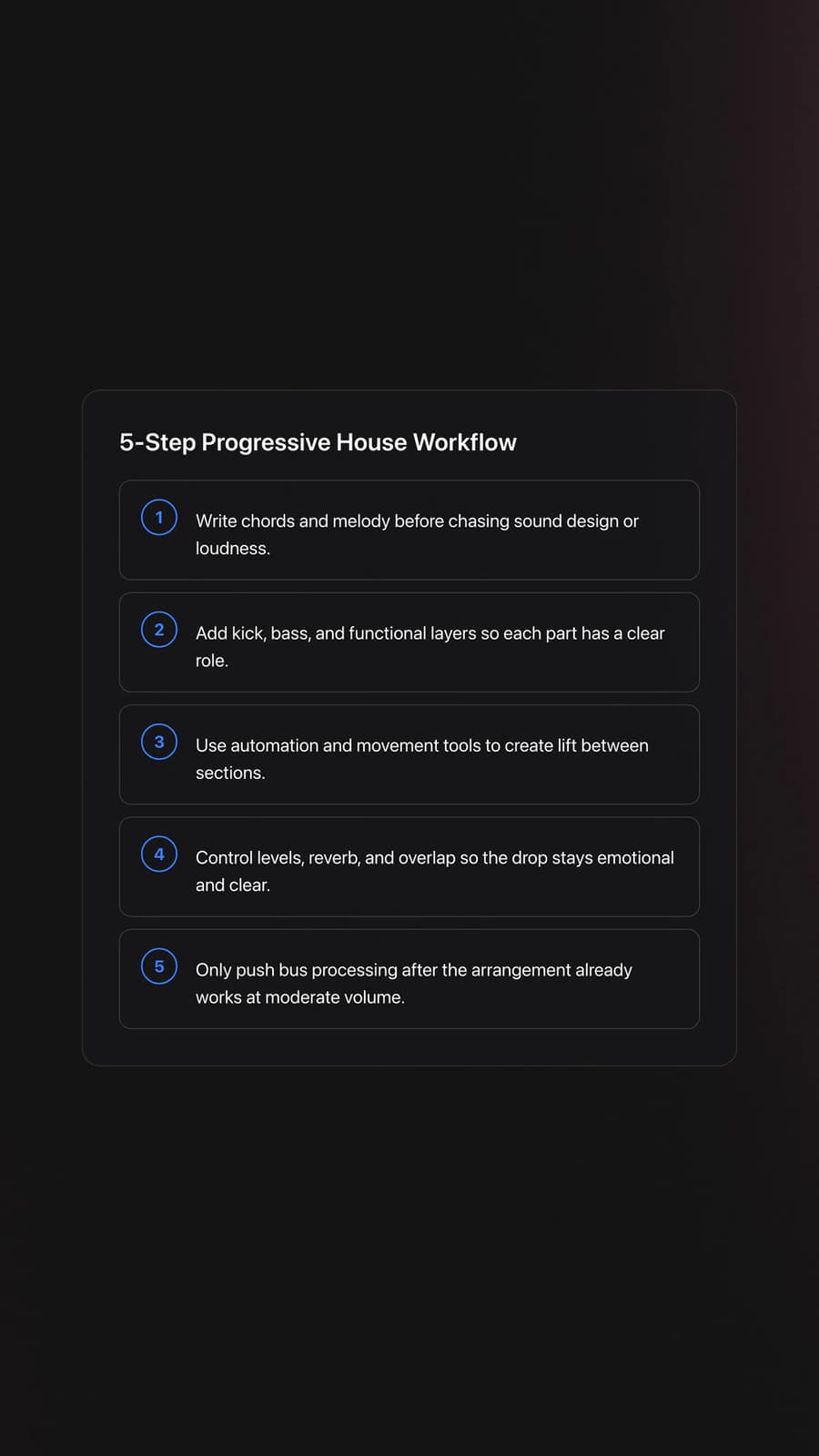
If you want to know how to make progressive house music, work in this order: harmony first, groove second, transitions third, mix balance fourth, loudness last. That order matches the transcript and fixes the most common beginner failure modes.
Why this order? Because arrangement problems sound like mixing problems when you are too close to the session. Producers often reach for saturation, widening, or limiting before the section even makes sense.
Step one is writing a strong chord and melody relationship. Keep the bass simple at first. In many progressive house songs, the emotional effect comes from how the lead sits over the chord movement, not from a busy bass line.
Example one: write a four-chord loop, then hold the lead on longer notes so the harmony carries the motion. Example two: keep the chords static for two bars and let a small lead variation create the lift into bar three.
Step two is layering by function. The transcript's stronger examples layer sounds and harmonies so they stop sounding like random presets stacked together. Assign each layer a role: attack, body, width, sub, texture, or air.
A useful split looks like this:
- Lead layer for identity and note definition
- Chord body layer for width and sustain
- Bass layer for groove and weight
- Optional string or texture layer for emotion
- Transition layer for movement between sections
Step three is level discipline. The transcript mentions that everything except the kick sits fairly low. That is often true in polished progressive house music. The kick anchors the track, but the drop feels large because the supporting layers are controlled, not crushed into the same zone.
Step four is automation. Tapestop, filter, pitch, and volume moves matter because progressive house depends on change over time. A static eight-bar loop can sound fine in isolation and dead inside a full arrangement.
Step five is effects cleanup. If you add heavy reverb to the lead, sidechain that reverb and trim both low and high extremes. The point is size without smear. Reverb should lengthen the emotional tail, not blur the timing.
A failure mode here is the fake-big lead. Symptom: the lead sounds impressive soloed but disappears when drums and bass enter. Usually the reverb is too wide, the highs are too sharp, or the chord layer is occupying the same band.
Fix it in sequence. First, cut low end from the lead reverb. Second, reduce the upper highs on competing chords and bass harmonics. Third, check whether one layer can be muted completely.
Validation Check
This same logic helps on the DJ side. If your progressive house mix library is unorganized, you waste time comparing near-identical tracks under pressure. Some performers manage this with playlists alone. Others use Vibes to build hierarchical categories and prep named sets on a canvas before exporting to Rekordbox or other DJ software. The tool matters less than the principle: sort by how tracks behave, not just by artist or label.
If you want a deeper companion topic, track layering for EDM and set preparation for melodic DJs both extend this workflow.
Mix Progressive House Music Without Clutter
Mixing progressive house music is mostly about separation. The transcript gives three practical cues: keep reverb clean, reduce excess highs where layers compete, and manage stereo width in bands instead of widening everything.
Start in the low end. The transcript points to a heavier sub-bass approach in more modern, Martin Garrix-style tracks. That works when the sub is defined and the kick still wins the first moment of impact.
Example one: if the kick peaks around the 50 to 60 Hz zone, let the sub fill the sustained space around it instead of competing with the same envelope. Example two: if the bass layer has too much upper information, trim it so the lead and hats keep their edge.
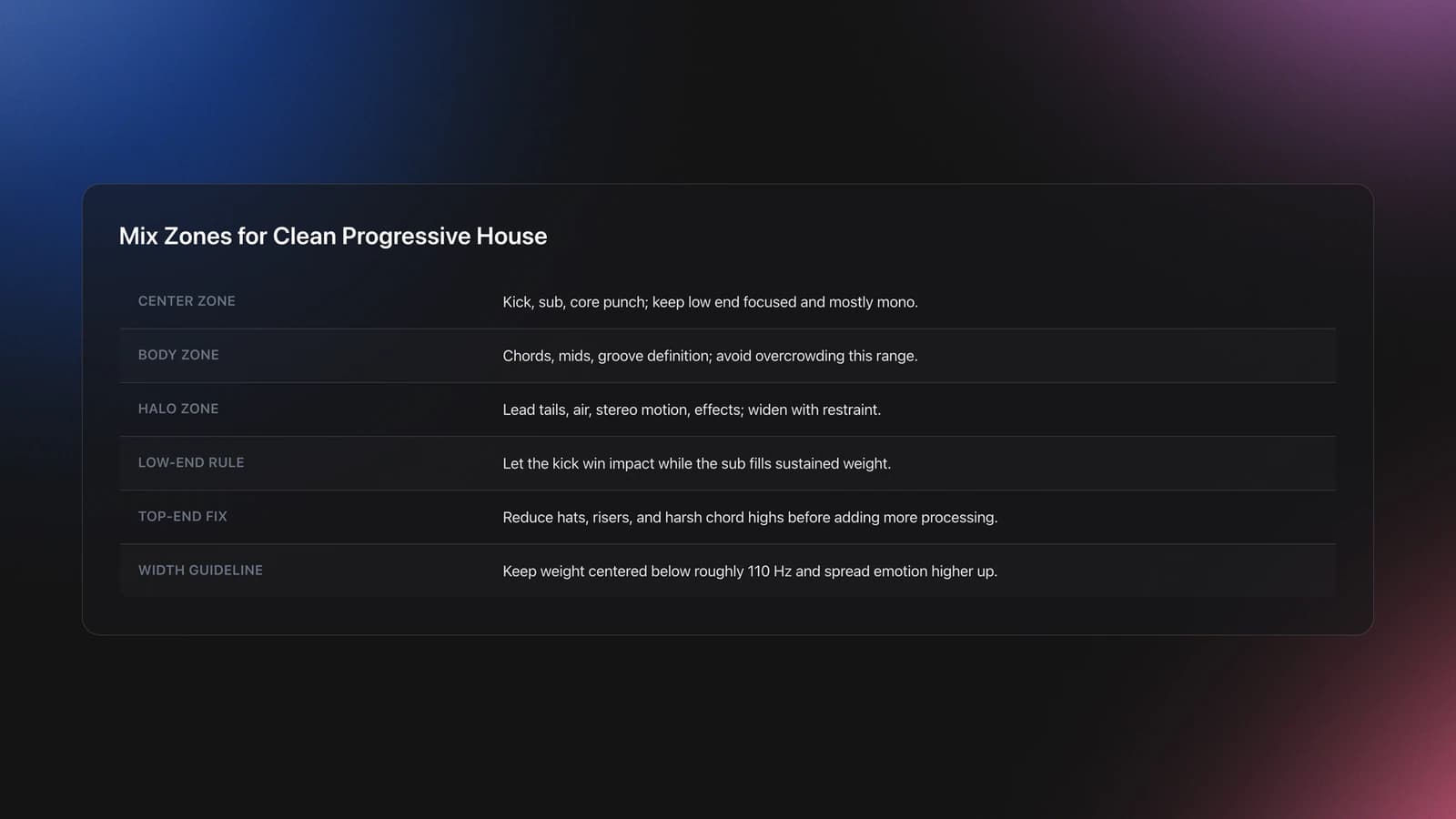
The transcript also mentions making everything below 110 Hz mono and widening above 500 Hz. Treat those numbers as a starting point, not a law. The broader idea is solid: keep the weight centered and let the emotion live wider.
This is where it helps to think in three zones.
- Center zone: kick, sub, core punch
- Body zone: chords, mids, groove definition
- Halo zone: lead tails, air, stereo motion, effects
When a mix feels cluttered, too many sounds are trying to live in the body zone. That is why simple EQ cuts often do more than extra processing. You are not polishing a bad idea. You are giving each layer a lane.
A second failure mode is over-bright energy. Symptom: the drop sounds exciting for 20 seconds, then tiring. The usual cause is stacked saw layers, sharp hats, and loud risers all living in the same top-end band.
The fix is often subtractive. Lower the hats slightly. Reduce the riser level. Trim harsh highs from supporting chords. Leave the lead one clean path through the upper mids.
The transcript mentions a pink-noise matching EQ approach. That can be useful as a rough reference, but it should not override arrangement judgment. Pink noise does not know which element is supposed to feel intimate, bright, or forward.
In other words, use reference tools to spot bias, not to finish the track for you. A spectrum can show buildup. It cannot decide whether your lead is emotionally convincing.
Compression should follow the same restraint. The transcript describes up to about 4 dB of gain reduction on the bus. That is enough to tighten movement if the mix is already balanced. It will not fix a muddy low mid or a weak chord progression.
You will know your progressive house mix is landing when the track keeps its lift on headphones, monitors, and smaller speakers. If the whole drop disappears on a phone or laptop, the width is doing too much work and the center is too weak.
A practical comparison helps here. Manual set planning inside playlists can work, and many DJs stay entirely inside Rekordbox or Engine DJ. But if your melodic library spans warm-up, peak, and after-hours material, a canvas-based prep tool can reduce guesswork because you can group tracks by vibe, BPM, key, and intended function before export. The value is not automation. It is cleaner decision-making.
| Method | Best For | Tradeoff |
|---|---|---|
| Manual playlists only | Small libraries and simple sets | Fast to start, harder to scale |
| Rekordbox-only prep | DJ-centric workflow and export readiness | Tag systems can get messy over time |
| Engine DJ prep | Standalone device workflows | Less convenient if your main library lives elsewhere |
| Structured library plus canvas planning | Large melodic libraries and set-specific prep | Requires manual organization discipline |
Method comparison for organizing and preparing progressive house sets
Arrange Progressive House Music for Lift
Arrangement is where progressive house music either breathes or stalls. The transcript shows the pattern well. Basic versions rely on obvious transitions and preset energy jumps. Better versions create motion with automation, layering changes, and restraint.
Think in phases instead of sections. Intro establishes groove. Break introduces emotion. Build tightens expectation. Drop releases tension. Outro gives the track a DJ-friendly exit. That sounds basic, but producers often skip the emotional transition between break and drop.
A worked example helps. In example one, bars 1 to 16 establish kick, bass, and a reduced chord loop. Bars 17 to 32 introduce a lead hint and rising texture. Bars 33 to 48 pull the kick, widen the chords, and automate filter opening. Bars 49 onward deliver the full lead with simplified drums.
In example two, the break starts with strings and piano, then gradually swaps the piano attack for a brighter saw layer before the drop. The notes do not change much. The timbre does. That creates lift without over-writing the section.
That technique matters because progressive house songs often depend on recognizability. If every section rewrites the main idea, the track loses identity. If nothing changes, the listener stops expecting anything.
The middle ground is controlled substitution. Replace one role at a time. Add one layer. Remove one layer. Automate one parameter. Let the listener feel momentum through contrast, not chaos.
A classic failure mode is the over-filled build. Symptom: by the final two bars before the drop, every riser, snare roll, uplifter, and vocal chop is active. The drop then feels smaller because there is no room left to expand.
The fix is to strip the last moments back. Leave one core riser, one rhythmic tension element, and one clear cue that the drop is coming. If the final bar sounds cleaner, the drop usually lands harder.
How do you know the arrangement works? Mute the master limiter and listen at low volume. If you can still feel where the emotional high point is, the arrangement is doing its job.
What does progressive house sound like when arranged well? It sounds patient. The track feels like it is always heading somewhere, even when the loop itself is simple.
Best Progressive House Songs: What to Study
If you want to learn from the best progressive house songs, do not just collect favorites. Study what each one is solving. Some tracks teach melody writing. Others teach drop restraint, mix translation, or breakdown pacing.
The transcript points to Martin Garrix-style progressive house as a modern reference, especially the use of strong melodies, strings, and a more present sub-bass. That is a useful lane to analyze because it balances festival scale with melodic clarity.
Build a study playlist with three buckets:
- Melody references for lead writing and chord payoff
- Mix references for low-end balance and width
- Arrangement references for break-to-drop pacing
Then annotate each track. Note where the drums thin out, where the lead first appears, how long the break lasts, and which layer makes the drop feel open. This turns passive listening into production data.
For DJs, the same library can also become set material if it is categorized well. A folder full of "best progressive house songs" is rarely enough, because one track may work as warm-up while another is clearly peak-time. Organizing by energy, mood, and function makes those differences usable in performance, whether you do it manually or inside a tool designed for DJ library structure.
If you want help building that reference pool, progressive DJ set flow, energy-based playlisting, and how to choose reference tracks are the next logical reads.
Common Mistakes in Progressive House Music
| Mistake | Why It Happens | How to Avoid |
|---|---|---|
| Risers louder than the drop | Effects are used to fake energy | Lower transition effects first and rebuild impact with arrangement |
| Too many melodic layers | Each preset sounds good soloed | Assign one role per layer and mute duplicates |
| Wide but weak low end | Stereo tricks are applied too low | Keep sub and core bass centered, then widen higher bands |
| Lead drowned in reverb | Bigger is mistaken for better | Sidechain the reverb and trim low and high extremes |
| Mastering used as repair | The mix is not solved before the bus | Fix balance and arrangement before compression and limiting |
Common progressive house production errors and their practical fixes
Progressive House Music vs EDM
What is the difference between EDM and progressive house? EDM is the broader umbrella. Progressive house is one approach inside it, usually defined by gradual energy flow, melody-driven writing, and a smoother emotional arc.
The confusion happens because big-room and festival tracks sometimes borrow progressive house elements. You may hear supersaws, uplifting chords, and emotional breaks in both. The difference is often in pacing and density.
A lot of generic EDM writing goes straight for impact. Progressive house music usually earns the impact over time. That is why the arrangement and transitions matter so much.
If your track jumps from idea to idea, it may still work as EDM. It probably will not feel convincingly progressive. Progressive tracks tend to evolve one core idea rather than replace it every eight bars.
The visual way to organize your DJ library
Tag tracks by vibe. See everything at once. Export to rekordbox, Serato, Traktor or Engine DJ.
14-day free trial. Full access, no strings attached.
or see how it works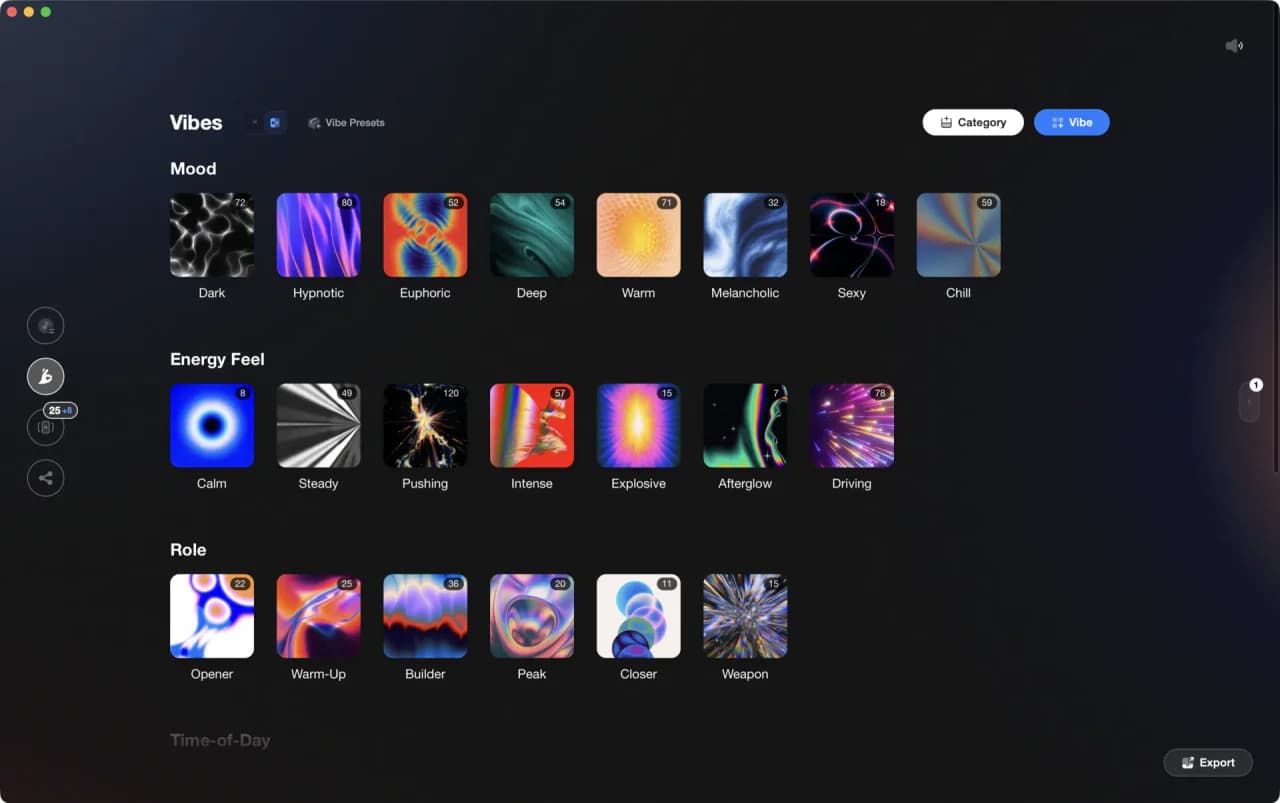
Techniques Covered

Equipment & Software
Continue Your Learning Journey
Start Here First



Related Content
Tech House: How to Build the Core Sound
intermediate
House Trance: Sound, Structure, Mixing
intermediate
House Music Explained
intermediate
90s House Music: Origins, Sound, Key Tracks
intermediate
Harmonic Mixing Guide for DJs: Energy & Workflow
intermediate
DJ Transitions: The Three-Layer Handoff for Beginners
intermediate
How To Mix In Key Live: Worked Transitions And Failure Fixes
intermediate
Transition DJ Online: Browser Mixer Workflow
intermediate
DJ Library Organization System: Tags, Crates, Keys
intermediate
Frankie Knuckles: House Music Pioneer
intermediateFrequently Asked Questions

Hey, it's Ben Modigell 👋
I DJ and produce as so I so: downtempo, minimal, dub house, tech house, and techno (releases on Spotify and SoundCloud, links above). Everything I write here comes from my own gigs, studio sessions, and library cleanups: the rules I follow, the failure modes I have actually hit, and the workflow I use when nobody is watching. If a technique did not earn its place in my own sets, it does not make it into a tutorial.