
Watch Mixmag’s tutorial above (83K views on YouTube).
This guide is for readers who know the name Frankie Knuckles but want the full picture. If you are stuck with the vague label "father of house music" and want to understand what he actually did, where he did it, and which records matter most, this will get you there. By the end, you will know how Frankie Knuckles shaped house music, why the Warehouse matters, and which Frankie Knuckles songs best show his sound.
Frankie Knuckles was not just a famous DJ attached to a genre after the fact. He was one of the central figures who helped turn post-disco club experimentation in Chicago into house music as a real culture, sound, and method.
If you are also tracing the broader roots of club culture, it helps to pair this with house music history, Chicago house essentials, how to organize DJ sets, and classic dance tracks to study.
Frankie Knuckles Explained
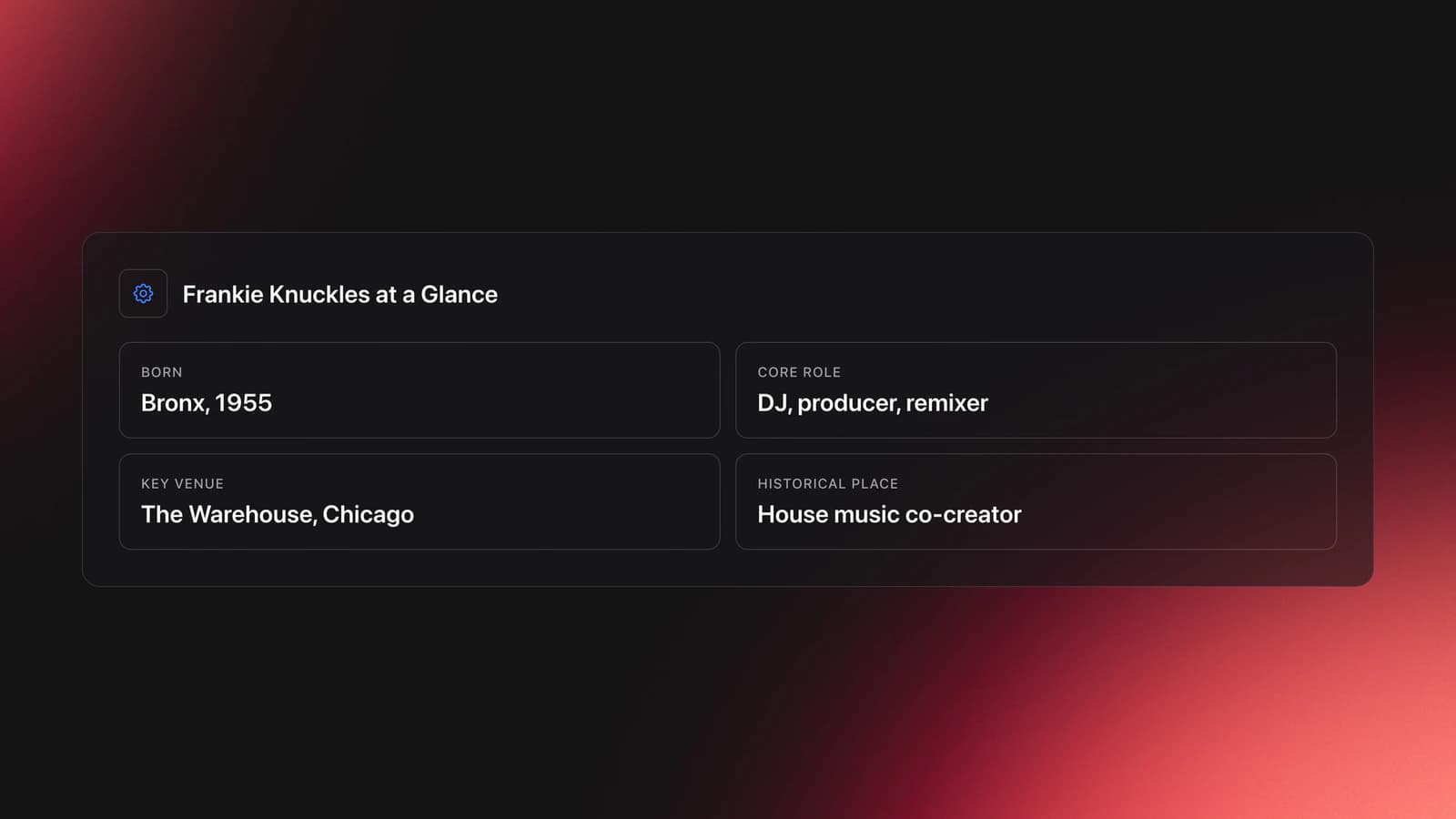
Frankie Knuckles was an American DJ, producer, and remixer born in the Bronx in 1955 who became the resident DJ at the Warehouse in Chicago. Britannica describes him as one of house music's creators and notes his role in shaping the sound through long-form DJ sets, edits, and production work. Britannica's Frankie Knuckles biography and Britannica's house music overview both place him at the center of house music's origin story.
That matters because a lot of simplified summaries skip the actual mechanism. Knuckles did not invent house music alone in a lab. He helped build the conditions that made it possible.
The transcript points to that clearly. The Warehouse was not just a venue. It was a testing ground for new records, new edits, new crowd reactions, and a new way of moving from disco, soul, Philly records, funk, and drum-machine-driven tracks into something more focused and more stripped down.
A good mental model is this: Frankie Knuckles was a bridge figure. He linked disco to house, DJ craft to production, and local Chicago nightlife to a global sound.
Classic house reference tracks
A starting crate of classic house, pulled from our DJ track index with live BPM and Camelot keys (these run roughly 118-134 BPM). Beatmatch to each track's tempo, use the long intros and outros to blend, and swap on the phrase. Click any row to open its full sonic profile.


Warehouse Era and Chicago Roots
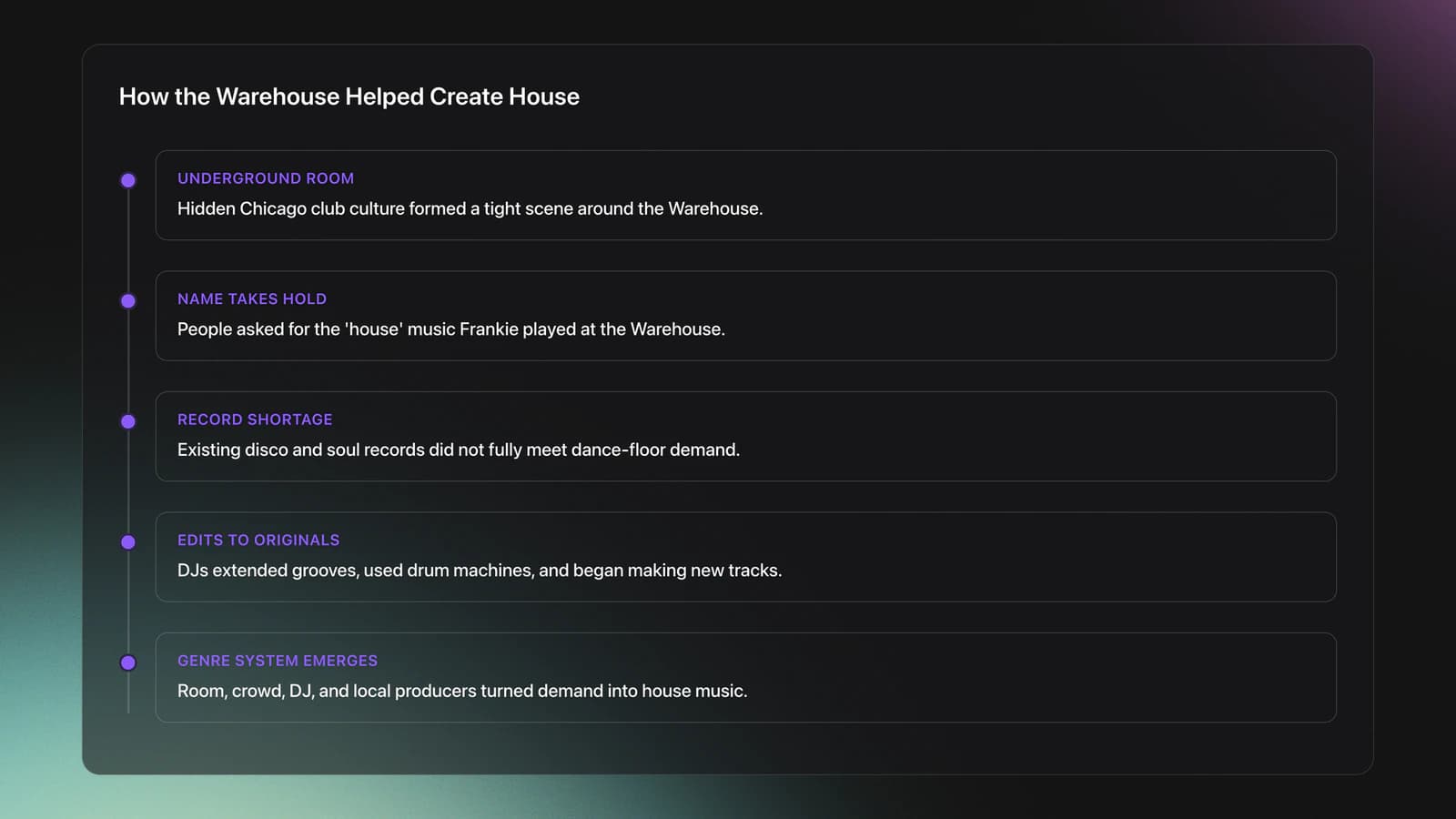
To understand Frankie Knuckles, start with the Warehouse. The transcript describes the club as hidden, industrial, and hard to find unless you already knew where it was. That detail matters because early house culture was underground in the literal sense. It was scene knowledge, not mass marketing.
You hear another important point in the transcript. People asked for "that house music like stuff that Frankie plays," because the Warehouse was called "the house." That naming story is part of why house music became house music.
The crowd and context matter just as much as the records. House emerged inside Black, gay, and Latino club spaces in Chicago, drawing from disco, soul, R&B, imported electronic records, and local experimentation. Britannica's history of house music makes the same point, describing early house as a Chicago club sound built in spaces serving predominantly Black and Latino patrons.
This is the first pillar idea in the article. A genre is not only a set of sonic traits. It is also a social system. In Frankie Knuckles's case, the system included a room, a crowd, a DJ, a record network, and a need for tracks that did not fully exist yet.
The transcript says there were not enough records with a steady four-on-the-floor drive to support the demand. That shortage pushed DJs and producers toward edits, drum machines, and original productions. In other words, the dance floor created production pressure.
That pressure explains why so many origin stories of house music sound collective rather than singular. Frankie Knuckles was central, but Jesse Saunders, Marshall Jefferson, Jamie Principle, Steve "Silk" Hurley, Chip E., and many others were also part of the system that pushed the music forward.
One concrete example is the shift from playing disco and soul records to extending and reshaping them. Britannica notes that Knuckles made reel-to-reel edits so the groove lasted longer for dancers. That is not a small technical footnote. It is a core behavioral pattern of early house.
Another example is the move from DJ edits to original records. The transcript names Jesse Saunders as an early Chicago figure making records, and that matches the broader history in which DJs and local producers started making tracks because existing records no longer covered what the dance floor needed.
A common failure mode when people study Frankie Knuckles is treating his story as hero worship and nothing else. The symptom is a timeline full of titles and praise, but no explanation of why the Warehouse mattered. If you cannot explain the room, the crowd, and the shortage of fitting records, you do not yet understand his role.
You will know you have the right frame when you can describe Frankie Knuckles as both a person and a function. He was a DJ and producer. He was also the operator inside the loop that turned underground demand into a new musical language.
That is also why his legacy stayed strong outside Chicago. Once the process proved itself, other cities could copy the output even if they did not share the exact original conditions.
The transcript's description of intimate, hidden parties also explains why the music felt different from later festival-scale dance culture. In underground spaces, vibe progression and emotional timing often mattered more than spectacle. That scene logic still shapes how many DJs think about musical storytelling.
If you are a DJ, this part connects directly to preparation. The lesson is not nostalgia. It is workflow. The strongest sets usually come from understanding what function each track serves in a room, then keeping that structure visible before the gig.
That is where library systems become useful. Some DJs do it with notes and folders. Others use tools like Vibes to organize local files into custom categories such as mood, function, and energy, then export that structure into performance software. The exact tool matters less than the method. You need a repeatable way to separate deep builders, peak records, and reset tracks before you are under pressure.
Did Frankie Knuckles Invent House Music?
Not in the simple single-inventor sense. A more accurate answer is that Frankie Knuckles was one of house music's main creators and the figure most closely associated with its early identity.
This distinction matters because house music did not appear in one moment. It developed through DJ practice, edits, club culture, early drum-machine use, and records made by several Chicago artists. Britannica explicitly says house was invented by deejay-producers such as Frankie Knuckles and Marshall Jefferson, not by one person alone.
So why does Knuckles get the strongest claim? First, the Warehouse gave the genre its name. Second, he shaped the listening habits that defined the music before the market did. Third, his DJing and production made the sound legible to others.
Think of it as three layers of influence. He helped define the environment. He helped define the style. He helped define the standard.
Here is a worked example. If you ask who made early house records, the answer includes Jesse Saunders and other Chicago producers. If you ask who gave the emerging sound a central club identity, Knuckles becomes much harder to replace. Those are different questions.
A second example is global recognition. When house music reached the UK in the 1980s, Chicago labels and DJs carried enormous symbolic weight. The transcript describes imported records entering London specialist shops, then feeding scenes that exploded by the late 1980s. Knuckles was one of the names that gave that imported culture authority.
The failure mode here is false certainty. You will often see either "Frankie Knuckles invented house music" or "he did not invent it at all." Both flatten the history. The more useful answer is that he was foundational, but not solitary.
You will know you have the balance right when you can say this without contradiction: Frankie Knuckles is rightly called the father of house music, but house music was still a collective creation.
| Claim | What Is Accurate | Why It Matters |
|---|---|---|
| He invented house music alone | Too simple | It erases Chicago's wider scene |
| He had little to do with house beyond the name | Wrong | It ignores the Warehouse and his DJ influence |
| He was one of the main creators | Accurate | It fits both the music and the culture |
| He is called the father of house music | Common and broadly justified | It reflects influence, not sole authorship |
A practical way to answer the invention question
Frankie Knuckles Songs That Define His Legacy
If you want to understand Frankie Knuckles through records, start with a short listening stack. The goal is not just to hear famous tracks. It is to hear the range inside his work.
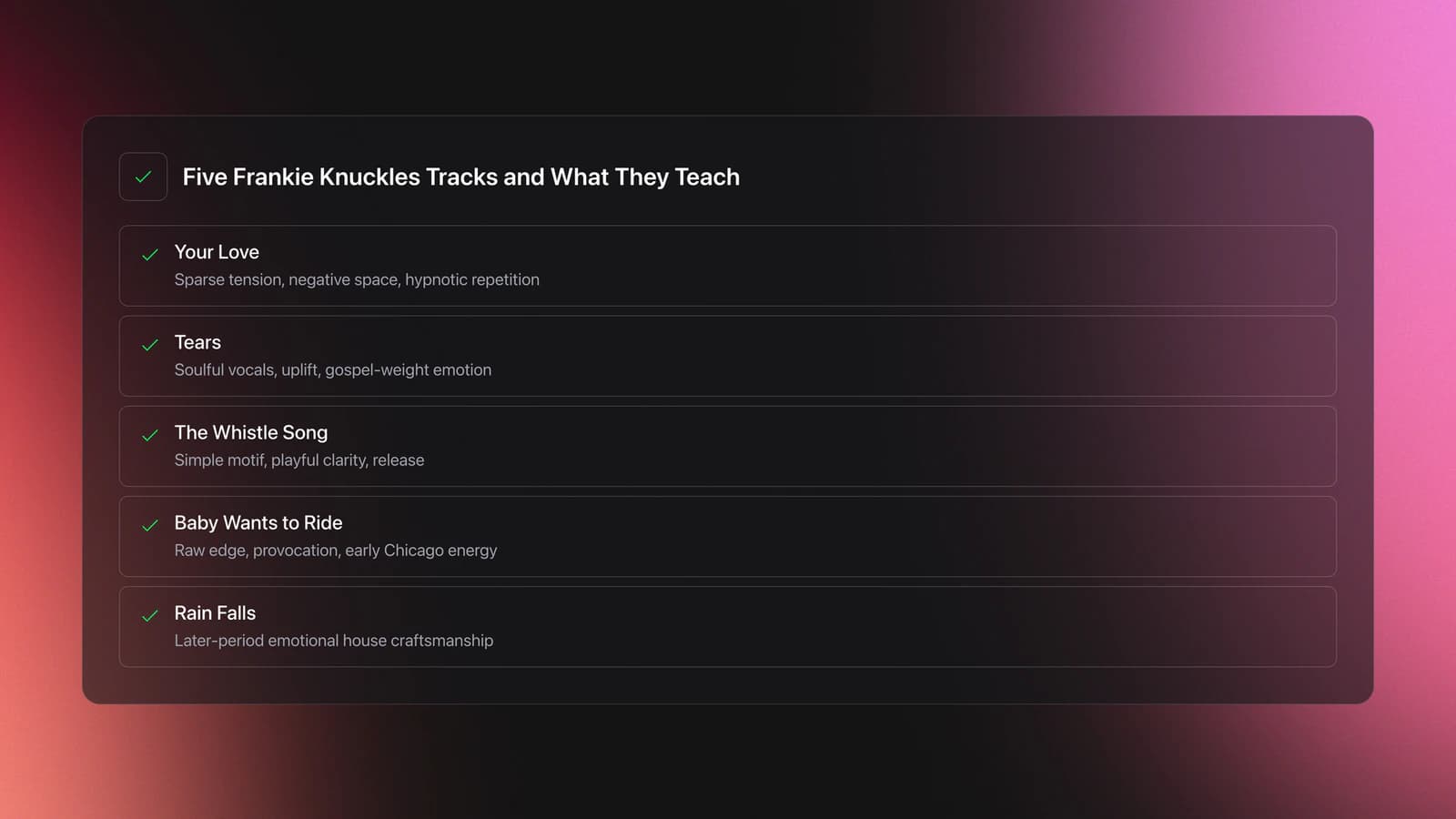
The most cited Frankie Knuckles songs include "Your Love," "Baby Wants to Ride," "Tears," and "The Whistle Song." The Guardian's obituary and later tribute coverage repeatedly highlight those records as central to his legacy.
Start with "Your Love." It is sparse, hypnotic, and emotionally direct. It shows how much tension Knuckles could build without overcrowding the track.
Then play "Tears," recorded with Robert Owens and David Morales. This track shows the vocal and soulful side of house at a high level. It carries gospel weight without losing club function.
After that, listen to "The Whistle Song." It is lighter on its feet, more playful, and immediately memorable. If "Your Love" teaches restraint, "The Whistle Song" teaches clarity.
Then add "Baby Wants to Ride." It shows the rawer, more provocative side of early Chicago house and helps explain why the scene felt dangerous, new, and unlike mainstream pop.
This section is the second pillar because it helps you hear the conceptual model in practice. Knuckles's records often combine three things: groove discipline, emotional openness, and arrangement patience.
Here is the first worked example. Compare "Your Love" to a more crowded modern house track. In "Your Love," the negative space is part of the hook. Fewer elements mean each entrance matters more. The result is tension that feels structural, not decorative.
Here is the second worked example. Compare "Tears" and "The Whistle Song." "Tears" leans into vocal expression and uplift. "The Whistle Song" leans into motif and release. Both work on a dance floor, but they do it through different emotional channels.
That distinction is useful for DJs because it shows why 'classic house' is not one mood. A track can be ecstatic, sensual, devotional, or minimal and still sit inside the same lineage.
A production background helps here too. Producers tend to hear arrangement logic faster because they know how breakdowns, returns, and simple hooks change physical response. That is one reason experienced selectors often spot energy shape, not just BPM, when they pick records.
The failure mode is reducing Frankie Knuckles songs to museum pieces. The symptom is talking about them only as history and never as functional records. These tracks still teach timing, restraint, and atmosphere.
You will know you are listening well when you can describe not just whether a track is good, but where it works. Does it open a room, deepen it, lift it, or reset it?
- "Your Love". Study tension, space, and hypnotic repetition.
- "Tears". Study soulful vocals and emotional lift.
- "The Whistle Song". Study simple melodic identity and release.
- "Baby Wants to Ride". Study edge, attitude, and early Chicago energy.
- "Rain Falls". Study later-period emotional house craft.
For DJs building crates from this angle, the practical move is to organize by function, not just artist. A dedicated system can help here. Some DJs keep separate playlists for builders, vocal lifts, and late-night rollers. Others use Vibes to tag local tracks by energy, mood, and use case, then keep those categories visible when they prepare a set. Either way, the point is the same. Study Frankie Knuckles songs as tools with emotional jobs.
Global Impact and Lasting Reputation
Frankie Knuckles matters not only because of what happened in Chicago, but because the sound traveled. The transcript describes imported Chicago records entering the UK through specialist shops and then connecting with already active scenes. By the late 1980s, house had become massive there.
That export story matters because it shows how local innovation becomes genre history. A hidden club culture became global once records, DJs, and promoters could move the sound across borders.
Knuckles also crossed into wider public recognition. The transcript mentions chart movement and television appearances around the late 1980s, which reflects the moment house stopped being only an underground language.
But his reputation stayed tied to feeling rather than celebrity. The transcript ends on a key principle: the music is bigger than the DJ. That line explains why so many tributes to Knuckles emphasize generosity, atmosphere, and service to the floor.
The Guardian's obituary notes that Knuckles described house as "disco's revenge," which is useful shorthand for the historical turn. As disco was pushed out of the mainstream, its emotional and rhythmic DNA survived in clubs, edits, and eventually house records.
WTTW's coverage of the 2024 digitization of roughly 5,000 records from his collection also shows how active his legacy remains in Chicago. That kind of archival work matters because it preserves not just famous releases, but the listening ecosystem around them.
In practice, his reputation rests on four linked contributions:
- He helped define the Warehouse sound.
- He shaped early house DJ practice through edits and selection.
- He made and remixed records that became canon.
- He gave house music a human, soulful center.
That last point is easy to miss if you focus only on drum machines and club chronology. House music was technical, but it was also spiritual, communal, and body-led. The transcript says that directly.
If you came into electronic music through polished modern systems, this can be clarifying. The strongest early house was not about perfection first. It was about shared feeling, narrative flow, and deep curation.
That is also why his influence still reaches DJs who play very different subgenres. The core lesson is transferable: choose records that move the room emotionally, then build the set so each transition changes pressure with intent.
How to Listen to Frankie Knuckles Today
The easiest mistake is starting with labels and ending there. Do not just memorize that Frankie Knuckles was important. Listen for what he actually prioritized.
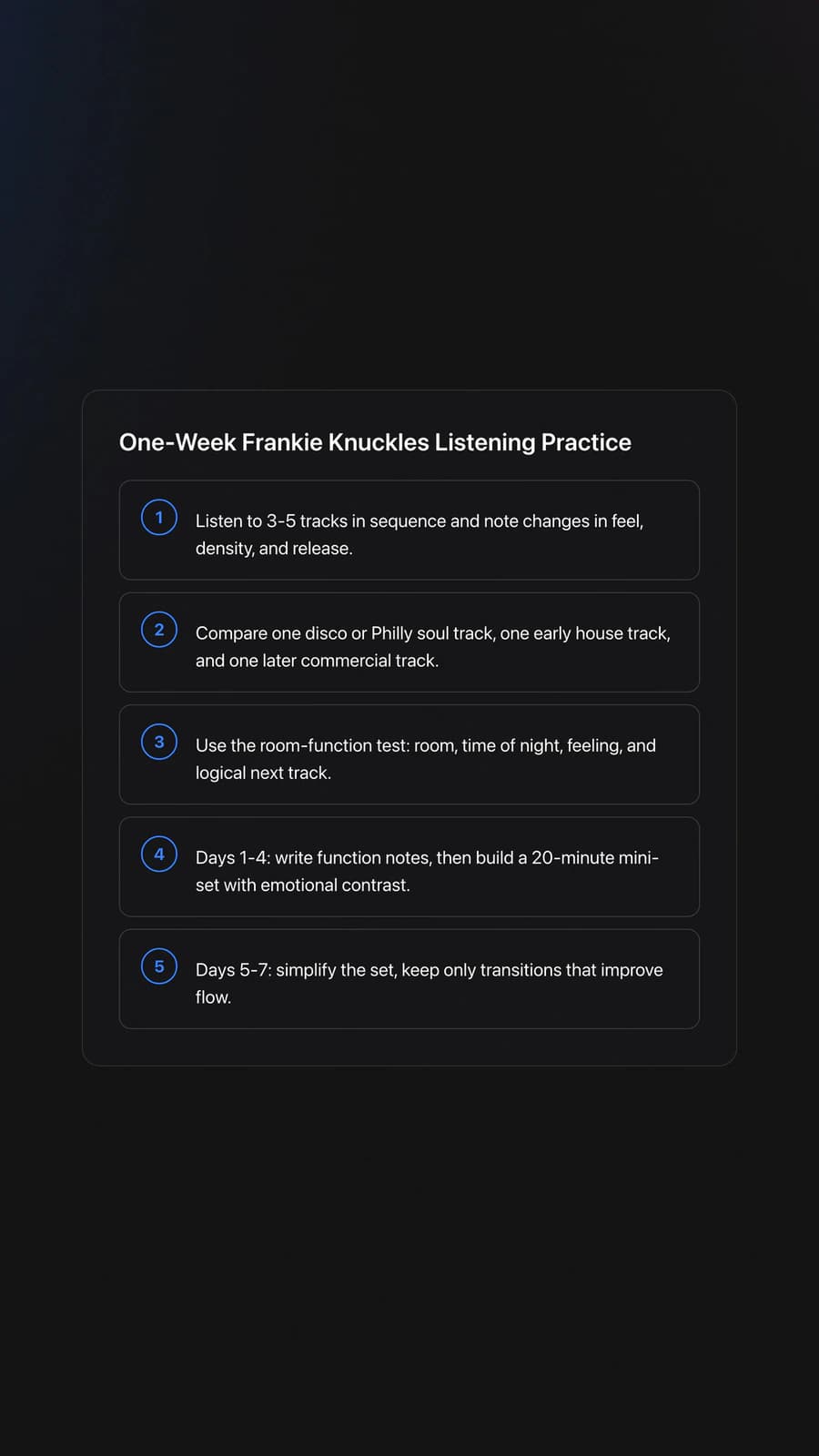
Start with sequence, not just singles. Play three to five key records in a row and ask what changes from one to the next. Notice tempo feel, vocal density, percussion pressure, and release points.
Next, compare his work to what came before. Put a disco or Philly soul record beside an early house record and listen for continuity. Then compare that house record to a later, more commercial track and listen for what was gained and lost.
This is where a simple listening framework helps. I call it the room-function test. For each track, ask four questions: what kind of room does it suit, what point in the night does it suit, what feeling does it create, and what track should logically follow it.
That framework keeps the music alive. It turns history into usable judgment.
It also fits the self-taught path many DJs take. A lot of people do not learn this music through formal instruction. They learn by playing tracks, watching reactions, uploading rough mixes, correcting mistakes, and gradually finding flow. That intuitive route is slower in some ways, but it often builds stronger musical instincts.
If you want a concrete practice loop, do this for one week:
- Day 1-2. Listen to five Frankie Knuckles tracks without mixing. Write one function note for each.
- Day 3-4. Build a 20-minute mini-set using only tracks with clear emotional contrast.
- Day 5-7. Rebuild the set with fewer transitions and more patience. Keep only what improves flow.
Validation Check
Common Mistakes When Learning Frankie Knuckles
| Mistake | Why It Happens | How to Avoid |
|---|---|---|
| Treating him as a solo inventor | People want a clean origin story | Study the wider Chicago scene alongside his role |
| Focusing only on biography | Names and dates are easier than listening | Pair every fact with one key track or set |
| Reducing house to one sound | Classic tracks get grouped too broadly | Compare sparse, vocal, raw, and melodic examples |
| Hearing history but not function | Legacy talk can turn records into artifacts | Ask where each track works in a room |
| Ignoring Black and queer club roots | Later mainstream histories flatten the context | Keep the social setting tied to the sound |
The most common reading and listening errors
Conclusion: Why Frankie Knuckles Still Matters
Frankie Knuckles still matters because he represents more than one thing at once. He is a historical figure, a practical model for DJs, and a reminder that genres are built inside scenes before they are packaged for mass culture.
Keep these three takeaways:
- Frankie Knuckles was one of house music's main creators, not a myth added later.
- The Warehouse, its crowd, and its musical gaps were essential to the genre's birth.
- His records still teach sequencing, restraint, and emotional control.
If you want to go further, stop reading summaries and start listening in sequence. That is where his legacy becomes concrete.
The visual way to organize your DJ library
Tag tracks by vibe. See everything at once. Export to rekordbox, Serato, Traktor or Engine DJ.
14-day free trial. Full access, no strings attached.
or see how it works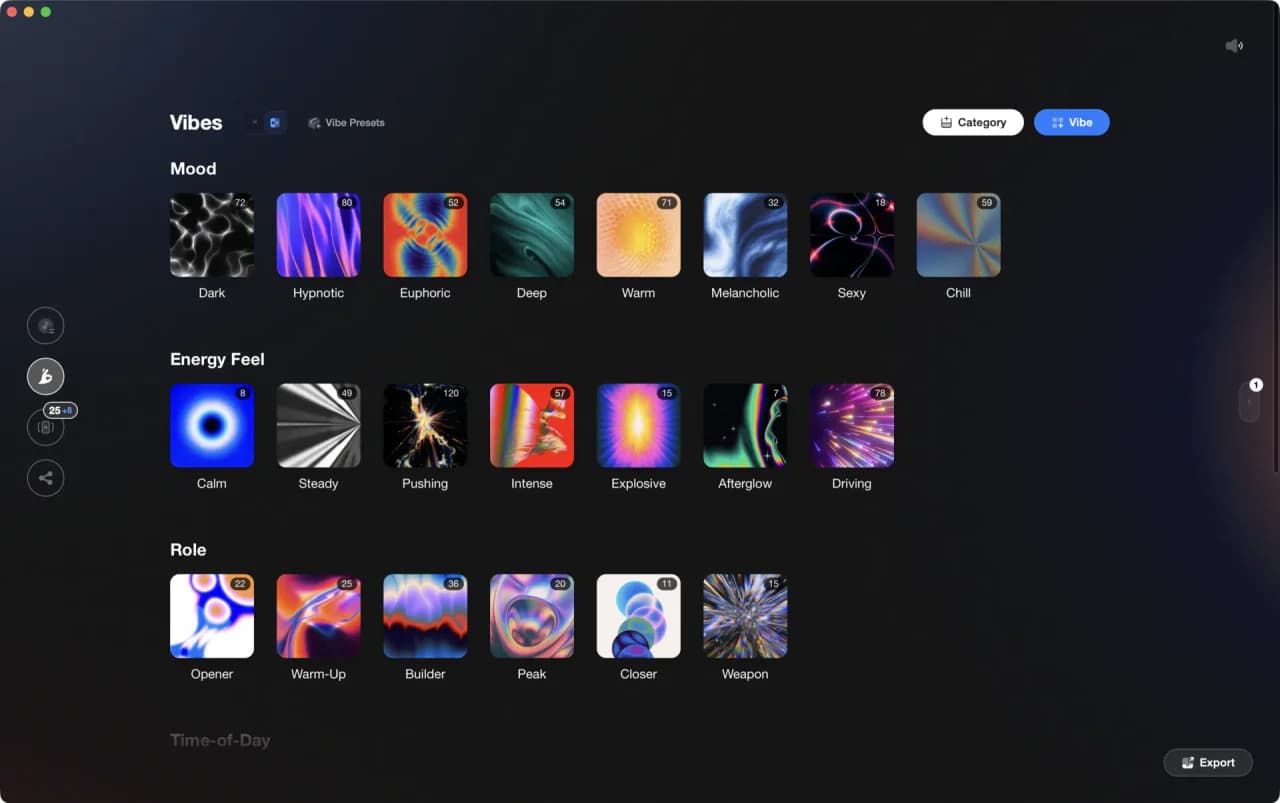
Techniques Covered
Continue Your Learning Journey
Frequently Asked Questions

Hey, it's Ben Modigell 👋
I DJ and produce as so I so: downtempo, minimal, dub house, tech house, and techno (releases on Spotify and SoundCloud, links above). Everything I write here comes from my own gigs, studio sessions, and library cleanups: the rules I follow, the failure modes I have actually hit, and the workflow I use when nobody is watching. If a technique did not earn its place in my own sets, it does not make it into a tutorial.