Watch Club Ready DJ School’s tutorial above (33K views on YouTube).
This guide is for DJs and electronic music listeners trying to pin down what deep house actually is, why some tracks feel timeless while others feel generic, and how to build better flow around that sound. After reading, you will be able to identify core deep house traits, separate it from nearby styles, and use those traits to choose, sequence, and mix tracks more deliberately.
Deep house is not just slower house with softer drums. It is a groove language built on warm chords, restrained low-end movement, space in the arrangement, and emotional control rather than constant impact. That distinction matters if you want your sets to feel intentional instead of flat.
If you are still refining your ear, start with the bigger picture first. Think in three layers: harmonic depth, groove patience, and energy shape. That mental model will make the rest of the genre much easier to hear.
Deep house also connects naturally to adjacent DJ workflows like house music structure basics, DJ set flow and energy, playlist curation methods, and harmonic mixing fundamentals. Those topics become more useful once you can hear what makes a track feel deep in the first place.
Deep House Definition and Core Traits
Deep house is a subgenre of house music that emerged in Chicago in the mid-1980s, shaped by producers such as Larry Heard and by a stronger blend of soul, jazz-funk, and melodic harmony than tougher club-focused house variants. Most descriptions place it around roughly 110 to 125 BPM, with warm pads, muted basslines, spacious percussion, and richer chord movement than more stripped styles.
The short definition is useful, but it does not help much in a mix. In practice, you identify deep house by how it behaves over time.
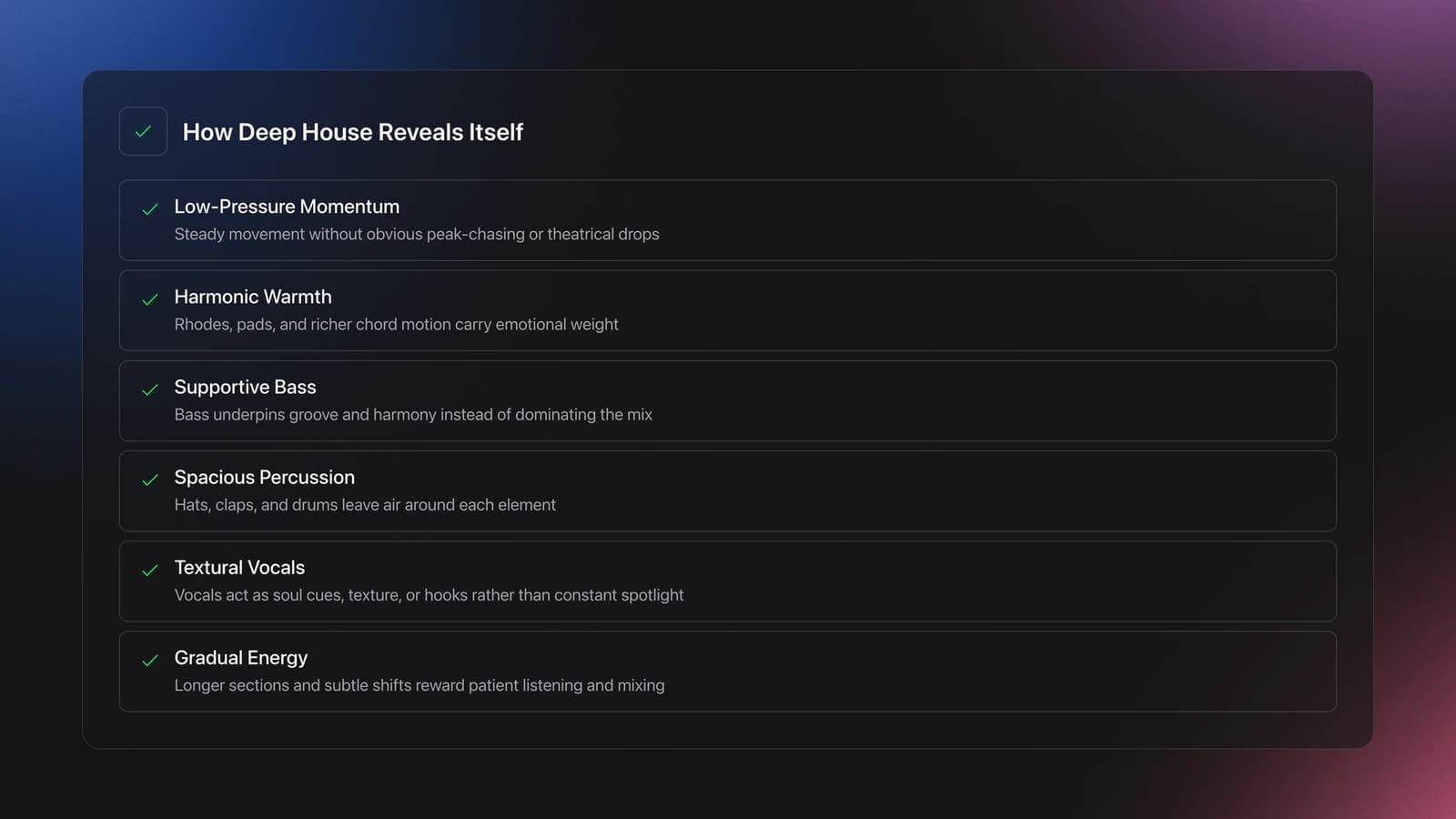
A deep house track usually avoids obvious peak-chasing. It builds trust through repetition, tone, and subtle changes rather than constant drops.
That gives you the first key concept. I call it low-pressure momentum. The track keeps moving, but it does not force every bar to announce itself.
- Warm, sustained chords instead of bright rave stabs
- Basslines that support the groove more than dominate it
- Percussion with space around each element
- Vocals used as texture, soul cue, or emotional hook
- Longer sections that reward patient mixing
- Energy changes that feel gradual, not theatrical
Example one. Take a track at 122 BPM with Rhodes-style chords, a round kick, light hats, and a bassline that lands cleanly under the harmony. Even before a vocal enters, it already reads as deep because the harmonic bed carries emotional weight.
Example two. Compare that with a 124 BPM track that uses the same tempo but adds a hard offbeat bass, bright lead stab, and sharper clap focus. The BPM is similar, but the emotional center shifts toward tech house or commercial house. Tempo alone tells you very little.
A common failure mode is labeling any mellow house track as deep house. The symptom is a playlist full of tracks that are slow and polished but harmonically thin. You end up with surface mood and no emotional depth.
You will know you are hearing real deep house when the groove holds your attention without obvious peaks, the chords carry mood on their own, and the track still feels alive after a long blend.
Genre histories from sources like Britannica's house music overview, Trax Records' label history, and the genre summaries collected in reference material on deep house all point back to that Chicago lineage and to the soul- and jazz-shaped harmonic identity that separated deeper records from more functional club cuts.
If you want to anchor the sound in actual records, start at the source. Larry Heard, recording as Mr. Fingers, is widely treated as the genre's origin point, and two tracks do most of the defining work. "Mystery of Love" from 1985 introduced the warm, funk-leaning groove that set deep house apart from the rest of early electronic dance music, and "Can You Feel It" followed with the dreamy pads and emotional weight that the style still chases today. Listening to those two records first gives you a reference for what "deep" actually means before you start sorting modern tracks.
From there, the lineage fans out in useful directions. Kerri Chandler brought a warmer New Jersey groove, blending garage-house rhythm with jazz voicings and soulful texture. Moodymann (Kenny Dixon Jr.) pushed the genre toward gritty, sample-rich, raw analog production rooted in Detroit soul and funk. Hearing how those three approaches differ, Heard's melodic warmth, Chandler's bass-forward soul, and Moodymann's loose grit, trains your ear faster than any single definition, because they map the genre's range while all staying recognizably deep.
Deep house reference tracks
A starting crate of deep house, pulled from our DJ track index with live BPM and Camelot keys (these run roughly 115-132 BPM). Beatmatch to each track's tempo, use the long intros and outros to blend, and swap on the phrase. Click any row to open its full sonic profile.










What Defines a Deep House?
What defines a deep house? The clearest answer is the relationship between harmony, groove, and restraint. Deep house uses chord color and subtle rhythmic movement to create immersion, then lets that atmosphere breathe instead of crowding it with constant high-energy events.
This is where listeners often get confused by tags. A track can borrow ambient house music textures, lounge polish, or soft house music pacing and still not land as deep house if the groove architecture is wrong.
The second key concept is emotional density. This means how much feeling the track carries without needing dramatic arrangement tricks.
High emotional density usually comes from chord voicing, bass restraint, and space. Low emotional density often comes from over-arranging a simple idea.
For DJs, this matters because deep house tracks can sound similar in previews but behave very differently in a set. One track will sit under another track beautifully. Another will feel washed out or vague the second you layer it.
A useful working filter is this:
- Does the harmony carry the track, even without the hook?
- Does the groove invite a long blend?
- Does the energy unfold gradually rather than spike?
- Would the track still make sense in a low-light room, not just a festival clip?
If the answer is yes to most of those, you are probably in deep house territory. If not, you may be hearing a neighboring form instead.
Deep House Sound Design and Arrangement
This section matters if you want to move beyond labels and into recognition. The sound of deep house comes from arrangement choices as much as sound choice.
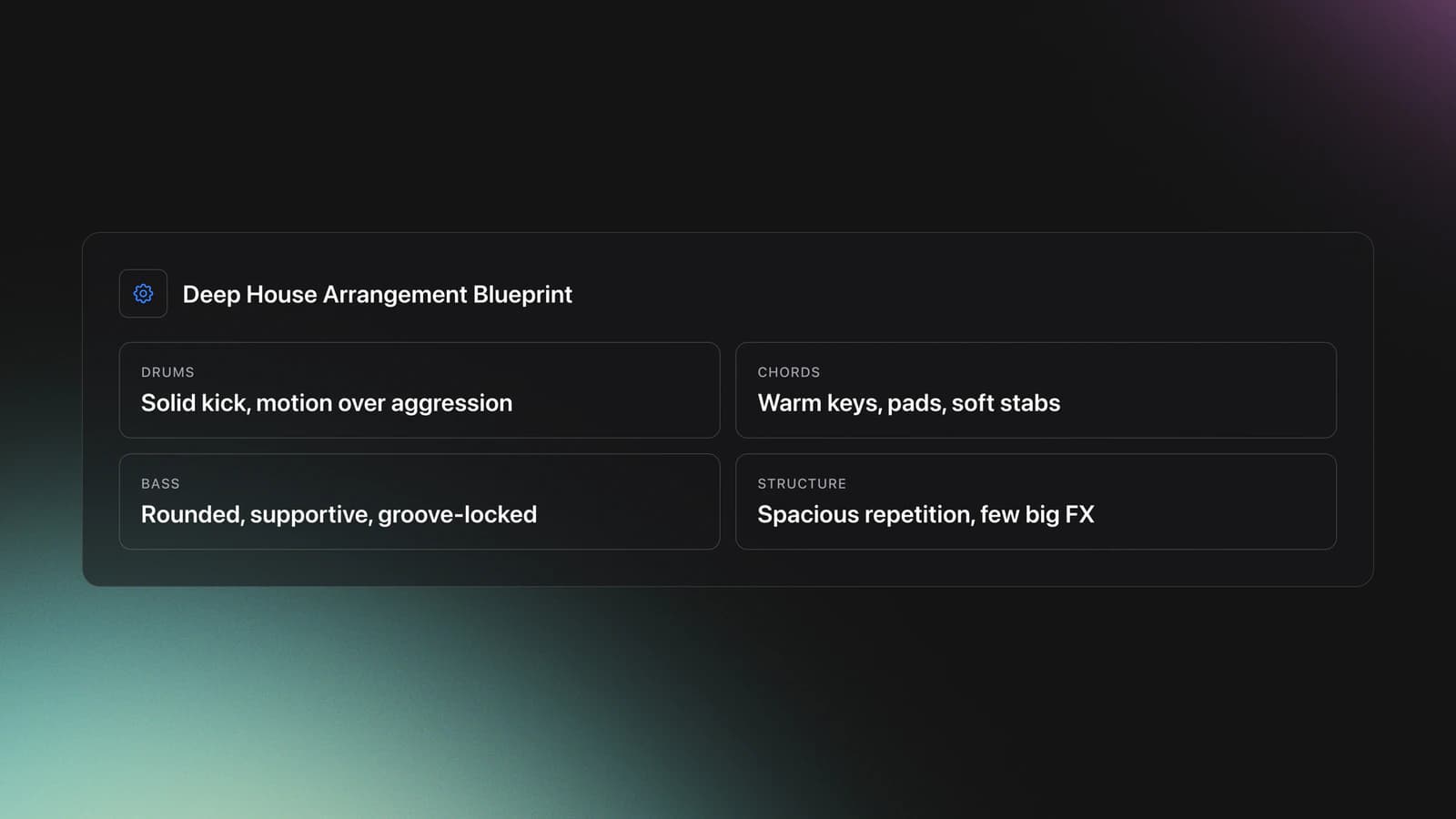
Start with drums. Deep house usually keeps the kick solid and centered, but it avoids turning the drum bus into the whole identity of the record. Hats, shakers, claps, and percussion push motion, not aggression.
Then listen to the chord instrument. Rhodes-style keys, pads, organ colors, and soft stabs do a lot of the emotional work. The chord progression often matters more than the melody.
Now the bass. In many deep house records, the bassline feels supportive and rounded rather than sharply sculpted for impact. It locks the floor and leaves room for harmony to stay audible.
Example one. A classic-feeling deep house track might use a four-on-the-floor kick, dusty clap, closed hat groove, warm minor seventh chords, and a simple bass phrase that repeats with tiny variation. The result feels human, even if every sound is electronic.
Example two. A more modern deep house song may add cleaner top-end, a tighter sidechain, and brighter vocal texture, yet it still works as deep house if the arrangement remains spacious and the harmonic center stays warm.
Notice what is missing. You do not need huge risers, giant snare rolls, or constant switch-ups. Deep house gains power by trusting repetition.
This is where it gets useful for mixing. Because the arrangement leaves room, deep house often tolerates longer overlaps than busier styles. A patient blend can sound better than a flashy cut.
That said, longer blends only work when the low-end, vocal phrasing, and chord tension stay compatible. If both tracks have busy mids or competing hooks, the overlap goes cloudy fast.
A common failure mode is overvaluing surface softness. The symptom is a folder of smooth tracks that have no internal movement. They sound good alone for 30 seconds, then disappear in a set.
You will know your ear is improving when you can predict, before mixing, whether a track wants a long transition, a short handoff, or a reset between phrases.
That prediction comes from repeated listening, not theory alone. Coming from a downtempo and minimal background, the way I learned structure and the right transition length was by hearing the same records over and over until the space inside them became obvious. The more deep house you blend in practice, the faster you can hear whether a record's space invites a long overlap or asks to be handed off quickly.
For present-day genre organization, Beatport's genre and sub-genre documentation is also useful. Not because Beatport defines culture by itself, but because it shows how active platforms still classify house subgenres for working DJs and labels.
Deep House vs Nearby Styles
Most confusion around deep house comes from overlap. Genres share BPM ranges, drum patterns, and vocal textures. The difference is usually in emphasis.
| Style | Core Focus | Typical Feel | Mixing Implication |
|---|---|---|---|
| Deep house | Harmony plus groove | Warm, immersive, patient | Supports long blends and subtle energy shaping |
| Tech house | Rhythmic punch and functionality | Tighter, drier, more percussive | Often benefits from cleaner handoffs and stronger contrast |
| Ambient house music | Atmosphere and texture | Drifty, spacious, less floor-driven | Works as setup or reset, not always as core dancefloor engine |
| Deep house lounge | Polish and relaxed mood | Smooth, accessible, sometimes less club-focused | Useful in warm-up spaces but can flatten a peak slot |
| Soft house music | Reduced intensity | Gentle and easygoing | May overlap with deep house, but not always harmonically rich |
| Deep house hip hop crossover | Beat-led fusion and vocal attitude | Head-nod meets house pulse | Requires tighter curation to avoid breaking set coherence |
Deep house makes the most sense when compared by behavior, not just by tags.
The practical question is not whether a track is pure. The practical question is what job it can do.
A deep house song can open a room, reset tension after a harder stretch, or hold a groove for ten minutes without feeling empty. A more lounge-coded record may only work in the first case. A tech house cut may only excel in the second.
This is why broad genre labels break down in performance. You need sub-buckets based on function.
For example:
- Deep and warm
- Deep and driving
- Deep with vocal lift
- Deep reset tracks
- Deep crossover records
That kind of structure gives you better options when energy starts to drift. Some DJs use color coding or comments. Others prefer hierarchical systems so one track can live under mood, energy, and set function at the same time. Build custom categories for mood, function, and energy, then lean on them when you sequence. If you would rather not wrestle that taxonomy into a generic music app, Vibes was built to hold exactly these mood and set-function buckets so a "deep reset after a vocal record" is something you can actually pull up mid-set. The important part is not the software. It is having a repeatable system before the gig.
You will know your categories are working when you can answer a specific need fast. Not just 'play another deep house track,' but 'find a deeper bridge after a vocal record that keeps the room moving without making the set brighter.'
Deep House Mixing: Transitions, Loops, and Energy
Once you understand the genre, mixing choices get clearer. Deep house often gives you more room to shape the transition because the tracks leave space in the arrangement.
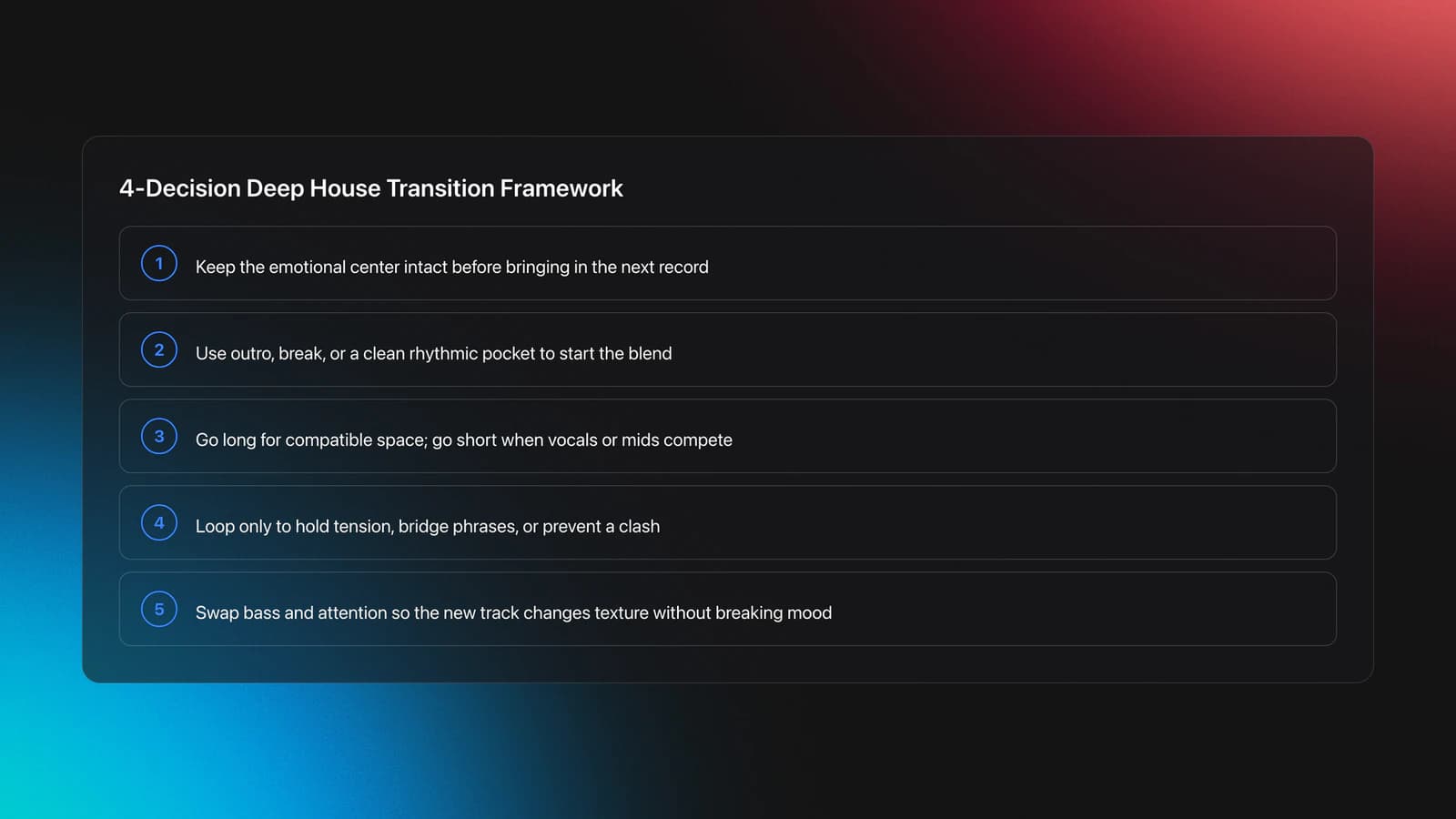
The transcript behind this article frames transitions around four decisions: how much of the current track to play, where the safe mix point is, how long both tracks should overlap, and what track should come next. That is a strong framework for deep house too.
Start with the simplest move. If a track is landing well and you want to respect its full arc, mixing the next record over the outro is often the cleanest choice.
But that should not become your only move. Deep house can get repetitive if every transition waits for the final bars.
Example one. Track A has a full vocal chorus and then drops into a stripped outro. Track B has a clean drum intro. You can cue Track B about 16 bars before Track A's chorus ends, use those bars to align phrasing and EQ, and then swap bass dominance as the chorus resolves. The audience hears continuity, not interruption.
Example two. Track A has a useful mid-song break but returns with a vocal line that will clash with Track B. In that case, loop a short rhythmic segment from Track A, keep only the texture you want, and let Track B take over the narrative. That preserves vibe without letting the old track re-enter at the wrong moment.
This is the operational rule. Respect the emotional center of the phrase. If the chorus, chord lift, or vocal statement is the reason the track works, do not cut it in half just because you are eager to move.
Shorter mixing can still be useful. If two records carry too much harmonic information or too many vocal elements, a faster transition protects clarity.
Longer mixing works when both tracks have compatible groove density. Faster mixing works when one of them needs to stop talking.
Looping becomes especially helpful in deep house because subtle repetitions do not feel as jarring as they might in more aggressive genres. A four- or eight-beat loop can hold tension, delay a phrase, or turn a fading groove into a bridge.
A failure mode here is looping without purpose. The symptom is a transition that sounds mechanically extended instead of musically framed. If the loop does not reveal a groove, support a handoff, or build a clear climax, it is probably filler.
You will know the transition worked when the room experiences a change in texture or energy without losing the thread of the set.
Deep House Set Flow and Track Selection
Track selection matters more than transition tricks. Deep house lives or dies on sequencing.
A good set does not just stack similar records. It moves through related shades without losing identity.
Why does this matter for deep house workflow? Because the genre is subtle. If every record has the same temperature, same vocal weight, and same harmonic color, the set starts to blur.
The third key concept is contrast inside coherence. You want enough variation to create motion, but not so much that the room loses trust.
This usually means sequencing by feel first, not by genre purity. Many experienced selectors move between downtempo edges, warmer deep house cuts, more driving records, and occasional crossover moments while keeping a clear emotional spine.
One real-world lesson from daytime festival and local venue sets is that atmosphere often matters more than venue prestige. A strong system, enough space to breathe, and a crowd ready to listen can make a modest room feel better than a bigger booking. That is exactly why deep house selection should focus on mood control, not just name value.
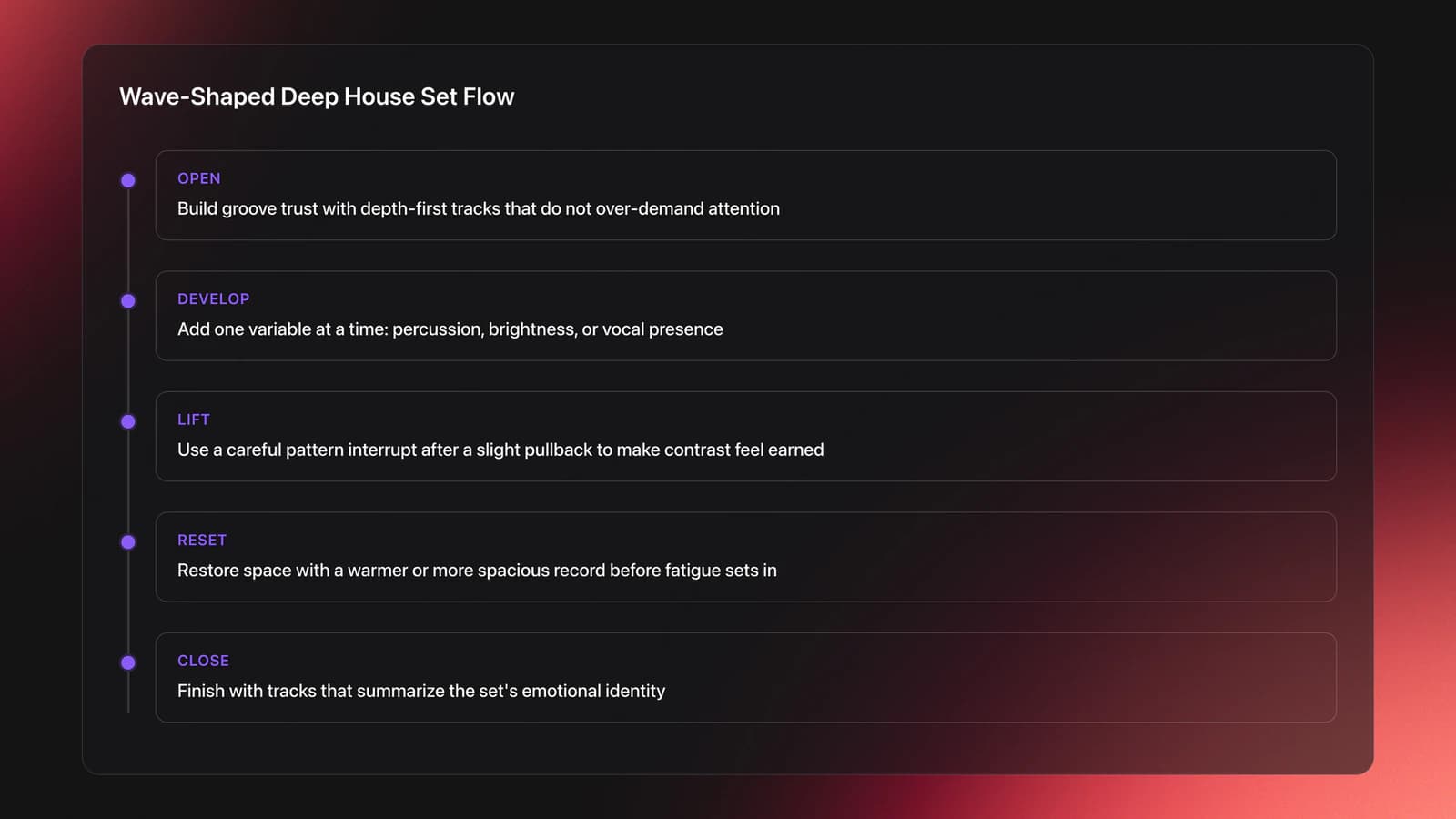
A useful progression model looks like this:
- Open with groove trust. Use tracks that establish depth without demanding attention.
- Add one variable at a time. Raise percussion, vocal presence, or brightness, but not all three at once.
- Create pattern interrupts carefully. A known vocal, brighter riff, or tougher groove works better after a slight pullback.
- Reset before intensity fatigue sets in. Use a warmer or more spacious record to restore contrast.
- Close with identity. End on records that summarize the set's emotional logic.
This also solves a common beginner problem. Many newer DJs think they need to keep raising energy every few minutes. In deep house, that often kills the point.
A better method is wave shaping. Pull back slightly before a lift. Then land the lift with intent. The contrast makes the bigger moment feel earned.
A common failure mode is overusing remixes, recognizable vocals, or crossover records back to back. The symptom is that the set starts sounding obvious and loses its internal depth.
Validation Check
Is Deep House Considered an EDM?
Is deep house considered an EDM? In the broadest sense, yes. It is electronic dance music. But that umbrella term is often too blunt to be useful.
In practice, many DJs and listeners use EDM to describe more peak-driven, festival-coded dance music. Deep house often sits outside that expectation because its design priorities are different.
If you call deep house EDM in a general music conversation, you are not wrong. If you are trying to describe programming choices, crowd expectations, or set architecture, the label tells you almost nothing.
That is why genre precision matters for working DJs. The room does not respond to taxonomy. It responds to structure, tension, and emotional pacing.
Why Is It Called Deep House?
Why is it called deep house? The term points to a deeper emotional and harmonic approach within house music rather than a harder or faster one. Early usage is tied to Chicago's evolving house scene, where producers and DJs pushed beyond raw drum-machine functionality toward warmer, more soulful, more musically layered records.
That deeper quality shows up in multiple ways. The bass often feels rounder. The chords carry more color. The atmosphere feels more internal.
So the word deep is not just branding. It describes the listening experience.
Common Deep House Mistakes
| Mistake | Why It Happens | How to Avoid |
|---|---|---|
| Tagging every mellow track as deep house | Tempo and polish are easier to hear than harmony | Sort by chord feel, groove density, and set function |
| Playing only full tracks with outro mixes | It feels safe and keeps phrasing simple | Practice mid-track entries and loop-assisted exits |
| Building sets with no contrast | Tracks sound compatible in isolation | Alternate warm, driving, vocal, and reset records deliberately |
| Overlapping busy vocals or mids | Both tracks seem smooth on their own | Shorten the blend and remove one track's narrative layer early |
| Confusing playlist mood with dancefloor function | Home listening and floor response are different | Test tracks in sequence, not as single previews |
Most deep house problems come from selection and phrasing, not from lack of effects.
Deep House Quick Listening Checklist
Use this when screening deep house tracks before adding them to your working library.
- Check whether the chord progression still carries mood without the hook
- Listen for bass support rather than bass dominance
- Note whether the groove invites a long blend
- Mark the emotional role: opener, builder, bridge, reset, closer
- Test one transition in context before trusting the genre tag
If you maintain a large local collection, this is also where preparation systems pay off. The practical issue is not owning enough deep house music. It is retrieving the right shade of deep house fast enough when the room changes. A structured library, whether built by folders, comments, or a category-based system, reduces that decision lag and makes intuitive playing more reliable.
Conclusion: Deep House as a DJ Tool
Deep house works because it gives you depth without chaos. The best records carry emotion through harmony, groove, and restraint, then leave enough space for long blends and careful sequencing.
Keep these takeaways in mind:
- Hear deep house through harmony, groove patience, and energy shape
- Organize tracks by behavior and function, not just genre tags
- Use transitions to preserve mood, not just to change songs
If you want better results fast, spend your next session comparing how three deep house tracks behave in sequence instead of hunting for more tracks. The genre becomes clearer when you test flow, not just labels.
The visual way to organize your DJ library
Tag tracks by vibe. See everything at once. Export to rekordbox, Serato, Traktor or Engine DJ.
14-day free trial. Full access, no strings attached.
or see how it works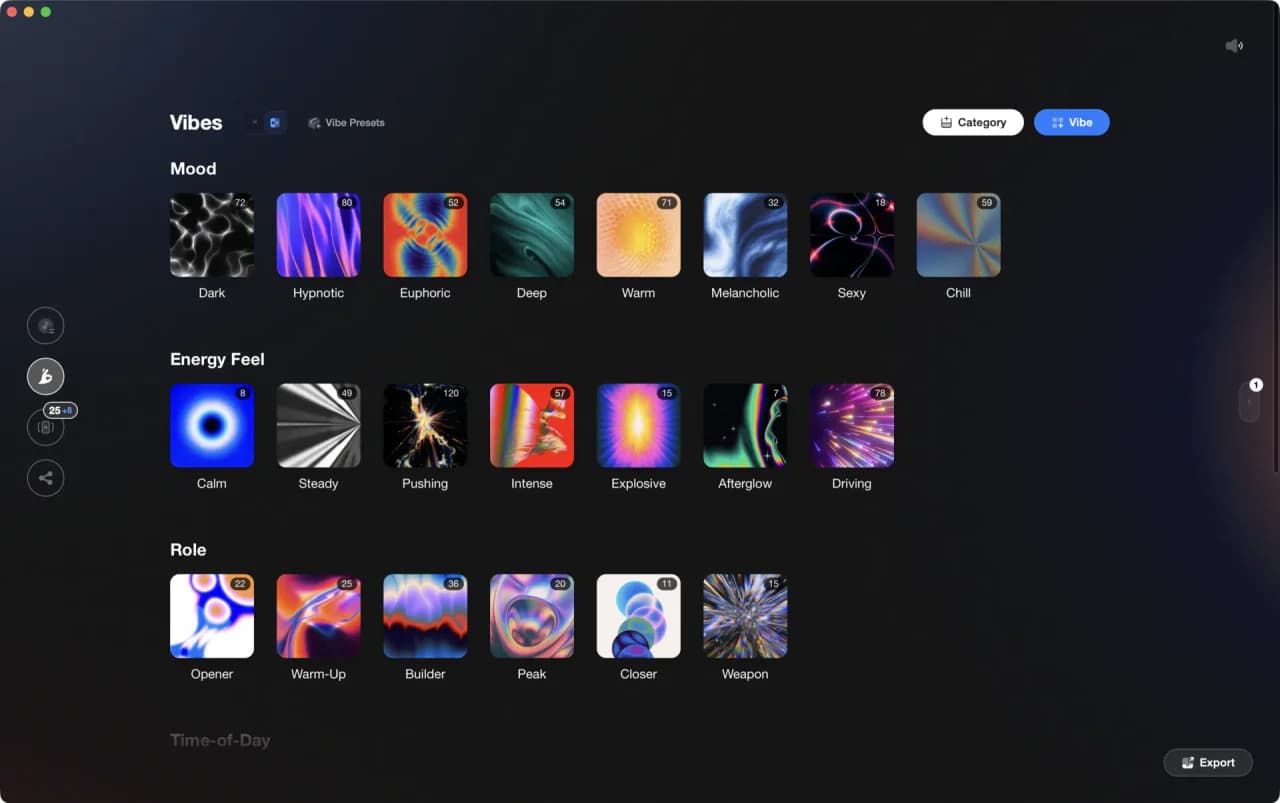
Techniques Covered

Equipment & Software
Continue Your Learning Journey
Start Here First


Related Content
House Music Explained
intermediate
House Trance: Sound, Structure, Mixing
intermediate
90s House Music: Origins, Sound, Key Tracks
intermediate
How To Mix In Key Live: Worked Transitions And Failure Fixes
intermediate
Harmonic Mixing Guide for DJs: Energy & Workflow
intermediate
DJ Record Pool Guide for Working DJs
intermediate
DJ Library Organization System: Tags, Crates, Keys
intermediate
DJ Transitions: The Three-Layer Handoff for Beginners
intermediate
Transition DJ Online: Browser Mixer Workflow
intermediateFrequently Asked Questions

Hey, it's Ben Modigell 👋
I DJ and produce as so I so: downtempo, minimal, dub house, tech house, and techno (releases on Spotify and SoundCloud, links above). Everything I write here comes from my own gigs, studio sessions, and library cleanups: the rules I follow, the failure modes I have actually hit, and the workflow I use when nobody is watching. If a technique did not earn its place in my own sets, it does not make it into a tutorial.