Phrasing
Phrasing helps DJs align musical sections so transitions land at the right moment and feel natural on the dancefloor.
Phrasing Tutorials
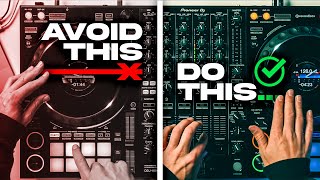

Phrasing is one of the fastest ways to make beginner DJ mixes sound intentional. If your transitions feel late, rushed, or messy even when the BPM is correct, phrasing is often the missing skill. Phrasing teaches you where musical sections begin and end so each move lands at a moment that makes sense.
For DJs, phrasing matters because crowds hear structure before they hear technique. When you start the next track on the right bar, breakdowns meet breakdowns, intros support outros, and energy changes feel natural instead of random.
In practice, learning phrasing unlocks smoother blends, cleaner drop-ins, and more confident timing across house, techno, hip-hop, and open-format sets. It also makes other skills easier, especially when you build reliable beat matching control and start planning transitions around song structure instead of guesswork.
What Is Phrasing?
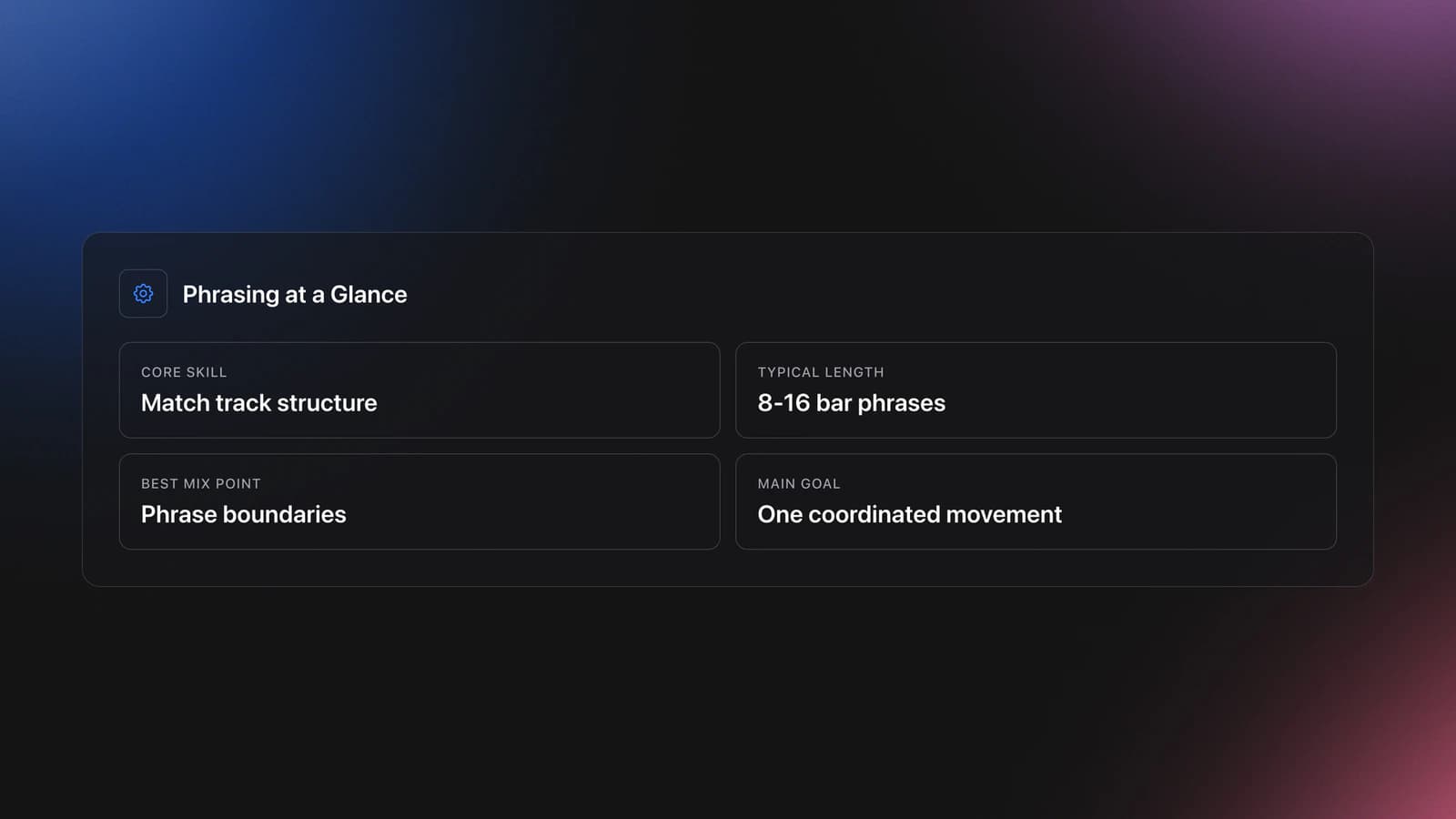
Phrasing is the skill of recognizing and using musical sections, usually built from bars and phrases, so transitions happen at structurally correct moments. In most DJ-friendly music, phrases often run 8 to 16 bars, and new elements tend to enter or leave at those boundaries.
The basic idea is simple. You are not only matching tempo. You are matching the shape of one track to the shape of another.
Educational breakdowns from the Native Instruments phrase mixing guide and the Point Blank guide to beats bars and phrases both describe phrases as short musical sections, commonly 8 to 16 bars, where arrangement changes become easy to hear and useful for mixing.
That is why phrasing sounds so professional when done well. One track may be stripping back into an outro while the next is building through an intro. The listener hears one coordinated movement instead of two unrelated records fighting for space.
Why Phrasing Matters in DJ Sets
Phrasing matters because it controls timing, energy, and clarity at the same time. If beats are aligned but phrases are not, the mix can still sound wrong because drops, vocals, or breakdowns collide.
Crossfader's Crossfader phrasing lesson explains this clearly: transitions improve when songs are layered in phrases so their changes happen together. That one idea solves a huge number of beginner mixing problems.
It also gives you more control over set flow. You can preserve tension, extend groove, swap energy levels, or prepare a fast cut without shocking the room.
- Cleaner transitions because structural changes line up
- Better energy control across intros, drops, and breakdowns
- Less vocal and bassline clutter during blends
- Faster decision-making when mixing under pressure
- A stronger foundation for add harmonic mixing to cleaner blends
How to Hear Phrasing
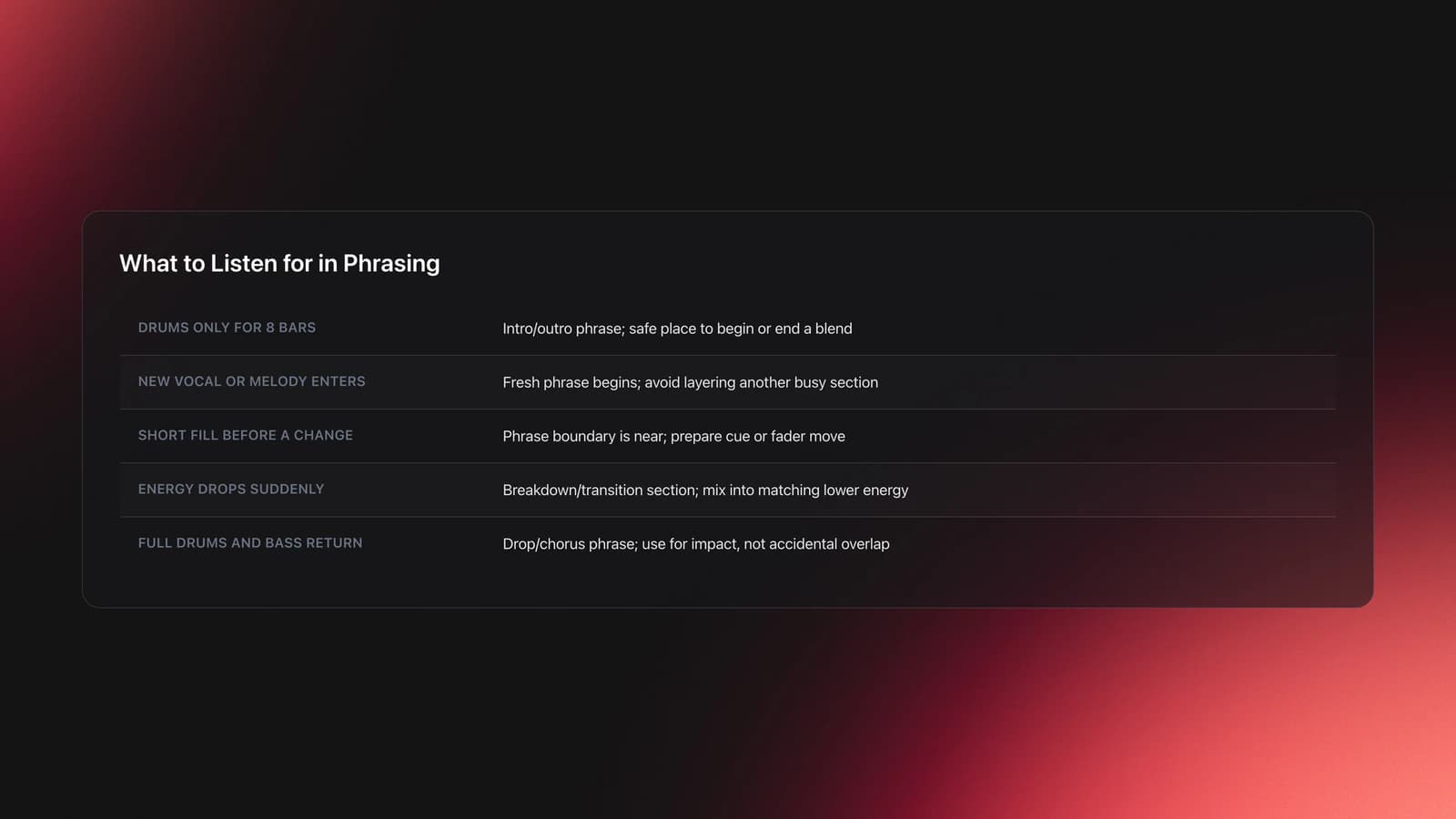
You hear phrasing by counting bars and listening for arrangement changes. In most dance music, each bar has four beats, and phrase boundaries often arrive after 8 or 16 bars with a new drum layer, vocal entry, fill, breakdown, or drop.
Start by counting like this: 1234, then the next bar, up to bar 8. When you reach the end of that cycle, listen for something to change. Native Instruments and Point Blank both highlight counting in bars as the practical path to identifying phrases.
You are listening for pattern resets. A hi-hat opens up. A clap drops out. A vocal starts. A riser ends. Those moments usually signal the start of a new phrase.
Waveforms can help, but they should confirm what your ears already suspect. Phrasing is strongest when you can feel the section change before you see it.
| What You Hear | What It Usually Means | How to Use It |
|---|---|---|
| Drums only for 8 bars | Intro or outro phrase | Good place to start or end a blend |
| New vocal or melody enters | Fresh phrase begins | Avoid stacking another busy section over it |
| Short fill before a change | Phrase boundary is coming | Prepare the cue or fader move |
| Energy drops suddenly | Breakdown or transition section | Mix into a matching breakdown or controlled build |
| Full drums and bass return | Drop or chorus phrase | Use for impact, not accidental overlap |
How to Use Phrasing in a Transition
To use phrasing in a transition, start the incoming track at the beginning of a phrase so its structure matches the outgoing track's next phrase change. The goal is simple: when one track changes section, the other changes with it.
This is the most common beginner workflow. First, identify the mix-out point in the playing track. Second, find a compatible phrase start in the next track. Third, trigger the new track on the correct count.
The Native Instruments phrase mixing guide recommends prepping tracks, listening for phrases, setting cue points, beatmatching, and then planning the transition. That sequence works because it separates structural listening from performance pressure.
A simple example helps. If the playing track is four bars away from an outro phrase ending, count those four bars. Then launch the incoming track at the phrase start that lets its intro complete right as the old track clears space.
If you use sync, phrasing still matters. Sync can align tempo, but it does not decide whether a breakdown should land against a drop.
- Count the outgoing track to the next phrase change.
- Cue the incoming track at a phrase start.
- Match tempo with ears or sync.
- Start the new track on beat one.
- Blend through one full phrase.
- Exit the old track as the new section takes over.
Once this becomes consistent, you can experiment with shorter swaps, longer overlays, or practice fast drop mixing transitions. But the timing rule stays the same.
Equipment and Setup for Phrasing
You do not need advanced gear to learn phrasing. Two playable decks, a mixer or controller, headphones, and tracks with clear structure are enough.
What helps most is not expensive hardware. It is clear reference points. Cue points, beat grids, and waveform overviews speed up learning, but they work best after you understand why the phrase boundary matters.
The Crossfader hot cue structure guide shows a useful setup: mark intro, build-up, drop, and breakdown points in chronological order. That kind of mapping makes phrasing visible and repeatable across your library.
If you practice with local files, a structured library also helps. In Vibes, you can group tracks by intro length, energy profile, and transition role so your phrasing drills use examples that actually compare well. That keeps practice focused instead of random.
Practice Drills for Phrasing
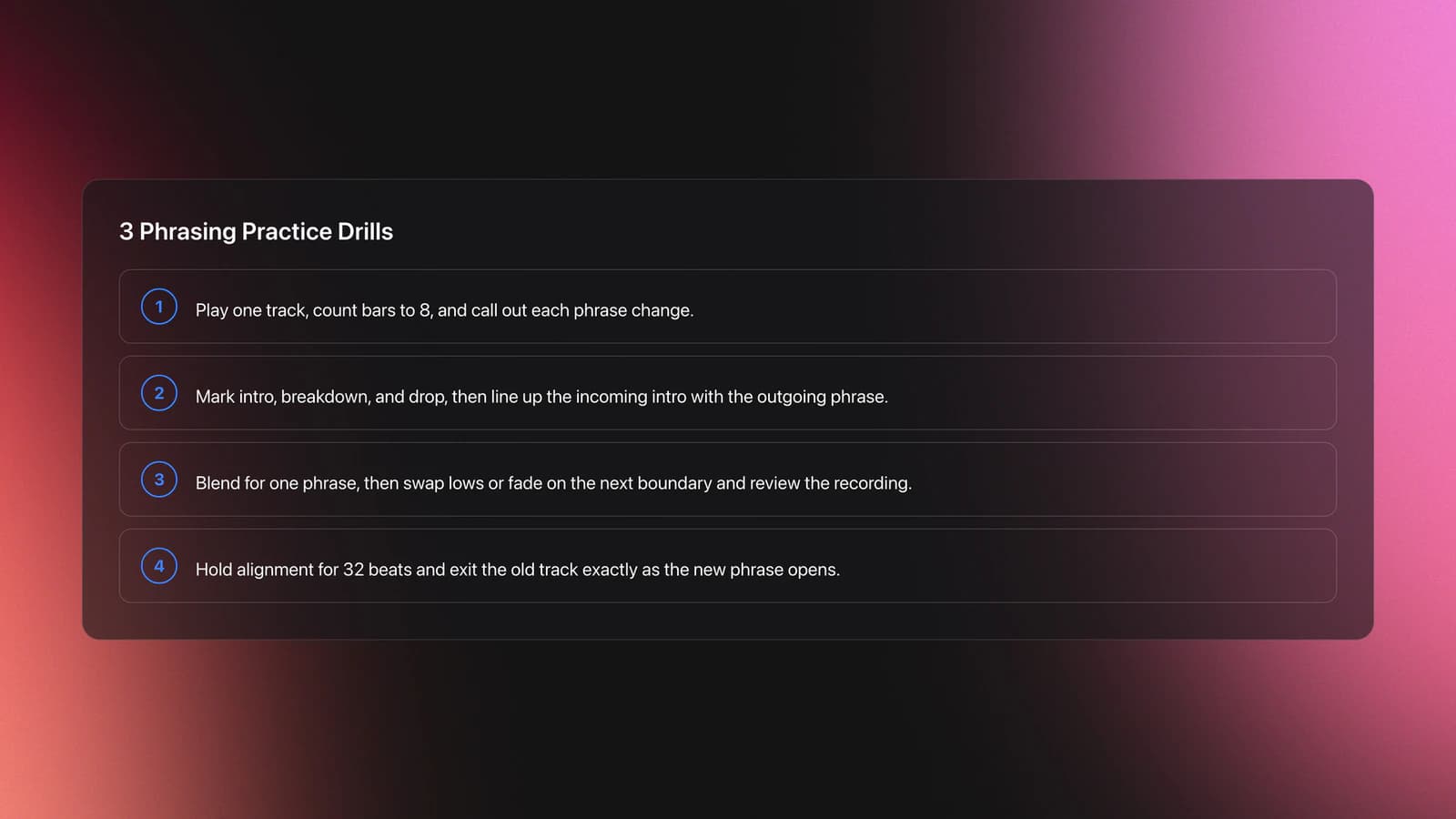
The fastest way to improve phrasing is short, focused repetition. In practice, isolated phrase-count drills improved timing faster than full-length marathon mixes, because they train one decision at a time.
Start with two tracks in the same BPM range and with clear intros and outros. Avoid tracks with unusual edits until your counting is stable.
Drill one is pure counting. Play a track, count bars to eight, and say out loud when the phrase changes. Do not touch the mixer yet. Just predict the next structural shift.
Drill two adds cueing. Mark the first beat of the intro, breakdown, and drop on each track. Then launch the incoming track so its intro phrase lines up with the outgoing track's outro or breakdown.
Drill three adds execution. Blend for exactly one phrase, then swap the low end or fade out the old track on the next phrase boundary. Record it and listen back for sections that feel early or late.
Most instructors recommend staying with the same small group of tracks for several days. Repetition teaches you what a phrase feels like, not just what it looks like.
A strong checkpoint is this: can you hold phrase alignment for 32 beats, then exit the old track exactly as the incoming phrase opens up? If yes, your phrasing is becoming dependable.
Common Mistakes With Phrasing
Most phrasing mistakes come from rushing the start point or ignoring what the arrangement is doing. The fix is usually not more effects. It is cleaner counting and better phrase selection.
| Mistake | Why It Happens | Fix |
|---|---|---|
| Starting on beat one but wrong phrase | Tempo is matched, but bars were not counted to the section change | Count to the next 8 or 16-bar boundary before pressing play |
| Drop collides with vocal or breakdown | The incoming section is too busy for the outgoing section | Choose an intro, outro, or breakdown phrase with matching energy |
| Trusting waveform only | Visuals are faster than listening, but can hide musical context | Use waveform as confirmation after counting by ear |
| Mixing tracks with awkward structure too early | Edited, live, or non-standard tracks break beginner assumptions | Practice first with DJ-friendly tracks that have obvious phrase changes |
Another common problem is trying to solve poor phrasing with long blends. Longer does not mean smoother. If the structure is wrong, extra bars often make the clash more obvious.
Where Phrasing Changes by Genre
Phrasing works across genres, but the signs look different. In house and techno, phrase changes often arrive in neat 8 or 16-bar blocks with obvious drum and energy changes.
In hip-hop and open-format music, phrasing can be shorter, more vocal-led, and less forgiving. You may use quicker cuts, shorter overlays, or chorus-to-verse swaps instead of long blends.
That is why phrasing is a transferable skill rather than a single transition style. The structure changes, but the question stays the same: what section is ending, and what should replace it?
As you improve, start pairing phrasing with key awareness, EQ choices, and hot cues. That is usually the point where transitions stop sounding practiced and start sounding musical.
Next Steps After You Learn Phrasing
Phrasing gives you timing discipline. Once that clicks, every transition method becomes easier to control. You stop guessing where to enter and start choosing where to shape the energy.
The best next step is to keep the structure simple. Practice with eight to ten tracks that share tempo range and obvious section changes. Then add more difficult songs only after your timing is repeatable.
From there, move into add harmonic mixing to cleaner blends, longer phrase blends, and faster swaps like practice fast drop mixing transitions. If your fundamentals still feel unstable, go back and build reliable beat matching control before adding complexity.
Key takeaways:
- Phrasing is about structural timing, not just BPM matching
- Count bars and listen for arrangement changes before you mix
- Short, repeatable drills build the skill faster than long unfocused sessions
Start with one phrase, one cue point, and one clean transition. That is enough to build real control.
The visual way to organize your DJ library
Tag tracks by vibe. See everything at once. Export to rekordbox, Serato, Traktor or Engine DJ.
14-day free trial. Full access, no strings attached.
or see how it works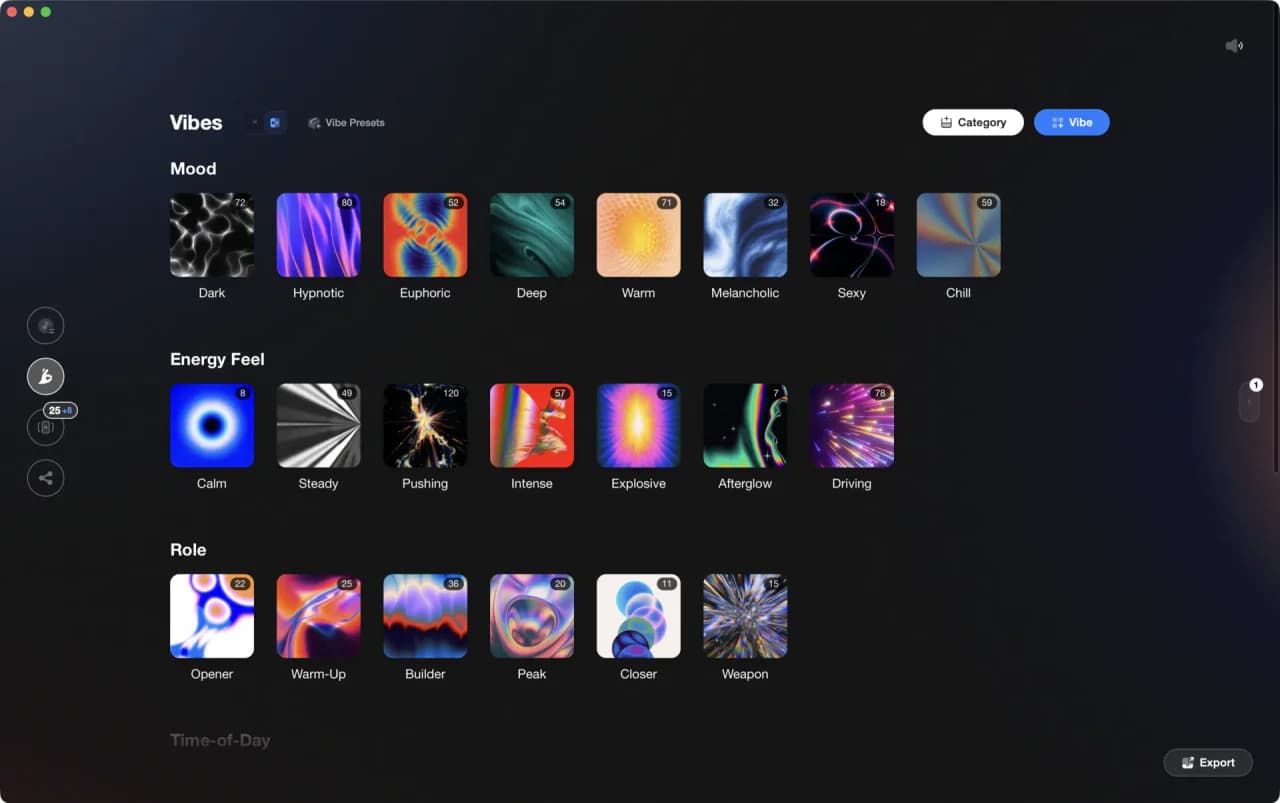
Equipment You'll Need
Frequently Asked Questions

Hey, it's Ben Modigell 👋
I DJ and produce as so I so: downtempo, minimal, dub house, tech house, and techno (releases on Spotify and SoundCloud, links above). Everything I write here comes from my own gigs, studio sessions, and library cleanups: the rules I follow, the failure modes I have actually hit, and the workflow I use when nobody is watching. If a technique did not earn its place in my own sets, it does not make it into a tutorial.