
Phrase Mixing
Align musical phrases across two tracks to create clean, natural transitions that preserve energy and song structure.
Phrase Mixing Tutorials
Phrase Mixing turns two separate songs into one continuous story. By aligning musical phrases, you move from one section to the next without fighting arrangements. Learn phrase mixing to time entrances, avoid clashing vocals, and land transitions exactly where the music expects change.
Why learn this now? Because phrase mixing stabilizes your timing under pressure. It makes every blend sound intentional. You will use it in clubs, radio mixes, livestreams, and practice sets. The result is smoother flow and clear energy control.
What Is Phrase Mixing?
Phrase mixing is the practice of lining up sections like intros, verses, builds, drops, and outros so both tracks change together. Educational pieces such as the Native Instruments phrase mixing guide show how aligning sections creates professional, musical transitions. See the Native Instruments phrase mixing guide. For a full walkthrough, see our plan harmonic transitions with the Camelot Wheel.
Most dance tracks follow repeating phrase lengths in multiples of four bars, often 8, 16, or 32. This lets you predict safe mix-in and mix-out points. For a clear overview of common bar counts across intros, breaks, and drops, review this breakdown of EDM song structure. See DeeJay Plaza on EDM song structure and bar lengths.
Phrasing guidance from DJ educators emphasizes counting and landing changes on the next phrase boundary to keep flow intact. Dubspot’s tutorial explains why most electronic styles use 8-bar phrases that add up to 32 beats, and how to watch for fills and waveform patterns. See the Dubspot tips on phrasing and transitions.
Why Master This Technique
- Cleaner blends. Sections end and start together, so arrangements do not collide.
- Energy control. Choose to rise, plateau, or reset by where the next phrase begins.
- Fewer clashes. You manage vocals and bass lines with time to swap EQ transparently.
- Confidence under pressure. Counting phrases anchors your timing in loud rooms.
Core Technique Breakdown
1) Pick the right pair. Favor compatible keys and arrangements. For fewer clashes, start with same-key or adjacent-key combinations. You can learn harmonic mixing to make overlays feel musical.
2) Find the mix-out phrase in Track A. Look for an outro, post-chorus, or breakdown where elements thin out. Confirm the bar count by tapping 1234 and counting 8 or 16 bars.
3) Set a mix-in cue in Track B. Place it at the start of an intro or a section that matches A’s phrase length. Hot cues make repeat practice fast.
4) Match tempo and phase. Use manual nudges or sync to align the beats. If this feels shaky, first master beat matching fundamentals.
5) Start B on beat 1 of A’s next phrase. Count down the final bar of the current phrase, then press play so both structures turn together.
6) Manage EQ and volume. Fade B up over 1–4 phrases while gradually swapping bass from A to B. Use EQ gently to avoid masking. You can use EQ mixing to keep the low end clean.
7) Complete the handoff on a phrase boundary. Either cut A at a fill, or crossfade so only B continues into the next section. For pop and hip-hop, a chorus-to-verse cut often works well, as described in the Native Instruments phrase mixing guide.
| Step | Action | Key Point |
|---|---|---|
| 1 | Choose key/arrangement-compatible tracks | Fewer clashes and simpler overlays |
| 2 | Mark A’s mix-out phrase | Confirm 8, 16, or 32 bars |
| 3 | Set B’s mix-in cue | Phrase length should match A |
| 4 | Align tempo and phase | Stabilize before you start B |
| 5 | Trigger B on beat 1 | Both phrases turn together |
| 6 | Swap bass and blend EQ | One kick and bass dominate at a time |
| 7 | Exit A on boundary | Finish on a natural change |
Practice Drills
In practice, counting phrases out loud while looping the outro of one track and the intro of another accelerates timing more than long, unfocused sessions.
Organize practice tracks into small, labeled collections with notes on phrase lengths and good mix points. If you manage a library on Vibes, tag practice crates by phrase length and log date-stamped reps so you can revisit tough pairs later.
Common Mistakes
| Mistake | Why It Happens | Solution |
|---|---|---|
| Starting off the phrase | Play is pressed mid-phrase so structures drift | Count full bars and trigger on beat 1; rehearse with hot cues. See the phrasing overview in the Dubspot tips on phrasing and transitions. |
| Two bass lines at once | Low frequencies stack and mask the kick | Swap bass during the overlap and favor one kick; refine with EQ mixing. |
| Overlong overlaps | Arrangements compete, vocals clash | Shorten to 1–2 phrases or cut on a chorus boundary. Native Instruments’ examples demonstrate chorus-to-verse timing. See the Native Instruments phrase mixing guide. |
| Redlining and listener fatigue | Levels pushed to compensate for EQ cuts | Set proper gain so meters stay out of the red. Serato recommends keeping peaks in the yellow. See the Serato manual note on keeping levels out of the red. |
Equipment You Need
Any two-deck setup works. Controllers and media players with clear waveforms make phrase spotting faster. Accurate beat grids and hot cues speed practice and performance.
Prepare tracks by analyzing, beat-gridding, and setting cues in your software. Pioneer DJ outlines simple routines for regular library maintenance and grid checks. See the Pioneer DJ article on library prep and grids.
Advanced Techniques
Loop correction. If B’s intro is too short, add an 8-bar loop to line up with A’s outro. Exit the loop on beat 1 of the next phrase to stay musical.
Chorus-to-verse cuts. For high-energy sets, cut on the last beat of a chorus into the verse of the next song to keep momentum. This is a common application highlighted in the Native Instruments phrase mixing guide.
Stems overlays. Use stems to keep only vocals from A over the instrumental phrase of B for one phrase, then remove to reveal B’s full drop. Start with same-key tracks for safety.
Structure spotting by waveform. Repeating blocks and color changes often mark phrase starts. DeeJay Plaza’s structure overview helps translate these visuals to bar counts. See DeeJay Plaza on EDM song structure and bar lengths.
Troubleshooting
Phrases will not line up. Verify bar counts. If A’s outro is 16 bars and B’s intro is 8, loop B’s first 8 bars once or beat jump by 8 bars to pad the structure.
Vocals still collide. Choose sections without prominent vocals, or move to an instrumental phrase. Same or adjacent keys reduce dissonance while you overlay.
Drops feel rushed. Start B one phrase earlier so the buildup completes with your crossfade. Aim for the handoff on a boundary, not mid-phrase.
Levels vary wildly between tracks. Set deck gains during prep and keep peaks in the yellow. Avoid pushing master and booth levels to red; this adds distortion and listener fatigue. See the Serato manual note on keeping levels out of the red.
Safety and Hearing
Long sessions in loud rooms increase risk of hearing loss. NIOSH considers repeated exposures at or above 85 dBA hazardous. Take breaks, use hearing protection, and set booth monitors sensibly. See the NIOSH overview of hazardous noise exposure.
Watch
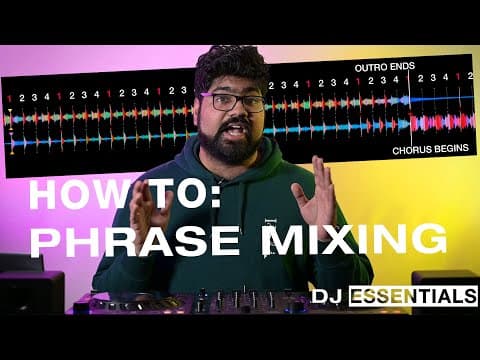
Stop guessing what track comes next
Tag by energy and mood. Vibes shows you what flows naturally together. Finally build sets that feel intentional.
14-day free trial. Full access, no strings attached.
or see how it works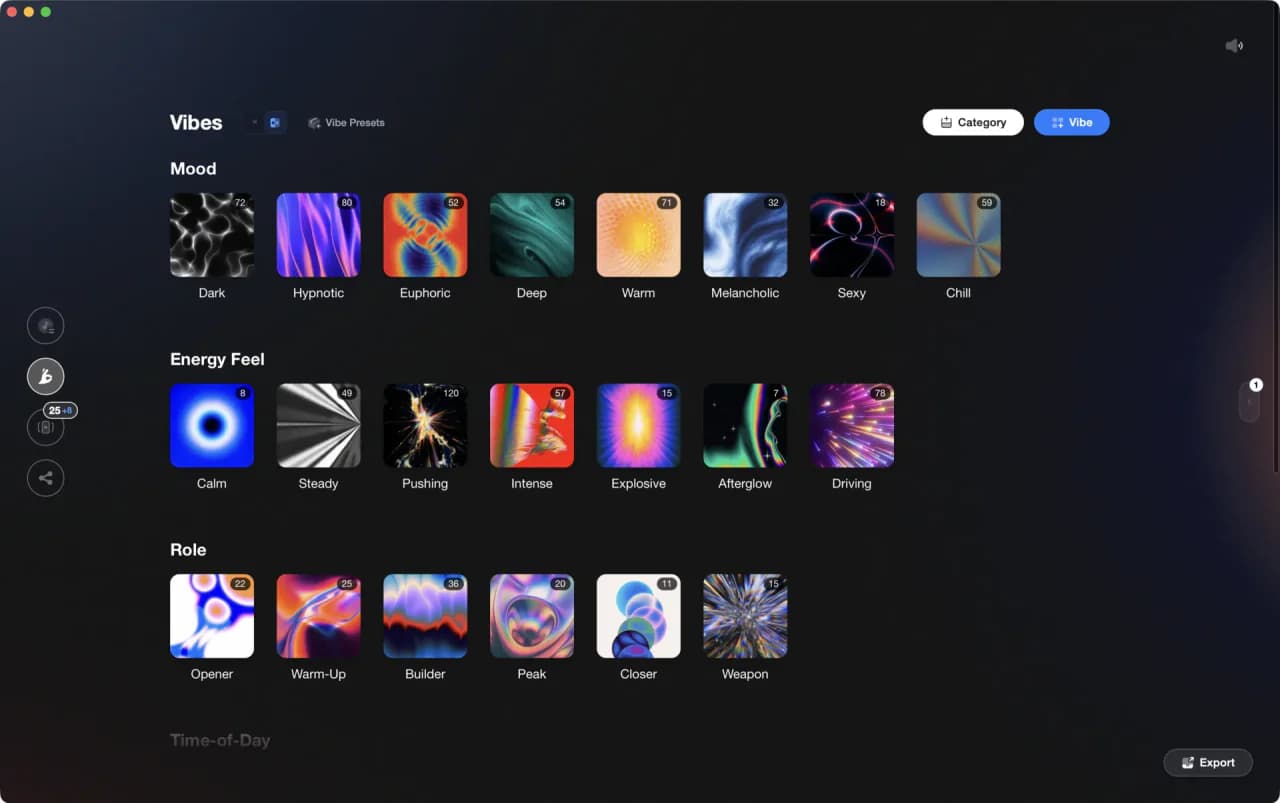
More Tutorials
Equipment You'll Need
Pioneer DJ DDJ-1000
optionalA 4-channel rekordbox DJ controller with full-size jog wheels, onboard displays, and club-style mixer controls.
Mixed In Key 11
optionalStandalone harmonic-mixing and library-prep software that detects keys, energy levels, cue points, and tags for DJ sets.
Beatport
optionalBeatport is a DJ-focused electronic music store and streaming platform for discovering, buying, and streaming tracks into supported DJ software and hardware.
VirtualDJ
optionalDJ software for Windows and macOS that handles audio mixing, video mixing, karaoke, stems, and broad hardware support.
Platinum Notes 10
optionalPlatinum Notes 10 evens loudness, repairs clipped peaks, and prepares DJ files for more consistent playback in Serato, rekordbox, and Traktor.
rekordbox
optionalCloud-connected DJ software for music management, performance, export prep, and club-standard hardware integration.
Pioneer DJ DDJ-400
optionalA compact 2-channel USB DJ controller built for rekordbox with a club-style layout aimed at new and progressing DJs.
Native Instruments FM8
optionalNative Instruments FM8 is a powerhouse FM synthesizer for hybrid DJ sets and live performance. Its low CPU usage and bright, cutting tones make it ideal for layering over tracks in a live mix. Bounce FM8 basslines as audio loops for Traktor Remix Decks or Ableton clips.
VirtualDJ 7
optionalA legacy DJ software platform for audio and video mixing, controller mapping, and DVS playback on Windows and Mac.
DJControl Inpulse 200 MK2
optionalCompact 2‑deck USB DJ controller with built‑in audio, Beatmatch Guide LEDs, and Serato DJ Lite/DJUCED integration.
Cockos REAPER
optionalA lightweight, deeply customizable digital audio workstation for recording, editing, mixing, MIDI production, and post work on Windows, macOS, and Linux.
Native Instruments Traktor Pro 4
optionalA professional 4-deck DJ software platform with stem separation, flexible beatgrids, effects, DVS support, and broad controller integration.
Serato DJ Pro
optionalProfessional DJ software for mixing, performance, library management, recording, and hardware-integrated club workflows.
Frequently Asked Questions

Hey, it's Ben Modigell 👋
I DJ and produce as so I so: downtempo, minimal, dub house, tech house, and techno (releases on Spotify and SoundCloud, links above). Everything I write here comes from my own gigs, studio sessions, and library cleanups: the rules I follow, the failure modes I have actually hit, and the workflow I use when nobody is watching. If a technique did not earn its place in my own sets, it does not make it into a tutorial.
