DJ Key Wheel Decision Framework: Four Safe Moves and Advanced Jumps
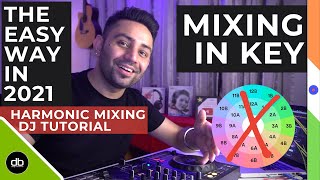
Watch Complete DJ Method’s tutorial above (113K views on YouTube).
This guide is for DJs who understand phrasing and beatmatching but still get stuck on harmonic clashes. If the djing key wheel feels useful but vague, this will make it practical. After reading, you will know which moves are safe, which are risky, and how to use the wheel to control energy instead of just avoiding bad mixes.
The short version is simple. The djing key wheel gives you four reliable options first: stay in the same key, move one step up, move one step down, or switch between relative major and minor on the same number. Everything beyond that can work, but you need to preview it and trust your ears.
If your broader weak point is track organization, it helps to pair harmonic thinking with a solid library system. A clean prep workflow makes this easier to apply in real sets, especially when you also tag tracks by energy flow, playlist structure, and harmonic transition practice.
Djing Key Wheel Basics
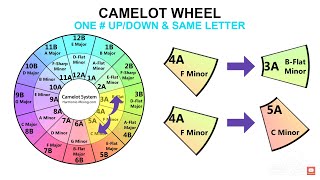
The djing key wheel is a DJ-friendly version of the circle of fifths. It keeps the same harmonic relationships, but replaces note names with easier alphanumeric labels.
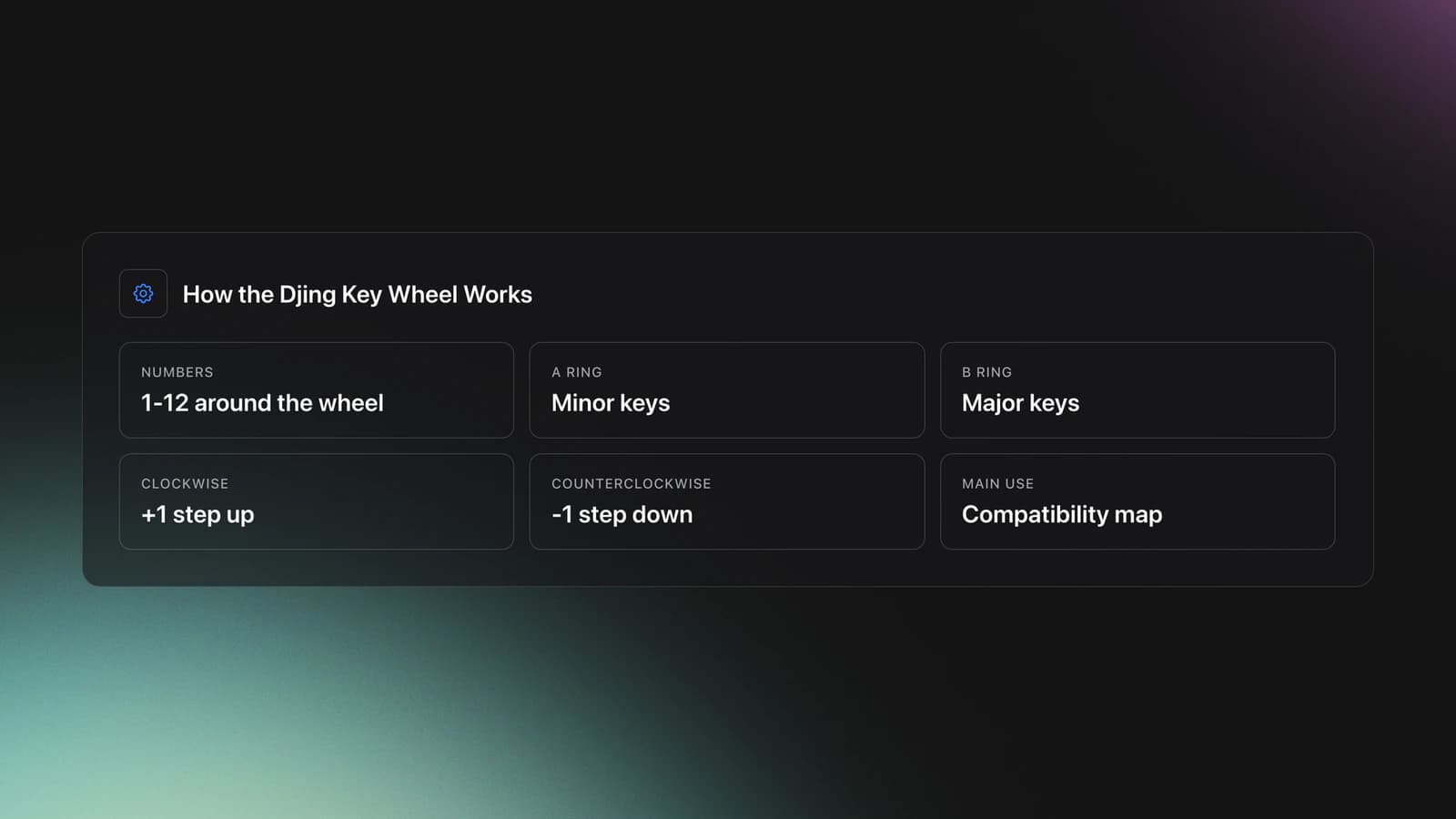
You get numbers from 1 to 12 around the circle. You also get two rings. A means minor. B means major.
That is the first thing to remember. The letters do not mean the musical key of A or B. They only tell you whether the track is in the minor ring or the major ring.
This matters because DJs do not need to memorize every key signature to use the system. You just need to read the code and know how to move around the wheel.
Think of the wheel like a clock. One number clockwise is one step up. One number counterclockwise is one step down.
The wheel is useful because it turns theory into repeatable decisions. Under pressure, that matters more than abstract music knowledge.
Most DJ software can display harmonic key notation after analysis. That includes Camelot-style labels used in many workflows. Mixed In Key also popularized this style of labeling for DJ prep, which is why many DJs refer to the harmonic wheel through that lens.
Still, the wheel is not magic. It is a compatibility map. It tells you where to start looking, not what will definitely sound good for every transition.
That difference is important. Harmonic compatibility is not the same as musical suitability.
Djing Key Wheel: The Four Safe Moves
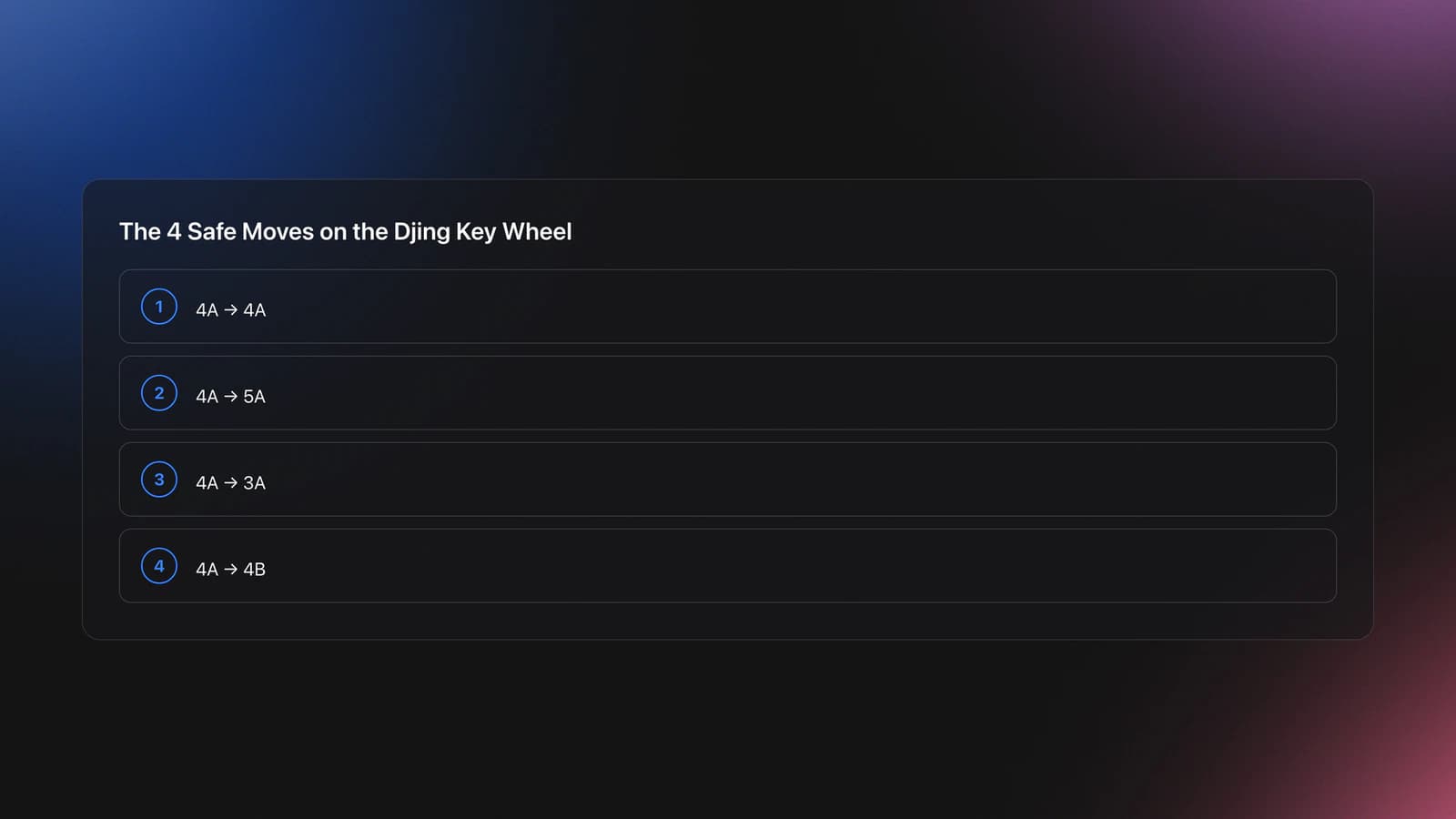
If you remember only one section from this guide, make it this one. The djing key wheel becomes easy once you reduce it to four reliable moves.
Those four moves are your default options:
- Stay on the same code. Example: 4A to 4A.
- Move one number up in the same ring. Example: 4A to 5A.
- Move one number down in the same ring. Example: 4A to 3A.
- Switch letter on the same number. Example: 4A to 4B.
These are reliable because the harmonic relationship is close. In practice, they create the fewest surprises during long blends.
Same-key mixes are the safest of all. If you mix 4A into 4A, both tracks share the same tonal center. That makes them the easiest pair for extended overlays, layered vocals, and smooth EQ-driven transitions.
One-step moves are usually the next safest. A move like 4A to 5A or 4A to 3A keeps you in a neighboring harmonic area. That often preserves continuity while still giving the set some motion.
Relative major and minor moves change color more than structure. A switch like 4A to 4B can feel like the same emotional material viewed under different lighting.
This is where the wheel stops being just a safety tool. It becomes an energy tool.
Up one step often feels like a lift. Down one step often feels like a release or deepening move. Relative major/minor shifts often feel like a mood reframe without a hard break.
That does not guarantee the crowd experiences it exactly that way. Arrangement, rhythm density, bass design, and vocal content still shape the result.
But as a repeatable mental model, it holds up. You can think in terms of stable, lift, deepen, or reframe.
Experienced DJs often notice this fastest in transitions with exposed melodic content. Pads, lead lines, and sustained chords reveal harmonic mistakes much sooner than percussion-only passages.
A producer's perspective helps here. When you have spent time studying arrangement, you start hearing not just the key label but how tension is built inside the phrase. That is why two tracks with compatible codes can still fight if both intros push strong chord information at the same moment.
You will know these four moves are working when blends feel connected without sounding static. The transition should preserve direction, and you should not feel a need to cut early just to escape harmonic friction.
Energy Control With the Djing Key Wheel
Why does this matter for real sets? Because the djing key wheel is not only about avoiding clashing notes. It gives you a simple way to shape movement across a room.
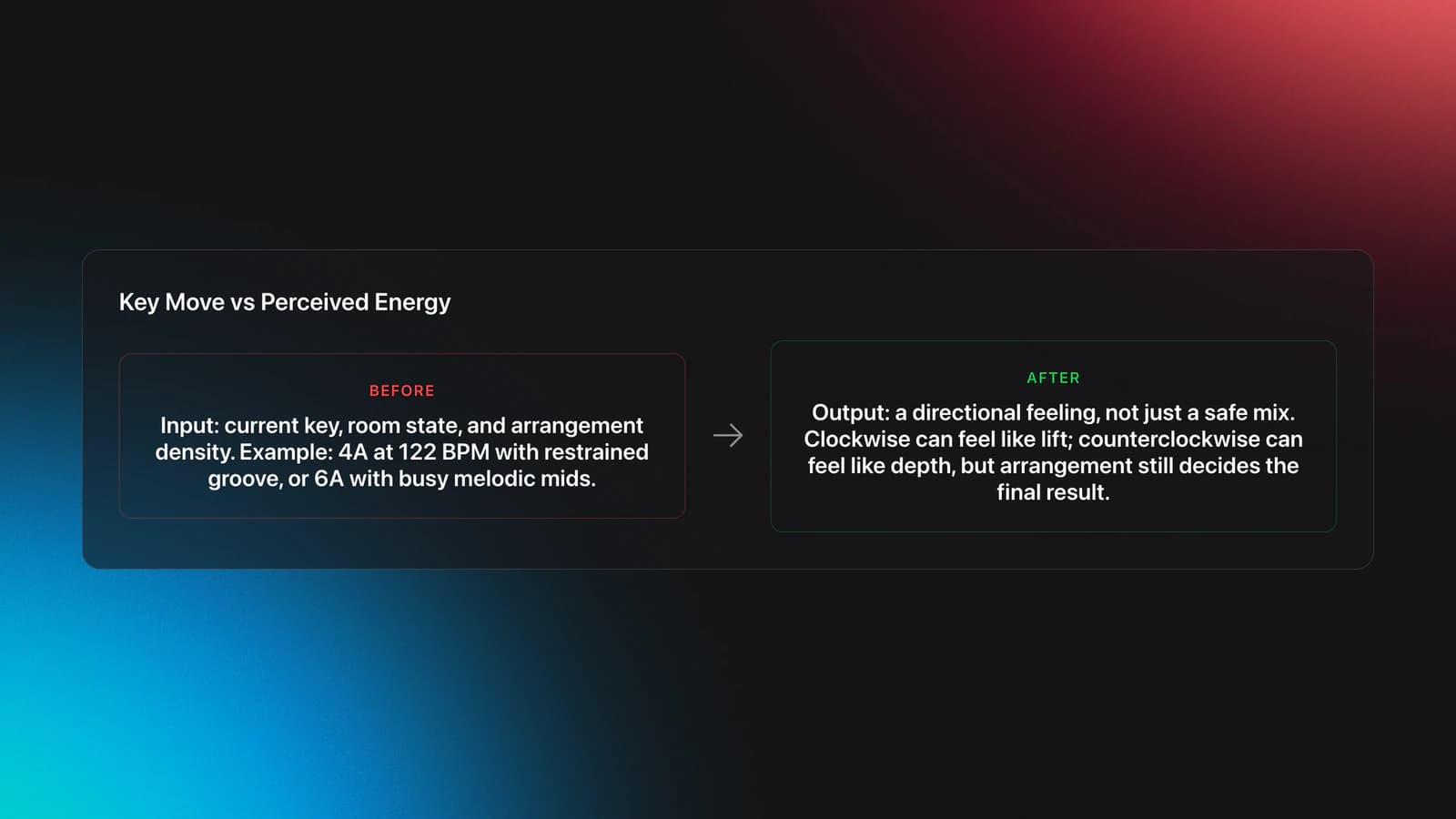
Start with the most practical idea. Harmonic movement changes perceived momentum. It does this even when BPM stays the same.
A one-step clockwise move often adds brightness or forward pull. A one-step counterclockwise move often feels more grounded or inward.
That is useful when you want contrast without changing genre, tempo, or groove. It lets you redirect emotion while keeping the dance floor anchored.
Example one. You are playing a warm-up set at 122 BPM. Your current track is 4A with a restrained groove and soft chords. The room is filling, but people are not fully committed yet.
You move into 5A. The next track has a slightly brighter top line and tighter drums. The BPM stays at 122, but the room reads it as a push.
Input: 4A, low-density intro, early-room energy. Process: one-step clockwise move into a track with stronger arrangement. Output: higher perceived momentum without forcing the tempo.
Example two. You are halfway through a deep set and want more depth, not less intensity. The current track is 6A with vocal fragments and busy mids.
You move into 5A. The next track is darker, more spacious, and more hypnotic. Instead of losing the floor, you create a deeper pocket.
Input: 6A, busy melodic content, already-locked crowd. Process: one-step counterclockwise move to a more stripped arrangement. Output: reduced harmonic glare and stronger immersion.
This is where context matters. Up does not always mean more energy. Down does not always mean less.
If the incoming track has stronger drums, heavier bass, or a more urgent vocal, it can still raise the room even on a downward wheel move. The harmonic direction is one variable, not the whole story.
That is also why some transitions work better in underground or daytime settings than in peak club conditions. In a more patient room, subtle tonal shading carries more weight. In a loud, high-pressure slot, arrangement impact may dominate the harmonic nuance.
A good real-world benchmark is whether the floor follows the emotional direction you intended within one phrase. If you aimed for lift, the room should lean in. If you aimed for depth, the transition should settle rather than splinter attention.
One practical workflow fix is to organize tracks by both key and function before the gig. Some DJs do this with comments and playlists. Others use tools like Vibes to sort local files into custom categories such as mood, function, and energy, then prepare sets around those buckets before exporting to DJ software. Either method works. The point is to stop making harmonic decisions in isolation.
Failure mode: you choose the right key move, but the mix still feels wrong. The usual symptom is not a clear clash. It is a muddy, indecisive transition where both tracks seem to weaken each other.
That usually means the wheel was right, but the overlap window was wrong. Too many active melodic elements were competing at once.
In practice, shorten the blend. Enter later. Or wait for a bar where one track drops to fewer notes.
You will know your wheel-based energy control is improving when you can predict not just whether a transition is safe, but what emotional direction it will create before you press play.
Advanced Djing Key Wheel Moves
Once the four safe moves are automatic, you can test wider jumps. These are useful, but they are not default moves.
Use them as controlled effects. Do not assume they will survive a long melodic blend.
The first advanced move is the plus-seven jump in the same ring. In the tutorial logic, this creates a one-semitone shift.
Example: 3A to 10A. Example: 1B to 8B. The number changes by seven, and the letter stays the same.
This can create a striking lift or color shift. It can also create obvious dissonance if both tracks expose too much melody at once.
Best use case: a short transition, a breakdown swap, or a deliberate impact moment. Weak use case: a long layered blend with vocals and pads.
The second advanced move is the plus-two or minus-two move in the same ring. Example: 4A to 6A or 4A to 2A.
This is stronger than the one-step move. It often feels more dramatic, which is why it can work well when you want to signal a section change.
Example one. You are at 126 BPM in a rolling techno section. Current track: 4A. Incoming track: 6A with a bigger synth stab but a sparse intro.
You wait until the outgoing track loses its lead line, then bring in the new groove under percussion. Because the overlap is narrow, the two-step move feels bold instead of messy.
Input: 4A with active lead. Process: time the swap during a stripped phrase, then introduce 6A carefully. Output: dramatic lift without extended chord conflict.
Example two. Current track: 4A, late-night deep roller. Incoming track: 2A with fewer highs, more space, and a lower emotional center.
You use a shorter exit and let the incoming track own the next phrase quickly. The result can feel like a deliberate descent rather than a mistake.
The third advanced move is the minus-three plus letter switch. Example: 6A to 3B. Example: 5B to 2A.
This is a more specialized option. It can work, but it needs testing. Treat it as a possibility, not a rule.
The fourth advanced move is the diagonal shift. Example: 4B to 5A or 5A to 4B.
Some DJs only trust one diagonal direction. The theory argument says both directions are equivalent in relationship. In practice, the arrangement decides whether either direction works.
That is the right way to think about advanced wheel moves. Theory explains the map. The records decide the result.
A common failure mode here is overconfidence in the code. The symptom is a transition that looked clever on paper but produces sour overlap the moment both hooks are live.
The fix is simple. Test advanced moves in cue, and keep the overlap short unless the melodic information is sparse.
You will know an advanced move is safe enough for performance when you can hear the overlap twice in prep, in different monitoring conditions, without wincing at sustained chord contact.
Ear Training Beats Rule Following
The harmonic wheel is useful. Blind obedience to it is not.
Tracks do not use every note in their key all the time. They reveal harmony in specific moments. That means two tracks with distant codes can still work in a short passage, while two supposedly safe tracks can clash if both intros are harmonically crowded.
This is why the best DJs use the wheel as a filter, then confirm with listening. Description comes first. Prescription comes second.
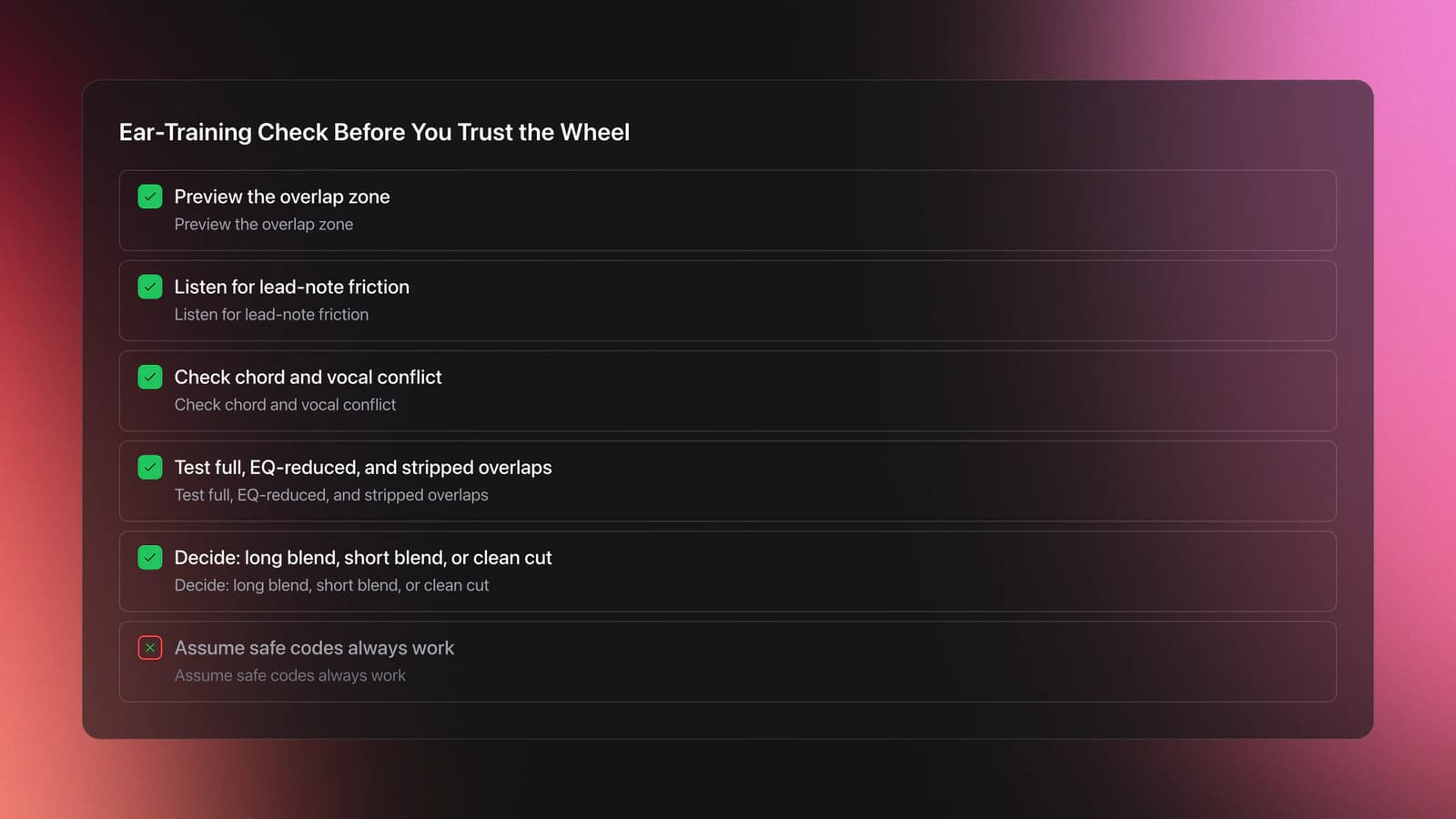
What happens in practice? You preview the actual overlap zone. You listen for lead-note friction, chord rub, and vocal conflict. Then you decide whether to blend long, blend short, or cut clean.
The most useful ear-training habit is to compare three versions of the same transition. First, full melodic overlap. Second, overlap with one track EQed down in the mids. Third, overlap only during a stripped phrase.
That teaches you whether the problem is key distance or arrangement density. Many DJs confuse those two things.
A practical test set can be built fast. Take one base track and compare it against same-key, neighbor-key, relative-key, and one risky advanced option. Record the results in a note field, playlist name, or crate comment.
If you play a lot of b2b or longer sets, this matters even more. Unpredictable handoffs and off-entry moments leave less room for theoretical perfection. What saves you is not just knowing the harmonic wheel dj system. It is recognizing trouble in one bar and reacting early.
A good example comes from small, atmosphere-heavy events where room energy matters more than status. In those settings, subtle harmonic control often reads better than obvious peak-time tricks. The lesson is simple: use the wheel to support the mood the room wants, not to prove you know the map.
You will know your ear is improving when you stop asking, "Is this allowed?" and start asking, "What is clashing here, and can I remove the problem by changing the overlap point?"
Common Djing Key Wheel Mistakes
Most harmonic mixing problems are not theory problems. They are workflow problems, timing problems, or listening problems.
| Mistake | Why It Happens | How to Avoid |
|---|---|---|
| Treating the wheel like a guarantee | Key codes show likely compatibility, not arrangement fit | Preview the exact overlap and test melodic density |
| Using advanced jumps in long blends | Wider moves create more tension than expected | Keep risky transitions short unless the phrases are sparse |
| Ignoring relative major and minor moves | DJs often overuse same-key mixing because it feels safest | Test same-number A/B switches for mood shifts without hard resets |
| Forcing energy assumptions | Up one step does not always raise the room | Judge the whole track, not just the wheel direction |
| Mixing over busy intros and outros | Too many active notes produce mud or clashes | Wait for stripped phrases or shorten the overlap |
The most common djing key wheel errors come from misuse, not from the system itself.
Practice Routine for Harmonic Mixing Wheel Skills
If you want the harmonic mixing wheel to become usable under pressure, practice it in layers. Do not jump straight to risky transitions.
- Week 1. Spend 15 minutes a day testing same-key and plus-or-minus-one transitions only.
- Week 2. Add same-number A/B switches and label each result as stable, lift, or reframe.
- Week 3. Test plus-two, diagonal, and other risky moves for 10 minutes. Keep only the ones that survive repeated listening.
Record the transitions that work. Build mini-crates or playlists around them. Then revisit them after a few days to check whether they still sound good with fresh ears.
If you want a stronger prep habit, connect this to crate planning for gigs and set-building workflow. Harmonic confidence improves much faster when your library is already filtered by function and mood.
How to Know the Djing Key Wheel Is Working for You
Progress here is easy to misread. The goal is not to become more rigid. The goal is to become more intentional.
You are improving when:
- You can name the four safe moves instantly.
- You can predict whether a move will feel stable, lifting, or deeper.
- You catch muddy overlap before it reaches the room.
- You know when to ignore the code because the phrasing says no.
- You prepare a few tested advanced moves instead of improvising all of them live.
This is the deeper point. The dj mixing key wheel should reduce friction, not narrow your taste. If it makes you avoid great tracks just because the label looks inconvenient, you are using the tool too rigidly.
Good harmonic mixing is not about obedience. It is about controlled choices.
Djing Key Wheel: Final Take
The djing key wheel works best when you treat it as a decision aid, not a rulebook. Start with the four safe moves. Use them to build dependable transitions. Then test wider jumps carefully and keep only the ones that survive real listening.
Keep these takeaways in mind:
- Use same key, plus one, minus one, and relative major/minor as your base system.
- Read wheel movement as likely emotional direction, not guaranteed crowd response.
- Trust your ears over the label when arrangement density creates conflict.
From there, the next step is simple. Test three transitions today, keep one, and reject two. That habit will improve your mixes faster than memorizing every possible code relationship.
The visual way to organize your DJ library
Tag tracks by vibe. See everything at once. Export to rekordbox, Serato, Traktor or Engine DJ.
14-day free trial. Full access, no strings attached.
or see how it works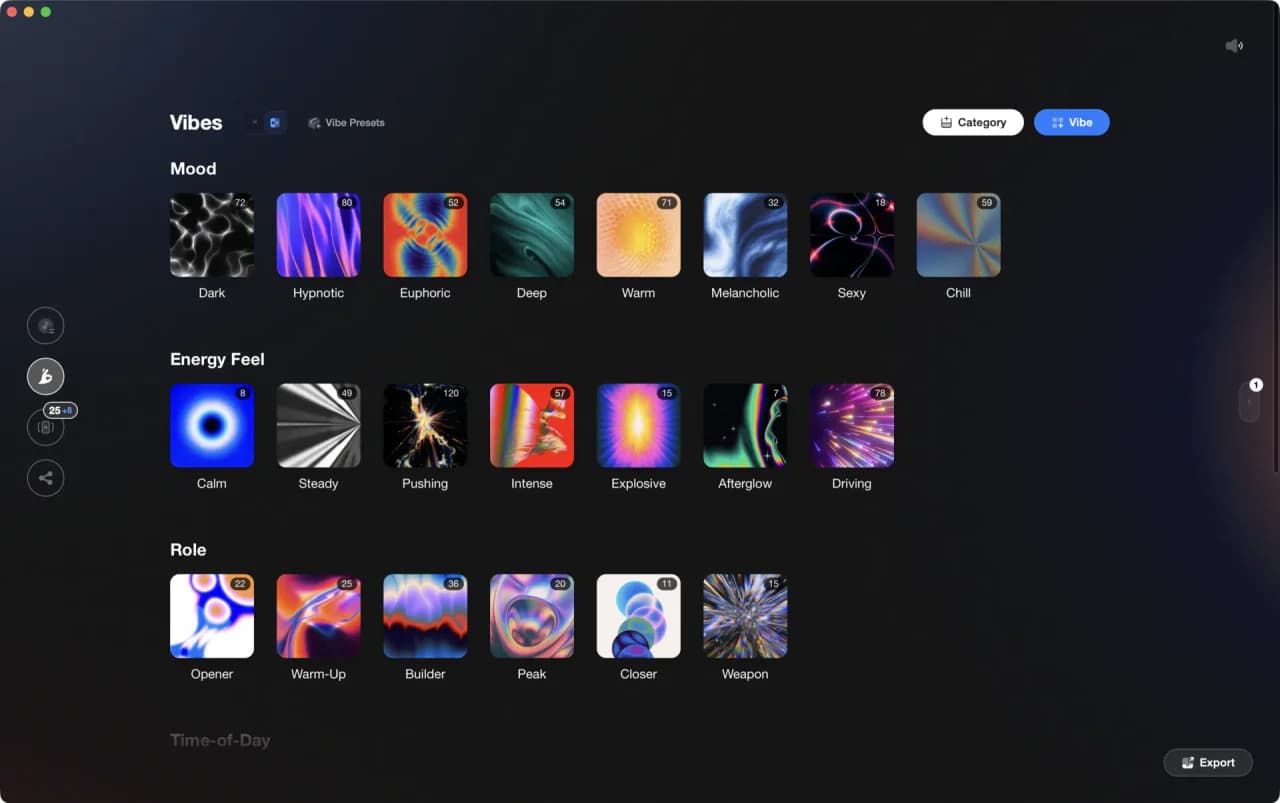
Techniques Covered
Diagonal Direction Mixing
Camelot Wheel Guide for DJs
Camelot Key Display Setup in Rekordbox, Serato and Traktor
Types of DJ Transitions

EQ Adjustments

Spotify BPM and Key Analysis

Track Analysis
EQ Swapping
Track Selection
Cueing Tracks
Equipment & Software
Continue Your Learning Journey
Start Here First


Related Content
How To Mix In Key Live: Worked Transitions And Failure Fixes
intermediateHarmonic Mixing Guide for DJs: Energy & Workflow
intermediate
DJ Transitions: The Three-Layer Handoff for Beginners
intermediate
DJ Playlist Spotify: Mixing With Streaming Inside Rekordbox
intermediateTransition DJ Online: Browser Mixer Workflow
intermediate
DJ Record Pool Guide for Working DJs
intermediate
DJ Library Organization System: Tags, Crates, Keys
intermediate
House Music Explained
intermediateFrequently Asked Questions

Hey, it's Ben Modigell 👋
I DJ and produce as so I so: downtempo, minimal, dub house, tech house, and techno (releases on Spotify and SoundCloud, links above). Everything I write here comes from my own gigs, studio sessions, and library cleanups: the rules I follow, the failure modes I have actually hit, and the workflow I use when nobody is watching. If a technique did not earn its place in my own sets, it does not make it into a tutorial.