Diagonal Direction Mixing
A harmonic mixing approach that shifts one step diagonally on the Camelot wheel to change both key center and mode while keeping transitions musical.
Diagonal Direction Mixing Tutorials
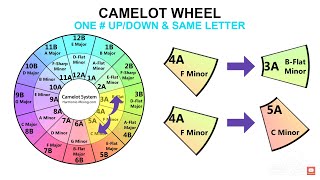
Diagonal Direction Mixing is a DJ harmonic mixing method that moves one step diagonally on the Camelot wheel, changing both key number and mode at the same time. In practice, Diagonal Direction Mixing lets you shift the emotional color of a set without sounding random. It matters when basic same-key blends feel too flat, but harsh key changes feel too abrupt.
If you already mix in phrase and can hold timing, this technique unlocks more dramatic transitions with less clash. You can use Diagonal Direction Mixing to brighten a darker section, darken a major-key run, or add lift before a breakdown. The core idea is simple. The execution is not.
What Is Diagonal Direction Mixing?
Diagonal Direction Mixing is a form of harmonic mixing where you move diagonally between compatible Camelot keys instead of staying on the same number or moving only one step around the wheel. Mixed In Key explains harmonic mixing as using key compatibility to keep transitions musical, and several educators describe the diagonal move as an advanced but usable option within Camelot-based DJing.
On the Camelot wheel, the usual safe moves are same key, plus or minus one number in the same mode, or the relative major or minor on the same number. The diagonal move changes two things at once. It changes the number and flips from A to B, or from B to A.
That is why it feels more directional than a basic harmonic blend. You are not just preserving the mood. You are steering it.
A common example is 8A to 7B, or 5B to 6A. DJ.Studio describes the diagonal mix as a move one step left while changing rings, and community explanations tied to Mixed In Key describe the same idea with direction depending on whether you move from minor to major or major to minor.
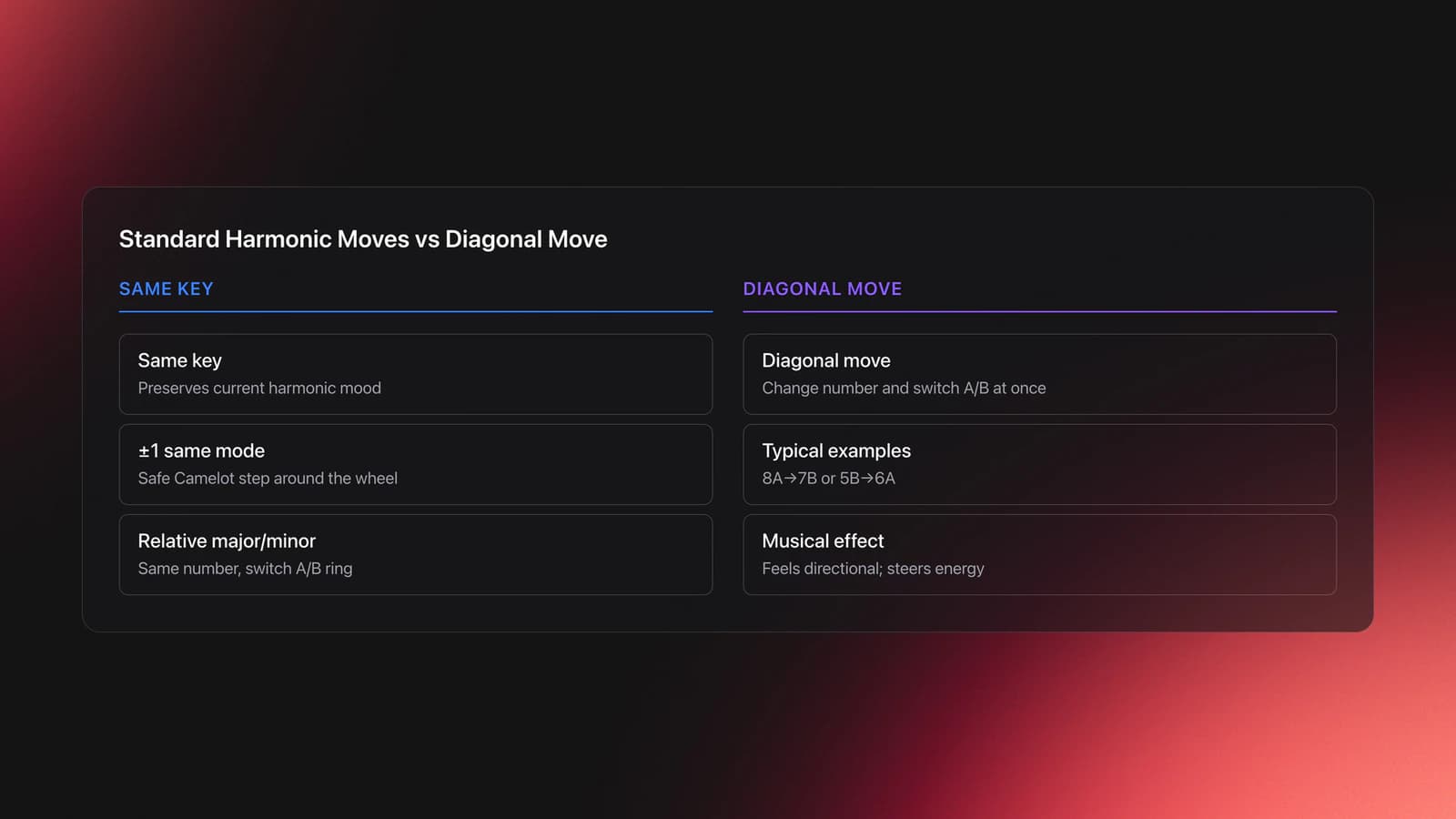
This also explains the name used here. "Diagonal Direction" is best understood as a directional diagonal key change inside harmonic DJ workflow, not as a separate mainstream transition family like beat juggling or scratching. The closest recognized technique in current DJ education is the diagonal mix within Camelot-based harmonic mixing.
Why Use Diagonal Direction Mixing
Diagonal Direction Mixing helps when you want more movement than a safe blend but less shock than an unrelated key jump. It creates a felt change in color, tension, and release while still sounding intentional.
- Adds emotional contrast without a full key clash
- Helps lift or darken energy between sections of a set
- Works well in long transitions with sparse intros or outros
- Gives harmonic sets more variety than same-key chains
- Builds stronger set progression when paired with phrase timing
This technique is most useful in genres with extended intros, outros, and repeating harmonic material. House, melodic techno, progressive house, and trance tend to give you enough room to test the move before the tracks get crowded.
In faster-cutting open-format sets, it can still work, but you usually hear less of the harmonic relationship because the overlap is shorter. In other words, the diagonal move matters most when the audience can actually hear the blend.
How to Do Diagonal Direction Mixing
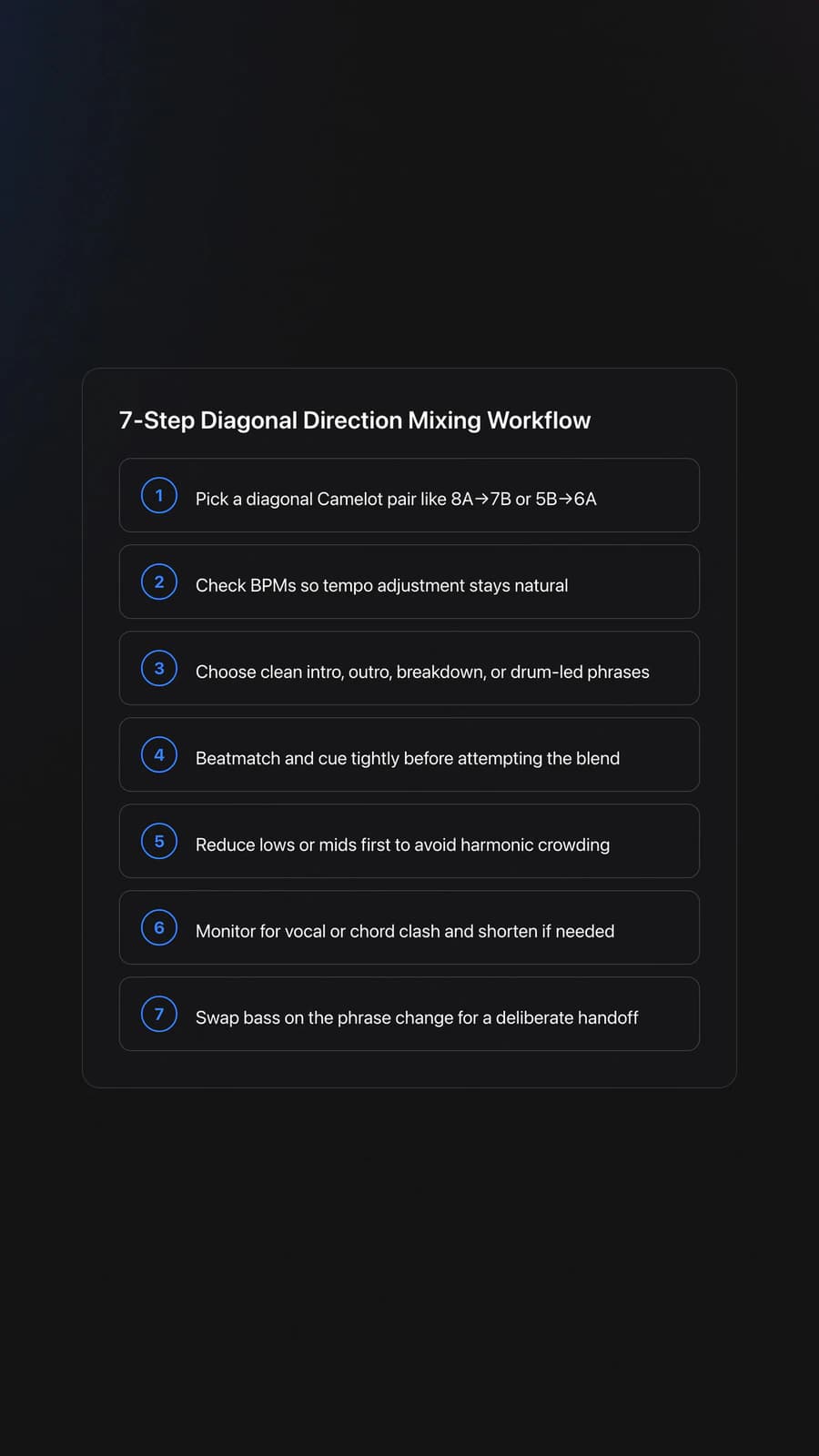
To perform Diagonal Direction Mixing, first choose two tracks with a valid diagonal Camelot relationship, then beatmatch them, align phrases, and make the overlap during sections with light harmonic conflict. Digital DJ Tips and other DJ educators consistently stress that phrase alignment and track structure matter as much as the technical transition tool itself.
| Step | Action | Key Point |
|---|---|---|
| 1 | Choose a diagonal key pair | Examples: 8A to 7B or 5B to 6A |
| 2 | Check BPM range | Keep tempo change small enough to preserve feel |
| 3 | Find clean entry and exit phrases | Use intros, outros, breakdowns, or drum-led sections |
| 4 | Beatmatch and cue carefully | Phase drift ruins the effect fast |
| 5 | Start with reduced lows or mids | Limit harmonic crowding in the overlap |
| 6 | Listen for vocal or chord clash | Abort early if harmony turns sour |
| 7 | Complete the bass swap on phrase change | Make the handoff feel intentional |
Start by selecting tracks that are diagonally compatible on the Camelot wheel. A minor-to-major move often feels like a lift. A major-to-minor move usually feels moodier or more tense.
Next, build reliable beat matching control before you worry about key drama. Harmonic ideas only sound good when the grooves are locked. If your timing drifts, the listener hears a weak mix before they hear a clever key move.
Then count phrases for cleaner transitions. The best place to test the incoming track is usually a section where one record is rhythm-heavy and the other is just entering with pads, hats, or a stripped intro. Digital DJ Tips emphasizes that transitions are easiest when at least one track is in a beats-only or sparse section.
Use EQ to create space. DJ TechTools notes that combining two full-range tracks makes the result louder and denser, so cuts help each song keep its place. With diagonal moves, that matters even more because harmonic information changes with the key relationship.
Start your blend with one crowded frequency area reduced. Often that means the incoming lows stay down until the phrase change. Sometimes trimming mids works better if both tracks carry chords or vocals.
Do not force a long mix just because the keys look compatible. Standard practice across DJ education is to treat key data as a guide, not a guarantee. If the melodies rub the wrong way, shorten the overlap or transition during a more percussive section.
Key Theory Behind the Move
The theory behind Diagonal Direction Mixing is that some diagonal Camelot moves share enough harmonic relationship to sound musical, even though they are less stable than the safest same-ring moves. Mixed In Key presents harmonic mixing as movement between compatible keys, while educators and community explanations describe the diagonal option as an advanced color change rather than a default choice.
That is the right mindset. Treat the diagonal move as a controlled mood shift, not a rule you should overuse.
Minor to major diagonals often feel brighter, more open, or more triumphant. Major to minor diagonals often feel deeper, darker, or more driving. Those are musical tendencies, not promises, because arrangement still matters.
A sparse synth loop may tolerate the move beautifully. Two full vocal hooks rarely will.
If you are new to key-based workflow, first learn harmonic mixing fundamentals. Once same-key, adjacent-key, and relative-key blends feel natural, diagonal transitions become easier to hear and control.
Equipment and Prep
You need accurate key data, solid cue monitoring, and tracks with space to overlap. That does not require expensive gear, but it does require preparation.
Essential tools are a two-deck DJ setup, headphones, and software or players that show BPM and key. Mixed In Key, rekordbox, Serato, Engine DJ, and similar systems can all support this workflow if their analysis is reasonably accurate, though key detection is never perfect.
Your track selection matters more than your controller model. Long intros, outros, breakdowns, and instrumentals give diagonal blends room to breathe. Dense radio edits do not.
Organized practice crates help a lot here. In Vibes, you could sort local tracks into custom groups by key family, energy, and transition role so you can rehearse diagonal pairs instead of hunting for them mid-session.
A simple preparation method works best. Build one playlist of safe diagonal pairs, one playlist of risky pairs, and one playlist of proven crowd-pleasers. That turns theory into repeatable reps.
Practice Drills for Diagonal Direction Mixing
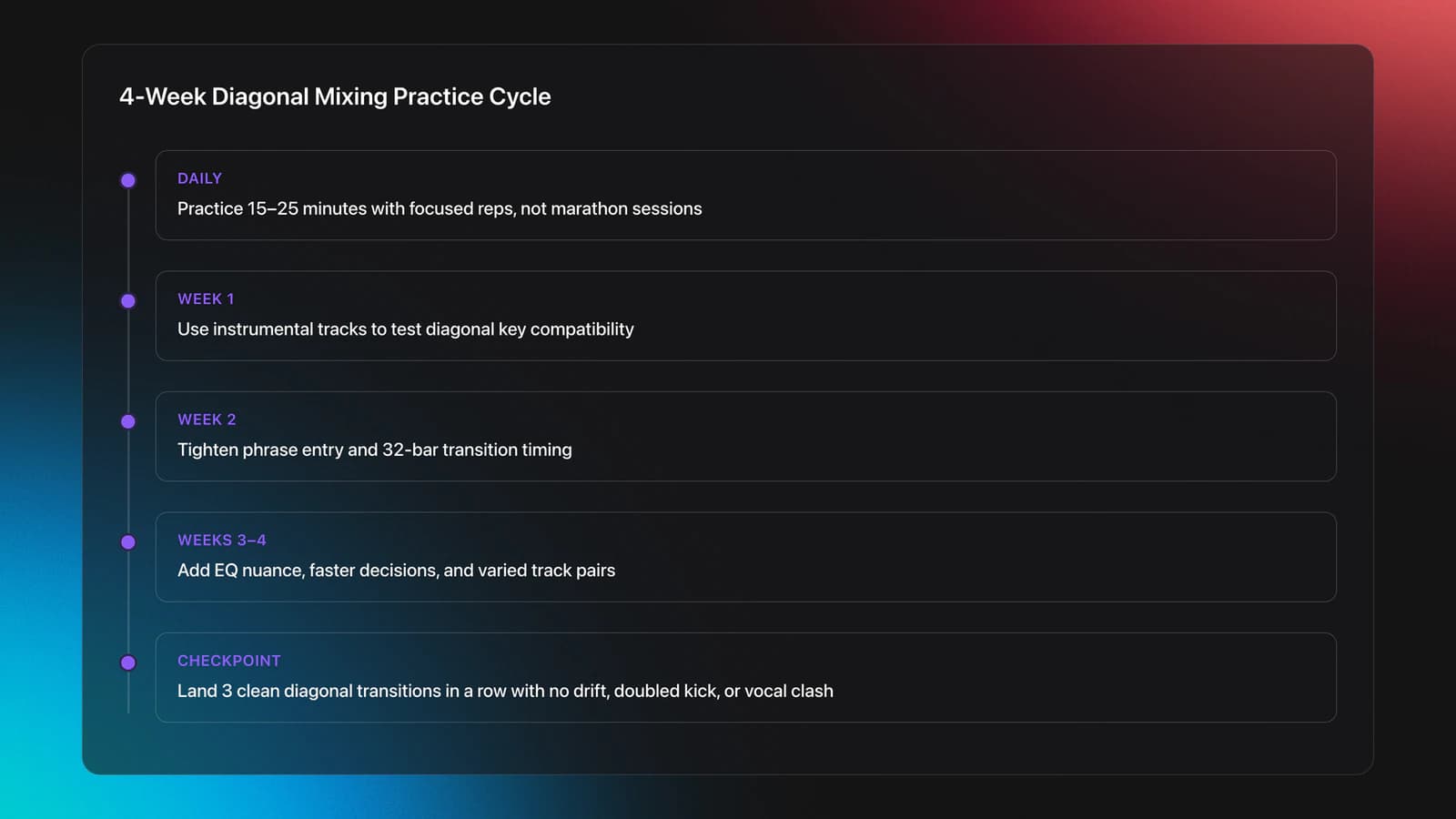
The fastest way to learn Diagonal Direction Mixing is to isolate one variable at a time: key move, phrase timing, then EQ management. In practice, short focused drills build this skill faster than marathon mixing sessions.
Start with instrumental tracks. Remove vocals from the equation while you learn what the diagonal shift actually sounds like.
Work in 2 to 4 week cycles. In week one, test compatibility. In week two, tighten phrase entry. In weeks three and four, add EQ nuance and faster decision-making.
Most practitioners improve faster with consistent short sessions. You only need 15 to 25 minutes a day if the reps are specific.
A strong checkpoint is this: complete a 32-bar diagonal transition at matched tempo with no obvious drift, no doubled kick problem, and no vocal clash. A stronger checkpoint is doing it three times in a row with different track pairs.
Common Mistakes
Most diagonal mixes fail for ordinary reasons, not exotic theory problems. The usual culprit is poor timing, crowded arrangement, or overconfidence in key labels.
| Mistake | Why It Happens | Fix |
|---|---|---|
| Trusting the key tag blindly | Analysis can be wrong or musically incomplete | Preview the overlap in headphones and trust your ears |
| Mixing two full vocal phrases | Lyrics and melodies compete for attention | Use instrumental sections or shorten the blend |
| Letting both basslines run too long | Low-end conflict muddies the transition | Swap lows on a phrase boundary |
| Ignoring phrase structure | Even good key matches sound awkward when sections misalign | Enter on the next 8 or 16 bar phrase |
| Forcing a long transition | A diagonal move is less stable than a same-key blend | Use a shorter, cleaner handoff |
| No EQ space management | Both tracks occupy the same range at once | Use shape blends with EQ mixing to reduce crowding |
Why do most beginners struggle with this move? Because they think harmonic compatibility can rescue weak transition mechanics. It cannot.
If the tracks are not locked, the phrase is wrong, or the overlap is too dense, the diagonal relationship becomes irrelevant. The listener just hears tension and confusion.
Troubleshooting in Real Sets
If a diagonal blend starts sounding sour, shorten the overlap immediately and exit on the next phrase. That is usually cleaner than trying to fix a bad harmonic relationship in real time.
If the mood shift feels too sharp, the problem may be arrangement rather than key. Try the same pair during a breakdown or an outro with less melodic material.
If the blend sounds technically clean but emotionally wrong, the tracks may be too different in energy profile. This is where use energy mixing for bigger set arcs becomes more useful than forcing harmonic logic alone.
If you keep missing the handoff, reduce complexity. Practice with tracks that have simple percussion, obvious 16-bar phrases, and no lead vocals.
Where This Technique Works Best
Diagonal Direction Mixing works best when the set needs a noticeable but musical turn. It is especially effective after several safe blends in a row, when you want the next transition to feel like a chapter change.
In melodic house or progressive sets, use it to brighten an ascent toward peak time. In deeper or darker sections, use the reverse emotional direction to add weight before a more driving record.
It can also help when adjacent-key options are limited. If your library has the right phrasing and energy match, a diagonal move may sound better than waiting for a perfect same-ring option.
That said, it is still a selective tool. Many educators present diagonal harmonic changes as useful but riskier than standard compatible-key mixing, which matches what most DJs hear in practice.
Next Steps
Diagonal Direction Mixing gives you a way to move a set emotionally without throwing away musical coherence. It sits between safe harmonic blending and bold contrast, which is why it rewards careful track choice more than flashy technique.
Key takeaways:
- Use diagonal moves as controlled mood shifts, not default transitions
- Phrase timing and EQ space matter as much as key compatibility
- Practice short, repeatable drills with sparse tracks before using it live
Start with one crate of proven diagonal pairs, rehearse 16 and 32 bar handoffs, and compare minor-to-major versus major-to-minor results. From there, combine this method with count phrases for cleaner transitions and learn harmonic mixing fundamentals. Once the move becomes reliable, it stops feeling theoretical and starts feeling like set storytelling.
The visual way to organize your DJ library
Tag tracks by vibe. See everything at once. Export to rekordbox, Serato, Traktor or Engine DJ.
14-day free trial. Full access, no strings attached.
or see how it works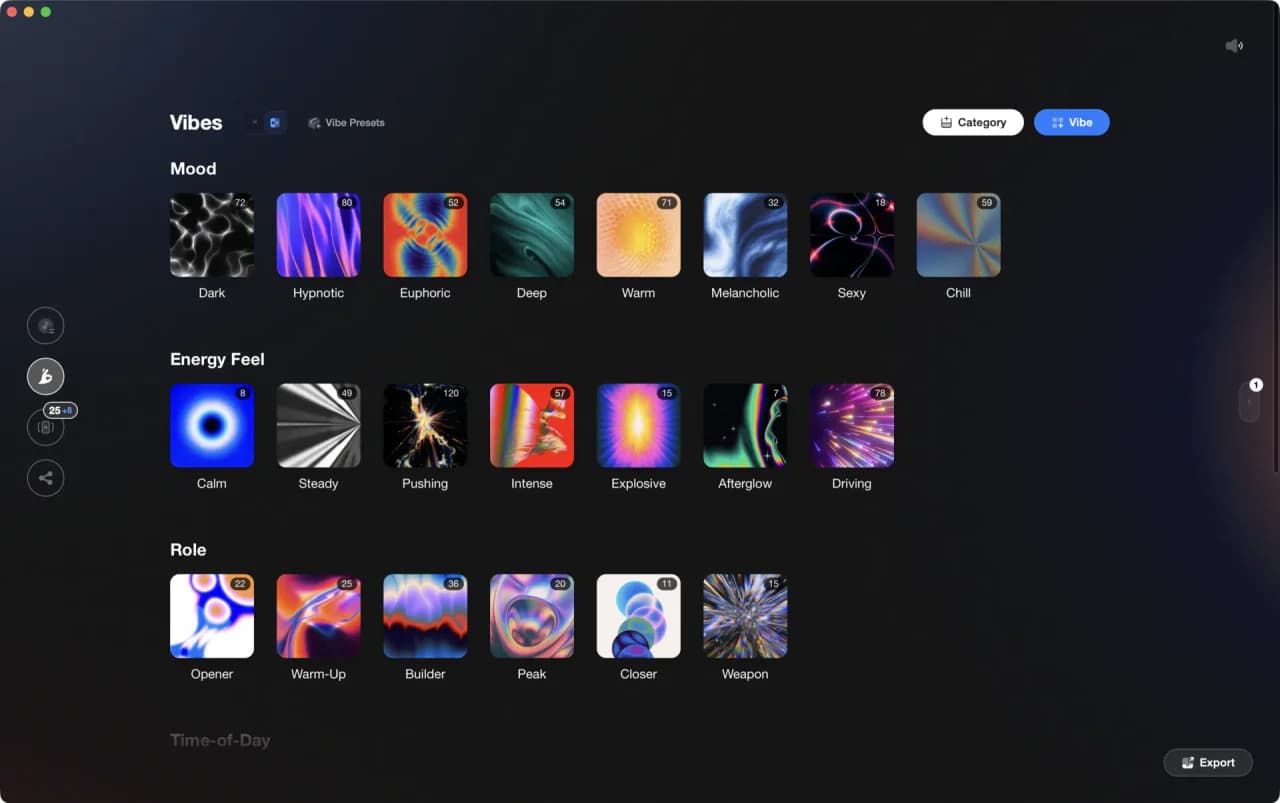
Equipment You'll Need
Pioneer DJ DDJ-1000
optionalA 4-channel rekordbox DJ controller with full-size jog wheels, onboard displays, and club-style mixer controls.
Pioneer DJ DDJ-400
optionalA compact 2-channel USB DJ controller built for rekordbox with a club-style layout aimed at new and progressing DJs.
VirtualDJ
optionalDJ software for Windows and macOS that handles audio mixing, video mixing, karaoke, stems, and broad hardware support.
DJControl Inpulse 200 MK2
optionalCompact 2‑deck USB DJ controller with built‑in audio, Beatmatch Guide LEDs, and Serato DJ Lite/DJUCED integration.
Numark Mixtrack Pro II
optionalA two-channel USB DJ controller with a built-in audio interface, touch-activated jog wheels, and performance pads for Serato-compatible mixing.
Traktor MX2
optionalA 2-channel DJ controller with integrated audio interface and tight Traktor Pro 4 integration for mixing, stems, effects, and performance pads.
Mixed In Key 11
optionalStandalone harmonic-mixing and library-prep software that detects keys, energy levels, cue points, and tags for DJ sets.
Platinum Notes 10
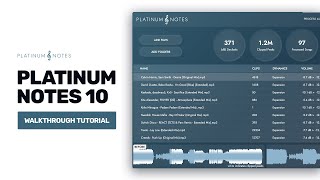
optionalPlatinum Notes 10 evens loudness, repairs clipped peaks, and prepares DJ files for more consistent playback in Serato, rekordbox, and Traktor.
rekordbox
optionalCloud-connected DJ software for music management, performance, export prep, and club-standard hardware integration.
Numark Mixtrack Pro FX
optionalA 2-deck USB DJ controller with a built-in audio interface, capacitive jog wheels, performance pads, and Serato DJ Lite support.
Frequently Asked Questions

Hey, it's Ben Modigell 👋
I DJ and produce as so I so: downtempo, minimal, dub house, tech house, and techno (releases on Spotify and SoundCloud, links above). Everything I write here comes from my own gigs, studio sessions, and library cleanups: the rules I follow, the failure modes I have actually hit, and the workflow I use when nobody is watching. If a technique did not earn its place in my own sets, it does not make it into a tutorial.