Beat Juggling
Beat juggling is a turntablism technique that uses two decks and a crossfader to extend, repeat, or rearrange rhythmic phrases into a new pattern.
Beat Juggling Tutorials
Beat juggling is a turntablism technique where you use two copies of the same beat, or two matching digital cue sources, to repeat, extend, and rearrange rhythmic fragments into a new pattern. If you want sharper timing, better hand independence, and more creative control than basic mixing offers, beat juggling is one of the fastest ways to develop it.
For DJs, beat juggling sits at the point where mixing becomes performance. It teaches you to hear bar structure, launch a sound on command, and cut cleanly with the crossfader. That is why beat juggling still matters even if you mainly play club sets and not battles.
It also exposes weak fundamentals very quickly. If your cueing is loose, your fader timing drifts, or you lose track of the one, the pattern collapses. Before going deeper, it helps to build reliable beat matching by ear and practice phrase alignment for cleaner patterns.
What Is Beat Juggling?
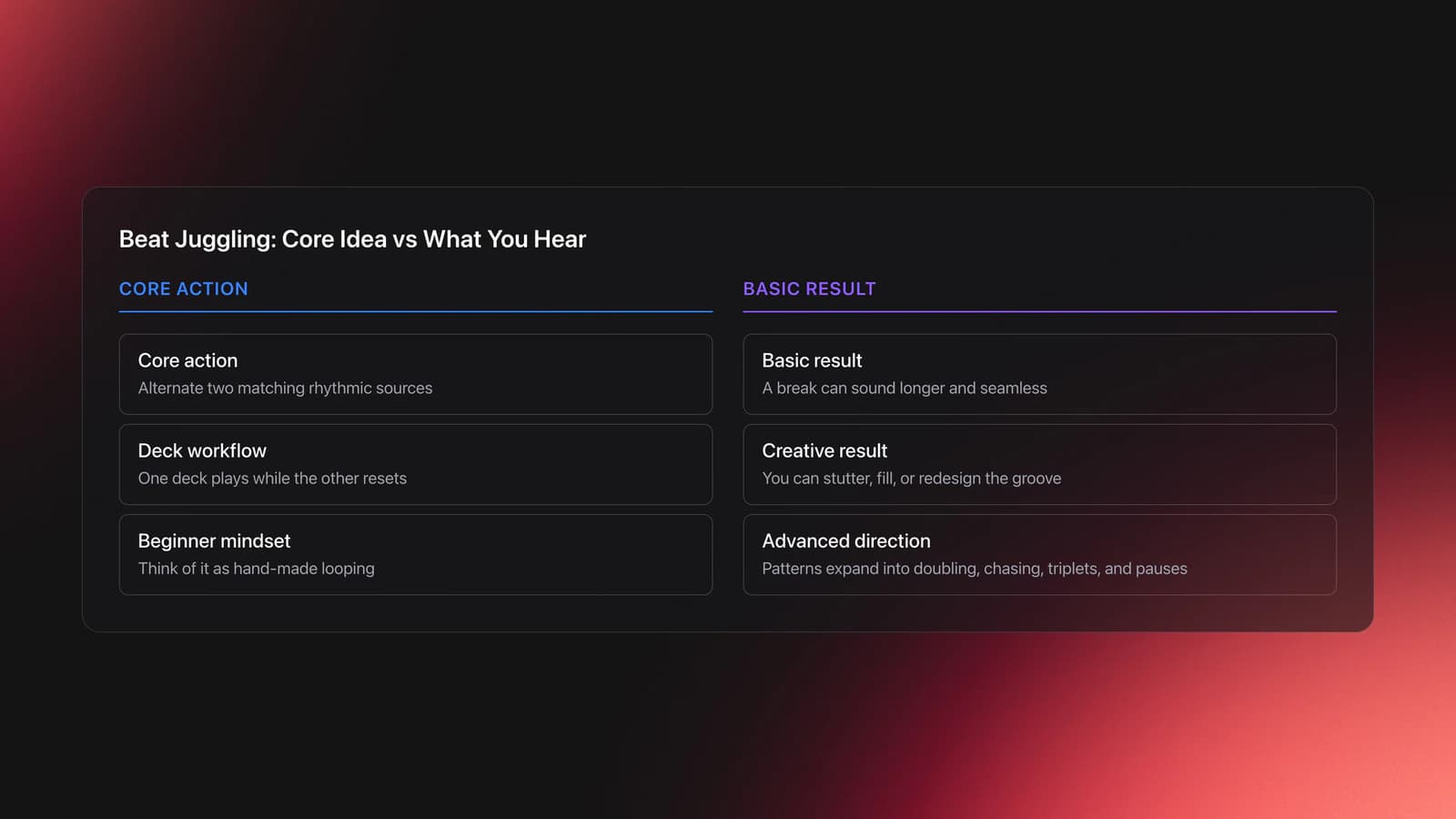
Beat juggling is the art of manipulating two rhythmic sources so one continues while the other resets, letting you loop or redesign a beat in real time. Pioneer DJ describes it as using two identical drum patterns on two turntables to create a new drum pattern, while Rob Swift frames advanced juggles as combinations of core root movements and timing choices.
In practice, you play a short break on deck A, switch to deck B at the right instant, then reset deck A to its start point before repeating the exchange. The result can sound like a longer drum break, a stuttered fill, or a completely new groove.
Beginners should think of beat juggling as controlled looping by hand. From there, the technique expands into doubling, chasing, triplets, pauses, and more complex patterns documented in resources like the Howcast beat juggling guide, the School of Scratch beat juggling resource list, and the Rob Swift root movements tutorial.
Why Learn Beat Juggling
Beat juggling improves timing, fader accuracy, and musical imagination. It forces you to control starts, stops, and resets at a much finer level than ordinary blending.
- It sharpens your sense of the downbeat and bar length.
- It builds independent control of both hands.
- It teaches you to create variation from minimal material.
- It makes battle and performance routines more musical.
- It improves transition timing in regular DJ sets.
Historically, beat juggling is central to modern turntablism. Pioneer DJ’s history overview points to it as one of the biggest technical developments of the 1990s, and links its growth to pioneers such as Steve Dee, DJ Cash Money, and Rob Swift through battle culture and evolving performance language.
Gear Setup for Beat Juggling
The minimum setup is simple: two decks, one mixer, headphones, and a beat source you can start from the same place every time. For vinyl, that usually means two copies of the same record plus visible cue marks. For digital setups, it means duplicate files and accurate cue points.
A sharp crossfader curve helps because the technique depends on fast, decisive audio switching. A loose or slow fader can still work for slow drills, but it becomes a bottleneck once you start chasing patterns or tighter subdivisions.
Choose material with a clear attack. Howcast recommends pronounced beat breaks for beginners, and that advice holds up because kicks and snares give you obvious landmarks when your hands are still learning the pattern.
| Element | Essential | Why It Matters |
|---|---|---|
| Two decks | Yes | Lets one beat play while the other resets |
| Crossfader mixer | Yes | Controls which deck is heard at each switch |
| Two copies or duplicate cues | Yes | Gives matching source material for repeatable launches |
| Battle mixer curve adjustment | Optional | Makes fast cuts cleaner |
| Pads or hot cues | Optional | Useful for digital variations and short drills |
| Musician earplugs | Optional | Helps protect hearing in loud rooms |
How to Start Beat Juggling
The basic method is to alternate two matching beats while resetting the inactive deck back to the start. This is the simplest form of beat juggling, and it is the foundation for almost every harder pattern.
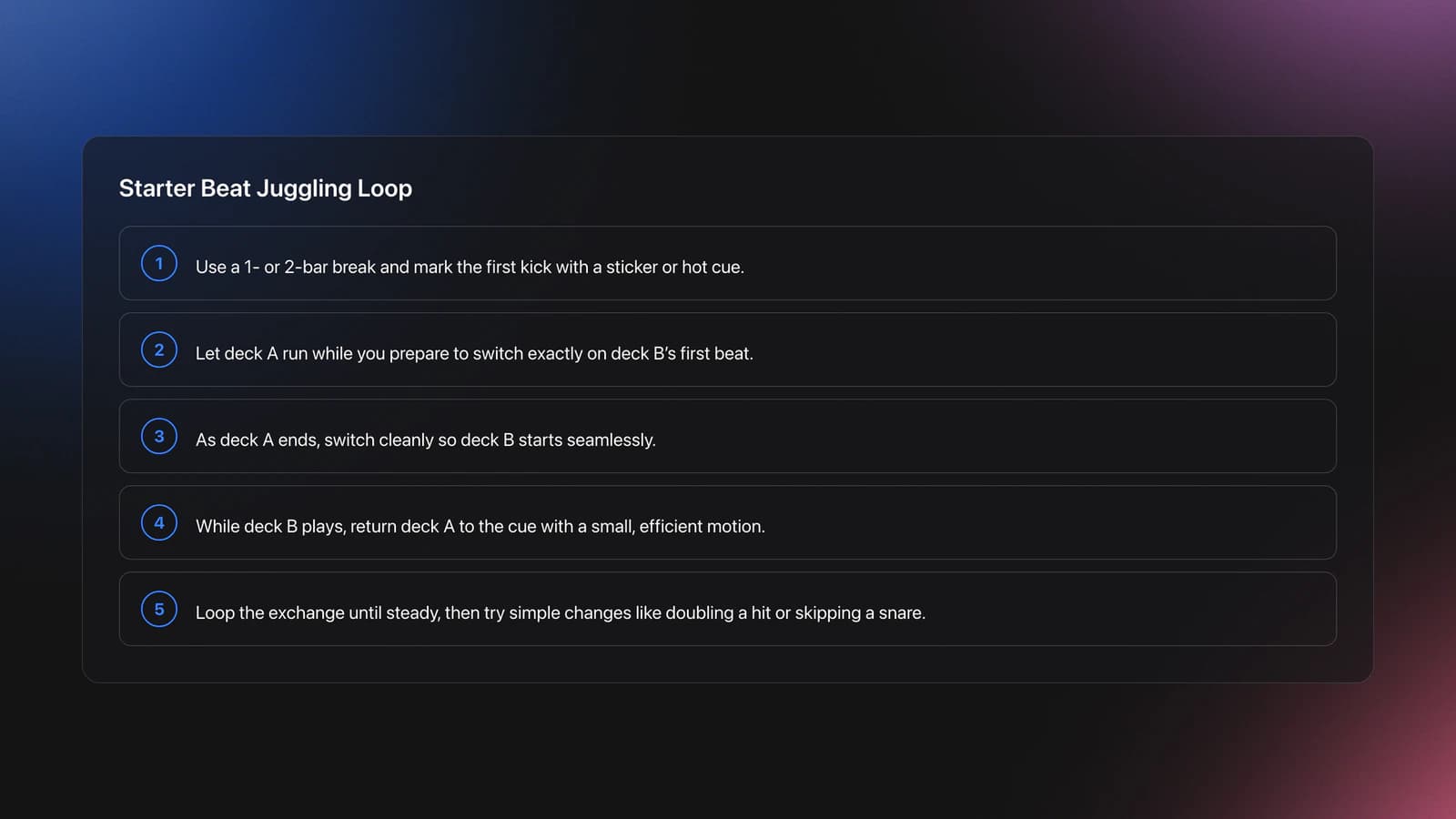
Start with a one-bar or two-bar break. Mark the first kick clearly, either with a sticker on vinyl or a hot cue in software. Your only goal at first is to make the loop sound seamless.
Play deck A. As the break ends, cut to deck B exactly as its first beat starts. While deck B plays, reset deck A to the cue point. Then repeat the exchange.
Do not rush to fancy patterns. Most early failures come from bad launches, not from lack of creativity. If the first beat lands late or early, the whole phrase feels crooked.
Keep your reset motion small. A short, efficient backspin or cue return is easier to repeat than a dramatic movement. The cleaner your mechanics, the more attention you can give to rhythm.
Once the hand loop is steady, add simple variation. Repeat one hit twice, skip a snare, or cut the second half of the bar. School of Scratch’s recommended lesson sequence also moves from basic looping into phasing, doubling, tripling, and chasing, which is a sensible progression.
If you are learning on digital gear, keep the principle the same. Pads and loops can speed up access, but the skill is still about timing, phrasing, and audio switching, not button collection.
Beat Juggling Fundamentals
Four fundamentals decide whether a juggle sounds tight: cue accuracy, fader timing, phrase awareness, and reset efficiency. If one is weak, the others have to compensate.
Cue accuracy means launching the sound from the same transient every time. On most beginner breaks, that is the first kick. Slight inconsistency here creates flams and timing smear.
Fader timing means opening the correct deck at the exact moment its hit should be heard. Rob Swift’s root movement idea is useful because it reminds you that the mixer is not separate from the platter. The cut and the launch form one gesture.
Phrase awareness means knowing where you are in the bar. You are not just repeating sounds. You are deciding whether to preserve the groove, create tension, or deliberately break expectation.
Reset efficiency means returning the silent deck quickly enough that the next launch feels calm instead of desperate. This is where it clicks. Advanced-looking routines often come from simple ideas executed with very little wasted motion.
Practice Drills for Beat Juggling
A good practice routine isolates one movement at a time. In practice, short drills with one measurable target produce faster progress than marathon sessions where every mistake repeats for an hour.
Work in 15 to 30 minute blocks. Practice one drill for 3 to 5 minutes, rest briefly, then repeat. Track progress in 2 to 4 week cycles so you can hear whether your launches and cuts are becoming more consistent.
Drill 1 is the hand loop. Use the same break on both decks and aim for 16 clean swaps. If one transition drifts, restart the count. This builds honesty into your practice.
Drill 2 is downbeat cutting. Leave the audio source simple and focus only on the crossfader. This teaches you to place the sound with intention instead of reacting late.
Drill 3 is controlled doubling. Repeat a single snare or kick once per bar. Small variations reveal whether your reset hand stays calm under repetition.
If you keep many practice breaks, organizing them by tempo, swing feel, and difficulty can save a lot of wasted setup time. A structured crate inside Vibes can help you keep duplicate-break drills, battle references, and progression sets in one place, especially when you want the same practice routine ready across multiple sessions.
From there, start recording your drills. Listening back exposes timing problems faster than real-time monitoring because you are no longer distracted by hand movement.
Common Beat Juggling Mistakes
Most beat juggling mistakes come from doing advanced ideas before the basic loop is stable. The fix is usually smaller than you think.
| Mistake | Why It Happens | Fix |
|---|---|---|
| Late launch | Cue point is vague or hand release is inconsistent | Mark one clear transient and practice 20 identical starts |
| Messy crossfader cuts | Fader hand reacts after the platter hand | Practice silent fader timing drills on the downbeat |
| Losing the bar | Counting stops once hand movement starts | Say the count out loud for the first few sessions |
| Overcomplicated patterns | Trying chase patterns before basic looping is reliable | Master a one-bar loop before adding doubles or gaps |
| Tense hands | Grip is too heavy and movement is too large | Use lighter touch and shorter reset travel |
Why do most beginners struggle with beat juggling? Because the technique punishes inconsistency immediately. A mix can hide small timing flaws. A juggle cannot.
Troubleshooting Timing Problems
If the juggle feels uneven, first decide whether the problem is the launch, the cut, or the count. Do not treat all timing errors as the same issue.
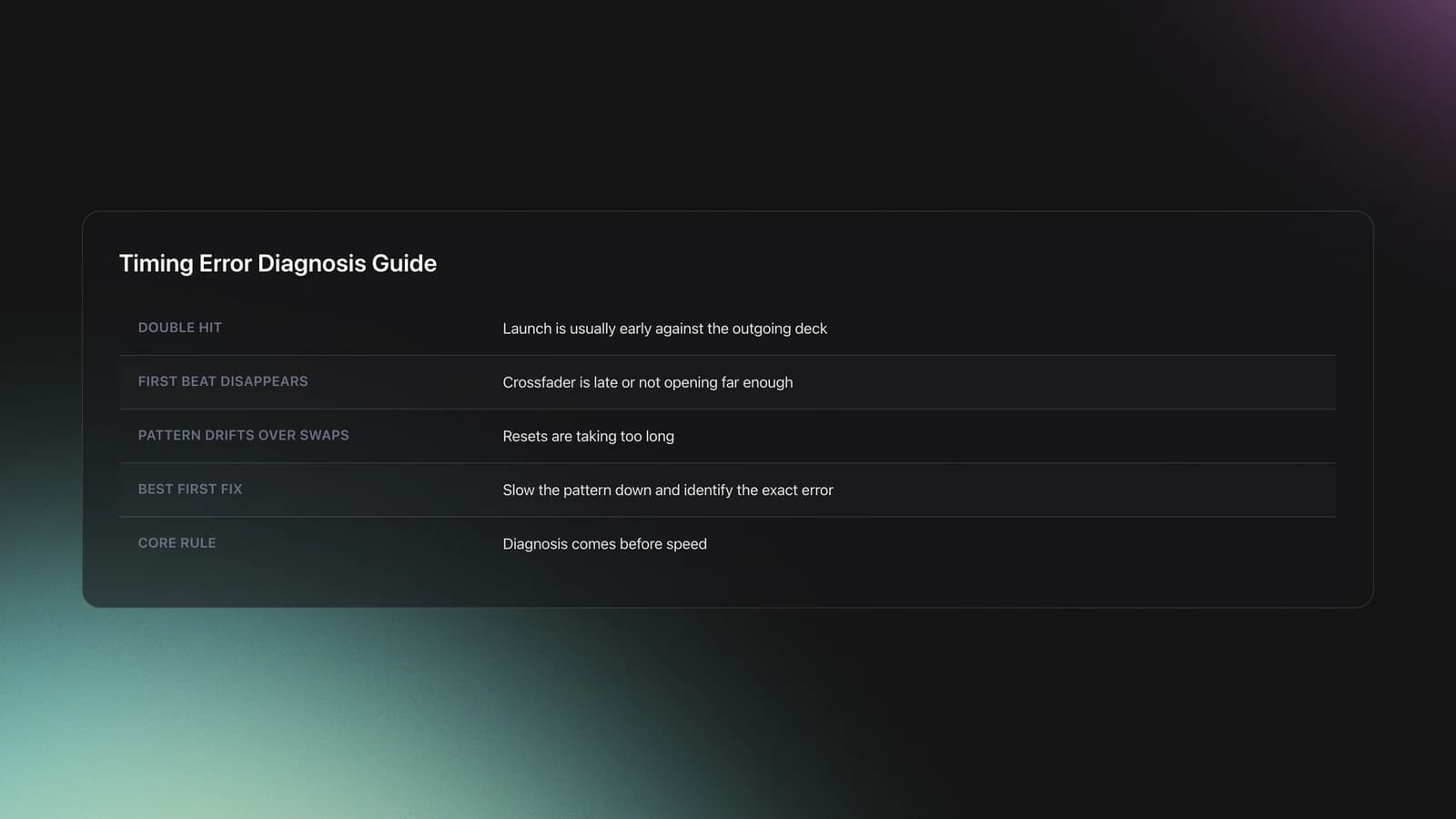
If you hear a double hit, your launch is usually early against the outgoing deck. If the first beat disappears, your crossfader is late or not opening far enough. If the whole pattern drifts after several swaps, your resets are taking too long.
Slow the pattern down until you can name the error before fixing it. In other words, diagnosis comes before speed. That habit matters later when you move into scratching once timing feels stable, because both skills depend on precise attack control.
Where Beat Juggling Fits in Real Sets
Beat juggling appears most often in turntablist showcases, battle routines, and hip-hop performance sections. It is less common in long-form club mixing, but the control it teaches transfers directly to cleaner edits, sharper transitions, and more confident live manipulation.
You can also use light juggling ideas as short live remixes between tracks. A repeated snare, delayed entry, or extended break can create excitement before a drop without turning the whole set into a battle routine.
When you begin building complete routines, combine this timing work with track selection and flow. That is where it helps to use harmonic mixing when building full routines and to keep reference tracks, battle cuts, and proven break sections organized in a system you can search quickly.
Beat Juggling Examples and Progression
A realistic progression starts with looping, then moves into doubling, tripling, chasing, and custom phrase edits. School of Scratch’s curated lesson list reflects that ladder well, and Rob Swift’s teaching adds a useful framework for understanding more advanced movements as combinations of basic mechanical choices.
Historically, the technique grew out of early break extension practices and later became a competitive art form in turntablism battles. Pioneer DJ’s history article points to early battle examples from figures like Miz and credits Steve Dee as the inventor of beat juggling in Rob Swift’s genealogy of the form.
That history matters because it gives you a listening roadmap. Watch classic routines. Study where the pattern stays stable and where it deliberately breaks. Most practitioners improve faster when they copy one simple historical phrase before inventing ten weak new ones.
Safety and Hearing
The main safety issue in beat juggling is hearing exposure, not the hand movement itself. The technique often involves repeated monitoring of short, loud transients, which can tempt you to raise booth or headphone levels more than needed.
Resources like the DanceSafe hearing protection guide recommend reducing exposure, taking breaks, and using proper hearing protection instead of makeshift solutions. Keep levels as low as possible while still hearing timing clearly.
If you practice in a loud environment, use musician earplugs and shorten sessions. Hearing damage builds slowly, and turntablists depend on fine timing perception.
Key Takeaways
Beat juggling teaches you to turn two matching sources into a new rhythmic idea through timing, resets, and fader control. It matters because it develops the exact skills that separate passive playback from active performance.
Start with a one-bar loop. Make the switch seamless. Then add one variation at a time.
- Master clean launches before chasing speed.
- Use short, repeatable drills with measurable targets.
- Study classic routines, then build your own patterns.
Your next step is simple: spend one week looping a single break cleanly for 16 repetitions, then expand into doubles and pauses. Once that feels stable, beat juggling stops feeling like chaos and starts feeling musical.
The visual way to organize your DJ library
Tag tracks by vibe. See everything at once. Export to rekordbox, Serato, Traktor or Engine DJ.
14-day free trial. Full access, no strings attached.
or see how it works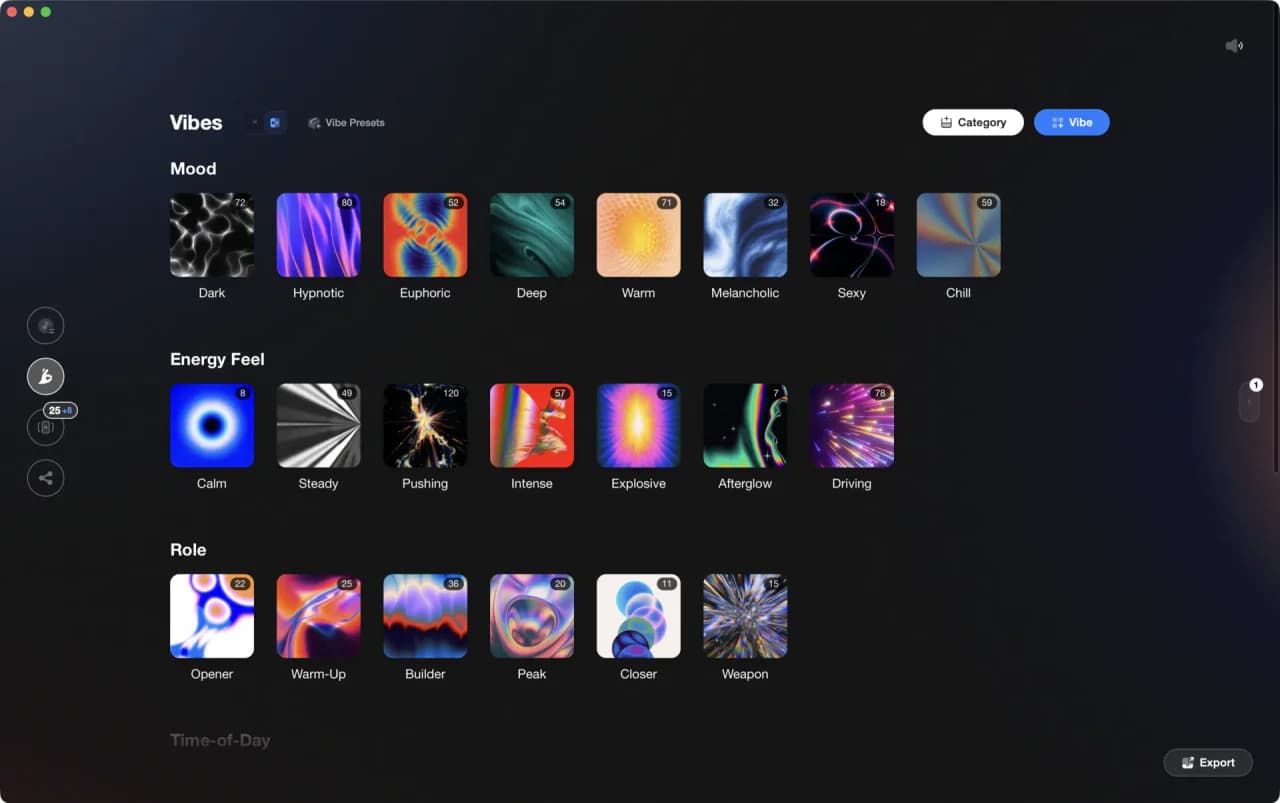
Equipment You'll Need
Pioneer DJ DDJ-FLX4
optionalA compact 2-channel DJ controller with built-in audio interface, USB-C connectivity, and beginner-friendly smart mixing features.
Pioneer DJ CDJ-3000
optionalProfessional flagship DJ media player with a 9-inch touchscreen, advanced MPU processing, and club-standard Pro DJ Link workflow.
Pioneer CDJ-400
optionalA discontinued digital DJ media player that plays CDs and MP3 files from USB storage, and can also work as a MIDI controller and USB audio interface.
Traktor MX2
optionalA 2-channel DJ controller with integrated audio interface and tight Traktor Pro 4 integration for mixing, stems, effects, and performance pads.
Native Instruments Traktor Pro 4
optionalA professional 4-deck DJ software platform with stem separation, flexible beatgrids, effects, DVS support, and broad controller integration.
Beatport
optionalBeatport is a DJ-focused electronic music store and streaming platform for discovering, buying, and streaming tracks into supported DJ software and hardware.
VirtualDJ
optionalDJ software for Windows and macOS that handles audio mixing, video mixing, karaoke, stems, and broad hardware support.
Serato DJ Pro
optionalProfessional DJ software for mixing, performance, library management, recording, and hardware-integrated club workflows.
Pioneer DJ DDJ-1000
optionalA 4-channel rekordbox DJ controller with full-size jog wheels, onboard displays, and club-style mixer controls.
DJControl Inpulse 200 MK2
optionalCompact 2‑deck USB DJ controller with built‑in audio, Beatmatch Guide LEDs, and Serato DJ Lite/DJUCED integration.
Mixed In Key 11
optionalStandalone harmonic-mixing and library-prep software that detects keys, energy levels, cue points, and tags for DJ sets.
rekordbox
optionalCloud-connected DJ software for music management, performance, export prep, and club-standard hardware integration.
Pioneer DJ DDJ-400
optionalA compact 2-channel USB DJ controller built for rekordbox with a club-style layout aimed at new and progressing DJs.
VirtualDJ 7
optionalA legacy DJ software platform for audio and video mixing, controller mapping, and DVS playback on Windows and Mac.
Frequently Asked Questions

Hey, it's Ben Modigell 👋
I DJ and produce as so I so: downtempo, minimal, dub house, tech house, and techno (releases on Spotify and SoundCloud, links above). Everything I write here comes from my own gigs, studio sessions, and library cleanups: the rules I follow, the failure modes I have actually hit, and the workflow I use when nobody is watching. If a technique did not earn its place in my own sets, it does not make it into a tutorial.