Turntablism
Turntablism is the art of using turntables and a mixer as instruments to create rhythmic, expressive sound through scratching, beat juggling, cueing, and performance routines.
Turntablism Tutorials
Turntablism is the art of treating the turntable like an instrument, not just a playback device. If you want sharper scratches, tighter routines, and more control over rhythm, turntablism gives you that path. Learn turntablism well and you stop reacting to records passively. You start shaping sound with intention.
For DJs, turntablism unlocks expression, timing, and stage presence. It sits at the intersection of scratching, cueing, beat juggling, and performance design. In practical terms, that means cleaner cuts, stronger phrasing, and routines that sound deliberate instead of random.
Most beginners struggle because the hands are doing different jobs at once. One hand moves the record. The other controls the crossfader. Your ears track timing, tone, and groove at the same time. That coordination takes work, but it can be trained in short, focused sessions.
What Is Turntablism?
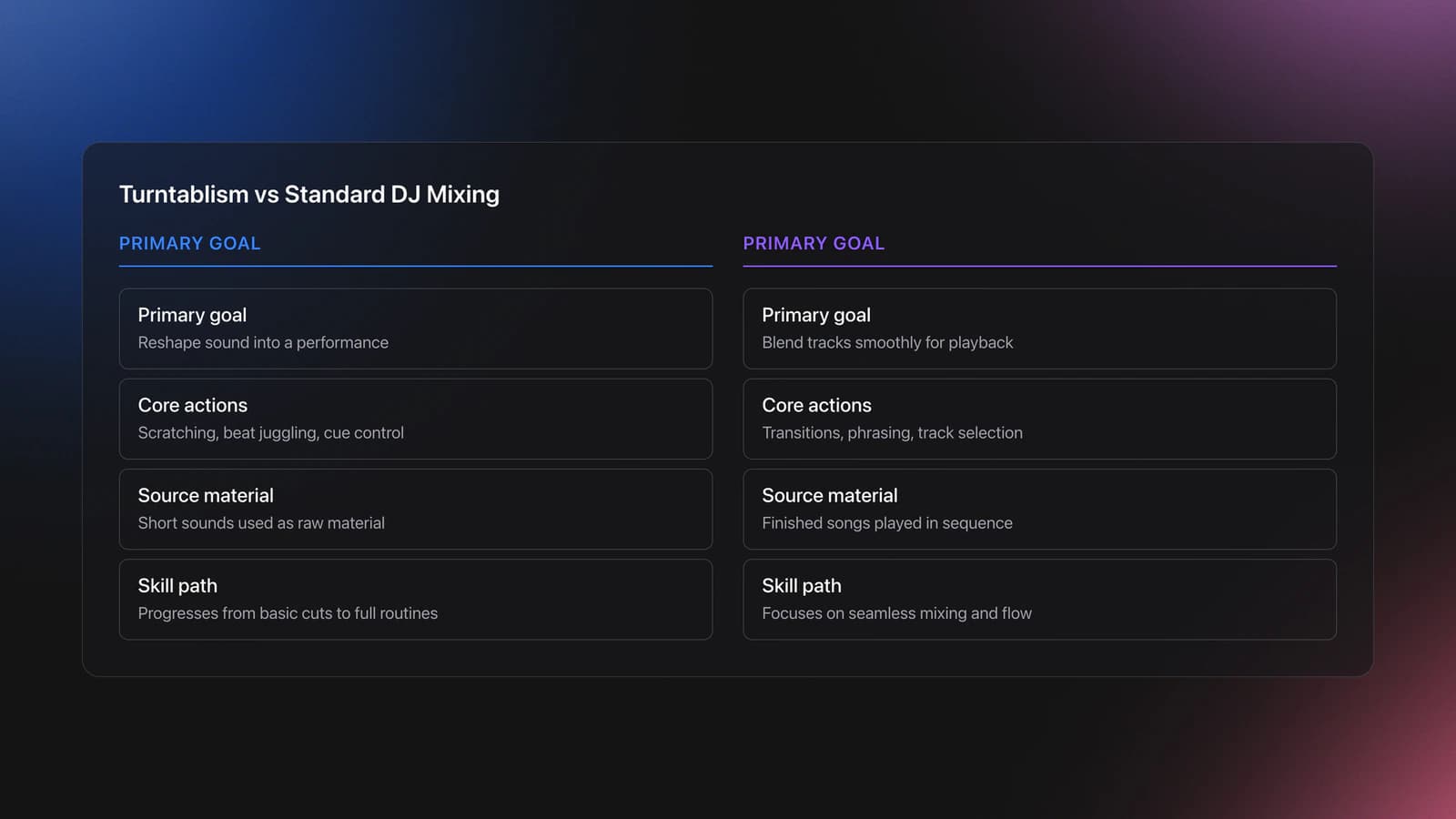
Turntablism is the performance practice of manipulating vinyl or DVS audio with turntables and a mixer to create new rhythmic and musical results. It commonly includes scratching, beat juggling, cue-point control, and short prepared routines rather than simple song playback.
That definition matters because it separates turntablism from standard mixing. A club DJ may blend tracks smoothly. A turntablist actively reshapes sound through touch, timing, and fader technique. Sources from Pioneer DJ and The Vinyl Factory both frame turntablism as a distinct performance culture tied to hip-hop DJing and creative record manipulation. See the Pioneer DJ turntablism history article and The Vinyl Factory turntablism history feature.
In other words, the record becomes your raw material. A short drum hit, vocal stab, or tone can become a rhythm part, a texture, or a full performance phrase.
Turntablism is also broad. Some DJs focus on battle-style scratches. Others build musical routines, tone play, or beat juggles. That is why the skill level is best described as multi-level. You can start with baby scratches and simple cuts, then progress into flares, crabs, and full routines.
Why Learn Turntablism
Turntablism improves more than flashy tricks. It builds timing, cue accuracy, hand independence, and a deeper sense of phrasing. Those skills carry into live sets, transitions, and even how you prepare records for performance.
It also teaches economy. A strong routine uses a few sounds with precise timing. That mindset helps DJs strip away clutter and focus on control.
- It sharpens timing through repeated bar-based movements.
- It improves hand independence between record and crossfader.
- It builds cue accuracy for cleaner starts and resets.
- It develops performance confidence under pressure.
- It gives live sets a personal, recognizable voice.
Gear for Turntablism
Turntablism works best with equipment that responds quickly and predictably. The standard setup is two direct-drive turntables and a mixer with a smooth, sharp crossfader. Direct-drive models matter because scratching and back-cueing demand fast startup and stable torque, which is why turntablist history consistently points to direct-drive decks as the practical standard.
If you are still building foundations, first master beat matching fundamentals. Even battle-focused turntablism benefits from stable tempo control and accurate cue drops.
Essential tools are simple: direct-drive decks or DVS, slipmats, a responsive mixer, headphones, and records or control vinyl with useful sounds. Optional tools include battle records, practice timers, and earplugs for longer sessions.
A sharp crossfader cut-in helps, but technique matters more than expensive gear at first. Clean mechanics beat gear chasing.
How to Start Turntablism
Start turntablism by isolating three movements: record control, crossfader control, and timing. Practice each part slowly, then combine them in short patterns. This creates reliable coordination faster than jumping straight into complex scratches.
Begin with the baby scratch. Move the record forward and backward evenly over a short sound without using the crossfader. Focus on consistent distance, relaxed wrists, and even rhythm.
Next, add simple cut-ins. Open the fader only for the forward motion, then only for the backward motion. This teaches you how sound starts and stops at precise moments.
From there, work on cue placement. The Red Bull cue-pointing tutorial shows why exact start points matter. Turntablism falls apart when your sample does not reset to the same place every time.
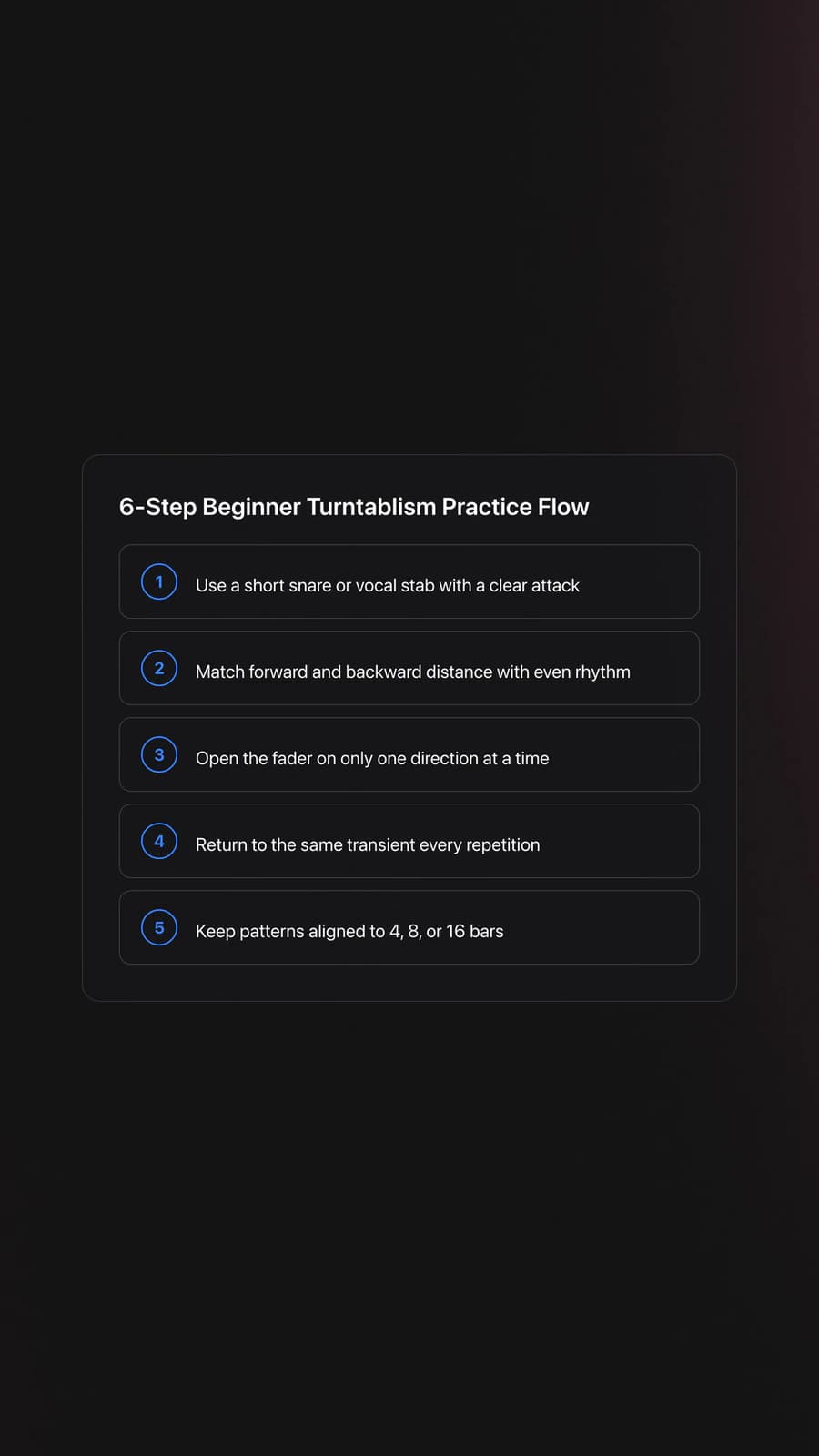
| Step | Action | Key Focus |
|---|---|---|
| 1 | Choose one short sound | Use a clear attack like a snare or vocal stab |
| 2 | Practice baby scratches | Match forward and backward distance |
| 3 | Add single fader cuts | Hear clean starts and stops |
| 4 | Reset the cue point repeatedly | Land on the same transient every time |
| 5 | Count in bars | Keep patterns aligned to 4, 8, or 16 bars |
| 6 | Record and review | Listen for timing drift and messy cuts |
A beginner path for learning turntablism without overload.
Do not rush into advanced scratches. Most instructors and educational resources build from control first, then speed. The DJ TechTools scratch technique guide reflects that same progression.
Core Skills Inside Turntablism
The core skills in turntablism are scratch mechanics, fader timing, cue accuracy, phrase awareness, and routine structure. If one of those is weak, the whole performance feels unstable.
Scratch mechanics control the shape of the sound. Record movement determines pitch contour, speed, and texture. Small, even motions are usually cleaner than large dramatic ones when you are learning.
Fader timing controls clarity. You are deciding when the audience hears the movement and when they do not. That is the difference between a smooth baby scratch and a sharp transformer-style cut.
Cue accuracy is the reset system behind everything. A missed cue point makes even good hand technique sound sloppy. That is why battle records and clear markers remain standard practice in turntablist workflows.
Phrase awareness keeps the performance musical. Even abstract scratches land harder when they resolve on bar lines. If this area feels weak, tighten your phrase mixing timing before building longer routines.
Routine structure is the final layer. A short turntablism routine often alternates texture, space, and impact. One dense section, one simpler answer, then a strong ending usually reads better than constant complexity.
Practice Drills for Turntablism
A good turntablism practice routine should be short, repetitive, and measurable. In practice, tight two-minute drills improved control faster than marathon sessions with no focus.
Start with one sound and one goal. For example, spend two minutes on even baby scratches at a moderate tempo. Then spend two minutes on forward cuts only. Then review the recording.
Next, use bar-based drills. Count 1 to 8 and keep the same scratch shape through the full phrase. The goal is not speed. The goal is consistency without rushing or dragging.
After that, build a call-and-response pattern. Scratch for one bar, leave one bar empty, then repeat. Silence exposes timing problems fast.
If you keep practice records, organized sample access helps. Some DJs build dedicated scratch crates by sound type, BPM range, or routine role. In Vibes, that kind of structure can make repeatable practice easier because your battle breaks, vocal stabs, and routine ideas stay grouped in one place.
When that feels stable, build stronger scratching control. A dedicated scratch foundation page helps you separate general turntablism from specific scratch families.
Most learners can improve noticeably in 2 to 4 weeks if they practice 15 to 30 minutes a day. The progression becomes clear when you track one metric at a time, such as cue accuracy, clean cuts, or staying locked for 16 bars.
Common Mistakes in Turntablism
Most turntablism mistakes come from trying to go fast before the movement is clean. The fix is usually smaller motion, slower tempo, and tighter listening.
| Mistake | Why It Happens | Solution |
|---|---|---|
| Overmoving the record | Large gestures feel expressive but break timing | Shorten the record path and repeat a fixed distance |
| Messy fader clicks | The hand tenses and loses precision | Practice single-direction cuts before combos |
| Bad cue resets | The start point is not clearly marked or memorized | Use a clear transient and reset after every rep |
| Rushing phrases | The DJ focuses on tricks instead of bar count | Count 4s and 8s aloud while practicing |
| Practicing too loud | Loud monitoring hides detail and increases fatigue | Lower monitor level and use hearing protection when needed |
Why do most beginners plateau here? Because they repeat full routines instead of fixing the weakest motion. Isolate the smallest broken part first.
If your scratches sound thin, listen to attack and release. If your routine feels loose, the problem is often phrasing, not difficulty. If your cueing is inconsistent, go back to reset drills before adding speed.
Turntablism in Real Performance
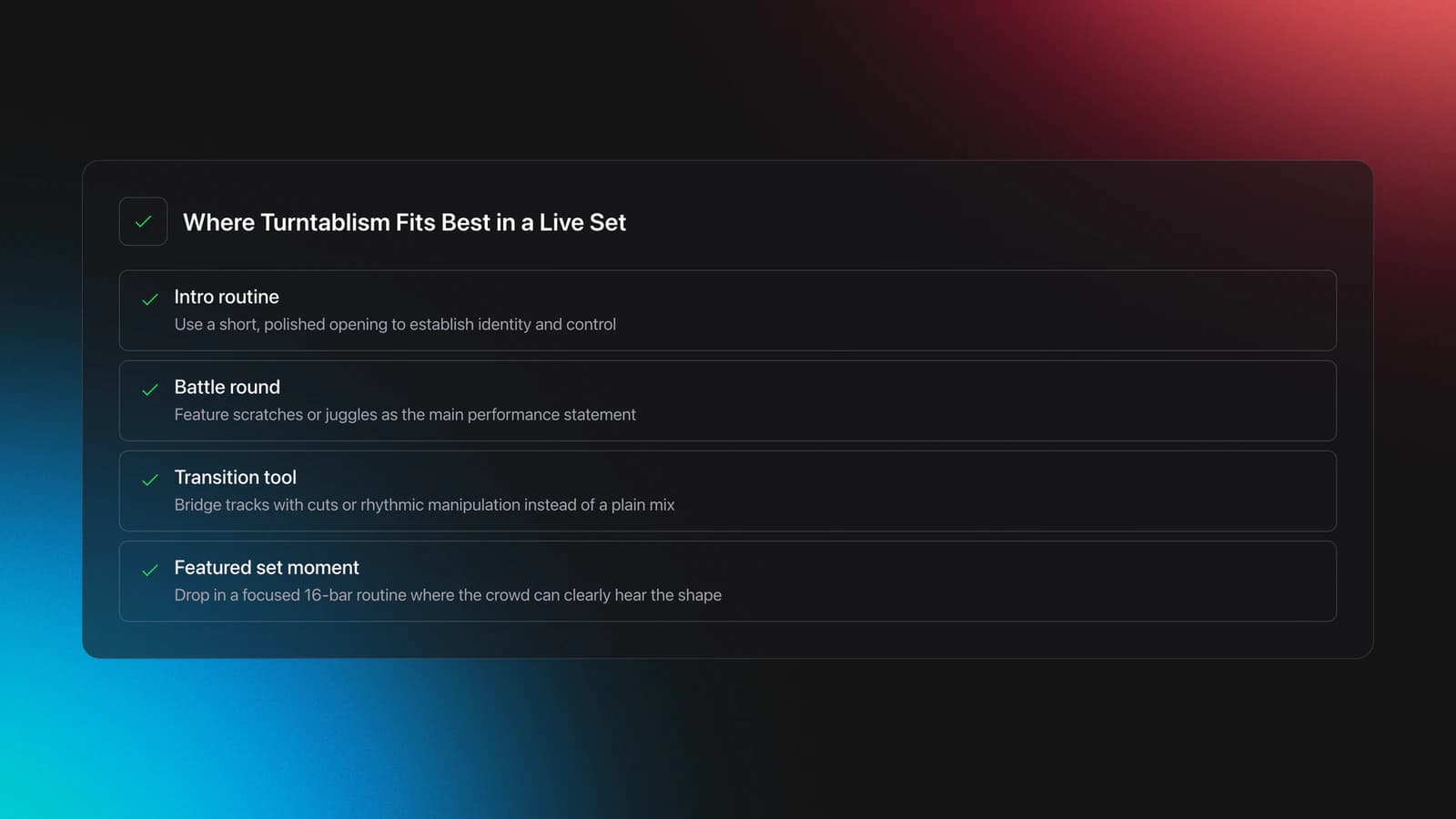
Turntablism works best when it serves a clear performance purpose. That can mean a short intro routine, a battle round, a transition tool, or a featured moment inside a hip-hop set.
Many classic examples center on scratching and beat juggling as performance statements, while educational material from Questlove and Pioneer DJ shows the broader creative role of advanced DJ techniques in live sets. See the Questlove advanced DJ techniques lesson and the Pioneer DJ turntablism history article.
In practice, a simple, clean 16-bar routine often lands harder than a crowded one. The audience hears shape and confidence before they hear technical density.
Once your scratch control is reliable, you can move into beat juggling patterns. That is a natural next step because turntablism often expands from single-sound manipulation into rhythmic reconstruction.
Hearing Safety for Turntablism
Hearing safety matters in turntablism because repeated practice can involve long exposure to loud monitors, headphones, and live systems. WHO advises keeping volume down, taking listening breaks, and using ear protection in noisy spaces, while CDC states repeated exposure to loud music can lead to permanent hearing loss and tinnitus. See the WHO safe listening guidance and CDC NIOSH music hearing risk bulletin.
For practice, lower the monitor level until detail is still clear. Give your ears quiet breaks every session. If you are rehearsing in loud rooms or near PA systems, wear musician earplugs.
How to Know You Are Improving
You are improving at turntablism when your movements become repeatable, not when they simply become faster. The first signs are cleaner cue resets, more even scratch distance, and better phrase alignment over 8 to 16 bars.
Record short takes weekly. Compare timing, cleanliness, and tension in the hands. If the pattern sounds calmer and more deliberate, that is progress.
A strong early benchmark is holding a simple scratch pattern for 16 bars without drifting. Another is resetting the same cue point ten times in a row with no audible miss.
Turntablism Summary
Turntablism turns the deck and mixer into expressive instruments. It builds timing, control, and live identity, but it rewards patience more than speed. If you start with cue accuracy, basic scratches, and short bar-based drills, progress becomes easier to measure and easier to keep.
Key takeaways:
- Build control first, then add speed and complexity.
- Practice in short, focused sessions with one clear goal.
- Keep routines musical by aligning ideas to phrases and bars.
Your next step is simple. Choose one sound, practice baby scratches and cut-ins for 15 minutes, then review the recording. From there, move into build stronger scratching control or move into beat juggling patterns when your timing feels stable.
The visual way to organize your DJ library
Tag tracks by vibe. See everything at once. Export to rekordbox, Serato, Traktor or Engine DJ.
14-day free trial. Full access, no strings attached.
or see how it works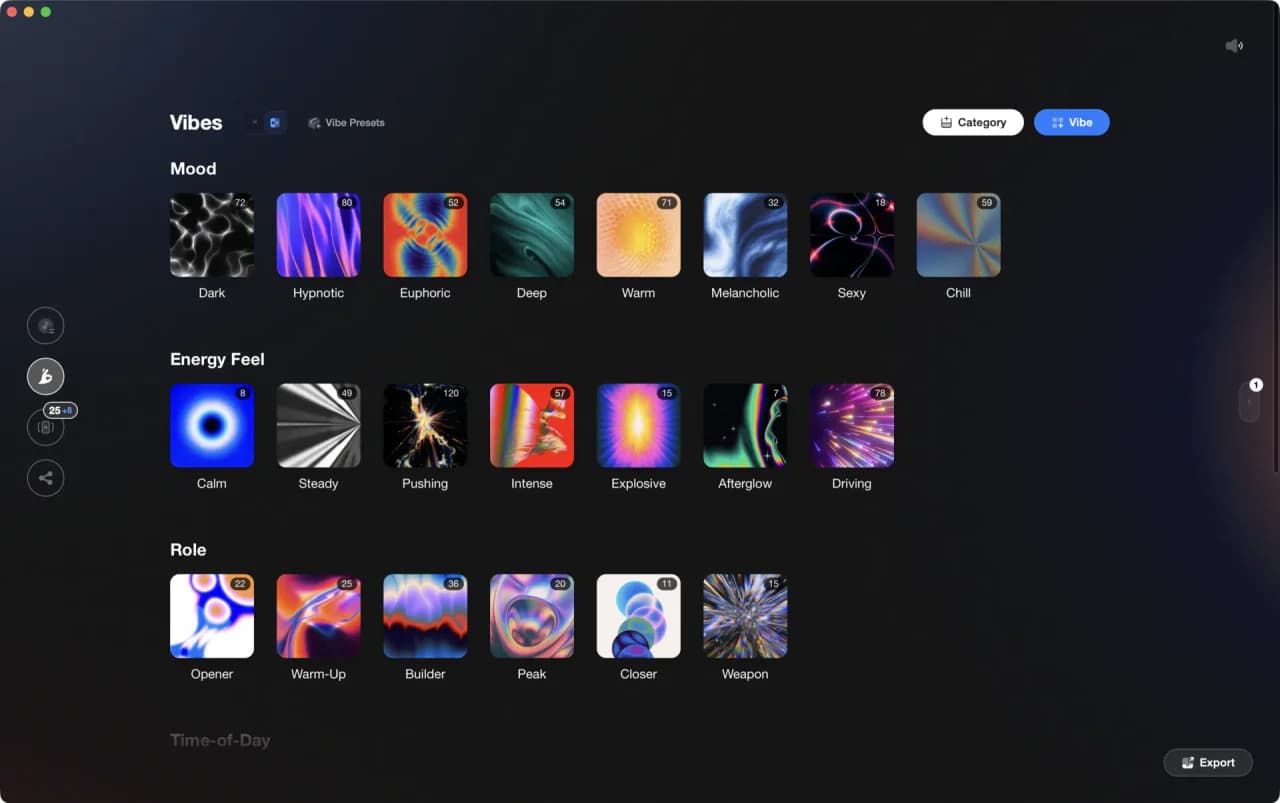
Equipment You'll Need
Pioneer DJ DDJ-FLX4
optionalA compact 2-channel DJ controller with built-in audio interface, USB-C connectivity, and beginner-friendly smart mixing features.
Pioneer DJ CDJ-3000
optionalProfessional flagship DJ media player with a 9-inch touchscreen, advanced MPU processing, and club-standard Pro DJ Link workflow.
Pioneer CDJ-400
optionalA discontinued digital DJ media player that plays CDs and MP3 files from USB storage, and can also work as a MIDI controller and USB audio interface.
Traktor MX2
optionalA 2-channel DJ controller with integrated audio interface and tight Traktor Pro 4 integration for mixing, stems, effects, and performance pads.
Native Instruments Traktor Pro 4
optionalA professional 4-deck DJ software platform with stem separation, flexible beatgrids, effects, DVS support, and broad controller integration.
Beatport
optionalBeatport is a DJ-focused electronic music store and streaming platform for discovering, buying, and streaming tracks into supported DJ software and hardware.
VirtualDJ
optionalDJ software for Windows and macOS that handles audio mixing, video mixing, karaoke, stems, and broad hardware support.
Serato DJ Pro
optionalProfessional DJ software for mixing, performance, library management, recording, and hardware-integrated club workflows.
Pioneer DJ DDJ-1000
optionalA 4-channel rekordbox DJ controller with full-size jog wheels, onboard displays, and club-style mixer controls.
DJControl Inpulse 200 MK2
optionalCompact 2‑deck USB DJ controller with built‑in audio, Beatmatch Guide LEDs, and Serato DJ Lite/DJUCED integration.
Mixed In Key 11
optionalStandalone harmonic-mixing and library-prep software that detects keys, energy levels, cue points, and tags for DJ sets.
rekordbox
optionalCloud-connected DJ software for music management, performance, export prep, and club-standard hardware integration.
Pioneer DJ DDJ-400
optionalA compact 2-channel USB DJ controller built for rekordbox with a club-style layout aimed at new and progressing DJs.
VirtualDJ 7
optionalA legacy DJ software platform for audio and video mixing, controller mapping, and DVS playback on Windows and Mac.
Frequently Asked Questions

Hey, it's Ben Modigell 👋
I DJ and produce as so I so: downtempo, minimal, dub house, tech house, and techno (releases on Spotify and SoundCloud, links above). Everything I write here comes from my own gigs, studio sessions, and library cleanups: the rules I follow, the failure modes I have actually hit, and the workflow I use when nobody is watching. If a technique did not earn its place in my own sets, it does not make it into a tutorial.