
DJ Set Energy Levels
Energy level is a 1 to 10 score for how hard a track pushes a dance floor, and a set is built by deciding the order of those scores before you play. The shape that works almost everywhere is a low opener, single-step climbs to a peak in the final third, and one deliberate drop back so the peak still reads as a peak.
Quick Answer
What an energy score actually measures
It is not volume and it is not tempo. Two tracks at 128 BPM can sit three points apart because energy is made of drum weight, bass presence, how busy the arrangement is, whether there is a vocal pushing at you, and how much tension the chords carry. A sparse 128 BPM roller and a 128 BPM festival anthem are not the same request to a room.
The 1 to 10 scale is the one most DJs share, largely because Mixed In Key detects an Energy Level from 1 to 10 during analysis and writes it into the file's tags, so the number shows up in Serato, Traktor and rekordbox libraries. You do not need that software to use the scale. You need one number per track that you trust and can sort by.
| Score | What it sounds like | Where it belongs |
|---|---|---|
| 1 to 2 | No beat, or a beat nobody can dance to. Ambient, intros, spoken word. | Doors open, dinner, the last record of the night. |
| 3 to 4 | A steady beat, soft drums, little bass weight. | The first hour of a warm-up. |
| 5 | A groove that works. People stop talking and start moving. | Filling the floor. |
| 6 to 7 | Full drums, a clear hook, obvious forward push. | The middle of most sets. |
| 8 to 9 | Big drops, anthems, records the room sings back at you. | The peak window. |
| 10 | The single biggest moment you own. | Once a night, if at all. |
The bands are relative to your room, not absolute. A track that is a 7 in a small bar can be a 5 at a festival.
The five shapes that work
There is no single correct curve. There is a short list of shapes, and the right one is decided by your slot rather than by taste.
| Shape | Where it fits | What the numbers do |
|---|---|---|
| Journey | A long solo set or an all-night slot. | Start at 3, climb one step at a time, peak at 8 or 9 in the final third, ease back to 5. |
| Warm-up | Opening for someone else. | Sit between 3 and 6 and stop there. The headliner needs somewhere to go. |
| Peak time | The headline hour. | Open at 7, hold a plateau at 8, take one dip to 6, finish at 9. |
| Steady groove | Deep house, after hours, a bar residency. | Lock the range at 5 to 6 and never leave it. |
| Closing | The last slot of the night. | Start at 7 or 8 and walk down to 4 across the final 40 minutes. |
Each of those slots has its own habits beyond the curve. If you are opening, read how to play a warm-up set. If you have the headline hour, how to play a peak time set covers holding a plateau. For the last slot, how to play a closing set covers the walk down.
Build the arc, step by step
- 1
Fix the slot before you touch music
Write down the length, the start time, who plays before you and who plays after. Ask what the DJ before you tends to end on. Your opening number is set by their last one, not by your taste.
- 2
Score every candidate 1 to 10
Do it in one sitting, on one pair of speakers, in one mood. Scores drift badly when you spread the job over weeks. Put the number in a field your DJ app can sort and filter, not in the filename.
- 3
Mark the peak window
Choose the 20 to 30 minutes where the room should be at its highest. In a standalone set it usually falls in the final third. In a warm-up there is no peak window at all, and that is the point.
- 4
Place five anchors
Only five tracks get locked: the opener, the first lift, the peak, the release after the peak, and the closer. Everything else stays negotiable.
- 5
Fill the gaps one step at a time
Between anchors, never climb more than one point per track. Coming down you can drop two or three points in a single move, because a big drop reads as a deliberate reset while a big jump up reads as panic.
- 6
Check key and tempo against that order
Now, and not before, look at whether the order is mixable. Sorting by BPM and key first is the classic mistake: it produces a smooth set that goes nowhere. See how to organize music by BPM and key for the second pass.
- 7
Add spares at every level
Two or three alternates per score, ready to hand. A planned set survives contact with a real floor only if you can swap sideways without leaving the level you are on.
- 8
Rehearse only the level changes
You do not need to practice the whole set. Practice the four or five transitions where the number moves, because those are the ones the room hears.
If you want the whole thing on one page you can fill in before a gig, use the DJ set planning template.
Do it inside your DJ app
None of the four main DJ apps ships a column called Energy. The rekordbox 7 manual, the Serato DJ Pro column list, the Traktor Pro 4 Smartlist filters and the Engine DJ sort fields all leave it out. So you borrow a field that already sorts and filters, and you put your number in it.
| App | Field to borrow | How you use it |
|---|---|---|
| rekordbox 7 | My Tag, the star Rating, or Comments | The track filter narrows a list by BPM, KEY, RATING, COLOR and My Tag. In Preferences > Advanced > Browse you can add My Tag values into the Comments column so the tag stays visible while you browse. |
| Serato DJ Pro | Comment or Grouping | Both are sortable columns: click a header to sort, hold Ctrl or Cmd and click a second header for a secondary sort. Park the shortlist in the Prepare panel and drag it onto Make New Crate to save it. |
| Traktor Pro 4 | Comment, Comment2 or Rating | Smartlists filter on all three and update themselves as you add music. Right-click a playlist and choose Select as Preparation List to build the shortlist for the night. |
| Engine DJ 5 | Rating (1 to 5 stars) or Comment | Smartlist rules cover Rating and Comment, with contains, is equal to, and range modifiers. |
Fields confirmed in each vendor's current documentation. Ratings only give you five steps, so if you use stars, work on a 1 to 5 scale and stay consistent.
Step size: up and down are not symmetrical
Going up
- Move one point at a time.
- Give each new level at least three or four tracks before climbing again.
- Use a vocal or a familiar hook to lift, not more volume.
- Mixed In Key's own guidance says the same thing: from 5 you go to 4, stay at 5, or step to 6.
Coming down
- -Drop two or three points in one move.
- -Do it right after a peak, while the room is still full.
- -A big drop buys you a second climb later.
- -Coming down slowly just sounds like the set running out of ideas.
Small tempo moves work the same way. Nudging the tempo up a beat or two per transition over several tracks lifts a room without anyone noticing a jump, which is why the tempo curve and the energy curve usually travel together. Energy-based mixing goes deeper on the transition side of this.
The mistakes that cost you the floor
- The premature peak. Playing your three biggest records in the first 30 minutes leaves you nothing for the hour that matters.
- The flat middle. A set that sits at 7 for 90 minutes stops registering as loud. The room adapts and then leaves.
- The sawtooth. Up, down, up, down every other track. The floor never settles long enough to commit.
- Planning by tempo alone. Perfect BPM order with random energy is a set that mixes beautifully and empties the room.
- No spares. One locked tracklist and no alternates means the first surprise ends your plan.
- Ignoring the handover. Opening three points below where the previous DJ finished throws away the room you were handed.
The faster way: sort the arc instead of building it by hand
Scoring a few thousand tracks by ear is the part people never finish. Vibes does that pass for you. Import Wizard pulls your library in from rekordbox, Serato, Traktor, Engine DJ, an Apple Music or iTunes Library.xml, or plain folders, and Smart Import detects which app it came from. Analysis gives every track its BPM, key in Camelot, musical or Open Key notation, an energy curve, and the sections inside it: intro, buildup, drop, breakdown, outro.
From there you build the shape instead of the list. Every track carries an energy value from 1 to 10, and Set Designer sorts a selection by Energy Flow, ascending, descending or as an arc, with key-path sorting when you want the harmonic route as well. Find Compatible pulls the Camelot neighbours inside a BPM window, half and double time aware, so the sideways spares at each level are already picked out. Auto-Tagging fills in vibes across the library so you can grab a level and a mood together. When the order is right, export it back to rekordbox, Serato, Traktor or Engine DJ as a folder tree, with optional Camelot key or BPM sub-folders.
The visual way to organize your DJ library
Tag tracks by vibe. See everything at once. Export to rekordbox, Serato, Traktor or Engine DJ.
14-day free trial. Full access, no strings attached.
or see how it works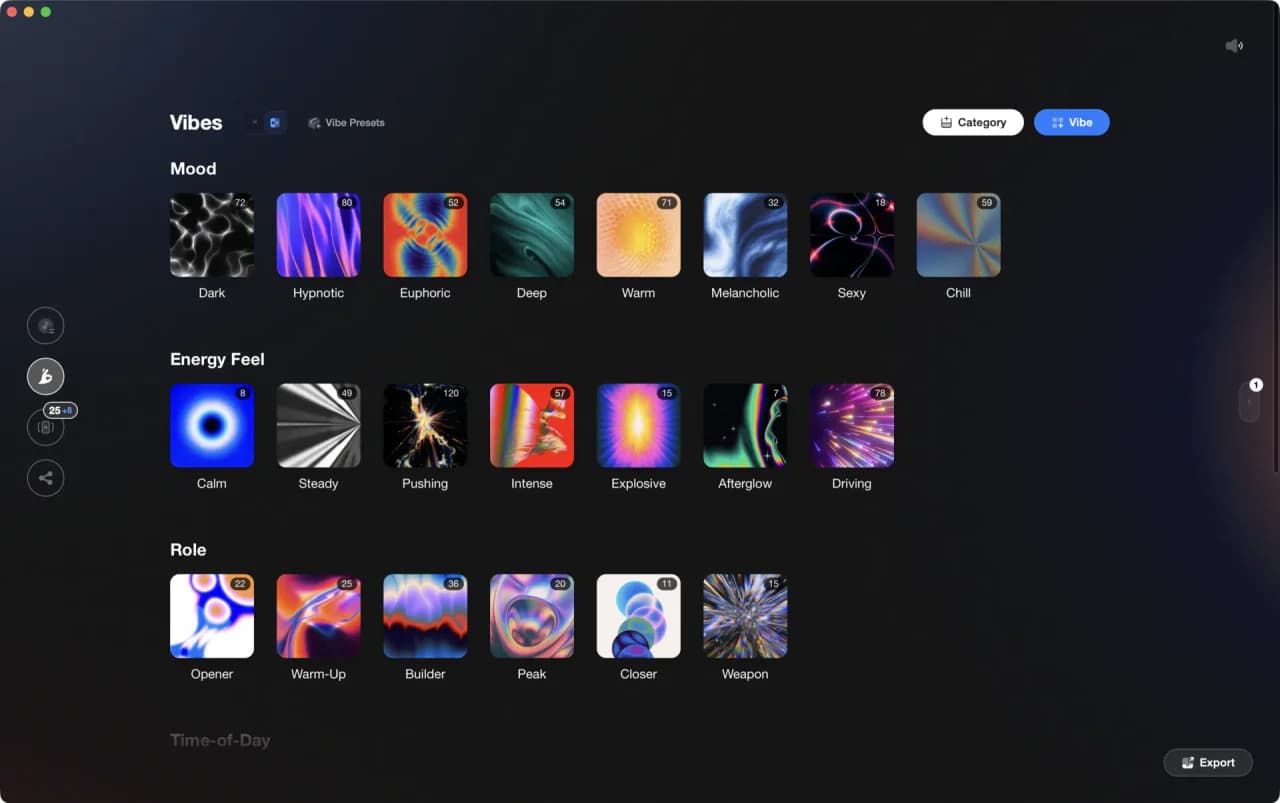
Frequently Asked Questions

Hey, it's Ben Modigell 👋
I DJ and produce as so I so: downtempo, minimal, dub house, tech house, and techno (releases on Spotify and SoundCloud, links above). Everything I write here comes from my own gigs, studio sessions, and library cleanups: the rules I follow, the failure modes I have actually hit, and the workflow I use when nobody is watching. If a technique did not earn its place in my own sets, it does not make it into a tutorial.