
Organizing Music by BPM and Key
Sorting a library by tempo and key needs two things: a trustworthy BPM and key value inside every file, and a browser that can sort or filter on those columns. This guide covers both, in your DJ app and in Apple Music, plus what streaming apps cannot do.
Quick Answer
What Has to Be True Before Sorting Works
Sorting is the easy part. A BPM column can only sort what the analysis wrote, so one unanalyzed folder or one track detected at half speed scatters the order you were trying to build. Check these four first.
- Every file is analyzed, not just the ones you played last month.
- Tempo and key are stored with the track, so the values survive an export to a USB stick or another app.
- One key notation across the library. Camelot codes and classical key names in the same column make the sort meaningless.
- Files you own. Streaming catalogs are browsed inside their own apps, and this job needs metadata you control.
How to Sort a DJ Library by Tempo and Key
The steps are the same in every major DJ app. The menu names change, the order does not.
- 1
Analyze the whole collection
Point the app at every folder you use and let it run. In rekordbox, Preferences > Analysis > Track Analysis sets what gets written: BPM and grid, key, phrase and vocal. With Auto Analysis enabled, analysis starts as soon as a file is added to the collection.
- 2
Pick one key notation and lock it
Camelot codes sort into a usable order, classical names do not. rekordbox sets this in Preferences > View > Display Type > Key display format: Classic shows the key name, Alphanumeric shows codes such as 1A and 2A. Serato DJ Pro has the same choice under Setup > Library + Display > Show Key As.
- 3
Show the BPM and key columns
Put both in the browser so you read tempo and key in one glance. Serato's library display settings decide which information appears, and every DJ app has an equivalent panel. A column you cannot see is a column you will not use.
- 4
Sort by clicking the BPM column
In rekordbox, click a column to sort the track list, and each click switches between ascending and descending. Serato behaves the same way, slowest to fastest. Traktor sorts a playlist by the column header you click, and a second click inverts the order.
- 5
Filter instead of scrolling
A sort still shows you everything. rekordbox's track filter, opened from the left of the search filter, refines the list by BPM, key, rating, color and My Tag. That is how you get from four thousand tracks down to twenty.
- 6
Save the result as a rule, not a snapshot
Turn the filter into a playlist that maintains itself. rekordbox Intelligent Playlists take a BPM value that is in the range you enter, Serato smart crates match rules on fields including BPM and Key, and Traktor Smartlists update automatically when new tracks land.
Use Tempo Bands, Not Exact Numbers
Nobody needs one folder for 124 BPM and another for 125. Group in bands of roughly five BPM, about as far as most tracks pitch before they start to sound off, and wide enough to absorb two analysis engines reading the same track as 127.98 and 128.
| Style | Typical BPM | Where it usually lands |
|---|---|---|
| Hip hop, R&B | 80 to 100 | Warm-up, or double time against 160 to 170 |
| Disco, nu-disco | 110 to 125 | Early floor, bridges into house |
| House, tech house | 120 to 130 | The main working band for most club sets |
| Trance, hard groove techno | 130 to 145 | Peak time |
| Drum and bass | 165 to 175 | Closing, or a half time bridge from around 85 |
Typical tempo bands. Treat them as habits of each style, not rules.
Keep the Key Next to the Tempo
A BPM sort gets you tracks that can beatmatch. It does not tell you which of them belong together. That is the key column's job: with Camelot codes the safe neighbours sit one step away on the wheel, or on the same number with the letter switched. Sort by tempo, read the key, and the short list is one you can trust. If your files have no key at all, run analysis again with key detection switched on, or check a single track with the song key and BPM finder. For reading the result, see how to tell what key a song is in.
Can Spotify Organize My Playlist by BPM?
Not in the app itself. The tempo sorters you find for Spotify are third party web tools that read the catalog through Spotify's Web API, and that route narrowed sharply: on November 27, 2024, Spotify closed the Audio Features endpoint, the source of those BPM values, to new applications. Tools with existing extended access keep working, new ones cannot be built on it. Treat Spotify as a place to find music and your own files as the place to organize it. Reading BPM and key from Spotify covers what is still possible.
How Can I Arrange Songs by BPM in Apple Music?
Music on Mac has a BPM field, it just does not fill it in for you. Apple's guide describes typing the number of beats per minute into the BPM field so a Smart Playlist can collect songs at the right speed. Fine for a workout list, hopeless for thousands of files, which is why DJ apps analyze instead.
- Select a song and choose Song > Get Info, then type the tempo into the BPM field. Command-I opens the same window.
- Choose View > Show View Options to show more categories, then click a column heading to sort by one of them.
- Choose File > New > Smart Playlist and set a rule, so the list keeps itself current instead of going stale.
- To DJ from that library, choose File > Library > Export Library to write a library XML, then point rekordbox at it under Preferences > Advanced > Database > iTunes Library File. Your Music tracks and playlists appear in its tree view.
The Faster Way
The manual route works. It is slow in one place: getting accurate tempo, key and energy onto thousands of files, then keeping the result in a shape you can play from. Vibes does that pass in one place. It imports from rekordbox, Serato, Traktor, Engine DJ, an Apple Music or iTunes Library.xml, or plain folders, with Smart Import detecting which app you came from, and its track analysis writes BPM, key in Camelot, musical or Open Key display, an energy curve and track sections across the library at once. After that, Find Compatible shows the harmonic neighbours of a track inside a BPM window and is half and double time aware, Set Designer sorts a set by Energy Flow or along a key path, and the export puts the playlists back into rekordbox, Serato, Traktor or Engine DJ as a folder tree, with optional Camelot key or BPM sub-folders.
The visual way to organize your DJ library
Tag tracks by vibe. See everything at once. Export to rekordbox, Serato, Traktor or Engine DJ.
14-day free trial. Full access, no strings attached.
or see how it works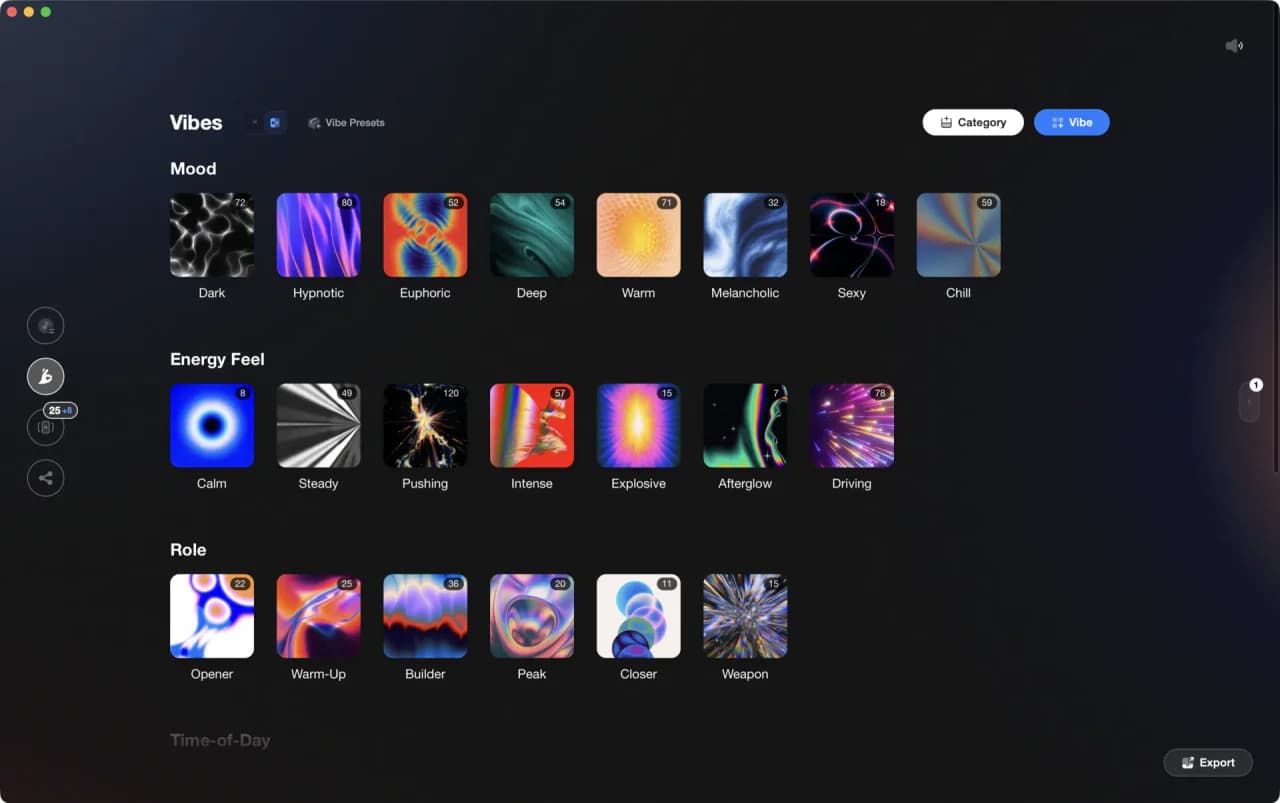
Frequently Asked Questions

Hey, it's Ben Modigell 👋
I DJ and produce as so I so: downtempo, minimal, dub house, tech house, and techno (releases on Spotify and SoundCloud, links above). Everything I write here comes from my own gigs, studio sessions, and library cleanups: the rules I follow, the failure modes I have actually hit, and the workflow I use when nobody is watching. If a technique did not earn its place in my own sets, it does not make it into a tutorial.