
How to Tell What Key a Song Is In
Three reliable ways to work out the key of a song: by ear from the chord it comes to rest on, from the sharps and flats in the key signature, and from the key column your DJ software fills in when it analyzes a file.
Quick Answer
What a key actually is
A key is the note a song keeps returning to, plus the scale built on that note. Musicians call the home note the tonic. Everything else is measured against it: which chords sound settled, which sound like they want to move, and which notes sound plain wrong.
So when someone asks what key is this song in, they are asking two things at once. Which note is home, and is the scale around it major or minor. Answer both and you have the key: C major, F minor, and so on.
How do I identify a key?
Work through it in this order. The fast checks come first, and the ear test at the end is the one that needs no sheet music and no software.
- 1
Play the last eight bars
Endings resolve. Loop the outro or let the final chord ring out. The note the music settles on is almost always the tonic.
- 2
Hum the resting note
Sing the note that feels finished, hold it, then find the same pitch on a keyboard or a fretboard. That gives you the letter name of the key.
- 3
Decide major or minor
Play a major chord on that root, then a minor one. One will sound like the song and the other will sound wrong. That choice is the second half of the key.
- 4
Check the chord family
List the chords the song uses. In a major key they will mostly be the I, ii, iii, IV, V and vi chords of that scale. If two or three chords sit outside the family, you probably picked the wrong home note.
- 5
Test the first chord too
Songs often open on the tonic as well as end on it. When the first and last chord agree, you are done. When they disagree, trust the ending.
What is the trick for figuring out key signatures?
There is a trick, and it is really two rules. If the key signature has sharps, take the last sharp on the right and go up one semitone: that is the major key. If it has flats, the second-to-last flat is the major key by name. One flat is F major, and an empty key signature is C major.
| Key signature | Major key | Relative minor |
|---|---|---|
| none | C | A minor |
| 1 sharp | G | E minor |
| 2 sharps | D | B minor |
| 3 sharps | A | F# minor |
| 4 sharps | E | C# minor |
| 1 flat | F | D minor |
| 2 flats | Bb | G minor |
| 3 flats | Eb | C minor |
| 4 flats | Ab | F minor |
Every key signature serves two keys at once: a major key and its relative minor. The sharps and flats are identical for both.
That last line is where most people go wrong. A key signature cannot tell a major key apart from its relative minor, because they use the same seven notes. You still have to listen for which chord the music rests on.
How to tell what scale a song is in?
Scale and key are nearly the same question. Once you know the tonic, the scale is whichever set of notes the melody actually uses over it.
- Major: bright and settled. The third note above the tonic is four semitones up.
- Natural minor: darker. The third is three semitones up and the seventh stays low.
- Harmonic minor: minor, but with a raised seventh, which gives the tense pull back to the tonic you hear across Latin, flamenco and Eastern European music.
- Modes: the same seven notes with a different home. A song that uses the C major set but rests on D is in D Dorian, not C major.
For DJ work the distinction that matters is major against minor, because that is all Camelot notation encodes. Modes get flattened into whichever major or minor key shares their notes, which is why an analyzer will label a Dorian track as a plain minor key.
How to find the key on guitar
Standard tuning gives you six open guitar notes, low to high: E, A, D, G, B and E again. Everything on the neck is measured from those six, which is why the same handful of keys keeps coming back.
The guitar keys for beginners are the five that fall under open shapes: G, C, D, A and E. The guitar chords for beginners taught in a first lesson come almost entirely from those five families, which is also why so much folk, country and rock sits in them.
So the fastest guitar method is to list the chords and see which family they fit. A song built on G, C, D and Em is in G major: those are the I, IV, V and vi chords of that key. If one chord refuses to fit any single row, it is usually a borrowed chord or a key change rather than a mistake in your list.
| Key | I | ii | iii | IV | V | vi |
|---|---|---|---|---|---|---|
| G | G | Am | Bm | C | D | Em |
| C | C | Dm | Em | F | G | Am |
| D | D | Em | F#m | G | A | Bm |
| A | A | Bm | C#m | D | E | F#m |
| E | E | F#m | G#m | A | B | C#m |
A guitar key chart for the five open keys. Match the chords a song uses against a row: the row that fits is the key, and the chord in the first column is the tonic.
Those five keys are also why the super easy guitar songs for beginners all sound related. Three chords from one row, in a different order.
Chord charts, apps and printable sheets
A guitar chords chart shows shapes, not keys. Chord boxes draw guitar chords, strings as the vertical lines and frets as the horizontal ones, with dots for your fingers. That is useful for playing the chord and useless for naming the key until you match the chords against a family.
A guitar chord finder works the other way round: you enter the frets you are holding and it tells you what the shape is called. A guitar chords app does the same on a phone, and some will listen through the microphone and name what you just played. Both hand you chord names, which is the input to the key question, not the answer to it.
Sites that publish guitar chords, songs and lyrics together often print a key at the top. Treat it as a hint. A page of guitar chords and lyrics for popular songs is usually transposed into whatever is easiest to play with a capo, so the key printed there can sit a few semitones away from the record.
Printed reference still beats scrolling. A guitar chords PDF in the gig bag, or a guitar chords for beginners PDF on a tablet, covers the shapes you need on one page. Charts that map guitar chords all over the neck are the next step up, and they earn their place once you start moving between keys instead of staying in open position.
Can AI tell me what key a song is in?
Yes, and software has been doing it for years, long before anything was marketed as AI. Key detection reads the pitch content of the audio, scores it against the twenty-four possible major and minor scales, and returns the best match. Whether the tool is sold as a key finder, music analysis software, or a feature buried inside a DJ app, the underlying method is the same.
Every major DJ app does it during track analysis. Serato's documentation says that checking Set Key will detect a key from the track and add key tag data to the track, with the key display options living in the SETUP screen under the Library + Display tab. The Traktor Pro manual lists Key alongside BPM and Gain as values its analysis detects. VirtualDJ leaves the BPM, Length and Key fields empty until a track has been analyzed.
rekordbox goes a step further and lets you choose how the result is written down. In Preferences > View > Key display format you can pick Classic, which shows Abm, B, Ebm, F#, or Alphanumeric, which shows 1A, 1B, 2A, 2B. The second one is the Camelot style most DJs mix by, and Camelot key display setup walks through switching it on in each app.
What detection gets right
- Straight tonal music with a clear bassline and clear chords.
- Club tracks where the bass states the root on every bar.
- Anything that stays in one key from start to finish.
- Batch work, where a thousand files get analyzed while you make coffee.
Where it slips
- -Relative major and minor get swapped, because they share every note.
- -Modal and folk material with no strong leading tone.
- -A track that changes key partway through still gets one label for the whole file.
- -Heavily processed, noisy or atonal audio.
- -Pitched-up rips and vinyl transfers can land a semitone off.
For a single file you do not need to install anything. A browser-based song key finder will find song key and tempo straight from an upload, and the same pass will find song BPM at the same time, because both fall out of the same analysis.
The faster way across a whole library
Everything above works on one song at a time. A DJ library is thousands of songs, and checking each one by ear is not a plan you will finish.
Vibes analyzes the whole library in one pass and gives every track a BPM, a key you can display as Camelot, musical or Open Key notation, an energy curve, and section markers for the intro, buildup, drop, breakdown and outro. The Import Wizard reads a rekordbox, Serato, Traktor, Engine DJ or Apple Music library, or a plain folder of files, and Smart Import works out which app it came from. Track Inspector lets you correct a key by hand on the tracks where your ear beats the analyzer, and you can re-analyze in bulk. Track analysis covers what it measures.
Once every track carries a key, Find Compatible shows the harmonic Camelot neighbours inside a BPM window, half and double time aware, and Set Designer can sort a set along a key path or an energy arc. Vibes works on files you own: it does not stream, it does not play out to DJ hardware, and it does not mix or record. You prepare the library there and export it back to your DJ app, with optional Camelot key sub-folders in the exported folder tree. Sorting the result is covered in how to organize music by BPM and key.
The visual way to organize your DJ library
Tag tracks by vibe. See everything at once. Export to rekordbox, Serato, Traktor or Engine DJ.
14-day free trial. Full access, no strings attached.
or see how it works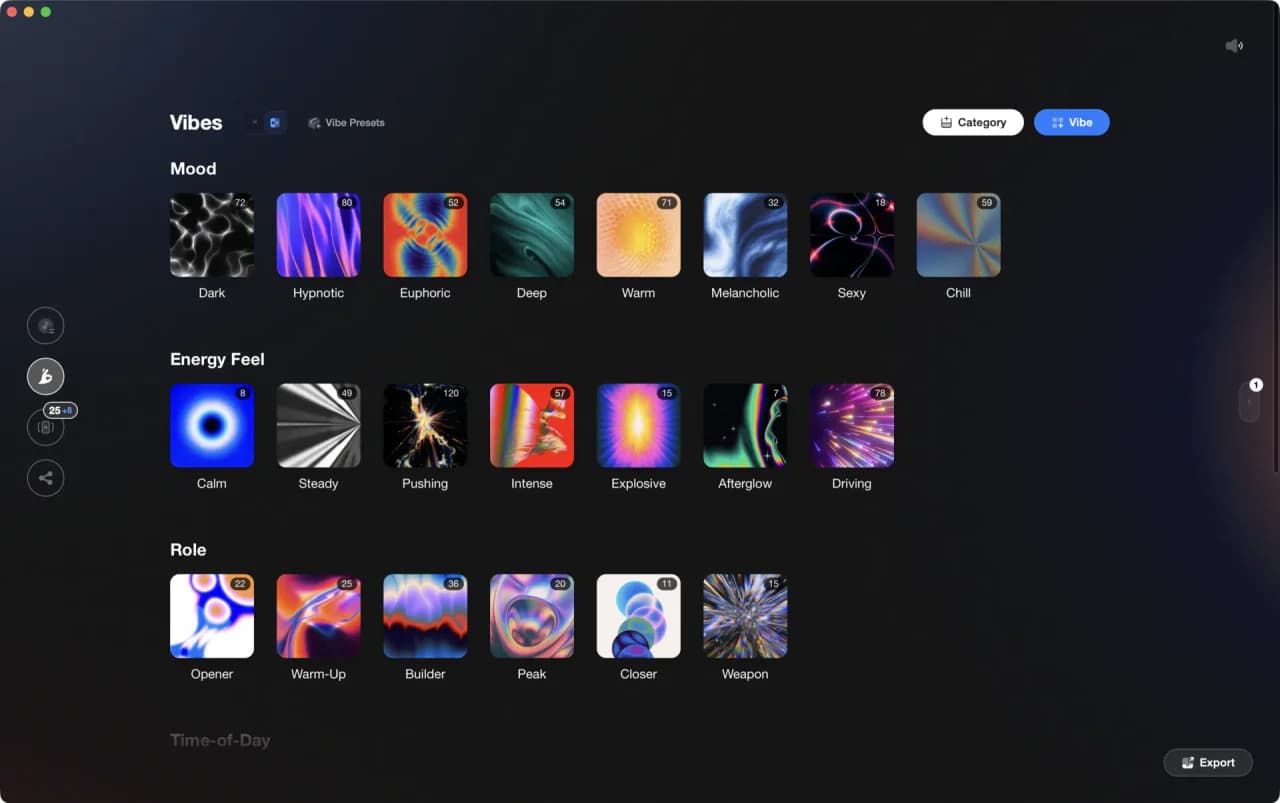
Frequently Asked Questions

Hey, it's Ben Modigell 👋
I DJ and produce as so I so: downtempo, minimal, dub house, tech house, and techno (releases on Spotify and SoundCloud, links above). Everything I write here comes from my own gigs, studio sessions, and library cleanups: the rules I follow, the failure modes I have actually hit, and the workflow I use when nobody is watching. If a technique did not earn its place in my own sets, it does not make it into a tutorial.