

Fix BPM and beatgrids in Traktor.
Wrong BPM values and drifting beatgrids break your mixes before they start. Here is how to correct them in Traktor, and how Vibes narrows the list before you ever open the decks.
$49$79USD one-time purchase. First 250 licenses at this price. 14-day free trial.
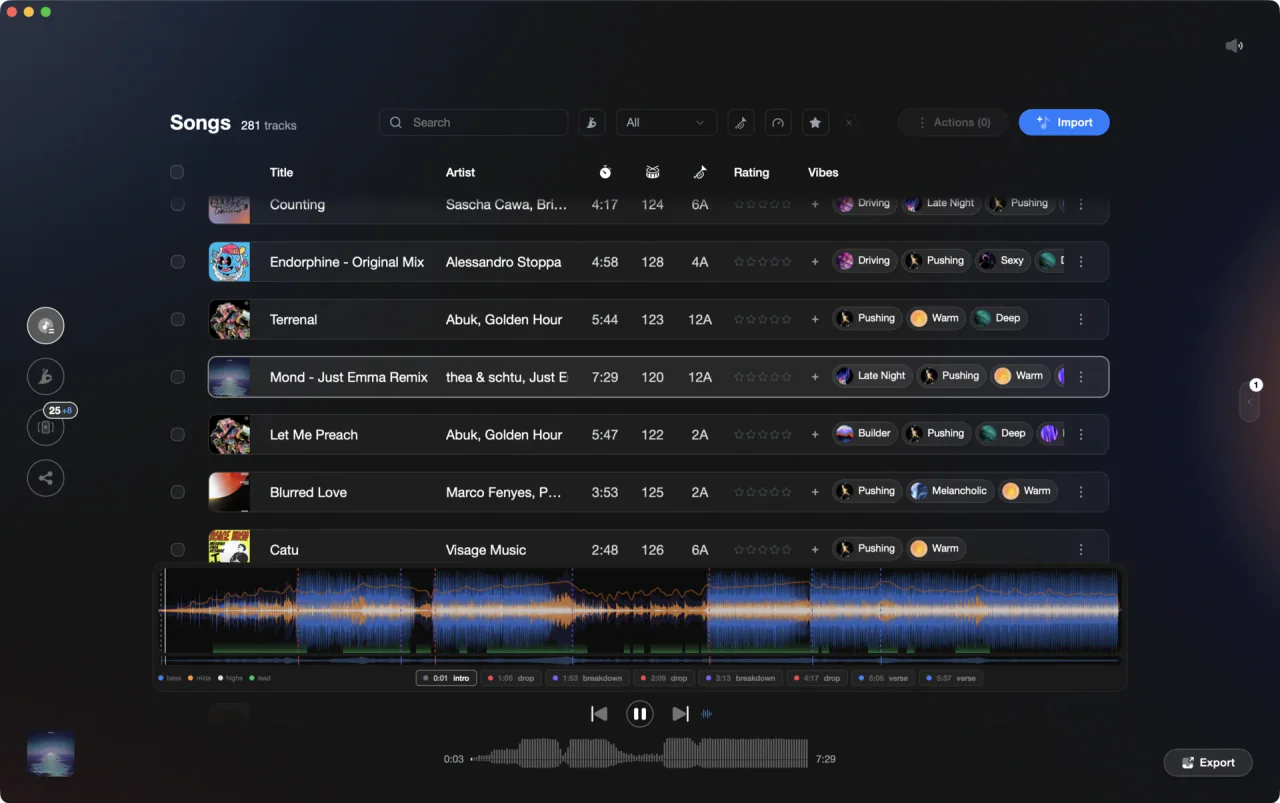
Vibes analyzes BPM and beat positions, so a drifting track is obvious before the gig.
Fix BPM and beatgrids in Traktor, step by step.
Traktor's built-in BPM detector is reliable for most tracks, but complex rhythms, live recordings, and older tracks with tempo drift can come out wrong. The steps below walk you through correcting them manually.
Trigger a fresh analysis
Right-click any track in the Traktor browser and choose Analyze. Traktor will re-detect the BPM and rebuild the beatgrid from scratch. Do this first before making manual edits, so you are starting from Traktor's best attempt.
Correct a wrong BPM value
Load the track into a deck and open the GRID tab on the deck's Advanced panel. If the detected value is doubled or halved, use the BPM x2 and BPM /2 buttons on that tab to correct it. For a value that is slightly off, click the BPM field on the GRID tab and type the correct number.
Align the beatgrid to the downbeat
Enter Grid Edit mode by clicking the GRID tab in the deck's Advanced panel. Play the track and drag the gridmarker (the yellow downbeat marker) to beat one on the kick drum, then use the nudge arrows to fine-tune the grid until the bars line up visually with the waveform. Lock the grid using the padlock button on the GRID tab when done, so future analysis does not overwrite your work.
Handle tracks with tempo drift
For live recordings or tracks that speed up and slow down, the outcome depends on your Traktor version. In Traktor Pro 3, there is no native variable-tempo beatgrid: the fixed grid will always drift, and the recommended workaround is to pre-process the audio in a DAW (Ableton Live, Logic, etc.) to quantize the tempo before importing. In Traktor Pro 4, Flexible Beatgrids are available: enter Grid Edit mode and place additional grid markers at each point where the tempo shifts. Traktor calculates a new BPM value between each pair of markers, keeping the grid locked throughout the track.
The catch
Fixing beatgrids track-by-track in Traktor is accurate but slow. A large library with many incorrect grids can take hours of manual work, and re-analysis will overwrite any corrections you have not locked. Note that multi-tempo tracks (live recordings, tracks with tempo drift) require Traktor Pro 4's Flexible Beatgrids feature or pre-processing in a DAW: Traktor Pro 3 cannot natively handle variable tempos.
The faster way
Let Vibes analyse your library before Traktor ever sees it.
Vibes runs BPM detection and downbeat-locked beat analysis across your whole library during prep, so every track that reads half, double or drifting lands on one list. Vibes never writes a beatgrid into your NML. Traktor keeps its own grid, and you fix the short list instead of the library.
See how it worksOrganize in Vibes, export to Traktor.
Your playlists, tags, ratings, and cue points travel back to the gear you play on, so nothing you do in Vibes is locked away.

Track 001
Artist A
Afterhours Mysterious
 Introspective
Track 002
Artist B
 Cozy FloorPeaceful
 Home
Home
Track 003
Artist C
Rave Aggressive
 Festival
 Build & Release
Frequently asked questions
The honest answers, including the trade-offs.
From a Vibes customer
The import worked perfectly. Have created several sets now and my life is so much easier
One-time purchase
Get Vibes with a single payment. No subscription.
Vibes is the step before you open your DJ software, not a replacement for it.
First 250 licenses at this price, then $79.
14 days • Full access
No strings attached
Secure checkout with Stripe
Already have Companion Pro? Upgrade instead

Methodology
How we keep this honest.

Verified against the app
Every step is checked against the current version of Traktor.
We own our bias
We make Vibes. We show the native way first and honestly, then where Vibes genuinely helps, and we say when it does not.
Live pricing
The Vibes price shown comes straight from our checkout, never a hardcoded marketing number.
Kept current
Last reviewed September 2026.
Keep exploring
Compare Vibes
DJ apps head to head
Works with your software
Vibes for DJs
Vibes features
How-to guides
Best DJ software
Move between apps
Learn to DJ