
CUE Splitter
The whole file is decoded to PCM in your browser's memory. A 90-minute mix needs roughly 1 to 2 GB of RAM while splitting: fine on modern laptops and desktops, phones and older machines may struggle.
Next stepOnce a mix is split into tracks, Vibes can import the batch and detect BPM, key, and cue points for each one. DJ library in Vibes
Free online CUE splitter: split an album rip or a recorded DJ mix into individual tracks in your browser. Upload a .cue file, paste a timestamp tracklist, or set markers on the waveform, then export WAV or MP3. No upload, files never leave your device.
- Live preview
- Local processing
- Export ready
How it works
Three Ways to Split an Album or Mix Into Tracks
Drop one long audio file, an album ripped as a single FLAC or WAV, a vinyl side, a recorded DJ set, and define where the tracks change:
- Upload a .cue file. The standard companion to single-file CD rips. Track numbers, titles, artists, and start times load automatically; warnings flag anything unusual in the sheet.
- Paste a tracklist. Any timestamp list works: YouTube chapters, SoundCloud comments, a 1001tracklists entry, or your own notes. Lines like 6:42 Artist - Title are parsed live as you type.
- Set markers manually. Click the waveform to add a split point, drag markers to the exact transition, double-click to remove one. The waveform makes track boundaries easy to spot by eye.
However you define them, the markers and the track table stay in sync: drag a marker and the start time updates, edit a start time and the marker moves. When everything lines up, export every track at once as WAV or MP3 320, or save your split points as a .cue sheet so the work is never lost.
Cue sheets
Where CUE Files Come From
A cue sheet is a small text file that describes how one continuous audio file breaks into tracks: titles, performers, and start times at CD-frame precision. Rippers like EAC and dBpoweramp write one whenever a CD is ripped as a single image instead of separate tracks, which is why so many archived albums arrive as album.flac plus album.cue. Mixed-set recorders and some radio logging tools produce them too. The classic way to split these was 2010-era desktop software like CUETools or Medieval CUE Splitter; this page does the same job in the browser with nothing to install and nothing uploaded.
DJ mixes
How to Split a DJ Mix Without a CUE File
Recorded sets rarely have a cue sheet, but the tracklist usually already exists somewhere: the timestamps you posted with the upload, the ID list on 1001tracklists, the chapter list in a YouTube description. Paste it straight in. The parser is tolerant of numbering, brackets, and dashes, and every line it cannot read is listed as a warning instead of silently dropped. Because DJ transitions are gradual, drag each marker to the spot that sounds right, mid-transition or on the incoming downbeat, then export. If you want fades on the cut points afterwards, run the tracks through the audio fade tool, and tag them properly with the MP3 metadata editor. Building the tracklist itself first? Use the tracklist maker.
Honest limits
Memory Expectations for Long Files
Everything happens locally: the file is decoded once to raw PCM and kept in memory so every split is instant and sample-accurate. That decoded audio is much bigger than the file on disk. A 90-minute stereo mix decodes to roughly 1 to 2 GB of RAM. Modern desktops and laptops handle that without drama; phones and older low-RAM machines may fail on very long recordings, so do multi-hour jobs on a desktop browser. Exports are processed one track at a time precisely so memory use stays flat during a long Split all run. If your segments end with abrupt cuts or dead air, the silence remover cleans up the edges.

Hey, it's Ben Modigell 👋
I've been DJing and producing music as "so I so," focusing on downtempo, minimal, dub house, tech house, and techno. My background in digital marketing, web development, and UX design over the past 6 years helps me create DJ tutorials that are clear, practical, and easy to follow.
Methodology
Last updated
Author and Methodology
Maintained by Ben Modigell, founder of Vibes. Ben builds DJ library, preparation, BPM, and harmonic-mixing tools for working DJs.
- Source
- Vibes DJ-tool taxonomy and page logic maintained by Vibes.
- Evidence
- Page output checked against the current tool behavior and internal DJ reference data.
- How this page is made
- Tool pages are built from reusable page logic, internal DJ reference data, and visible on-page calculations. Programmatic reference pages are generated from structured data rather than hand-written one by one.
BPM, key, and genre labels can vary by edit, remaster, detection engine, and DJ software. Use these pages as a practical mixing reference, then verify important tracks in your own library.
Report a correctionThe visual way to organize your DJ library
Tag tracks by vibe. See everything at once. Export to rekordbox, Serato, Traktor or Engine DJ.
14-day free trial. Full access, no strings attached.
or see how it works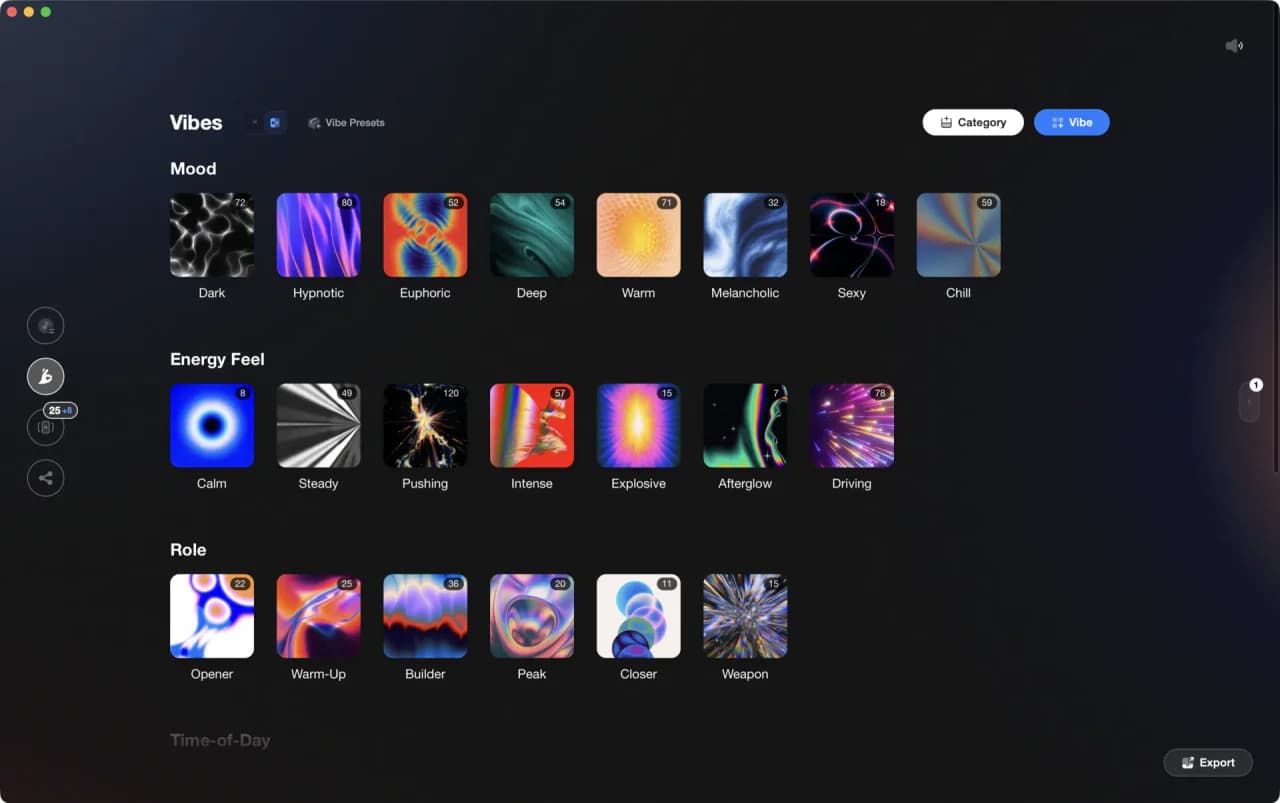
Frequently Asked Questions
Related Tools
MP3 to WAV
Convert MP3 to lossless WAV in your browser, batch supported
WAV to MP3
Convert WAV to 320 kbps MP3 in your browser, batch supported
AIFF to MP3
Convert AIFF to 320 kbps MP3, with our own AIFF reader
AIFF to WAV
Convert AIFF to WAV losslessly in your browser
M4A to MP3
Convert M4A/AAC to MP3 in your browser
M4A to WAV
Convert M4A/AAC to lossless WAV in your browser
FLAC to MP3
Convert FLAC to 320 kbps MP3 in your browser
FLAC to WAV
Convert FLAC to WAV losslessly in your browser
OGG to MP3
Convert OGG/Opus to MP3 in your browser
OGG to WAV
Convert OGG/Opus to lossless WAV in your browser
Opus to MP3
Convert Opus voice notes and recordings to MP3 in your browser
MP3 to OGG
Convert MP3 to OGG Vorbis in your browser, batch supported
MP3 to Opus
Convert MP3 to Opus in your browser, batch supported
WAV to FLAC
Compress WAV to lossless FLAC in your browser
MP3 to FLAC
Convert MP3 to FLAC in your browser, batch supported
MP3 to AIFF
Convert MP3 to AIFF for rekordbox and Mac workflows
WAV to AIFF
Convert WAV to AIFF losslessly in your browser
Mono to Stereo
Convert mono audio files to stereo in your browser
Stereo to Mono
Downmix stereo audio files to mono in your browser
LUFS Meter
Measure integrated LUFS, true peak, and loudness range in your browser
MP3 Metadata Editor
Edit MP3 tags and album art in your browser, no upload
Spectrogram Analyzer
View any audio file as a spectrogram in your browser
Audio Quality Checker
Detect fake FLACs and upscaled MP3s by their frequency cutoff
Frequency Detector
Detect the dominant frequency of audio or your mic in Hz
Tone Generator
Generate sine, square, and sweep test tones at any frequency
Music Visualizer
Audio-reactive visuals for any track, export as video
Waveform Generator
Turn any track into a waveform image, PNG or SVG
DJ Drop Maker
Record or upload a DJ drop and add reverb, delay, and pitch effects
Audio Fade
Add fade in and fade out to any audio file in your browser
Audio Trimmer
Trim, cut and join MP3 or WAV in your browser, no upload
MIDI to MP3
Render a MIDI file to MP3 or WAV in your browser
Silence Remover
Trim silence from the start and end of audio files
Slowed & Reverb Generator
Make slowed + reverb and nightcore versions of any song
Reverse Audio
Reverse any audio file and export as WAV or MP3
Audio Normalizer
Normalize audio loudness to a target level in your browser
Audio Looper
Cut a section of a track and export it as a seamless loop
Audio to MIDI
Convert melodies and chords from audio into a MIDI file