
Reverse Audio
Next stepOnce the reversed file is exported, Vibes can pull it into your library alongside tracks from rekordbox, Serato, Traktor, and Engine DJ. DJ library in Vibes
Flip any audio file backwards and download the result as WAV or MP3. Runs entirely in your browser with batch support — drop a folder of samples if you like.
- Runs in your browser
- Files stay private
- No account needed
Making a Reverse Cymbal or Riser
The most-used reversed sound in dance music is the reverse crash: take a cymbal (or the last second of any sustained sound), reverse it here, and you get a swell that builds from silence to a peak. Place the peak exactly on the downbeat of the next section and the transition carries itself. The same trick on a vocal phrase's tail, a piano chord, or a reverb-heavy snare gives you free risers that already sit in the track's key, because they came from the track. For longer builds, reverse a full bar, then run it through the Key & BPM Changer to stretch it across two.
Backmasking: Hearing Songs Backwards
Reversing full songs has a folklore of its own: hidden messages, real (The Beatles, Pink Floyd, and Missy Elliott all deliberately recorded backmasked lines) and imagined. If you came here to check one, drop the song, download the reversed WAV, and scrub to the rumored spot; you are hearing exactly the same samples the artist recorded, played end to front, with no quality lost in the flip.
Part of the Browser Audio Toolkit
Pair a reversed tail with a tempo-matched edit from the Key & BPM Changer, check what you are working with using the Song Key & BPM Finder, or convert formats with the audio converters. Everything runs locally, nothing uploads.

Hey, it's Ben Modigell 👋
I've been DJing and producing music as "so I so," focusing on downtempo, minimal, dub house, tech house, and techno. My background in digital marketing, web development, and UX design over the past 6 years helps me create DJ tutorials that are clear, practical, and easy to follow.
Methodology
Last updated
Author and Methodology
Maintained by Ben Modigell, founder of Vibes. Ben builds DJ library, preparation, BPM, and harmonic-mixing tools for working DJs.
- Source
- Vibes DJ-tool taxonomy and page logic maintained by Vibes.
- Evidence
- Page output checked against the current tool behavior and internal DJ reference data.
- How this page is made
- Tool pages are built from reusable page logic, internal DJ reference data, and visible on-page calculations. Programmatic reference pages are generated from structured data rather than hand-written one by one.
BPM, key, and genre labels can vary by edit, remaster, detection engine, and DJ software. Use these pages as a practical mixing reference, then verify important tracks in your own library.
Report a correctionThe visual way to organize your DJ library
Tag tracks by vibe. See everything at once. Export to rekordbox, Serato, Traktor or Engine DJ.
14-day free trial. Full access, no strings attached.
or see how it works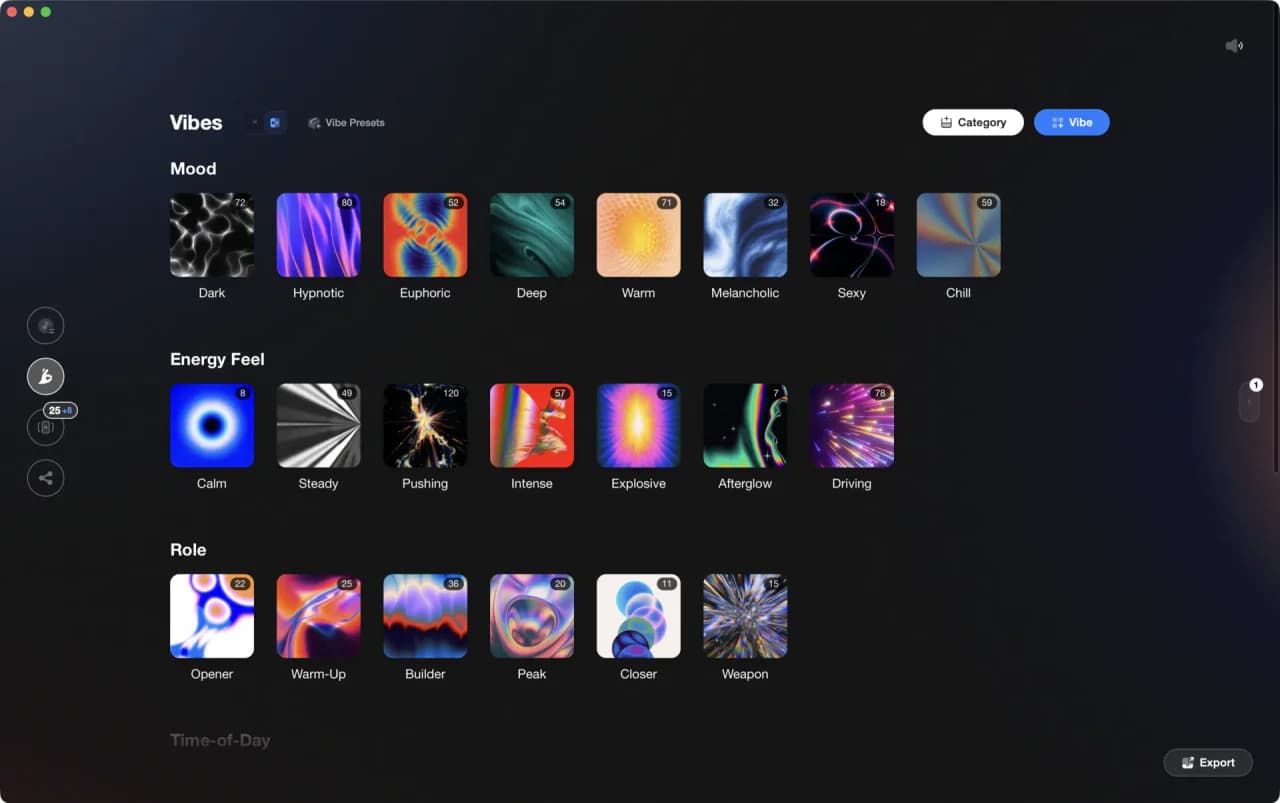
Frequently Asked Questions
Related Tools
MP3 to WAV
Convert MP3 to lossless WAV in your browser, batch supported
WAV to MP3
Convert WAV to 320 kbps MP3 in your browser, batch supported
AIFF to MP3
Convert AIFF to 320 kbps MP3, with our own AIFF reader
AIFF to WAV
Convert AIFF to WAV losslessly in your browser
M4A to MP3
Convert M4A/AAC to MP3 in your browser
M4A to WAV
Convert M4A/AAC to lossless WAV in your browser
FLAC to MP3
Convert FLAC to 320 kbps MP3 in your browser
FLAC to WAV
Convert FLAC to WAV losslessly in your browser
OGG to MP3
Convert OGG/Opus to MP3 in your browser
OGG to WAV
Convert OGG/Opus to lossless WAV in your browser
Opus to MP3
Convert Opus voice notes and recordings to MP3 in your browser
MP3 to OGG
Convert MP3 to OGG Vorbis in your browser, batch supported
MP3 to Opus
Convert MP3 to Opus in your browser, batch supported
WAV to FLAC
Compress WAV to lossless FLAC in your browser
MP3 to FLAC
Convert MP3 to FLAC in your browser, batch supported
MP3 to AIFF
Convert MP3 to AIFF for rekordbox and Mac workflows
WAV to AIFF
Convert WAV to AIFF losslessly in your browser
Mono to Stereo
Convert mono audio files to stereo in your browser
Stereo to Mono
Downmix stereo audio files to mono in your browser
LUFS Meter
Measure integrated LUFS, true peak, and loudness range in your browser
MP3 Metadata Editor
Edit MP3 tags and album art in your browser, no upload
Spectrogram Analyzer
View any audio file as a spectrogram in your browser
Audio Quality Checker
Detect fake FLACs and upscaled MP3s by their frequency cutoff
Frequency Detector
Detect the dominant frequency of audio or your mic in Hz
Tone Generator
Generate sine, square, and sweep test tones at any frequency
Music Visualizer
Audio-reactive visuals for any track, export as video
CUE Splitter
Split albums and DJ mixes into tracks with a cue file or timestamps
Waveform Generator
Turn any track into a waveform image, PNG or SVG
DJ Drop Maker
Record or upload a DJ drop and add reverb, delay, and pitch effects
Audio Fade
Add fade in and fade out to any audio file in your browser
Audio Trimmer
Trim, cut and join MP3 or WAV in your browser, no upload
MIDI to MP3
Render a MIDI file to MP3 or WAV in your browser
Silence Remover
Trim silence from the start and end of audio files
Slowed & Reverb Generator
Make slowed + reverb and nightcore versions of any song
Audio Normalizer
Normalize audio loudness to a target level in your browser
Audio Looper
Cut a section of a track and export it as a seamless loop
Audio to MIDI
Convert melodies and chords from audio into a MIDI file