
M4A to MP3 Converter
Next stepOnce the MP3 is ready, Vibes can pull it into your library alongside tracks from rekordbox, Serato, Traktor, and Engine DJ. DJ library in Vibes
Convert M4A files to MP3 without uploading anything: decoding and encoding run in your browser. Drop multiple files for batch conversion, download each result seconds later. Typical use: iTunes and Apple Music purchases that need to play on gear and software that only reads MP3.
- Runs in your browser
- Files stay private
- No account needed
Method
How It Works
- Drop one or many M4A files into the area above
- Each file is decoded locally, then re-encoded to MP3 at 320 kbps
- A download button appears per file; nothing is ever uploaded
M4A vs MP3: What Actually Changes
M4A (AAC) is the lossy format of the Apple ecosystem, technically better than MP3 at the same bitrate. iTunes purchases and Apple Music downloads ship this way, and compatibility outside Apple's world remains hit-and-miss. MP3 is the universal lossy format: small files, playable literally everywhere, at the cost of discarding audio detail during compression. At 320 kbps that loss is inaudible to most listeners on most systems, which is why it remains the standard for sharing and USB sticks. Converting between them changes the container and encoding, never the music itself: same length, same sample rate, same channels. What changes is file size, compatibility, and (when a lossy encoder is involved) how much audio detail survives.
About the Quality
Straight answer: M4A/AAC and MP3 are both lossy; re-encoding loses a little more, so use 320 kbps output and keep the M4A if you can. The encoder is the LAME MP3 engine, the reference encoder for high-quality MP3, running as WebAssembly in your browser.
Why In-Browser Beats Uploading (and Installing)
Upload-based converter sites spend most of their time moving your file over the network, then make you wait in a queue behind other users, and your audio sits on someone else's server. Desktop tools like Audacity or ffmpeg avoid that but demand installation and, in ffmpeg's case, a command line. This converter takes the third path: the same class of codec runs as WebAssembly inside the page, so a M4A you drop is being encoded milliseconds later, nothing installs, nothing uploads, and batch conversion of a whole folder works from any machine, including one you don't own.
Made for DJ and Producer Workflows
This converter is part of a set of browser-based audio tools for DJs: analyze a track's key and BPM, change its key or tempo, and if you manage a whole library across formats, the Vibes app keeps it organized with keys, BPM, and energy written where rekordbox, Serato, and Traktor read them.

Hey, it's Ben Modigell 👋
I've been DJing and producing music as "so I so," focusing on downtempo, minimal, dub house, tech house, and techno. My background in digital marketing, web development, and UX design over the past 6 years helps me create DJ tutorials that are clear, practical, and easy to follow.
Methodology
Last updated
Author and Methodology
Maintained by Ben Modigell, founder of Vibes. Ben builds DJ library, preparation, BPM, and harmonic-mixing tools for working DJs.
- Source
- Vibes DJ-tool taxonomy and page logic maintained by Vibes.
- Evidence
- Page output checked against the current tool behavior and internal DJ reference data.
- How this page is made
- Tool pages are built from reusable page logic, internal DJ reference data, and visible on-page calculations. Programmatic reference pages are generated from structured data rather than hand-written one by one.
BPM, key, and genre labels can vary by edit, remaster, detection engine, and DJ software. Use these pages as a practical mixing reference, then verify important tracks in your own library.
Report a correctionThe visual way to organize your DJ library
Tag tracks by vibe. See everything at once. Export to rekordbox, Serato, Traktor or Engine DJ.
14-day free trial. Full access, no strings attached.
or see how it works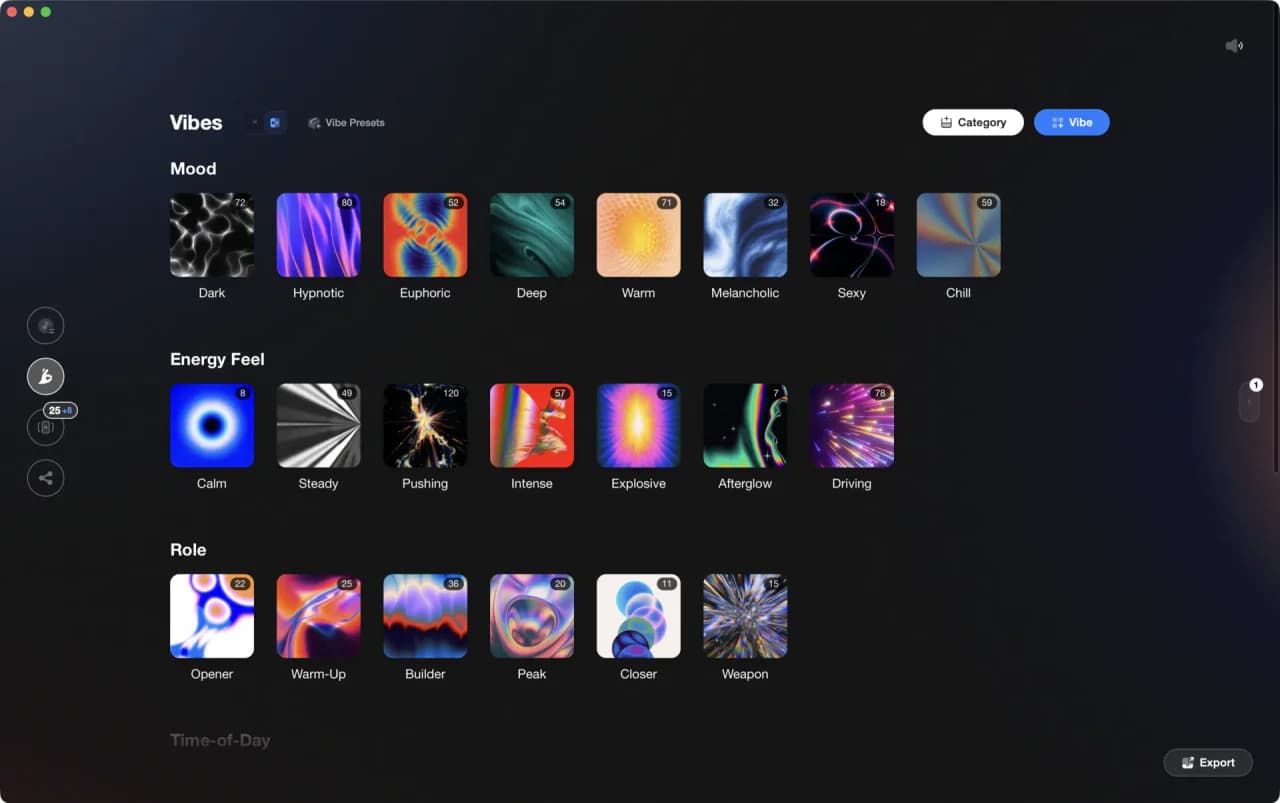
Frequently Asked Questions
Related Tools
MP3 to WAV
Convert MP3 to lossless WAV in your browser, batch supported
WAV to MP3
Convert WAV to 320 kbps MP3 in your browser, batch supported
AIFF to MP3
Convert AIFF to 320 kbps MP3, with our own AIFF reader
AIFF to WAV
Convert AIFF to WAV losslessly in your browser
M4A to WAV
Convert M4A/AAC to lossless WAV in your browser
FLAC to MP3
Convert FLAC to 320 kbps MP3 in your browser
FLAC to WAV
Convert FLAC to WAV losslessly in your browser
OGG to MP3
Convert OGG/Opus to MP3 in your browser
OGG to WAV
Convert OGG/Opus to lossless WAV in your browser
Opus to MP3
Convert Opus voice notes and recordings to MP3 in your browser
MP3 to OGG
Convert MP3 to OGG Vorbis in your browser, batch supported
MP3 to Opus
Convert MP3 to Opus in your browser, batch supported
WAV to FLAC
Compress WAV to lossless FLAC in your browser
MP3 to FLAC
Convert MP3 to FLAC in your browser, batch supported
MP3 to AIFF
Convert MP3 to AIFF for rekordbox and Mac workflows
WAV to AIFF
Convert WAV to AIFF losslessly in your browser
Mono to Stereo
Convert mono audio files to stereo in your browser
Stereo to Mono
Downmix stereo audio files to mono in your browser
LUFS Meter
Measure integrated LUFS, true peak, and loudness range in your browser
MP3 Metadata Editor
Edit MP3 tags and album art in your browser, no upload
Spectrogram Analyzer
View any audio file as a spectrogram in your browser
Audio Quality Checker
Detect fake FLACs and upscaled MP3s by their frequency cutoff
Frequency Detector
Detect the dominant frequency of audio or your mic in Hz
Tone Generator
Generate sine, square, and sweep test tones at any frequency
Music Visualizer
Audio-reactive visuals for any track, export as video
CUE Splitter
Split albums and DJ mixes into tracks with a cue file or timestamps
Waveform Generator
Turn any track into a waveform image, PNG or SVG
DJ Drop Maker
Record or upload a DJ drop and add reverb, delay, and pitch effects
Audio Fade
Add fade in and fade out to any audio file in your browser
Audio Trimmer
Trim, cut and join MP3 or WAV in your browser, no upload
MIDI to MP3
Render a MIDI file to MP3 or WAV in your browser
Silence Remover
Trim silence from the start and end of audio files
Slowed & Reverb Generator
Make slowed + reverb and nightcore versions of any song
Reverse Audio
Reverse any audio file and export as WAV or MP3
Audio Normalizer
Normalize audio loudness to a target level in your browser
Audio Looper
Cut a section of a track and export it as a seamless loop
Audio to MIDI
Convert melodies and chords from audio into a MIDI file