
Spectrogram Analyzer
Next stepVibes already builds a multi-band waveform and frequency profile for every track in your library, not just the one file here. Track analysis in Vibes
See any track as a spectrogram: a heatmap of frequency over time, with intensity shown in the site's lavender-to-pink scale. Read where a track's energy lives, spot low-pass filters and lossy cutoffs, and inspect rips. Everything runs in your browser and nothing is uploaded.
- On-device analysis
- Audio never uploads
- Results stay local
How to read it
How to Read a Spectrogram
A spectrogram has three dimensions on one picture. Time runs left to right, frequency runs bottom (bass) to top (treble), and intensity is the color: darker means little energy, brighter lavender and pink means more. Once you learn to read it, a track's whole arrangement is visible before you even press play. If what you're really after is a verdict on a suspicious rip, the audio quality checker reads the cutoff automatically and estimates the true source quality.
- A kick drum is a short, bright vertical smear low down near 40 to 120 Hz, repeating on the beat.
- A hi-hat or cymbal is a thin vertical streak high up, a burst of broadband energy above ~6 kHz that fades quickly.
- A sustained note or pad draws steady horizontal lines: the fundamental plus a stack of evenly spaced harmonics above it.
- Noise and reverb look like a soft cloud with no clean lines, filling the space between the tonal parts.
The color scale
What the Lavender and Pink Mean
Intensity is mapped through a 256-step scale in the Vibes color family. Near-black is close to silence, deep violet is quiet detail, lavender-blue and lavender are the body of the sound where most musical energy sits, and pink through near-white marks the loudest peaks. Because the scale is consistent, two spectrograms are directly comparable: a duller, darker top means a track with less high-end air, and a bright wash all the way up means an open, full-bandwidth mix.
Why DJs use one
Why DJs and Producers Use Spectrograms
For a DJ, the single most valuable use is checking rips. Download pools, private trackers, and re-uploads are full of files that claim to be high quality but were transcoded from a lossy source. The spectrogram shows the truth: a hard horizontal edge with darkness above it means a low-pass, whether from a filter or from lossy encoding. The frequency axis here is intentionally linear, not logarithmic, so that a lossy cutoff reads as a clean horizontal line you cannot miss. Producers use the same view to check their masters, find muddy build-up or harsh resonances, and see exactly where each element sits in the frequency range before they EQ.
Want the verdict without reading the picture yourself? The Audio Quality Checker detects the cutoff automatically and estimates whether a file is lossless or a transcode. To pull the key and tempo out of the same track, use the Song Key & BPM Finder.

Hey, it's Ben Modigell 👋
I've been DJing and producing music as "so I so," focusing on downtempo, minimal, dub house, tech house, and techno. My background in digital marketing, web development, and UX design over the past 6 years helps me create DJ tutorials that are clear, practical, and easy to follow.
Methodology
Last updated
Author and Methodology
Maintained by Ben Modigell, founder of Vibes. Ben builds DJ library, preparation, BPM, and harmonic-mixing tools for working DJs.
- Source
- Vibes DJ-tool taxonomy and page logic maintained by Vibes.
- Evidence
- Page output checked against the current tool behavior and internal DJ reference data.
- How this page is made
- Tool pages are built from reusable page logic, internal DJ reference data, and visible on-page calculations. Programmatic reference pages are generated from structured data rather than hand-written one by one.
BPM, key, and genre labels can vary by edit, remaster, detection engine, and DJ software. Use these pages as a practical mixing reference, then verify important tracks in your own library.
Report a correctionThe visual way to organize your DJ library
Tag tracks by vibe. See everything at once. Export to rekordbox, Serato, Traktor or Engine DJ.
14-day free trial. Full access, no strings attached.
or see how it works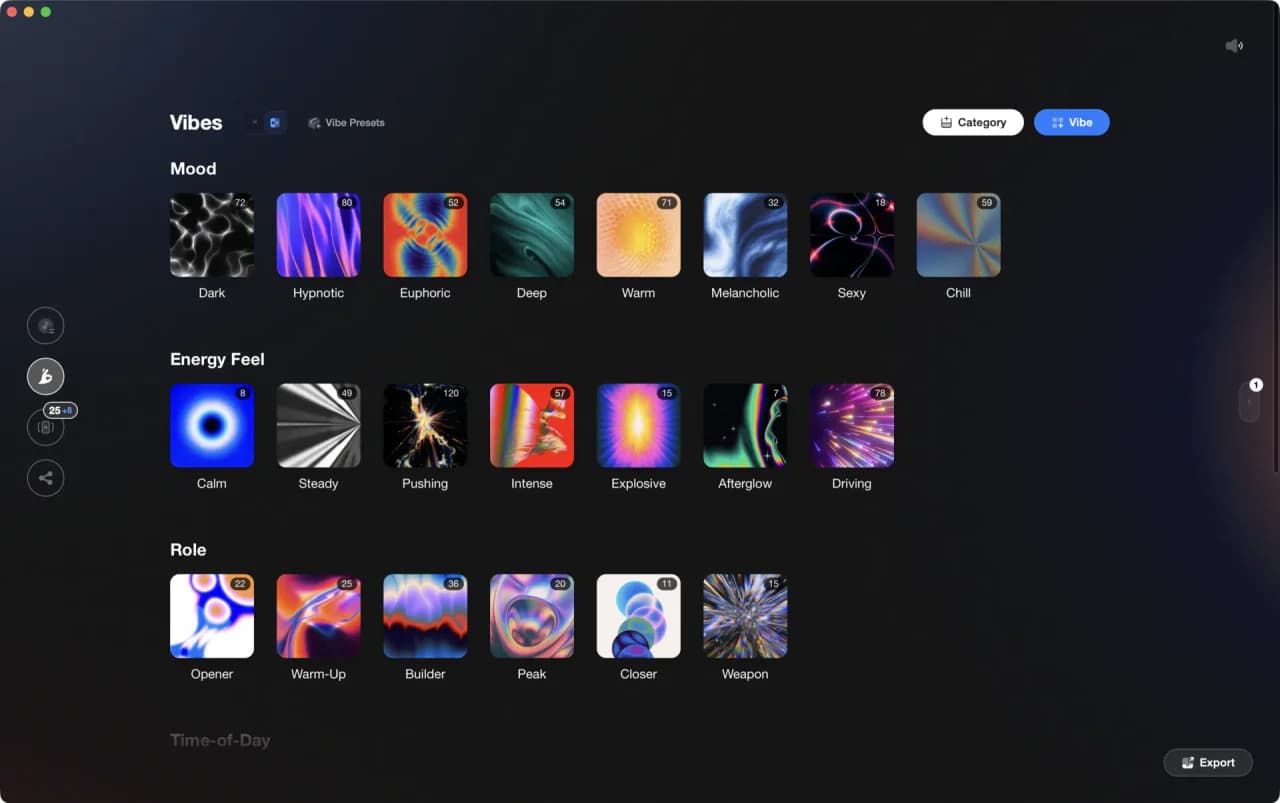
Frequently Asked Questions
Related Tools
MP3 to WAV
Convert MP3 to lossless WAV in your browser, batch supported
WAV to MP3
Convert WAV to 320 kbps MP3 in your browser, batch supported
AIFF to MP3
Convert AIFF to 320 kbps MP3, with our own AIFF reader
AIFF to WAV
Convert AIFF to WAV losslessly in your browser
M4A to MP3
Convert M4A/AAC to MP3 in your browser
M4A to WAV
Convert M4A/AAC to lossless WAV in your browser
FLAC to MP3
Convert FLAC to 320 kbps MP3 in your browser
FLAC to WAV
Convert FLAC to WAV losslessly in your browser
OGG to MP3
Convert OGG/Opus to MP3 in your browser
OGG to WAV
Convert OGG/Opus to lossless WAV in your browser
Opus to MP3
Convert Opus voice notes and recordings to MP3 in your browser
MP3 to OGG
Convert MP3 to OGG Vorbis in your browser, batch supported
MP3 to Opus
Convert MP3 to Opus in your browser, batch supported
WAV to FLAC
Compress WAV to lossless FLAC in your browser
MP3 to FLAC
Convert MP3 to FLAC in your browser, batch supported
MP3 to AIFF
Convert MP3 to AIFF for rekordbox and Mac workflows
WAV to AIFF
Convert WAV to AIFF losslessly in your browser
Mono to Stereo
Convert mono audio files to stereo in your browser
Stereo to Mono
Downmix stereo audio files to mono in your browser
LUFS Meter
Measure integrated LUFS, true peak, and loudness range in your browser
MP3 Metadata Editor
Edit MP3 tags and album art in your browser, no upload
Audio Quality Checker
Detect fake FLACs and upscaled MP3s by their frequency cutoff
Frequency Detector
Detect the dominant frequency of audio or your mic in Hz
Tone Generator
Generate sine, square, and sweep test tones at any frequency
Music Visualizer
Audio-reactive visuals for any track, export as video
CUE Splitter
Split albums and DJ mixes into tracks with a cue file or timestamps
Waveform Generator
Turn any track into a waveform image, PNG or SVG
DJ Drop Maker
Record or upload a DJ drop and add reverb, delay, and pitch effects
Audio Fade
Add fade in and fade out to any audio file in your browser
Audio Trimmer
Trim, cut and join MP3 or WAV in your browser, no upload
MIDI to MP3
Render a MIDI file to MP3 or WAV in your browser
Silence Remover
Trim silence from the start and end of audio files
Slowed & Reverb Generator
Make slowed + reverb and nightcore versions of any song
Reverse Audio
Reverse any audio file and export as WAV or MP3
Audio Normalizer
Normalize audio loudness to a target level in your browser
Audio Looper
Cut a section of a track and export it as a seamless loop
Audio to MIDI
Convert melodies and chords from audio into a MIDI file