
Tone preview
Stopped. Press play, or click the number to edit it.
Start low on headphones: square and sawtooth waves are harsher than sine at the same volume.
- Nearest note
- A4
- Cents deviation
- In tune
- Period
- 2.273 ms
- Wavelength (343 m/s)
- 78.0 cm
- Waveform
- Sine
Assumes 440 Hz equal-tempered tuning; wavelength uses 343 m/s.
Frequency and waveform
Presets and sweeps
Next stepVibes analyzes the real frequency and energy balance of every track in your library, well beyond a single test tone. Track analysis in Vibes
Quick answer
What is a tone generator used for?
Play a pure test tone at any frequency from 1 Hz to 22 kHz, in sine, square, triangle, or sawtooth. Use the presets for tuning references, subwoofer placement tests, and frequency sweeps, or dial in an exact Hz value with the slider and fine-tune buttons.
A tone generator plays a single, pure test tone at an exact frequency, so you can check tuning against a reference (440 Hz), calibrate playback levels (1 kHz), test subwoofer placement (25 to 60 Hz), or sweep the full audible range to find room resonances and rattles.
- Live preview
- Local processing
- Export ready
Presets
What Each Preset Is For
440 Hz is the international tuning standard: play it against an instrument, tuner, or your own ear to check for drift. For the exact frequency of any other note, the note frequency chart covers the full range at 432, 440, and 444 Hz references.
1 kHz is the standard reference tone for level calibration: it's the frequency most meters, monitors, and calibration tools are tuned against, so it's the tone to use when you're setting a baseline playback level rather than checking tuning. Once levels are set, the LUFS meter checks loudness on real material against streaming targets.
The subwoofer test tones (25 to 60 Hz) are built for the classic subwoofer crawl method: place the sub temporarily at your listening position, play one of these low tones through it, then get down at floor level and crawl around the room listening for where the bass sounds fullest and least boomy, not simply loudest. Wherever that spot is on the floor is roughly where the room's low-end response is smoothest, so that's where the subwoofer should permanently sit. Test with more than one of the low presets, since a single frequency can hide a room null that only shows up at a slightly different one.
The frequency sweeps ramp continuously across a range instead of holding one tone. The full 20 Hz to 20 kHz sweep is useful for scanning the whole audible range for dead spots or resonances, and the 20 to 200 Hz bass sweep isolates the low end, where most room modes and rattles actually live. Listen for any point where the volume jumps, buzzes, or sets something in the room rattling; that frequency is worth investigating further.
Waveform
Sine vs. Square for Testing
A sine wave contains energy at exactly one frequency and nothing else, which makes it the right default for tuning, level calibration, and anything where you want a clean, unambiguous signal. A square wave is built from that same fundamental frequency plus all of its odd harmonics (3x, 5x, 7x, and on), so it carries far more high-frequency energy for the same fundamental pitch. That extra harmonic content is exactly why square waves are good for hunting rattles: a buzz might not show up on the fundamental alone but will show up on one of the harmonics riding on top of it. The tradeoff is that square waves sound noticeably harsher and louder-feeling than a sine wave at the same volume setting, and they're rougher on both ears and tweeters, so start quiet.
Triangle and sawtooth sit on either side of that line: triangle rolls its harmonics off faster and sounds closer to a sine wave, while sawtooth includes every harmonic, not just the odd ones, and comes across even harsher than square.
Honest limits
Human Hearing Range: What This Tool Can and Can't Tell You
20 Hz to 20 kHz is the commonly quoted range of human hearing, but that's a nominal figure for young, healthy ears, not a fixed ceiling. Sensitivity to the highest frequencies declines steadily with age: most adults over 40 struggle to hear much above 15 to 16 kHz, and that ceiling often drops further by 60, regardless of how sharp their hearing feels day to day. Playing the 10 kHz preset or running the full sweep will give you a rough sense of where your own high end starts to fall off.
That said, this is not a calibrated hearing test. The result depends entirely on your speakers or headphones being able to reproduce those frequencies accurately in the first place, on your playback volume being consistent, and on background noise in the room. If you have genuine concerns about your hearing, see an audiologist rather than relying on a browser tone. If you've generated a tone and instead need to identify the frequency of an existing sound or recording, the frequency detector does that in reverse.

Hey, it's Ben Modigell 👋
I've been DJing and producing music as "so I so," focusing on downtempo, minimal, dub house, tech house, and techno. My background in digital marketing, web development, and UX design over the past 6 years helps me create DJ tutorials that are clear, practical, and easy to follow.
Methodology
Last updated
Author and Methodology
Maintained by Ben Modigell, founder of Vibes. Ben builds DJ library, preparation, BPM, and harmonic-mixing tools for working DJs.
- Source
- Vibes DJ-tool taxonomy and page logic maintained by Vibes.
- Evidence
- Page output checked against the current tool behavior and internal DJ reference data.
- How this page is made
- Tool pages are built from reusable page logic, internal DJ reference data, and visible on-page calculations. Programmatic reference pages are generated from structured data rather than hand-written one by one.
BPM, key, and genre labels can vary by edit, remaster, detection engine, and DJ software. Use these pages as a practical mixing reference, then verify important tracks in your own library.
Report a correctionThe visual way to organize your DJ library
Tag tracks by vibe. See everything at once. Export to rekordbox, Serato, Traktor or Engine DJ.
14-day free trial. Full access, no strings attached.
or see how it works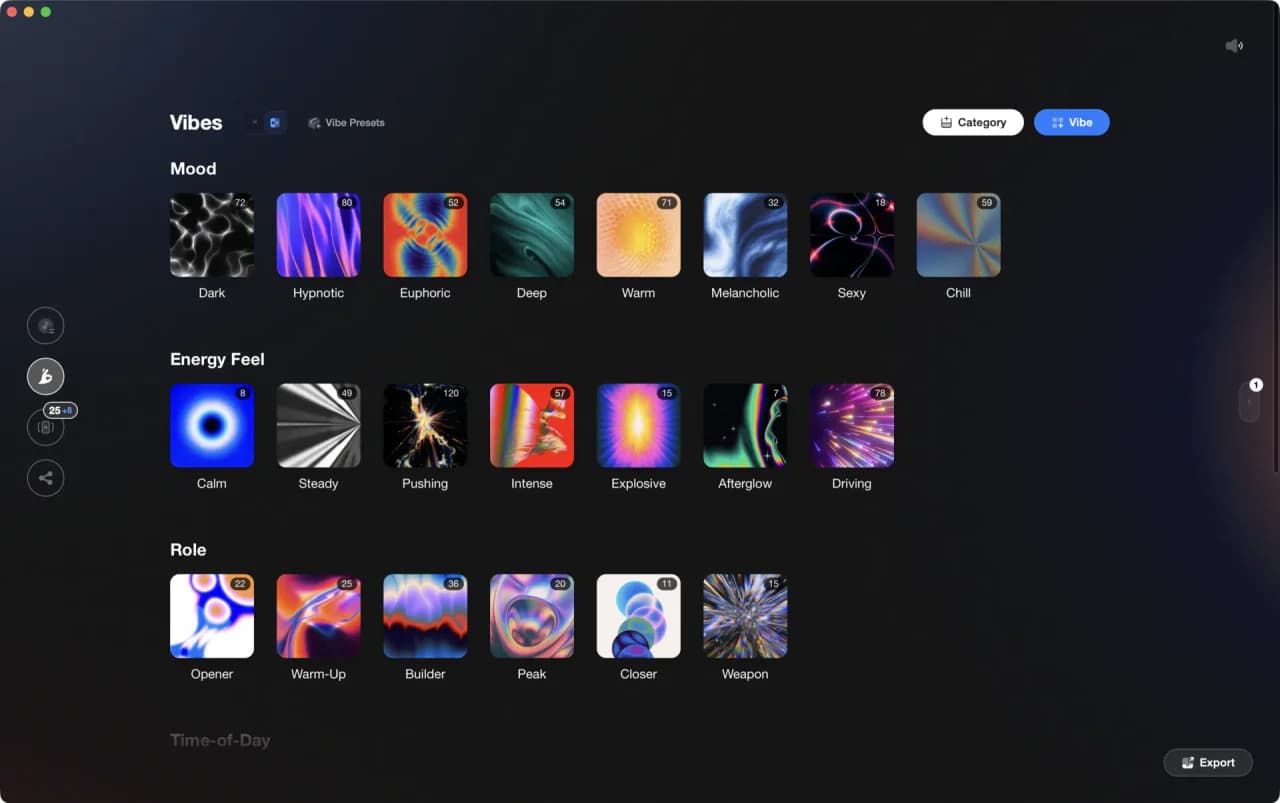
Frequently Asked Questions
Related Tools
MP3 to WAV
Convert MP3 to lossless WAV in your browser, batch supported
WAV to MP3
Convert WAV to 320 kbps MP3 in your browser, batch supported
AIFF to MP3
Convert AIFF to 320 kbps MP3, with our own AIFF reader
AIFF to WAV
Convert AIFF to WAV losslessly in your browser
M4A to MP3
Convert M4A/AAC to MP3 in your browser
M4A to WAV
Convert M4A/AAC to lossless WAV in your browser
FLAC to MP3
Convert FLAC to 320 kbps MP3 in your browser
FLAC to WAV
Convert FLAC to WAV losslessly in your browser
OGG to MP3
Convert OGG/Opus to MP3 in your browser
OGG to WAV
Convert OGG/Opus to lossless WAV in your browser
Opus to MP3
Convert Opus voice notes and recordings to MP3 in your browser
MP3 to OGG
Convert MP3 to OGG Vorbis in your browser, batch supported
MP3 to Opus
Convert MP3 to Opus in your browser, batch supported
WAV to FLAC
Compress WAV to lossless FLAC in your browser
MP3 to FLAC
Convert MP3 to FLAC in your browser, batch supported
MP3 to AIFF
Convert MP3 to AIFF for rekordbox and Mac workflows
WAV to AIFF
Convert WAV to AIFF losslessly in your browser
Mono to Stereo
Convert mono audio files to stereo in your browser
Stereo to Mono
Downmix stereo audio files to mono in your browser
LUFS Meter
Measure integrated LUFS, true peak, and loudness range in your browser
MP3 Metadata Editor
Edit MP3 tags and album art in your browser, no upload
Spectrogram Analyzer
View any audio file as a spectrogram in your browser
Audio Quality Checker
Detect fake FLACs and upscaled MP3s by their frequency cutoff
Frequency Detector
Detect the dominant frequency of audio or your mic in Hz
Music Visualizer
Audio-reactive visuals for any track, export as video
CUE Splitter
Split albums and DJ mixes into tracks with a cue file or timestamps
Waveform Generator
Turn any track into a waveform image, PNG or SVG
DJ Drop Maker
Record or upload a DJ drop and add reverb, delay, and pitch effects
Audio Fade
Add fade in and fade out to any audio file in your browser
Audio Trimmer
Trim, cut and join MP3 or WAV in your browser, no upload
MIDI to MP3
Render a MIDI file to MP3 or WAV in your browser
Silence Remover
Trim silence from the start and end of audio files
Slowed & Reverb Generator
Make slowed + reverb and nightcore versions of any song
Reverse Audio
Reverse any audio file and export as WAV or MP3
Audio Normalizer
Normalize audio loudness to a target level in your browser
Audio Looper
Cut a section of a track and export it as a seamless loop
Audio to MIDI
Convert melodies and chords from audio into a MIDI file