
- Cents deviation
- In tune
- MIDI note number
- 69
- Reference pitch
- 440 Hz (A4)
Nearest note is rounded to the closest equal-tempered semitone; cents deviation shows how far the input sits from that note.
Full chart, C0 to B8, at 440 Hz reference
| Oct | C | C# | D | D# | E | F | F# | G | G# | A | A# | B |
|---|---|---|---|---|---|---|---|---|---|---|---|---|
| 0 | ||||||||||||
| 1 | ||||||||||||
| 2 | ||||||||||||
| 3 | ||||||||||||
| 4 | ||||||||||||
| 5 | ||||||||||||
| 6 | ||||||||||||
| 7 | ||||||||||||
| 8 |
Click any cell to hear the note.
EQ bands to notes, at 440 Hz reference
| Band | Frequency | Notes |
|---|---|---|
| Sub | 20 Hz to 60 Hz | D#0 to B1 |
| Bass | 60 Hz to 250 Hz | B1 to B3 |
| Low mids | 250 Hz to 500 Hz | B3 to B4 |
| Mids | 500 Hz to 2 kHz | B4 to B6 |
| High mids | 2 kHz to 4 kHz | B6 to B7 |
| Presence | 4 kHz to 6 kHz | B7 to F#8 |
| Air | 6 kHz to 20 kHz | F#8 to D#10 |
Note ranges are the nearest equal-tempered notes at each band edge; use them to aim a surgical cut or boost at a specific pitch rather than a raw frequency.
Next stepBeyond BPM and key, Vibes captures a frequency and energy profile for every track in your library, the data behind its suggestions. Track analysis in Vibes
Quick answer
What frequency is A4?
Convert any Hz value to the nearest musical note with cents deviation, or look up the exact frequency of any note. Switch the reference pitch between 432, 440, and 444 Hz and every value recalculates, including the full chart from C0 to B8 below.
440 Hz, the international standard tuning reference. Every octave doubles the frequency, so A5 is 880 Hz and A3 is 220 Hz, up or down from that one fixed point.
- Instant result
- No sign-up
- Free to use
Formula
The Note-to-Frequency Formula
Every note's frequency follows from a single reference point and the equal-tempered scale: f = 440 × 2^((n − 69) / 12), where n is the note's MIDI number (A4 is 69) and 440 is the A4 reference in Hz. Each step of n moves one semitone; twelve steps double the frequency, one full octave. Swap in 432 or 444 for the reference and every note shifts by the same ratio, keeping all the intervals between notes identical.
In practice
How to Use a Note Frequency Chart
Three common uses come up constantly in production and DJing: tuning a synth or sampled instrument to match the key of a track before layering it in, finding the root frequency of a kick drum or bassline so two elements don't fight for the same low-end space, and setting a surgical EQ notch at a note's exact frequency instead of sweeping and guessing. If you already know a track's key but not the underlying frequencies, run it through the Song Key & BPM Finder first, then use this chart to get the exact Hz values to tune to. To see every note in a full scale at once, the scale finder lays out the notes alongside their Camelot and relative keys.
Context
432 Hz vs 440 Hz Tuning
440 Hz has been the international tuning standard since 1955 and is what nearly every DAW, synth, and tuner defaults to. 432 Hz shifts the same equal-tempered scale down by a fixed ratio, roughly 32 cents flatter across every note, and has a following among some producers and listeners who find it warmer, though this is a subjective preference, not a technical advantage; no measurement shows 432 Hz to be more "natural" or in tune than 440 Hz. Some orchestras and mastering engineers tune slightly sharp, to 442 or 444 Hz, for a brighter perceived sound. Whichever reference a track uses, all its internal intervals stay the same; only the absolute pitch shifts.

Hey, it's Ben Modigell 👋
I've been DJing and producing music as "so I so," focusing on downtempo, minimal, dub house, tech house, and techno. My background in digital marketing, web development, and UX design over the past 6 years helps me create DJ tutorials that are clear, practical, and easy to follow.
Methodology
Last updated
Author and Methodology
Maintained by Ben Modigell, founder of Vibes. Ben builds DJ library, preparation, BPM, and harmonic-mixing tools for working DJs.
- Source
- Vibes DJ-tool taxonomy and page logic maintained by Vibes.
- Evidence
- Page output checked against the current tool behavior and internal DJ reference data.
- How this page is made
- Tool pages are built from reusable page logic, internal DJ reference data, and visible on-page calculations. Programmatic reference pages are generated from structured data rather than hand-written one by one.
BPM, key, and genre labels can vary by edit, remaster, detection engine, and DJ software. Use these pages as a practical mixing reference, then verify important tracks in your own library.
Report a correctionThe visual way to organize your DJ library
Tag tracks by vibe. See everything at once. Export to rekordbox, Serato, Traktor or Engine DJ.
14-day free trial. Full access, no strings attached.
or see how it works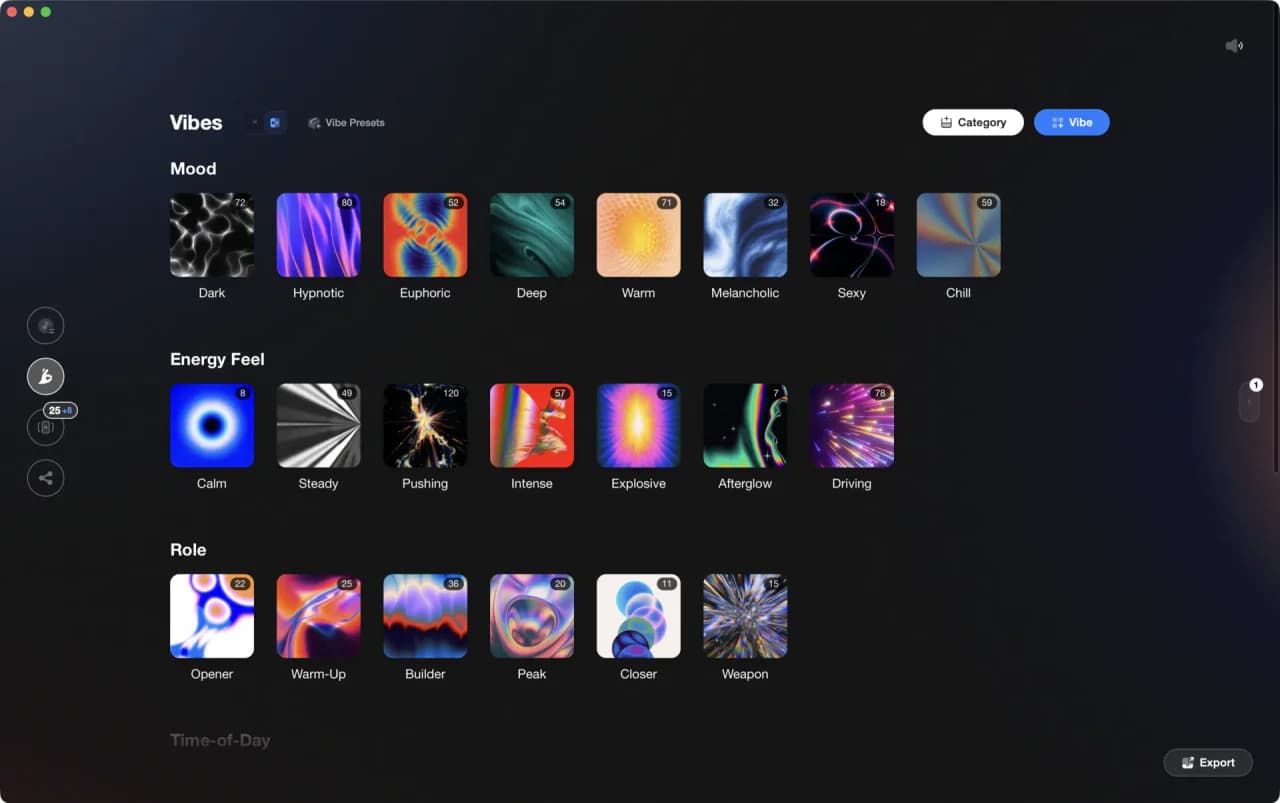
Frequently Asked Questions
Related Tools
Song Key & BPM Finder
Analyze any audio file: key, Camelot code, and BPM detected in your browser
Key & BPM Changer
Change a song's key, tempo, or speed in your browser with exact BPM targets
Camelot Wheel
Interactive Camelot wheel for harmonic mixing
Harmonic Mixing Chart
Complete reference chart for all key notations
Key Compatibility Checker
Check if two keys mix well together
Camelot Wheel Cheat Sheet
Printable reference of all 24 Camelot keys and compatible keys
Camelot Wheel SVG Pack
29 free Camelot Wheel SVG diagrams for blog posts, courses, and tutorials
Key Transposer
Transpose keys by semitones with Camelot and Open Key notation
Scale Finder
See the notes of any scale with Camelot and relative keys
Semitone Calculator
Count semitones between notes and transpose by any interval