
DJ Drop Maker
Next stepOnce your drop is finished, Vibes can pull it into your library with the rest of your tracks, tagged and ready. DJ library in Vibes
Record a short voice clip (or upload one), pick an effect chain, and download a finished DJ drop as WAV or MP3. Reverb, echo, pitch, radio, and stadium chains are rendered offline so what you preview is exactly what you export. Everything runs in your browser.
- Live preview
- Local processing
- Export ready
Basics
What Is a DJ Drop?
A DJ drop is a short branded voice clip, usually two to five seconds, that you fire over a mix to stamp your name on it: "You're locked in with DJ Nova" over a breakdown, a pitched-down "exclusive" before a big tune, a radio-style shout on the one. Radio DJs have used them for decades; club and mixtape DJs use them to make sure nobody rips a set without your name all over it. A good drop is part ID, part hype tool, and it earns its keep every time someone asks "who made this mix?" and the mix answers for you.
Writing
How to Write a Drop That Does Not Suck
- Keep it short. Under five seconds, ideally two or three. You will play this over live music dozens of times; every extra word is a word fighting the vocal of the track underneath
- Name plus one hook, nothing else. "DJ Havoc. Turn it up." beats a full sentence about your residency, your city, and your socials. One idea per drop; make three different drops if you have three ideas
- Match the energy of your sets. A whispered, pitched-down drop suits a deep house set; a shouted riser suits festival trap. Record the read at the intensity you actually play at, because effects can widen a voice but they cannot fake commitment
- Write for the ear, not the page. Read it out loud five times before recording; anything you stumble on, cut. No drop name yet? Run the DJ name generator first, since the whole point of a drop is saying your name
Recording
Recording Tips for a Cleaner Take
- Get close to the mic. Ten to fifteen centimeters. Proximity gives you the bassy, present radio voice for free and pushes the room noise down relative to your voice
- Find a dead room. A closet full of clothes beats an empty kitchen every time. Hard parallel walls add a boxy slap that no plugin removes; soft surfaces around you keep the take dry so the reverb you add is the only reverb on it
- A phone voice memo re-uploaded here is fine. Modern phone mics are genuinely good at speech. Record the memo under a duvet, AirDrop or transfer the file, and upload it: that routinely beats a laptop mic across the room
- Record three takes and pick one. The first take is a rehearsal, the second is usually tight, the third is the swing for the fences. The tool auto-trims silence, so leave a beat of quiet before and after each read
Honest note on quality: a produced drop from a studio voice-over artist, recorded on a large-diaphragm condenser and mixed by hand, will beat a browser take. What this tool gets you is a real, usable drop for free, today, in your own voice, and for most working DJs that is the version that actually ends up in the set.
Effects
What Each Effect Chain Does
Each preset is a designed chain, not a single knob, and every result is peak-normalized to -1 dBFS so drops sit at a consistent level next to your tracks:
- Clean boost: input gain into a soft-clip saturator plus a high shelf at 4.5 kHz. Louder and brighter without sounding processed; the default for a straight ID
- Club reverb: a medium hall convolver at 45 percent wet. The all-purpose "announcer in the room" sound
- Echo drop: a 375 ms feedback delay (a 3/8 note at a 120 BPM feel) with the echoes decaying into a reverb tail. The classic dub-style name echo
- Deep: pitched down 4 semitones through a proper pitch shifter (no chipmunk-in-reverse time smearing) with subtle reverb. The trailer-voice drop
- Chipmunk riser: pitched up 5 semitones with a short slap delay. Energy and silliness for build-ups
- Radio: a 300 to 3400 Hz telephone band with light distortion. The old-transmission, pirate-radio texture
- Stadium: long reverb, a half-second echo, and a short haas widener that spreads the voice across the stereo field. The festival PA announcement
The reverb, delay, and pitch sliders fine-tune any chain from there. If you want your finished drops matched in loudness against other samples, run them through the audio normalizer, and tag the MP3 versions with your name and artwork in the MP3 metadata editor before sending them around.

Hey, it's Ben Modigell 👋
I've been DJing and producing music as "so I so," focusing on downtempo, minimal, dub house, tech house, and techno. My background in digital marketing, web development, and UX design over the past 6 years helps me create DJ tutorials that are clear, practical, and easy to follow.
Methodology
Last updated
Author and Methodology
Maintained by Ben Modigell, founder of Vibes. Ben builds DJ library, preparation, BPM, and harmonic-mixing tools for working DJs.
- Source
- Vibes DJ-tool taxonomy and page logic maintained by Vibes.
- Evidence
- Page output checked against the current tool behavior and internal DJ reference data.
- How this page is made
- Tool pages are built from reusable page logic, internal DJ reference data, and visible on-page calculations. Programmatic reference pages are generated from structured data rather than hand-written one by one.
BPM, key, and genre labels can vary by edit, remaster, detection engine, and DJ software. Use these pages as a practical mixing reference, then verify important tracks in your own library.
Report a correctionThe visual way to organize your DJ library
Tag tracks by vibe. See everything at once. Export to rekordbox, Serato, Traktor or Engine DJ.
14-day free trial. Full access, no strings attached.
or see how it works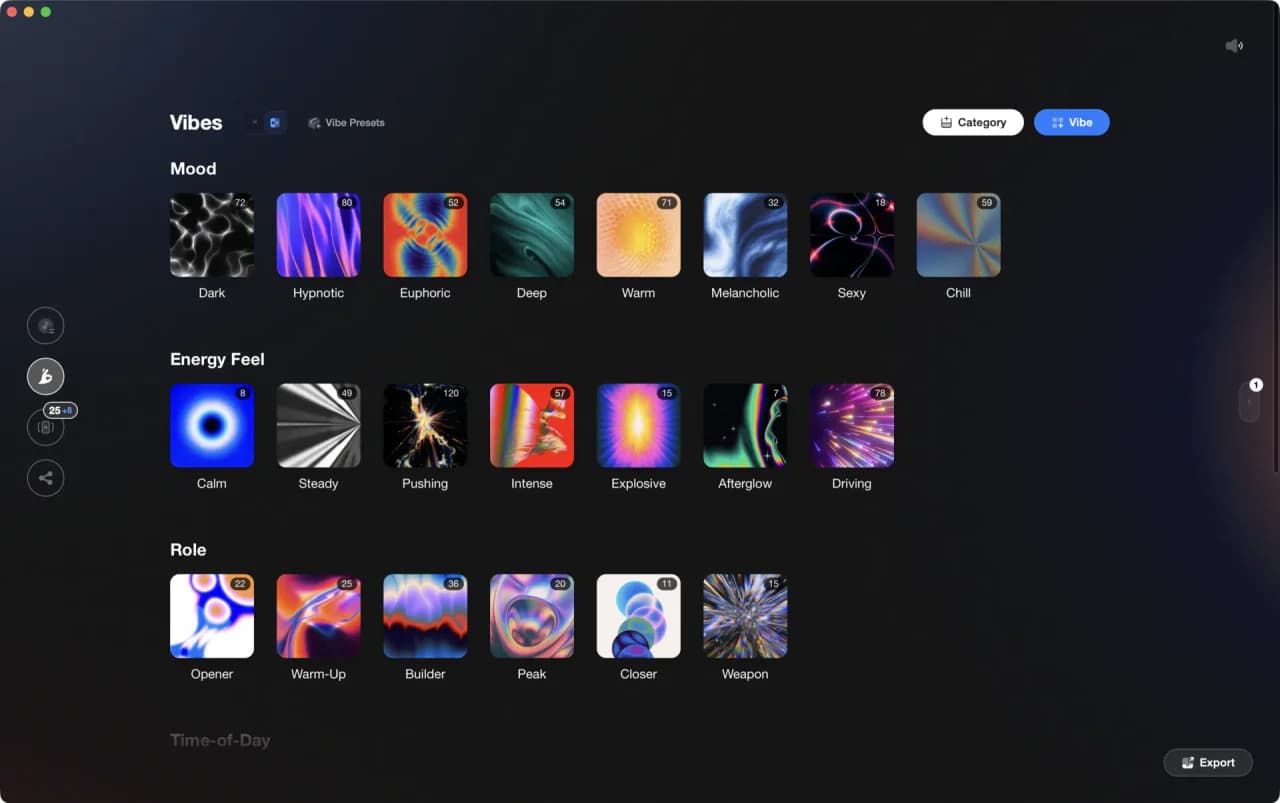
Frequently Asked Questions
Related Tools
MP3 to WAV
Convert MP3 to lossless WAV in your browser, batch supported
WAV to MP3
Convert WAV to 320 kbps MP3 in your browser, batch supported
AIFF to MP3
Convert AIFF to 320 kbps MP3, with our own AIFF reader
AIFF to WAV
Convert AIFF to WAV losslessly in your browser
M4A to MP3
Convert M4A/AAC to MP3 in your browser
M4A to WAV
Convert M4A/AAC to lossless WAV in your browser
FLAC to MP3
Convert FLAC to 320 kbps MP3 in your browser
FLAC to WAV
Convert FLAC to WAV losslessly in your browser
OGG to MP3
Convert OGG/Opus to MP3 in your browser
OGG to WAV
Convert OGG/Opus to lossless WAV in your browser
Opus to MP3
Convert Opus voice notes and recordings to MP3 in your browser
MP3 to OGG
Convert MP3 to OGG Vorbis in your browser, batch supported
MP3 to Opus
Convert MP3 to Opus in your browser, batch supported
WAV to FLAC
Compress WAV to lossless FLAC in your browser
MP3 to FLAC
Convert MP3 to FLAC in your browser, batch supported
MP3 to AIFF
Convert MP3 to AIFF for rekordbox and Mac workflows
WAV to AIFF
Convert WAV to AIFF losslessly in your browser
Mono to Stereo
Convert mono audio files to stereo in your browser
Stereo to Mono
Downmix stereo audio files to mono in your browser
LUFS Meter
Measure integrated LUFS, true peak, and loudness range in your browser
MP3 Metadata Editor
Edit MP3 tags and album art in your browser, no upload
Spectrogram Analyzer
View any audio file as a spectrogram in your browser
Audio Quality Checker
Detect fake FLACs and upscaled MP3s by their frequency cutoff
Frequency Detector
Detect the dominant frequency of audio or your mic in Hz
Tone Generator
Generate sine, square, and sweep test tones at any frequency
Music Visualizer
Audio-reactive visuals for any track, export as video
CUE Splitter
Split albums and DJ mixes into tracks with a cue file or timestamps
Waveform Generator
Turn any track into a waveform image, PNG or SVG
Audio Fade
Add fade in and fade out to any audio file in your browser
Audio Trimmer
Trim, cut and join MP3 or WAV in your browser, no upload
MIDI to MP3
Render a MIDI file to MP3 or WAV in your browser
Silence Remover
Trim silence from the start and end of audio files
Slowed & Reverb Generator
Make slowed + reverb and nightcore versions of any song
Reverse Audio
Reverse any audio file and export as WAV or MP3
Audio Normalizer
Normalize audio loudness to a target level in your browser
Audio Looper
Cut a section of a track and export it as a seamless loop
Audio to MIDI
Convert melodies and chords from audio into a MIDI file