
Tracklist workspace
Edits are saved in this browser.
Set details (optional)
Import cue sheet
Import an existing cue file at any time. Its tracks remain editable below.
- Tracks
- 0
- Total time
- --
- Average gap
- --
Times use each track's start. Set a total duration above to give the final track an end time.
Track editor
0 rowsNo tracks yet. Add a row, paste a list, or import a cue sheet.
Next stepVibes builds that same ordered list from your own library, with next-track suggestions by BPM, key, and vibe before you export it. Set Designer in Vibes
Build a tracklist row by row, paste a messy list of timestamps, or drop a .cue file, then export it as YouTube timestamps, SoundCloud timestamps, 1001tracklists format, CSV, or a .cue sheet.
- Saved locally
- Editable output
- Private by default
Why it matters
Why Post a Tracklist With Every Mix
A tracklist turns a mix into something discoverable. Listeners searching for a track they heard find your set instead of scrolling past it, and a clean submission to 1001tracklists earns you a backlink and a profile listing that keeps drawing traffic long after upload day. On YouTube specifically, a tracklist formatted as chapters gives viewers a reason to jump around and keep watching instead of dropping off, which is exactly the retention signal the algorithm rewards.
YouTube chapters
YouTube's Automatic Chapter Rules
YouTube only turns a timestamp list into clickable chapters when it follows three rules. The export panel above checks your tracklist against them automatically and lists exactly what's failing if it isn't ready yet:
- The first chapter must start at 0:00
- You need at least 3 chapters total
- Every chapter must be at least 10 seconds long
Capture
How to Grab Timestamps While You Record
The easiest path is letting your recording software do it for you: most DJ mixers and standalone recorders can export a .cue sheet alongside the audio file, marking a new INDEX every time you hit the cue button. Drop that .cue file above and it prefills the whole editor. If your setup doesn't export one, note the mm:ss on your recorder's counter the moment each track drops in, then paste those rough notes into the Paste tab for cleanup.
Either way, plan the set before you record it: the DJ set time calculator scaffolds how many tracks you need for your target length, so you're publishing a set you already planned rather than reverse-engineering one after the fact.
Unknown tracks
Be Honest About Unreleased IDs
Don't guess at a title you're not sure of: it misleads anyone searching for the real thing and can misattribute a producer's unreleased work. The standard convention is to label it plainly as "ID - ID", or "Artist - ID" if you know the artist but not the track name. If you want to leave yourself a better trail to identify it later, run the clip through the song key & BPM finder and note the key and tempo next to the ID: useful fingerprint data once someone reveals the real title.

Hey, it's Ben Modigell 👋
I've been DJing and producing music as "so I so," focusing on downtempo, minimal, dub house, tech house, and techno. My background in digital marketing, web development, and UX design over the past 6 years helps me create DJ tutorials that are clear, practical, and easy to follow.
Methodology
Last updated
Author and Methodology
Maintained by Ben Modigell, founder of Vibes. Ben builds DJ library, preparation, BPM, and harmonic-mixing tools for working DJs.
- Source
- Vibes DJ-tool taxonomy and page logic maintained by Vibes.
- Evidence
- Page output checked against the current tool behavior and internal DJ reference data.
- How this page is made
- Tool pages are built from reusable page logic, internal DJ reference data, and visible on-page calculations. Programmatic reference pages are generated from structured data rather than hand-written one by one.
BPM, key, and genre labels can vary by edit, remaster, detection engine, and DJ software. Use these pages as a practical mixing reference, then verify important tracks in your own library.
Report a correctionThe visual way to organize your DJ library
Tag tracks by vibe. See everything at once. Export to rekordbox, Serato, Traktor or Engine DJ.
14-day free trial. Full access, no strings attached.
or see how it works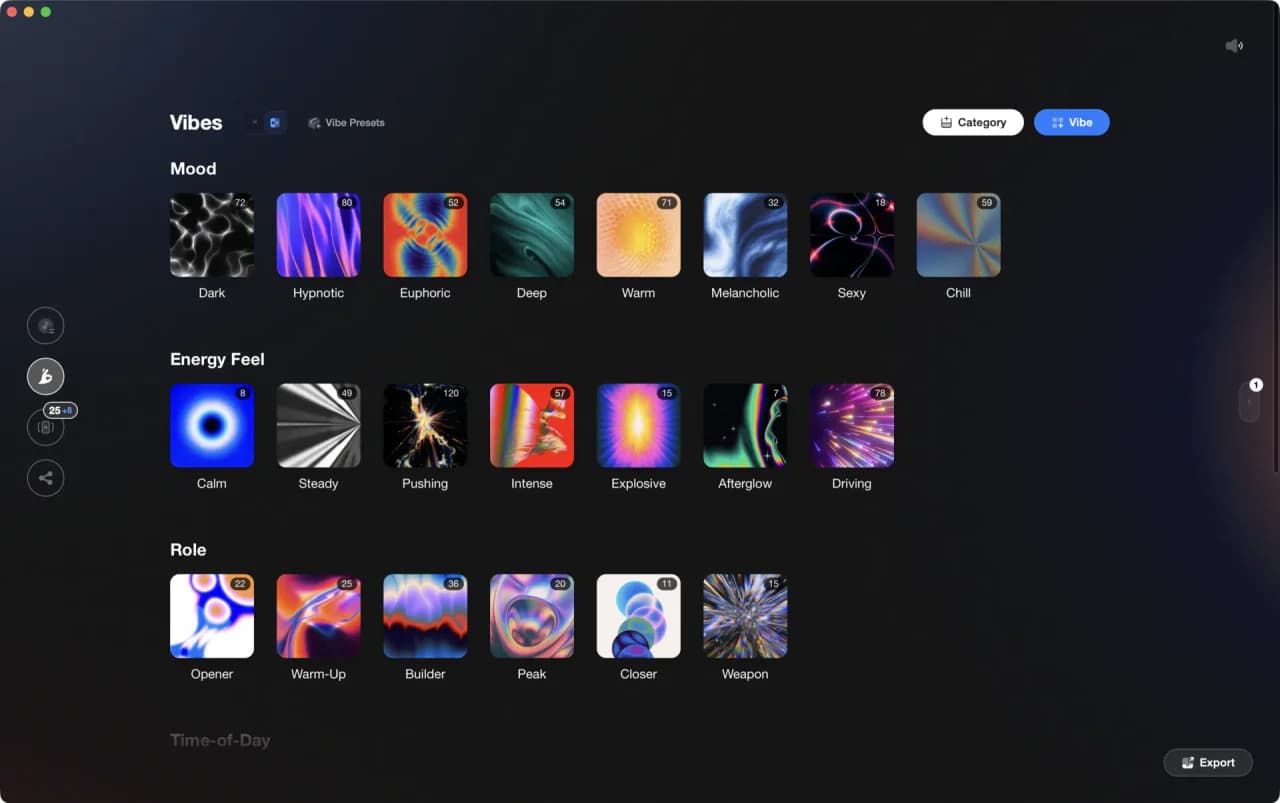
Frequently Asked Questions
Related Tools
BPM Tapper
Tap to detect BPM in real-time
BPM to Milliseconds
Convert BPM to delay times for every note subdivision
Halftime / Doubletime
Calculate half, double, and triplet tempo variants
Set Time Calculator
Plan how many tracks you need for your set
Pitch & Tempo Calculator
Calculate BPM after pitch changes or find pitch % between tempos
Beats to Time Calculator
Convert bars and beats to seconds at any BPM
MS to BPM Calculator
Convert milliseconds to BPM: delay times, loop lengths, and beat intervals
DJ Transitions Guide
Every DJ transition type with BPM bridging and key-compatible techniques