
DJ Transitions: The Complete Guide
Quick answer
How do you transition between two songs as a DJ?
Every DJ transition comes down to three decisions: when to move, which technique to use, and how to handle the tempo and key gap. This guide covers all nine core techniques step by step, with a calculator that tells you whether two BPMs can be pitched, bridged, or need a hard cut.
- DJ-ready reference
- Printable
- Methodology included
Direct pitch change
Too big for one smooth pitch ride, which is where it gets creative: a halftime or doubletime bridge, an echo cut, a spinback, or an acapella swap all cross this gap in style.
(140 − 126) ÷ 126 × 100 = +11.1%
Halftime / doubletime bridge
B in halftime · reads as 70 BPM
-44.4% pitch on A
Out of pitch range
A in doubletime · reads as 252 BPM
-44.4% pitch on A
Out of pitch range
Halftime: (70 − 126) ÷ 126 × 100 · Doubletime: (140 − 252) ÷ 252 × 100
Next stepVibes filters your library to tracks sharing a mixable BPM range and a compatible key, so a transition has real candidates waiting. Find Compatible in Vibes
Fundamentals
What Makes a DJ Transition Work
Three rules sit under every technique in this guide. Get these right and even a plain fader swap sounds deliberate. Get them wrong and no amount of FX will save the blend.
Phrasing. Dance music is built in 16 and 32 bar phrases. A new phrase is where the track itself changes: a drop, a breakdown, a new element. Count bars (1-2-3-4 per bar, 8 bars to a section) and make every major move, first fader up, bass swap, final fader down, land on a phrase boundary. A technically perfect beatmatch that swaps mid-phrase still feels wrong, because the two tracks are telling different parts of their story at the same moment. Use the beats-to-time calculator to see how long 16 or 32 bars runs at any BPM.
The one-bass rule. Never let two basslines play at full level at the same time. Low frequencies stack into mud, eat all the headroom, and make the mixer limiter clamp down on the whole club. The incoming track always enters with its low EQ fully cut, and the bass swap happens as one decisive move, one or two beats, not a slow crossfade.
Energy direction. A transition is an energy decision before it is a technical one. Decide whether the next track lifts the floor, holds it, or gives it a breather, then pick the technique to match: a drop swap to lift, a long blend to hold, an echo out into a breakdown to reset. The crowd hears the energy move, not the fader move.
Techniques
The 9 Core DJ Transition Techniques
These nine cover essentially every transition you will hear in a club. Learn the EQ blend and the echo out first: together they handle 80 percent of real sets.
1. EQ Blend (Bassline Swap)
The default club transition for beatmatched 4/4 music. Use it whenever both tracks can share the air for 16 to 32 bars.
- Beatmatch the incoming track and cue it at its intro or a sparse section.
- On a phrase boundary, bring its fader up with the low EQ fully cut.
- Blend mids and highs over 8 to 16 bars until both tracks read clearly.
- On the next phrase boundary, swap basslines in one move: outgoing low down, incoming low up, within one or two beats.
- Ease the outgoing mids and highs down over the following phrase, then take its fader out.
Best for: house, techno, trance, any steady 4/4.
2. The Cut
An instant switch on the downbeat. Use it when blending would sound mushy, when the tempos have no relationship, or when the moment calls for a jolt.
- Cue the incoming track on a strong downbeat: the first beat of a phrase, ideally its drop or hook.
- Let the outgoing track run to the last beat of a phrase.
- On the one, hit play on the new track and kill the old channel in the same motion.
- Optional: chop the outgoing track's last bar with the fader to telegraph the switch.
Best for: hip hop, open format, any BPM gap. The timing is fully exposed, so practice the one.
3. Echo Out (Delay Tail)
The universal escape hatch. Ends any track cleanly and works between any two tempos, which makes it the first transition every beginner should own.
- Set the echo or delay to a beat-synced value: 1/2 or 3/4 works almost everywhere.
- On the last beat of a phrase, engage the echo and pull the channel fader down. The tail keeps ringing in time.
- Start the next track on the following downbeat, either dry or under the decaying tail.
- Bring the new track in at full EQ: nothing else is filling the low end.
Best for: everything. Especially BPM jumps and genre changes.
4. Filter Fade
A smoother, one-knob cousin of the EQ blend. Use it in melodic material where hard EQ moves would feel clinical.
- Beatmatch the incoming track and bring it in behind a high-pass filter (filter knob right).
- Over a phrase, open the incoming filter toward neutral while pushing the outgoing track into its own high-pass.
- Cross them: incoming lands at neutral as the outgoing thins out to hats and air.
- Fade the outgoing track out under the filter.
Best for: melodic house, progressive, trance. Keep filter resonance low: a little movement helps, squealing does not.
5. Loop Roll Exit
Manufactures an exit point on a track that has no clean outro, and builds tension while doing it.
- Near the end of a phrase, capture a 4-beat loop on the outgoing track.
- Halve it on the beat: 2 beats, 1 beat, 1/2, 1/4. The shrinking loop reads as a build.
- As the roll tightens, cut to the new track on the one, or throw the roll into an echo out.
Best for: EDM, open format, bass music. Overused it gets gimmicky: once or twice an hour.
6. Backspin / Spinback
A hard reset with attitude. The record audibly rewinds, then the next track drops. Use it as punctuation, not as a comma.
- Play the outgoing track into the last bar of a phrase.
- On the last beat, spin the platter or jog wheel backward hard.
- Kill the channel as the spin dies and drop the new track on the one at full energy.
Best for: hip hop, dancehall, open format. Once or twice a set keeps it powerful.
7. Drop Swap
Swap tracks at the exact moment a drop hits, or run two drops together. The biggest payoff of any transition, and the easiest one to trainwreck.
- Beatmatch and phrase-align both tracks so their drops land on the same one. Count both builds in advance.
- Run the incoming track's build over the outgoing track's final phrase, incoming bass cut.
- At the drop, swap fully to the new track in a single fader-and-bass move.
- Drum and bass variant: let both drops run together for 8 bars (the double drop), then pull one out.
Best for: EDM, drum and bass, festival sets. Mistimed by a bar, the whole room knows.
8. Acapella / Hook Layer
Use a vocal as the bridge: the crowd follows the words while the instrumental changes underneath. The signature open-format move.
- Prep first: know the vocal's BPM and key before the gig (the song key and BPM finder covers both).
- Bring the new instrumental in under the outgoing track's last vocal line, bass cut.
- Cut the outgoing music on a phrase boundary so its vocal rides the new instrumental.
- Keep the layer to 8 to 16 bars, then let the new track take over fully.
Best for: open format, vocal house. Key matching matters most here: a clashing vocal is the most exposed mistake in DJing.
9. Long Ambient Blend
The transition as part of the music: 32 to 64 bars where two tracks coexist and the handover is never announced. The core skill of deep and melodic sets.
- Pick tracks with long intros and outros in compatible keys. This blend lives or dies in preparation.
- Layer the incoming intro under the outgoing outro at low level, high-passed if it carries any low end.
- Trade mids and highs gradually across several phrases: pads in, hats out, texture over texture.
- Swap the bass at a moment when one track's low end drops away naturally, so the move hides inside the arrangement.
Best for: deep house, dub techno, downtempo, warmup sets.
| Technique | Difficulty | Fits | Risk |
|---|---|---|---|
| EQ blend | Easy | House, techno, trance | Low |
| The cut | Easy | Hip hop, open format | Medium: timing exposed |
| Echo out | Easy | Any genre, any BPM | Low |
| Filter fade | Easy | Melodic house, trance | Low |
| Loop roll exit | Medium | EDM, bass, open format | Medium: gimmicky if overused |
| Backspin | Medium | Hip hop, dancehall | Medium: cliche if overused |
| Drop swap | Hard | EDM, drum and bass | High: mistimed drop |
| Acapella layer | Hard | Open format, vocal house | High: key and timing exposed |
| Ambient blend | Medium | Deep, melodic, downtempo | Low |
Tempo
Matching Tempos: How to Mix Between Different BPMs
The calculator at the top of this page runs this math for any two tracks. Here is what the numbers mean in practice.
Pitch ranges. CDJs and most software offer ±6, ±10, and ±16 percent ranges. The honest limits are tighter than the hardware: up to about 4 percent, nobody on the floor hears the tempo move. From 4 to 8 percent it is audible, especially on vocals, but workable if you spread the ride across a phrase or split it between both decks. Past 8 percent, pitching sounds wrong even with keylock on, because the groove itself changes character.
The key cost. With keylock off, roughly 6 percent of pitch equals one semitone. Ride a track up 6 percent and it is now in a different key, which can turn a compatible blend into a clash mid-transition. The pitch and tempo calculator shows the exact semitone shift for any pitch move, and the key and BPM changer tells you what key a track lands in after the ride.
Halftime and doubletime bridges. Tracks at a 2:1 tempo ratio share a pulse: drum and bass at 174 BPM reads as 87 in halftime, so an 87 BPM hip hop track blends into it with zero pitch change. The same logic pairs 70 BPM hip hop with 140 BPM dubstep, and explains why trap produced at 150 feels like 75. When the gap between two tracks is too wide to pitch, check whether one of them halved or doubled lands near the other: the halftime and doubletime calculator maps these relationships for any BPM.
Some jumps have no direct bridge. House at 124 and drum and bass at 174 do not line up: 124 doubled is 248, 174 halved is 87. The working route is a stepping stone: echo out of the house track into something around 87, a hip hop or halftime break, then blend that into 174 as a seamless doubletime layer. Two clean moves instead of one impossible one.
Key
Keeping Transitions in Key
Harmonic mixing keeps long blends musical. The Camelot wheel makes it mechanical: from any key, the safe moves are the same number (identical key), one step up or down on the wheel (adjacent keys), or the same number with the letter flipped (relative major or minor). The +2 jump, two steps clockwise, is the classic energy boost: noticeably brighter without sounding off. Check any specific pairing with the key compatibility checker, and use the song key and BPM finder to look up keys before the gig instead of guessing at 1 a.m.
Key rules apply to melodic overlap, not to transitions as such. If the blend happens over intros, outros, or breakdown-free percussive sections, drums against drums, a key clash is inaudible because nothing tonal is fighting. This is the practical loophole: a track in the wrong key can still follow the current one if you transition through its percussive sections with a shorter technique, an EQ blend over the drums or an echo out, instead of a long melodic layer.
Genres
Transitions by Genre
House and techno. Long EQ blends over 32 bars are the native language. Tracks are built with DJ-friendly intros and outros for exactly this, so use them: mix outro into intro, swap bass on the phrase, and save FX for moments that need them. Tempo gaps are small (roughly 120 to 135), so almost everything is a direct pitch ride.
Drum and bass. Double drops and drop swaps are the currency: phrase-align two drops and let them hit together. Halftime sections are the built-in bridge for tempo changes and for pulling hip hop or 140 material into a set. Blends are shorter, 8 to 16 bars, because the arrangements are denser.
Open format. Cuts, echo outs, and word cues do the work, because the BPM map of a night jumps constantly: 90s hip hop into house into reggaeton. Use lyrical hooks as handoff points (end of a sung line into the next track's hook) and treat every genre change as an echo out or cut moment rather than forcing a blend.
Hip hop. Backspins, cuts on the one, and acapella layers. Blending two rap vocals over each other is almost always a mistake: swap on bar lines, let the DJ moves be audible, and use instrumental sections and acapellas to restructure tracks live.
Practice
Practice Drills That Actually Build the Skill
Playing through your library is not practice. These three drills isolate the mechanics.
- The same-track blend. Load the same track on both decks, offset by 32 bars, and practice bassline swaps between them. Because both sides are identical, any mud, gap, or level jump you hear is pure technique error. Repeat until the swap is inaudible.
- The 10-track EQ-only mix. Record a mix of 10 tracks using only faders and EQ: no FX, no filters, no loops. Listen back the next day and mark every moment where two basslines overlap or the energy dips. FX skills are easy to add later; this drill builds the foundation they sit on.
- Forced key-clash recovery. Deliberately queue two clashing tracks and get out cleanly: find the percussive section, shorten the overlap, use the filter or an echo out. Clashes happen in every real set the moment a request or a crowd shift forces your hand; practicing the recovery removes the panic.
Go deeper
Single-Technique Tutorials
This page is the overview: every technique, when to use it, and how to bridge tempo and key. When you want to drill one move in isolation, these tutorials go deeper: the bassline swap, phrase, EQ, and fader mechanics, picking the right move for two specific records, and protecting groove and energy through the swap.

Hey, it's Ben Modigell 👋
I've been DJing and producing music as "so I so," focusing on downtempo, minimal, dub house, tech house, and techno. My background in digital marketing, web development, and UX design over the past 6 years helps me create DJ tutorials that are clear, practical, and easy to follow.
Methodology
Last updated
Author and Methodology
Maintained by Ben Modigell, founder of Vibes. Ben builds DJ library, preparation, BPM, and harmonic-mixing tools for working DJs.
- Data used
- Techniques reflect standard club practice across rekordbox, Serato, and Traktor workflows. Pitch range figures, loop and FX behavior, and phrasing conventions were checked against the current behavior of each platform and CDJ pitch fader settings.
- Source
- Vibes DJ-tool taxonomy and page logic maintained by Vibes.
- Evidence
- Page output checked against the current tool behavior and internal DJ reference data.
- How this page is made
- Tool pages are built from reusable page logic, internal DJ reference data, and visible on-page calculations. Programmatic reference pages are generated from structured data rather than hand-written one by one.
BPM, key, and genre labels can vary by edit, remaster, detection engine, and DJ software. Use these pages as a practical mixing reference, then verify important tracks in your own library.
Report a correctionThe visual way to organize your DJ library
Tag tracks by vibe. See everything at once. Export to rekordbox, Serato, Traktor or Engine DJ.
14-day free trial. Full access, no strings attached.
or see how it works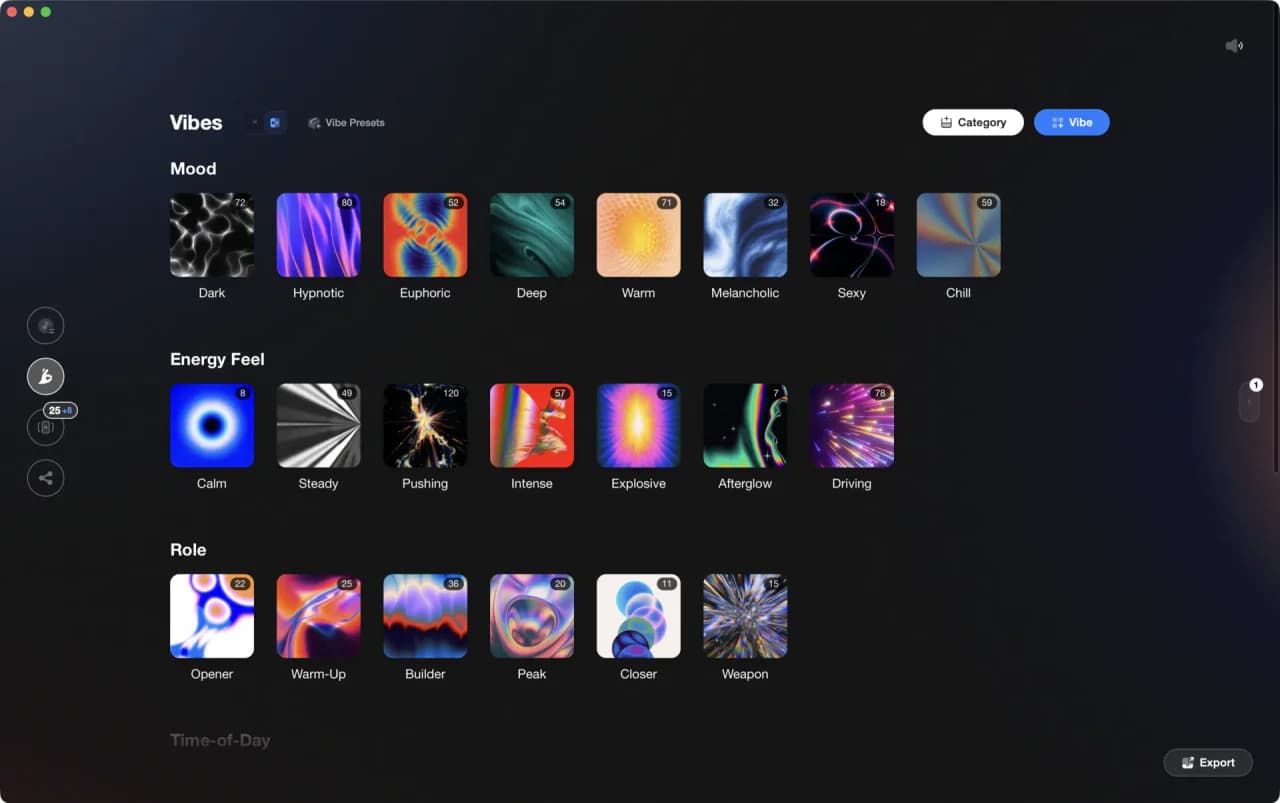
Frequently Asked Questions
Related Tools
BPM Tapper
Tap to detect BPM in real-time
BPM to Milliseconds
Convert BPM to delay times for every note subdivision
Halftime / Doubletime
Calculate half, double, and triplet tempo variants
Set Time Calculator
Plan how many tracks you need for your set
Pitch & Tempo Calculator
Calculate BPM after pitch changes or find pitch % between tempos
Beats to Time Calculator
Convert bars and beats to seconds at any BPM
MS to BPM Calculator
Convert milliseconds to BPM: delay times, loop lengths, and beat intervals
Tracklist Maker
Build a tracklist and export YouTube timestamps, 1001tracklists, and cue formats