
Find compatible tracks in one click.
A compatible track is one that sits within a few BPM of what is playing and in a harmonically related key: the same Camelot code, one step up or down the wheel, or the relative major or minor. Filter your library down to that set first, then let energy, structure, and your own tags decide which of the survivors you actually play. Vibes does that filtering from a single track: pick one, and the list narrows to its harmonic neighbours inside a BPM window that already allows for half and double time.
$49$79USD one-time purchase. First 250 licenses at this price. 14-day free trial.
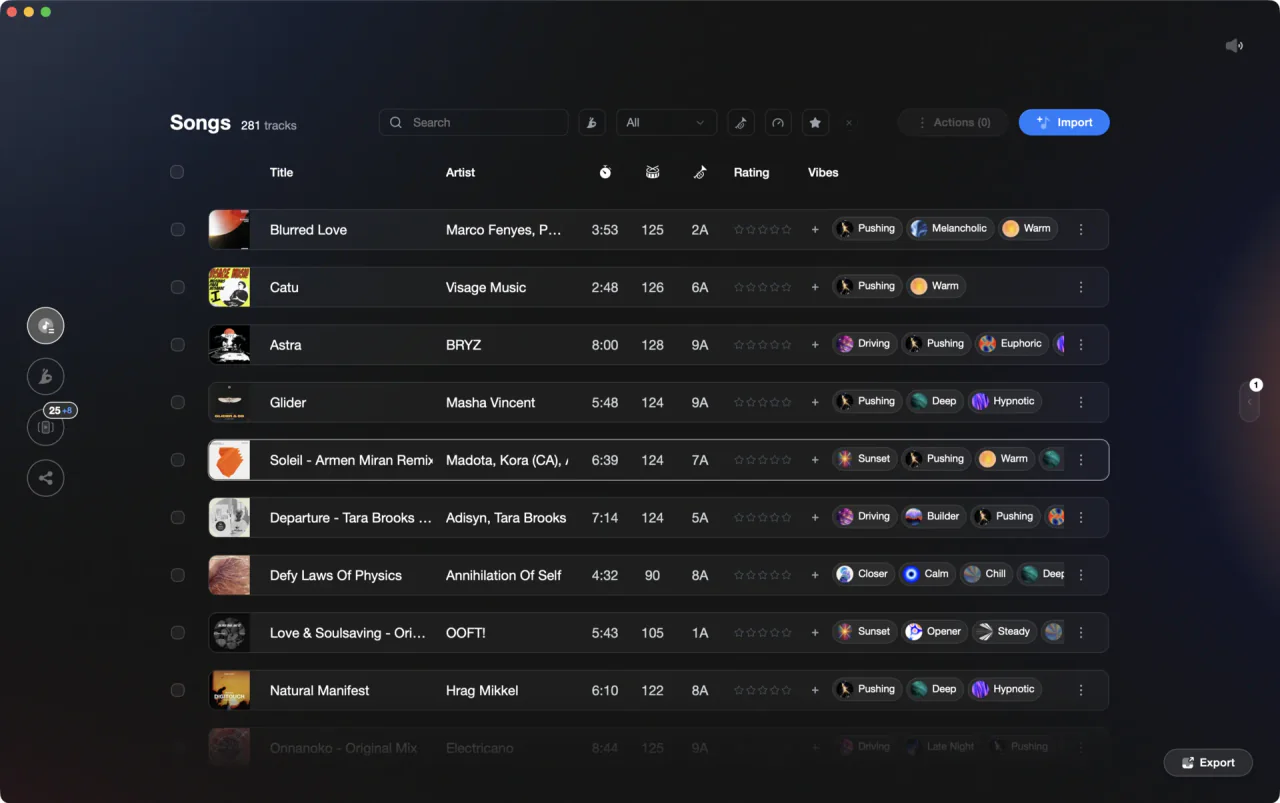
Every row carries a BPM and a key. That is what the filter runs on.
Find compatible takes one analyzed track and filters your library to its harmonic Camelot neighbors in a BPM window of six percent either side, half and double time included, using key and BPM Vibes detected on your own machine.
How it works.
Import from Rekordbox, Serato, Traktor, or Engine DJ and the BPM and key your library already holds come across with the tracks. Anything still missing gets analyzed, in bulk if you want.
Open the menu on any analyzed row and choose Find compatible. It stays grayed out while a BPM or a key is missing, so no shortlist ever gets built on half the data.
The library narrows to the harmonic Camelot neighbours and a BPM window around the source tempo. Your rating filter and whatever you typed in the search box stay put, so you can keep narrowing the shortlist from there.
Import from Rekordbox, Serato, Traktor, or Engine DJ and the BPM and key your library already holds come across with the tracks. Anything still missing gets analyzed, in bulk if you want.
Open the menu on any analyzed row and choose Find compatible. It stays grayed out while a BPM or a key is missing, so no shortlist ever gets built on half the data.
The library narrows to the harmonic Camelot neighbours and a BPM window around the source tempo. Your rating filter and whatever you typed in the search box stay put, so you can keep narrowing the shortlist from there.
One track in, a short list out.
Find Compatible sets the key and tempo filters for you, so what is left on screen can actually follow the track you picked.
Camelot
Four keys, picked for you.
The key filter jumps to the harmonic neighbours of the track you started from: the same code, one step up, one step down, and the same number with the other letter, which is the relative major or minor. Start from 8A and the filter comes back set to 8A, 9A, 7A and 8B. That is the fastest way to find compatible tracks DJ sets are built on, and it needs no wheel chart open on a second screen.
See Track Analysis
Track 001
Artist A
Afterhours Mysterious
 Introspective
Track 001
Artist A
AfterhoursMysteriousIntrospective
Track 002
Artist B
 Cozy FloorPeaceful
 Home
HomeTrack 002
Artist B
Cozy FloorPeacefulHome
Track 003
Artist C
Rave Aggressive
 Festival
 Build & Release
Track 003
Artist C
RaveAggressiveFestivalBuild & ReleaseTempo
A window that allows for half time.
The BPM filter opens to roughly six percent either side of the source tempo, so a 124 BPM track gives you 117 to 131. Half and double time come on with it, which is how an 87 BPM roller still surfaces when you are looking for something to follow a 174 BPM track.
 Euphoric
 MelancholicMysteriousAggressivePeacefulRaveAfterhours
 ClubHome
Your tags
Compatible, and the right feel.
If the track you started from carries vibes, those go into the filter as well, so what is left is not only harmonically safe but right for the moment you are in. Your rating filter and your search stay untouched, so the shortlist lands inside the narrowing you had already done by hand.
See Vibe OrganizationWhile you build
Ranked suggestions inside the set.
Set Designer runs the same idea as a ranked list instead of a filter. Say whether the next track should be slower, similar or faster, pick a key intent from a safe harmonic match to a dramatic lift, and turn on Sound Match so candidates are ranked by how they actually sound and not only by their tags.
See Set DesignerFrequently asked questions
The honest answers, including the trade-offs.
From a Vibes customer
The import worked perfectly. Have created several sets now and my life is so much easier
One-time purchase
Get Vibes with a single payment. No subscription.
Vibes is the step before you open your DJ software, not a replacement for it.
First 250 licenses at this price, then $79.
14 days • Full access
No strings attached
Secure checkout with Stripe
Already have Companion Pro? Upgrade instead

Methodology
How we keep this honest.

Verified against the app
Find Compatible is described from the shipping version of Vibes, not a roadmap.
We own our bias
Vibes is our product. We call out where a feature has limits or where another tool does something differently.
Live pricing
The Vibes price shown comes straight from our checkout, never a hardcoded marketing number.
Kept current
Last reviewed September 2026.