

Use Mixed In Key with Rekordbox.
Analyze your files in Mixed In Key, then select them in Rekordbox, right-click and choose [Reload Tag]: the key and the energy level come straight out of the ID3 tags. Cue points travel on a separate channel, a rekordbox xml file both apps point at, and to see the Camelot codes exactly as Mixed In Key wrote them, set Preferences > View > Display Type > [Key display format] to [Display key information on the database].
$49$79USD one-time purchase. First 250 licenses at this price. 14-day free trial.
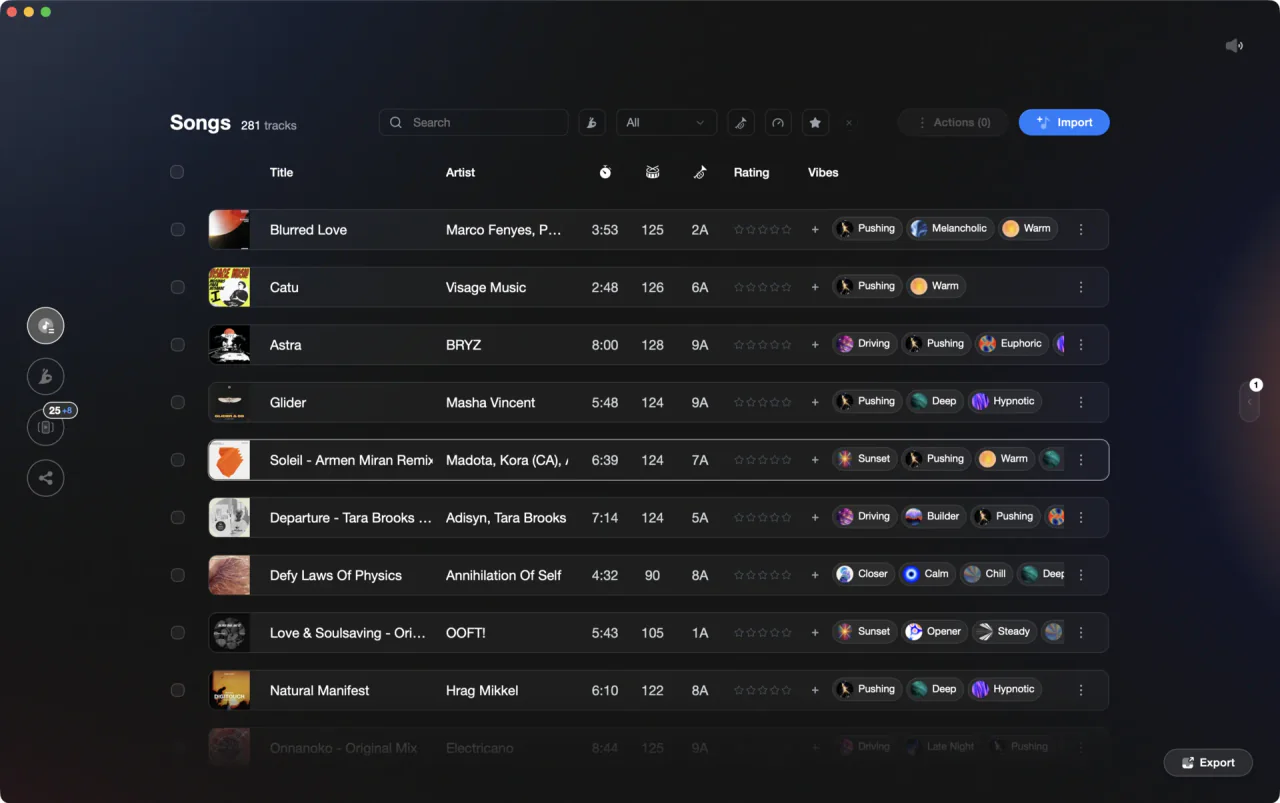
Vibes analyzes and sorts the files; Rekordbox keeps the cue points and the decks.
Use Mixed In Key with Rekordbox, step by step.
Mixed In Key and rekordbox exchange data over two separate channels: ID3 tags carry the key and the energy level, and a rekordbox xml file carries the cue points. Set both up once, and each new batch of music is a short routine.
Stop Rekordbox running its own key detection
Open Preferences > Analysis > Track Analysis. Under [Track Analysis Setting] you choose what gets analyzed: [BPM / Grid], [KEY], [Phrase] and [Vocal]. Leave [BPM / Grid] ticked and untick [KEY], so Rekordbox stops producing a competing key value. In the same tab, leave [Key Analysis] > [Write the value to the ID3 tag] off, so Rekordbox never writes its own key back into your files.
Add your music and analyze BPM and grid first
Drag your files into [Collection] and let the analysis finish. Mixed In Key's cue point workflow expects Rekordbox to have the beatgrid already, so run this pass before you touch anything else. If [Auto Analysis] is set to [Disable] in the same Track Analysis tab, select the tracks, right-click and choose [Analyze Track].
Analyze the same files in Mixed In Key
Add the identical files to Mixed In Key and let it run. By default it writes the key to the Key field and the results into the Comments field. Check Settings > Tag Options before the first batch: there is an option that adds a leading zero to single-digit Camelot numbers, so 1A is written as 01A, which some Pioneer DJ hardware sorts more cleanly.
Pull the tags in with Reload Tag
Back in Rekordbox, select the tracks you just analyzed, right-click and choose [Reload Tag]. That reads the ID3 tag information from the file again and reloads it into the track information in [Collection] and your playlists. The key and the energy text appear within a second or two. Nothing is copied, so the files stay where they are.
Set the key display format so nothing is converted
Open Preferences > View > Display Type > [Key display format]. [Classic] shows key names, [Alphanumeric] shows values such as 1A and 2A, and [Display key information on the database] shows the key exactly as it is recorded on the track. Pick the last one if you want Mixed In Key's Camelot codes shown untouched rather than re-rendered by Rekordbox.
Build the xml bridge for cue points
Tick [rekordbox xml] under Preferences > View > Layout > [Media Browser], then set [Imported Library] under Preferences > Advanced > Database. Export with the [File] menu > [Export Collection in xml format] and save it to a plain local folder, not a cloud-synced one and not an external drive. In Mixed In Key, open Settings > DJ Software, turn Rekordbox on and select that same file.
Import the MIK Cue Points playlist
Re-run the analysis in Mixed In Key so it writes the cue points into the xml. In Rekordbox, click the reload icon on [rekordbox xml] in the [Media Browser] to refresh it, open its [Playlists], right-click the playlist named [MIK Cue Points] and choose [Import Playlist]. Then select the tracks and use [Import To Collection] so the cue points land on your own copies.
The catch
The xml file is a snapshot, not a live link. Every batch of new music means exporting the collection again, re-analyzing in Mixed In Key and re-importing the playlist. And [Reload Tag] replaces the track information with whatever the tag says, so anything you typed by hand in Rekordbox is overwritten. Pick one place to edit metadata and stay there.
Where Vibes fits
Analysis and sorting, before anything reaches the xml.
Vibes is not a bridge to Mixed In Key and it does not write cue points into Rekordbox: that stays a job for the two apps above. What it does is the analysis and the ordering. Every track gets BPM, key shown as Camelot, musical or Open Key, an energy curve and sections, and finished playlists and vibes export back to Rekordbox as a folder tree.
See how it worksOrganize in Vibes, export to Rekordbox.
Your playlists, tags, ratings, and cue points travel back to the gear you play on, so nothing you do in Vibes is locked away.

Track 001
Artist A
Afterhours Mysterious
 Introspective
Track 002
Artist B
 Cozy FloorPeaceful
 Home
Home
Track 003
Artist C
Rave Aggressive
 Festival
 Build & Release
Frequently asked questions
The honest answers, including the trade-offs.
From a Vibes customer
The import worked perfectly. Have created several sets now and my life is so much easier
One-time purchase
Get Vibes with a single payment. No subscription.
Vibes is the step before you open your DJ software, not a replacement for it.
First 250 licenses at this price, then $79.
14 days • Full access
No strings attached
Secure checkout with Stripe
Already have Companion Pro? Upgrade instead

Methodology
How we keep this honest.

Verified against the app
Every step is checked against the current version of Rekordbox.
We own our bias
We make Vibes. We show the native way first and honestly, then where Vibes genuinely helps, and we say when it does not.
Live pricing
The Vibes price shown comes straight from our checkout, never a hardcoded marketing number.
Kept current
Last reviewed September 2026.
Keep exploring
DJ apps head to head
Works with your software
Vibes for DJs
Vibes features
How-to guides
Best DJ software
Move between apps
Learn to DJ