

Show Camelot key in Rekordbox.
Open Preferences in Rekordbox, choose the View category, open the Display Type tab, and set Key display format to Alphanumeric. Every analyzed track then reads as a Camelot code like 8A or 12B, and the Traffic Light control in the browser panel highlights the tracks whose key is compatible with the deck you have selected. You set it once and it holds for the whole collection.
$49$79USD one-time purchase. First 250 licenses at this price. 14-day free trial.
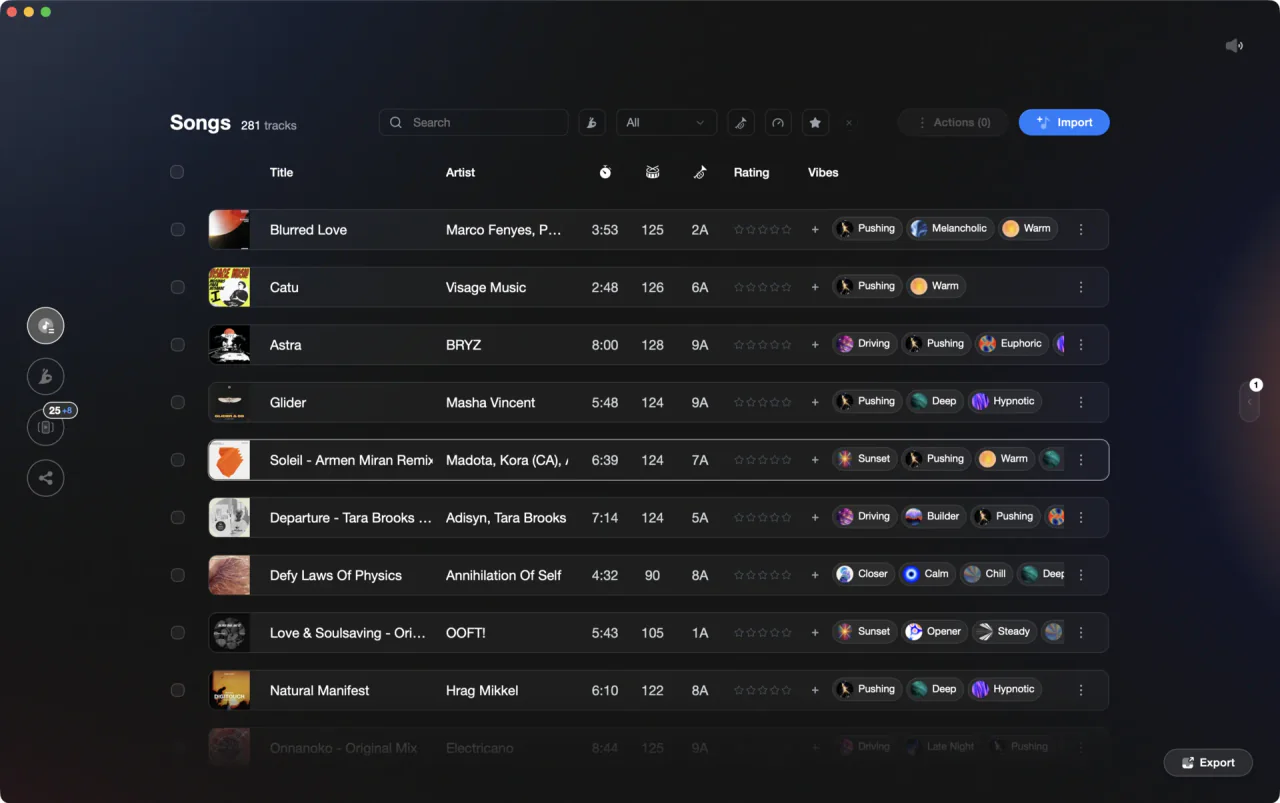
Vibes showing the detected key as a Camelot code next to BPM for every track.
Show Camelot key in Rekordbox, step by step.
Rekordbox keys come from its own track analysis, and the app can print them in two notations. Here is how to change key format in Rekordbox 7, get the Key column on screen, and switch on the highlight that marks the compatible tracks.
Analyze your tracks with KEY switched on
Rekordbox can only show a key it has detected. Click the settings icon in the upper right to open the Preferences window, select the Analysis category, open the Track Analysis tab, and tick [KEY] in Track Analysis Setting next to [BPM / Grid]. Close the window, right-click the tracks and choose [Analyze Track]. Tracks that were analyzed long ago can be re-analyzed the same way.
Switch Key display format to Alphanumeric
The rekordbox Camelot key settings live here. In the Preferences window, select the View category and open the Display Type tab. Set Key display format to [Alphanumeric], which prints codes such as 1A and 2A, rather than [Classic]. In Rekordbox change key to Camelot once and both the track list and the deck follow. There is no shortcut: the default rekordbox keyboard shortcuts cover Performance mode functions only.
Add the Key column to the track list
Codes only appear in the browser if the column is on the header. Right-click any column header at the top of the track list and the column list opens. Click [Key] to add it, then drag it left so it sits beside BPM and you can read both in one glance. That is all it takes to show key in Rekordbox.
Turn on the Traffic Light highlight
The rekordbox Traffic Light control sits in the browser panel. Switch it on and the app highlights the keys of tracks that are compatible with the key of the track on the selected deck, as long as the Key column is displayed. The range of keys it highlights is set in the Preferences window, View category, Display Type tab, under Traffic Light.
Filter the browser by key
Click the icon on the left of the search filter to open the track filter. It refines the list by [BPM], [KEY], [RATING], [COLOR] and My Tag. Tick [KEY], then turn on [MASTER PLAYER] or [MASTER DECK] and the filter takes its value from the track loaded on the master player, so the list narrows to that key while you play.
Know which key control does what
Two different things share the word key here. The format you just picked is a display setting and it does not touch the audio. If you want to change key in Rekordbox itself, use the semitone up and down buttons on a Performance mode deck, or the Key Sync button that matches one deck to the other. Double-click the readout to reset it.
The catch
Alphanumeric changes what Rekordbox prints, not what the analysis found. If you select [Display key information on the database], the key is shown exactly as it is recorded on the track instead, so a code another tool wrote into the tag stays in that tool's notation. And a Camelot code is only as good as the detection behind it, so re-analyze anything that looks wrong before you build a set on it.
The faster way
Camelot codes on every track, and the compatible ones already listed.
Vibes analyzes the files you own and shows the key in Camelot, musical or Open Key notation, next to BPM, an energy value and the track's sections. Find Compatible then does the wheel math for you: pick a track and it lists the harmonic neighbours inside a BPM window you set, half and double time aware. When you export a playlist back to Rekordbox, Vibes can build the folder tree with Camelot key sub-folders, so the grouping survives the trip.
See how it worksOrganize in Vibes, export to Rekordbox.
Your playlists, tags, ratings, and cue points travel back to the gear you play on, so nothing you do in Vibes is locked away.

Track 001
Artist A
Afterhours Mysterious
 Introspective
Track 002
Artist B
 Cozy FloorPeaceful
 Home
Home
Track 003
Artist C
Rave Aggressive
 Festival
 Build & Release
Frequently asked questions
The honest answers, including the trade-offs.
From a Vibes customer
The import worked perfectly. Have created several sets now and my life is so much easier
One-time purchase
Get Vibes with a single payment. No subscription.
Vibes is the step before you open your DJ software, not a replacement for it.
First 250 licenses at this price, then $79.
14 days • Full access
No strings attached
Secure checkout with Stripe
Already have Companion Pro? Upgrade instead

Methodology
How we keep this honest.

Verified against the app
Every step is checked against the current version of Rekordbox.
We own our bias
We make Vibes. We show the native way first and honestly, then where Vibes genuinely helps, and we say when it does not.
Live pricing
The Vibes price shown comes straight from our checkout, never a hardcoded marketing number.
Kept current
Last reviewed September 2026.
Keep exploring
Compare Vibes
DJ apps head to head
Works with your software
Vibes for DJs
Vibes features
How-to guides
Best DJ software
Move between apps
Learn to DJ