
Closing DJ Set
A closing set is the last slot of the night, and it is a planned walk down rather than a fade: hold the peak while the floor holds, release once, come down in stages, and finish on a record you chose before the gig. This is how to time each stage, read when the room is ready, and prepare the shortlist in your DJ app.
Quick Answer
What the closer is actually there to do
The closing set DJ takes over a room that is already warm, already loud, and already tired. Nobody needs to be convinced to dance. The job is not to raise the room, it is to spend the energy that is left in the right order, and to decide when the night is over rather than letting it drift to a stop. That is the opposite of the opening job, where you are building something that somebody else will cash in.
Closing the whole night
- You own the ending.
- Plan a real walk down and a final track.
- Expect the house lights, and expect the last 20 minutes to be a much smaller crowd than the peak.
- Finish before the room is empty, not after.
Handing over to another DJ
- -You are not closing anything.
- -Keep the energy where the next DJ can use it, stay in a tempo range they can mix out of, and do not play the biggest record you own on your last track.
The four stages of a close
Treating the ending as one long fade is what empties a room early. It is four stages, and only the last one is quiet.
| Stage | Roughly when | What it sounds like |
|---|---|---|
| Hold | Until the floor thins on its own | Peak material carried on. No new climb, no drop. You are keeping what the DJ before you built. |
| First release | The last 40 to 45 minutes | One deliberate step down in weight. Same tempo, less drum, more melody or vocal. |
| Comedown | The last 25 minutes | Tempo comes down a few beats per track. Familiar records, longer blends, less mixing trickery. |
| Goodnight | The last 8 to 10 minutes | One or two known records and the final track, played out rather than mixed out. |
Timings are for a 90 minute to two hour slot. In a 60 minute slot the hold stage almost disappears and the walk down starts around the 35 minute mark.
How to tell the room is ready for you to ease off
The single most common way to kill a night early is to start the first release because the clock said so. Read the floor instead. Any two of these together mean you can begin.
- The floor has visibly thinned, and the people leaving are not being replaced.
- The bar queue is gone and staff have started clearing glasses off the tables.
- The people still dancing are the same faces you saw an hour ago, in the same spots.
- A big record lands and the reaction is smaller than the last one you dropped.
- Coats are on. Once a third of the floor is holding a jacket, the night has decided.
Plan the close backwards
A DJ closing set is planned in reverse. Pick the final track first, then the two records that lead into it, then work backwards to where you expect the hold stage to end. Everything before that stays loose, because you do not know yet what the room will look like.
- 1
Confirm the slot and who follows you
Length, start time, and whether anyone plays after you. If there is a handover, ask the next DJ what tempo they open at. If there is not, ask the venue what time the lights go up. Both answers change the whole plan.
- 2
Choose the final track
One record, decided before you leave the house. It should be known to most of the room, singable or instantly recognizable, and it should end properly rather than loop forever.
- 3
Build the goodnight reserve
Three or four records that you would be happy to play in the last ten minutes, sitting in their own crate or playlist. This is the part DJs improvise, and improvising at the end of a long night is how a good set gets a bad ending.
- 4
Order the comedown by energy, not by BPM
Sort the shortlist so the energy descends step by step, then check that the tempo route works. Sorting by tempo first gives you a smooth sequence that goes nowhere. The ordering job itself is covered in DJ set energy levels.
- 5
Check the harmonic route through the last five
The final records are the ones people remember, so they are the ones worth checking key by key. Long blends at lower tempo expose a clashing key far more than a fast peak time cut does.
- 6
Add sideways spares at every stage
Two alternates per stage, same energy, different mood. If the room holds longer than you expected, you extend sideways instead of climbing back up.
- 7
Save it as a real crate or playlist
Not a temporary shortlist. Name it for the venue and the date so the same close is reusable, and so you can see afterward which records actually worked.
- 8
Decide how the last track ends
Let it play out to the end, cut it on the last beat, or ride a filter out. Decide which of the three it is now, because that is the decision that goes worst when it is made live.
Doing it inside your DJ app
Every major DJ app gives you the two things this needs: a saved crate or playlist for the walk down, and a column you can sort so the order is not held in your head. Build two lists, not one. The first is the comedown, in order. The second is the goodnight reserve, which stays short enough to read at a glance in a dark booth.
Whatever you use, keep the closing crate physically separate from the peak time crate. At the end of a long night the risk is not that you cannot find a record, it is that you reach into the wrong list and play a monster with 20 minutes left. For the wider prep routine, see how to prepare for a DJ gig.
Choosing the actual last track
There are three endings that work, and they are chosen by the room rather than by genre. A sing-along record leaves people talking on the way out and suits bars, weddings and mixed crowds. A long, melodic record played out in full suits a club floor that has been going for hours. A hard, sudden cut on a big drop suits a small crowd of people who came for the music and would rather leave on a shock than a hug.
What all three share: the last record is not mixed out of. Ending on a blend tells the room another track is coming, and then nothing comes, which is the flattest possible finish. Play it, let it end, and turn the music off before anyone asks whether it is over.
The faster way: sort the walk down instead of guessing it
The hard part is not knowing that energy should descend, it is knowing which of your records sit where. Vibes does that pass for you. Import Wizard pulls the library in from rekordbox, Serato, Traktor, Engine DJ, an Apple Music or iTunes Library.xml, or plain folders, and Smart Import detects which app it came from. Analysis gives every track its BPM, its key in Camelot, musical or Open Key notation, an energy curve, and the sections inside it: intro, buildup, drop, breakdown, outro.
From there the close builds itself. Set Designer sorts a selection by Energy Flow in descending order, which is exactly the shape a comedown needs, with key-path sorting when you want the harmonic route checked as well. Find Compatible pulls the Camelot neighbours inside a BPM window, half and double time aware, so the sideways spares at each stage are already picked. Auto-Tagging fills in vibes across the library, so a goodnight reserve is a filter rather than an evening of digging. When the order is right, export it back to rekordbox, Serato, Traktor or Engine DJ as a folder tree, with optional Camelot key or BPM sub-folders.
The visual way to organize your DJ library
Tag tracks by vibe. See everything at once. Export to rekordbox, Serato, Traktor or Engine DJ.
14-day free trial. Full access, no strings attached.
or see how it works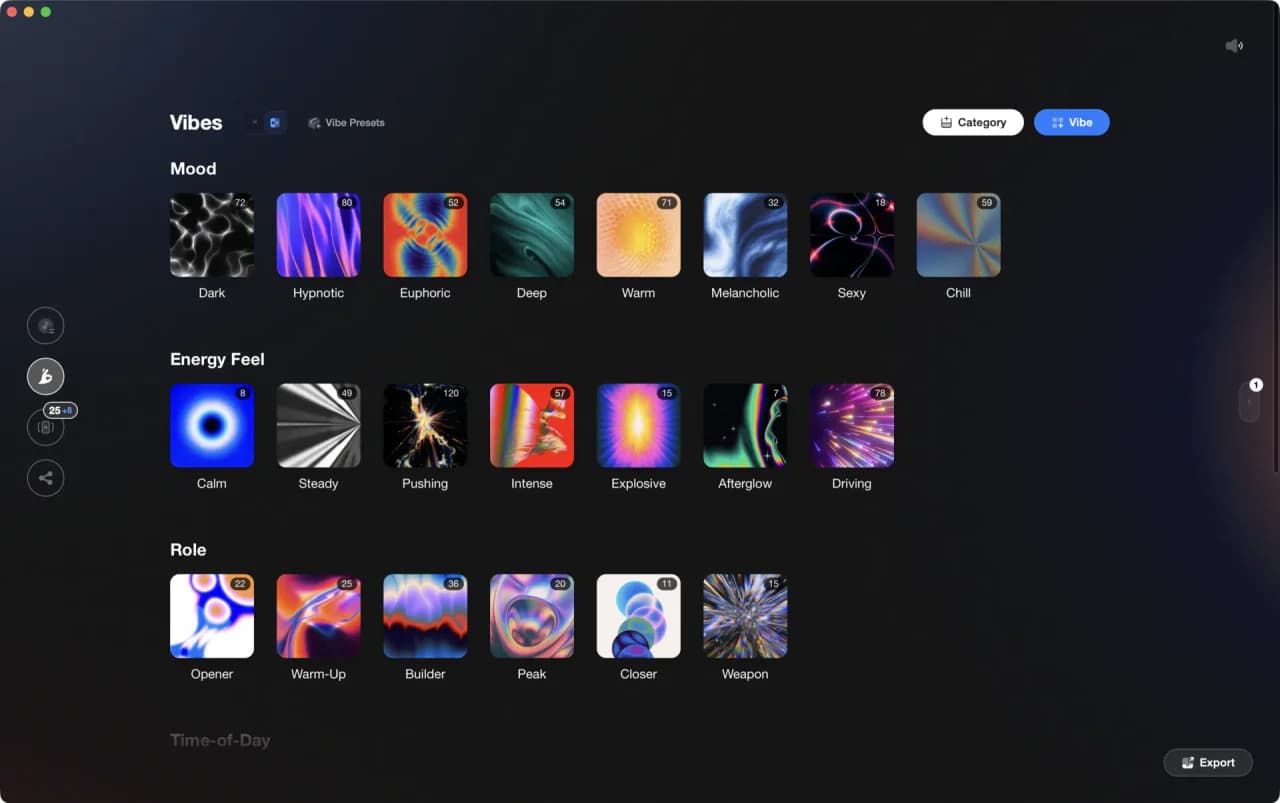
Frequently Asked Questions

Hey, it's Ben Modigell 👋
I DJ and produce as so I so: downtempo, minimal, dub house, tech house, and techno (releases on Spotify and SoundCloud, links above). Everything I write here comes from my own gigs, studio sessions, and library cleanups: the rules I follow, the failure modes I have actually hit, and the workflow I use when nobody is watching. If a technique did not earn its place in my own sets, it does not make it into a tutorial.