

Set cue points in Rekordbox.
To set cue points in Rekordbox, load the track in Export mode, play to the spot, and click an empty hot cue button, or set the cue point and click MEMORY. Hot cues jump and play instantly, memory cues are markers you cue up from, and both save to the track the moment you set them. Here is how to set, save, delete, and export them, and how to get structural cue points without placing each one by hand.
$49$79USD one-time purchase. First 250 licenses at this price. 14-day free trial.
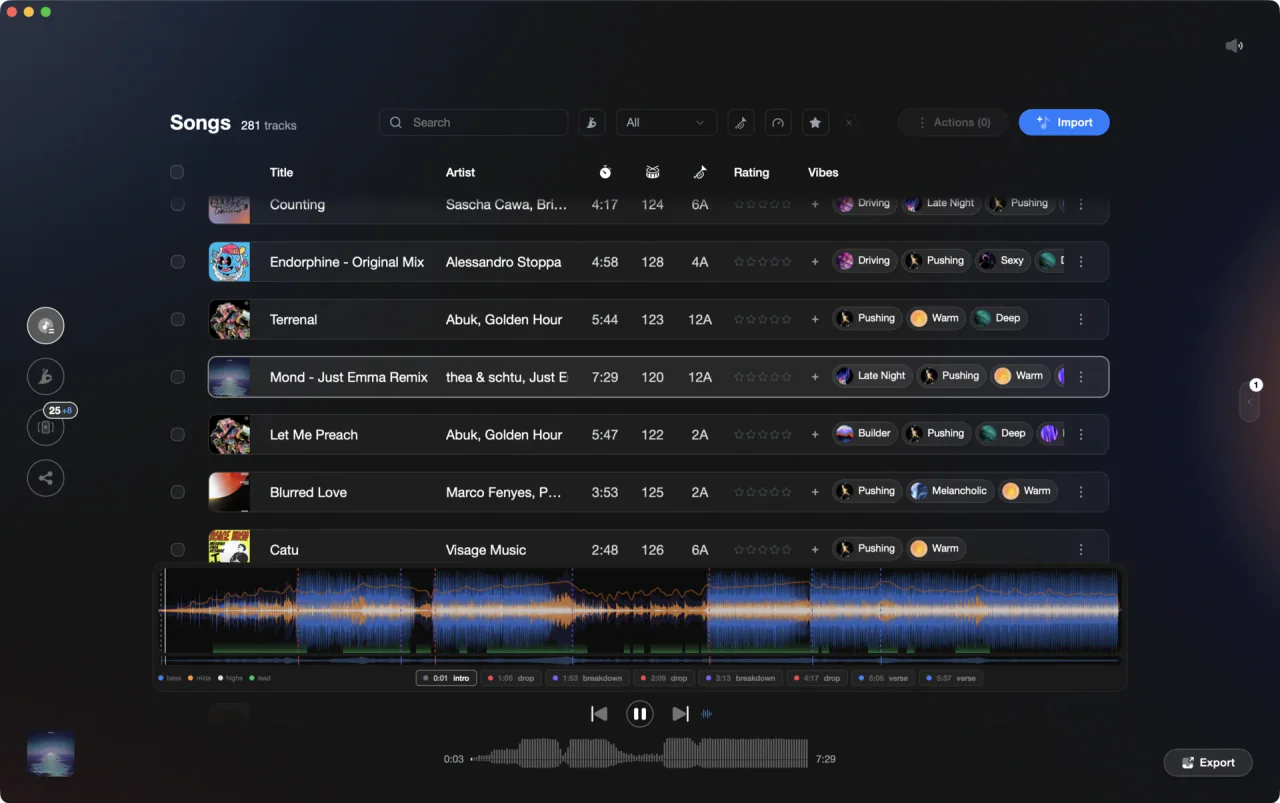
Mark the intro, the drop, and the outro on every track.
Setting cue points in Rekordbox.
Rekordbox gives you hot cues for instant jumps and memory cues as navigational markers. You set both by hand while you listen, or let the analysis place a first pass.
Know the difference
A hot cue jumps to a point and immediately plays from there. A memory cue is a saved marker: call it and playback jumps there and pauses, ready to start. Export mode gives you eight hot cues per track, labeled A through H, and those are the ones that travel to CDJs. Memory cues are capped at 10 per track in the software, and saved loops count toward the same 10.
Set hot cues in Rekordbox
Open Export mode and load the track into a player. Play or scrub to the spot, then click an empty A to H button in the HOT CUE panel of the sub-information panel, or in the CUE/LOOP function panel in the 1 PLAYER layout. To set hot cue points in Rekordbox more precisely, pause first, zoom the waveform, and move the playhead onto the beat before you click the button. With Quantize on, the hot cue snaps to the nearest beat of the grid.
Set memory cues in Rekordbox
Memory cues do not jump, they mark. Set the cue point first: pause and click CUE, or click IN during playback for a real-time cue. Then click MEMORY in the function panel. Each press adds a marker to the track's MEMORY panel, in position order, and a saved loop lands in the same list. The rule is simple: pad to set hot cue, MEMORY to set memory cue. Rekordbox writes both to the collection the moment you click.
Let Rekordbox place cue points automatically
Two options automatically set cue points in Rekordbox. Auto Cue, under Preferences > Controller > Deck in Performance mode, sets the initial cue point (the main CUE, not a hot cue) at the beginning of the track, where the audio first reaches the Auto Cue Level. Rekordbox 7 also has Intelligent Cue Creation, the CUE Analysis tab under Preferences > Analysis, which sets hot cues or memory cues while it analyzes a track: Auto mode works from phrase analysis and cue trend data, Manual mode places them from the 1.1 bars position at a fixed bar interval. It depends on your subscription plan. To set auto cue points in Rekordbox that way, turn Set CUE during analysis on before analyzing, and re-analyze tracks you imported earlier. Treat the result as a first pass and move any marker that lands off the phrase.
Save and check your cues
You do not need to save hot cues in Rekordbox by hand. Every cue writes to the collection database as soon as you set it, and it is there the next time the track loads. Setting a pad in Performance mode saves the same way, so you never save cue points in Rekordbox as a separate action. What is not automatic is a backup: File > Library > Backup Library keeps a copy of the cues along with everything else.
Color and name
Right-click a hot cue to change its color, and type a comment in its row of the HOT CUE panel, for example green for the intro and red for the drop, so the layout reads at a glance in the booth.
Export cue points to USB
In Export mode, connect the USB drive and drag a playlist or tracks from the collection onto the drive under Devices in the tree view. Hot cues, memory cues, and loops travel with each track, and colors and comments show on players that support them. Nothing separate is needed to export cue points in Rekordbox to a device: exporting the track exports its cues.
The catch
Even with Auto Cue and Intelligent Cue Creation, the markers that matter in a set, the drop, the breakdown, the bar where the vocal ends, are still placed one at a time, by ear, on every track. For a large library that is hours of repetitive work before the structure is usable. Analysis-based cues also follow the phrase analysis or a fixed bar count, so on tracks with loose or unusual structure they need checking anyway.
The faster way
Auto-detect the structure.
Vibes analyzes each track and marks the intro, buildup, drop, breakdown, and outro automatically, then exports those cue points back into Rekordbox so the layout is ready before you play.
See how it worksOrganize in Vibes, export to Rekordbox.
Your playlists, tags, ratings, and cue points travel back to the gear you play on, so nothing you do in Vibes is locked away.

Track 001
Artist A
Afterhours Mysterious
 Introspective
Track 002
Artist B
 Cozy FloorPeaceful
 Home
Home
Track 003
Artist C
Rave Aggressive
 Festival
 Build & Release
Frequently asked questions
The honest answers, including the trade-offs.
From a Vibes customer
The import worked perfectly. Have created several sets now and my life is so much easier
One-time purchase
Get Vibes with a single payment. No subscription.
Vibes is the step before you open your DJ software, not a replacement for it.
First 250 licenses at this price, then $79.
14 days • Full access
No strings attached
Secure checkout with Stripe
Already have Companion Pro? Upgrade instead

Methodology
How we keep this honest.

Verified against the app
Every step is checked against the current version of Rekordbox.
We own our bias
We make Vibes. We show the native way first and honestly, then where Vibes genuinely helps, and we say when it does not.
Live pricing
The Vibes price shown comes straight from our checkout, never a hardcoded marketing number.
Kept current
Last reviewed September 2026.
Keep exploring
DJ apps head to head
Works with your software
Vibes for DJs
Vibes features
How-to guides
Best DJ software
Move between apps
Learn to DJ