
How to Pick Songs for a DJ Set
Track selection for a set is a shortlist you build in your library before the gig, not a decision you make under pressure. This guide covers how many tracks to bring, what to open with, and how to order them by energy and key.
Quick Answer
Start from the slot, not from your favorites
A shortlist is only useful if it answers a real question. Before you touch the library, write down four things about the booking. Everything after this is filtering.
- Slot and length. A 60 minute opening slot and a 60 minute peak slot need almost no overlapping tracks.
- Room and crowd. Small bar, wedding floor, club at 1am: each tolerates a different amount of unfamiliar music.
- Tempo lane. Decide the band you will live in, for example 122 to 128 BPM, and treat anything outside it as a deliberate move.
- Who plays before and after you. Your last track should hand the next DJ something they can use.
The seven steps, inside your DJ app
Every app has the same three ingredients: a searchable library, a place to stage candidates, and columns for BPM, key and comments. The steps below work in rekordbox, Serato DJ Pro, Traktor, Engine DJ and VirtualDJ, because none of them depend on a feature unique to one app.
- 1
Create an empty prep playlist
Make one playlist or crate named for the gig and the date. Everything you consider goes in here, not into your permanent folders.
- 2
Filter to tracks you know
Sort by play count, rating or date added and pull in the tracks you have already played or rehearsed. Unknown music is a separate, smaller pile.
- 3
Overfill on purpose
Add about twice the number of tracks you can play in the slot. The surplus is what lets you change direction without panic.
- 4
Check BPM and key on every candidate
Analyze anything new, then fix the obvious analysis errors by hand. A wrong BPM in the shortlist becomes a wrong decision at the worst moment.
- 5
Group by energy, not by genre
Split the shortlist into three buckets: warm-up, cruise and peak. Most DJ apps let you record this in a rating, a color or the comments field.
- 6
Order inside each bucket by key
Within a bucket, put harmonically related tracks next to each other so any of the neighbours is a usable next track. The Camelot wheel tool shows which codes sit next to each other.
- 7
Mark the anchors
Flag one opener, two or three tracks that always work, and one exit track. These are the ones you fall back on when the floor does something you did not expect.
- 8
Rehearse the risky joins
Play the three transitions you are least sure about at home. Any join that needs luck gets cut or gets a cue point.
How many tracks to bring
At an average of four minutes per track you play about 15 tracks an hour, less if you let tracks run long, more if you cut every one short. Bring double, because a shortlist with no slack forces you to play the wrong track.
| Set length | Tracks you play | Shortlist to prepare |
|---|---|---|
| 30 minutes | 7 to 9 | 15 to 20 |
| 1 hour | 14 to 18 | 30 to 40 |
| 2 hours | 28 to 35 | 60 to 70 |
| 4 hours | 55 to 70 | 110 to 140 |
Rough counts at an average of four minutes of playing time per track.
Longer bookings change the shape as well as the count. A four hour booking is really three sets in a row, so prepare it as a warm-up block, a peak block and a closing block rather than one long list. How many songs for a DJ set works through the per-slot math in more detail.
Order the shortlist: energy first, key second
Energy decides where a track can go in the set. Key decides which of the tracks in that spot mixes cleanly. Doing it the other way round produces a set that is harmonically perfect and emotionally flat.
- Give every track an energy value from 1 to 10 based on how hard it hits, not on its tempo.
- Lay the values out as a curve: a slow rise, a plateau, one or two dips that let the room breathe, then the peak.
- Inside each step of the curve, sort by key so the neighbouring codes sit together.
- Leave one deliberate reset per hour: a track that drops the energy on purpose so you have somewhere to climb from.
If the curve idea is new, energy-based mixing covers the reasoning, and how to build a set by energy covers the ordering in practice.
Openers, peaks and exits
Three positions in a set carry most of the risk. Choose those tracks first, then fill the space between them.
Opening track
- Familiar to you, not necessarily to the room.
- Steady groove, no big drop, sits at the bottom of your tempo lane.
- It buys you three or four minutes to hear the room and the system before you commit to a direction.
Peak track
- -The one you would be annoyed to leave unplayed.
- -Highest energy value in the shortlist, a clear structure you can mix out of, and at least two prepared follow-ups so the moment after the peak is not a guess.
The exit matters as much. Pick a closing track that lands softer than the peak and ends cleanly, so the handover does not sound like the power went out.
Selection mistakes that show up in the shortlist
- Playing tracks you have never heard all the way through. You cannot plan around a breakdown you did not know was there.
- A shortlist with one energy level. Everything peaks, so nothing does.
- Trusting the analysis blindly. Half-time and double-time detection errors put unmixable tracks next to each other.
- Preparing on a laptop and playing from a USB drive you exported last month. Export again after the shortlist is final.
- No exit plan. When the floor rejects a track, you need the next choice already flagged, not a search box.
Where Vibes fits
The manual version of this works. It just takes an evening per gig, and most of that evening goes into judging BPM, key and energy one track at a time. Vibes does that part on the files you already own.
- Analysis gives you BPM, key in Camelot, musical or Open Key display, an energy curve and the track sections, so the three values you sort by are already there.
- Find Compatible returns the harmonic Camelot neighbours inside a BPM window you set, and it is half-time and double-time aware, which is the step people get wrong by hand.
- Set Designer sorts a shortlist by Energy Flow, ascending, descending or as an arc, and can sort by key path instead.
- The finished list exports back to rekordbox, Serato, Traktor or Engine DJ as a folder tree, with optional Camelot key or BPM sub-folders.
What it does not do: it is not a DJ app. There are no decks, no mixing and no recording, it does not play to your hardware, and it works on files you own rather than streaming libraries. The playing still happens in your DJ app, which is why the export step exists.
Continue readingSet DesignerOrder a shortlist by energy flow or key path, then export it to your DJ app.The visual way to organize your DJ library
Tag tracks by vibe. See everything at once. Export to rekordbox, Serato, Traktor or Engine DJ.
14-day free trial. Full access, no strings attached.
or see how it works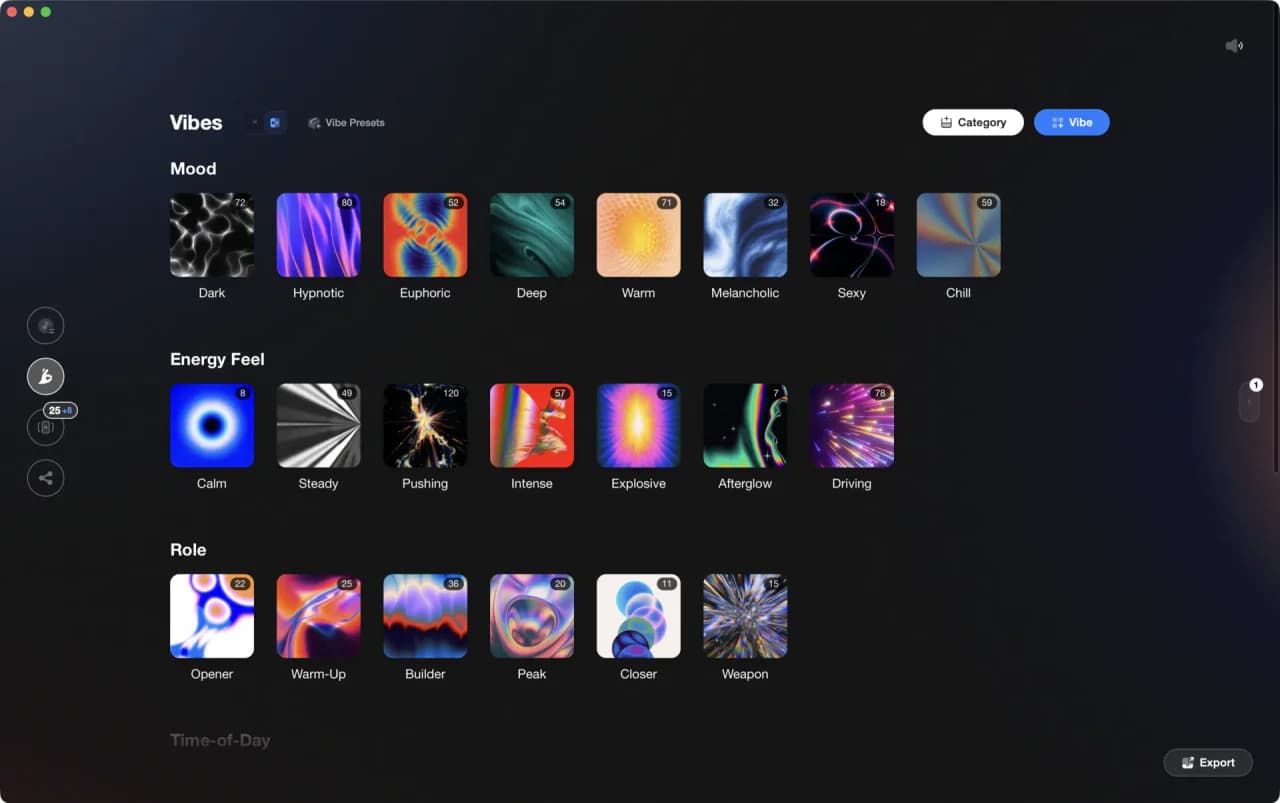
Frequently Asked Questions

Hey, it's Ben Modigell 👋
I DJ and produce as so I so: downtempo, minimal, dub house, tech house, and techno (releases on Spotify and SoundCloud, links above). Everything I write here comes from my own gigs, studio sessions, and library cleanups: the rules I follow, the failure modes I have actually hit, and the workflow I use when nobody is watching. If a technique did not earn its place in my own sets, it does not make it into a tutorial.