Energy-Based Mixing
Energy-Based Mixing is the DJ technique of selecting and sequencing tracks by intensity, tension, and release so a set feels intentional from start to finish.
Energy-Based Mixing Tutorials

Virtual DJ Library Setup That Sticks
Energy-Based Mixing is for DJs who want sets to feel like a journey instead of a stack of unrelated transitions. The core idea is simple: choose and sequence tracks by perceived intensity, tension, and release, not just by BPM or key. When Energy-Based Mixing clicks, you stop asking only, "Can these tracks mix?" and start asking, "What does the room need next?"
This technique matters because smooth technical mixing is only part of what people remember. They remember lift, suspense, payoff, and timing. Energy-Based Mixing helps you create those moments by controlling density, vocal presence, groove pressure, breakdown size, and how hard each drop lands.
If you can already lock in reliable beat matching first and learn phrase mixing for cleaner rises and resets, this is the next layer. It turns track selection into performance control.
What Is Energy-Based Mixing?
Energy-Based Mixing is the practice of arranging and blending tracks so the emotional and physical intensity of a DJ set rises, holds, dips, and peaks on purpose. It uses crowd psychology, track structure, and selective contrast to shape momentum across minutes, not just single transitions.
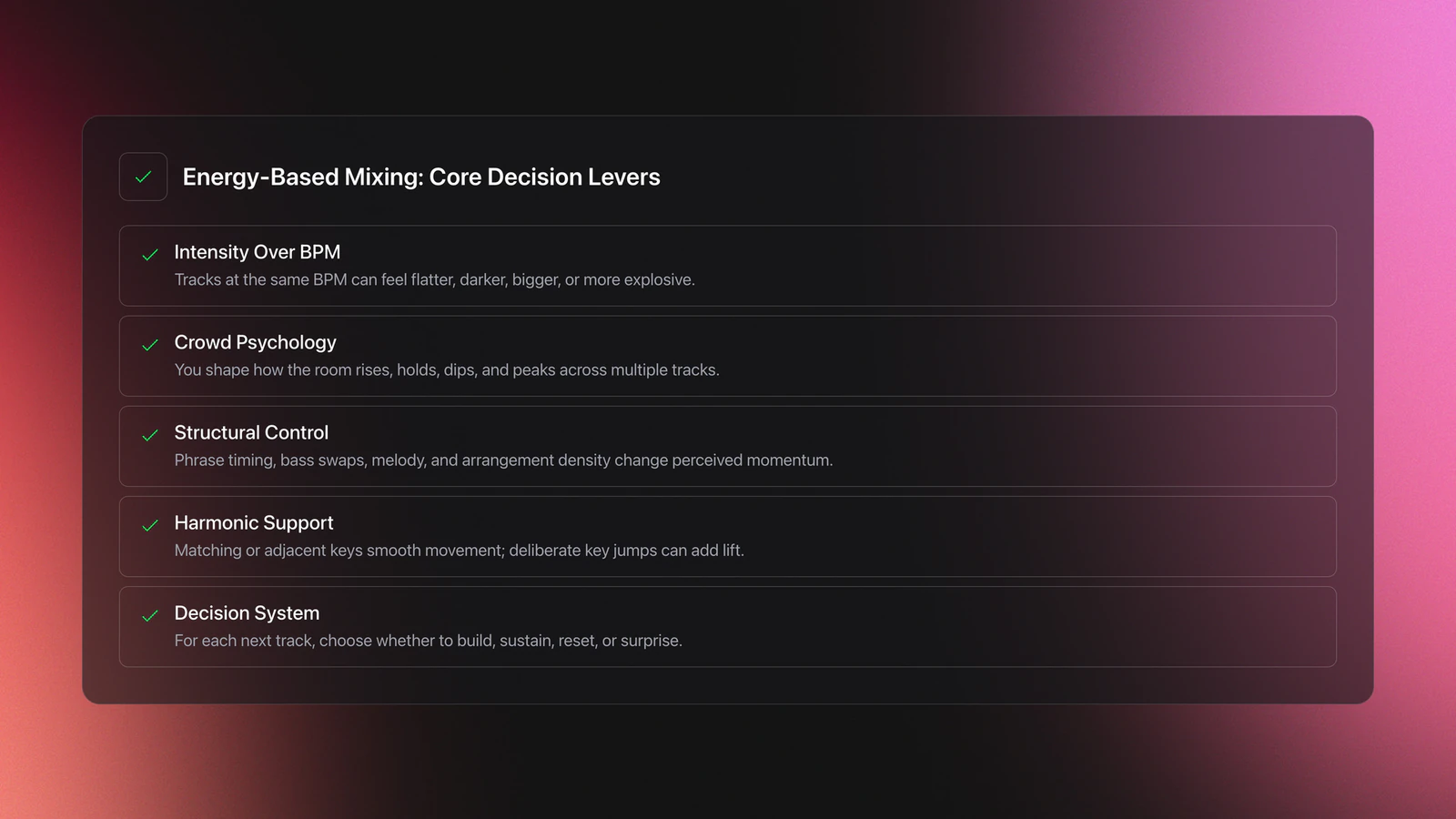
In other words, you are mixing the room as much as the records. A track with the same BPM as the current one can still feel flatter, darker, bigger, tighter, or more explosive.
That is why BPM alone is not enough. Harmonic compatibility can help, and resources like the Mixed In Key harmonic mixing guide and the DJ.Studio compatible keys tutorial explain how adjacent or matching keys often support smoother movement, while techniques such as Camelot wheel jumps can create a deliberate lift in intensity.
Professional teaching around genre-specific mixing also points to phrase timing, bass swaps, and the role of melody in shaping tension. The Pioneer DJ mixing techniques guide shows that different genres manage groove, layering, and release in distinct ways, which is central to energy control.
So the technique is not a fixed formula. It is a decision system. You evaluate what the current track is doing, predict the effect of the next one, and choose whether to build, sustain, reset, or surprise.
Why DJs Use Energy-Based Mixing
DJs use Energy-Based Mixing because it makes sets feel intentional. Instead of staying at one intensity level, you control pacing so the crowd gets movement, contrast, and payoff.
- Build tension before a peak instead of peaking too early
- Avoid flat stretches where every track hits with the same force
- Recover smoothly after a big moment without killing the room
- Adapt to crowd response with more precision than BPM matching alone
- Create memorable arcs in warm-up, peak-time, and closing sets
This also explains why energy-based DJs often sort music by more than genre. They think in terms like warm-up roller, pressure builder, vocal release, reset tool, or peak hammer. Those labels are practical because they describe function.
How to Do Energy-Based Mixing
To do Energy-Based Mixing well, identify the current track's role, choose the next track's intended effect, and time the transition so the change feels earned. The goal is not constant escalation. The goal is controlled movement.
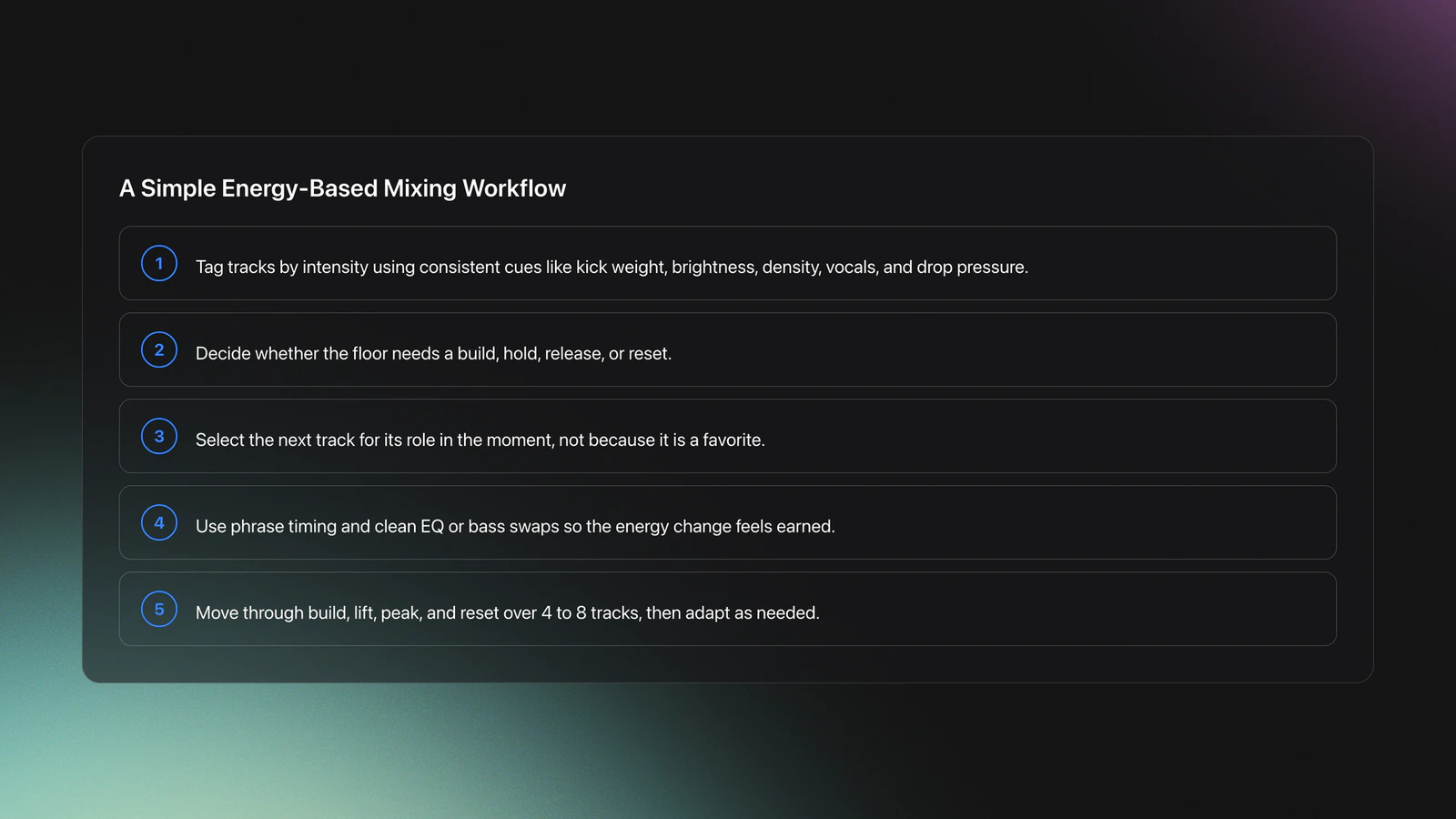
Start by rating your tracks for perceived intensity. Use a simple 1 to 5 scale, or tags such as low, medium, high, and peak. Keep the criteria consistent. Judge kick weight, brightness, arrangement density, vocal urgency, and how crowded the drop feels.
Next, decide what the room needs. There are usually four options: build, hold, release, or reset. A build adds pressure. A hold keeps dancers locked. A release opens space after tension. A reset reduces overload so the next peak lands harder.
Then choose tracks by role, not title. One record may be technically strong but still wrong for the moment. Energy-Based Mixing improves when you stop thinking of songs as favorites and start thinking of them as tools.
Phrase timing matters here. Bring in a higher-energy record too early and you waste the payoff. Bring it in too late and the room may drift. This is where shape transitions with controlled EQ mixing becomes useful, because clean bass swaps preserve momentum while the new track takes over.
Key can support the effect. The DJ TechTools advanced key mixing article and the Mixed In Key harmonic mixing guide both describe how certain key relationships can create a subtle or stronger lift. That does not mean every energetic transition must be harmonic. It means key is one more lever.
Software can help too. The Serato Pitch 'n Time DJ documentation explains key shifting and key sync tools that can make harmonically sound transitions easier when you need to preserve color while changing intensity.
A simple working sequence is: low pressure to groove builder, groove builder to recognisable hook, hook to heavier drop, then a short relief moment before the next climb. In practice, that may span 4 to 8 tracks.
| Stage | What You Play | What It Does |
|---|---|---|
| Build | Sparser groove with forward movement | Creates expectation without spending the peak |
| Lift | Brighter or denser track with more tension | Raises urgency and dance-floor focus |
| Peak | Largest payoff track or sequence | Delivers the emotional or physical release |
| Reset | Less crowded arrangement or lower-intensity groove | Prevents fatigue and sets up the next rise |
That pattern is not a rule. It is a scaffold. As your judgment improves, you can shorten it, stretch it, or break it on purpose.
Equipment and Library Setup
The equipment needs are basic, but the library setup matters a lot. You need cueing headphones, stable beatmatching tools, and enough tracks in each energy band to make real choices instead of forcing a jump.
For most DJs, the hidden problem is not transition skill. It is poor classification. If every folder is just genre and date added, Energy-Based Mixing becomes guesswork under pressure.
This is one place where Vibes fits naturally. If you organize local tracks into categories such as warm-up, pressure, vocal release, peak-time, and reset, you can rehearse energy decisions instead of searching blindly mid-mix.
A useful setup includes BPM, key, and one custom field for perceived energy or function. If you also use harmonic mixing to support energy lifts, your choices become faster because you are narrowing by both mood and compatibility.
Practice Drills for Energy-Based Mixing
The fastest way to improve Energy-Based Mixing is to practice short sequences with one clear energy goal. Do not free-mix for an hour and hope the lesson appears.
In practice, short, repeatable drills improved set control faster than marathon sessions. The key was tracking one variable at a time across 2 to 4 week cycles.
Drill one is the three-track arc. Pick one builder, one peak, and one reset. Mix them in order. Then reverse the process with different tracks until you can hear why one sequence feels natural and another feels rushed.
Drill two is the hold drill. Choose three tracks that all feel medium-high energy, then keep the floor locked for 10 minutes without noticeably dropping pressure. This teaches control, not escalation.
Drill three is the fake peak drill. Use a breakdown-heavy track that suggests a huge drop, then follow it with a groove tool rather than the biggest record in your crate. This shows whether you can delay payoff without losing trust.
Drill four is the harmonic lift drill. Test same-key, adjacent-key, and intentional energy-boost transitions, using examples from the DJ TechTools advanced key mixing article. Listen for when the lift feels exciting and when it feels forced.
For organized practice, Vibes can help you build small training crates by function rather than by event. That makes it easier to repeat the same exercise with new combinations and measure whether your sequencing decisions are getting sharper.
Common Mistakes in Energy-Based Mixing
Most Energy-Based Mixing mistakes come from misreading contrast. Beginners often assume louder, brighter, or faster always means better. It does not.
| Mistake | Why It Happens | Fix |
|---|---|---|
| Peaking too early | The DJ spends the biggest track before enough tension exists | Use at least one builder before the first major payoff |
| No reset moments | Every transition pushes harder, so the room gets fatigued | Insert a groove-focused or sparser track after a peak |
| Confusing BPM with energy | A faster track is assumed to feel bigger | Judge density, arrangement, brightness, and vocal impact too |
| Forcing harmonic rules | The DJ chooses key over context | Trust your ears and choose function first, compatibility second |
Another common issue is overlong blending. A long overlap can flatten the impact of a strong incoming record, especially if both tracks are dense. Sometimes the best energy move is a cleaner, shorter handoff.
Why do most beginners struggle here? Because they practice transitions in isolation. Energy-Based Mixing only makes sense when you judge several records as one connected shape.
Troubleshooting Flat or Chaotic Sets
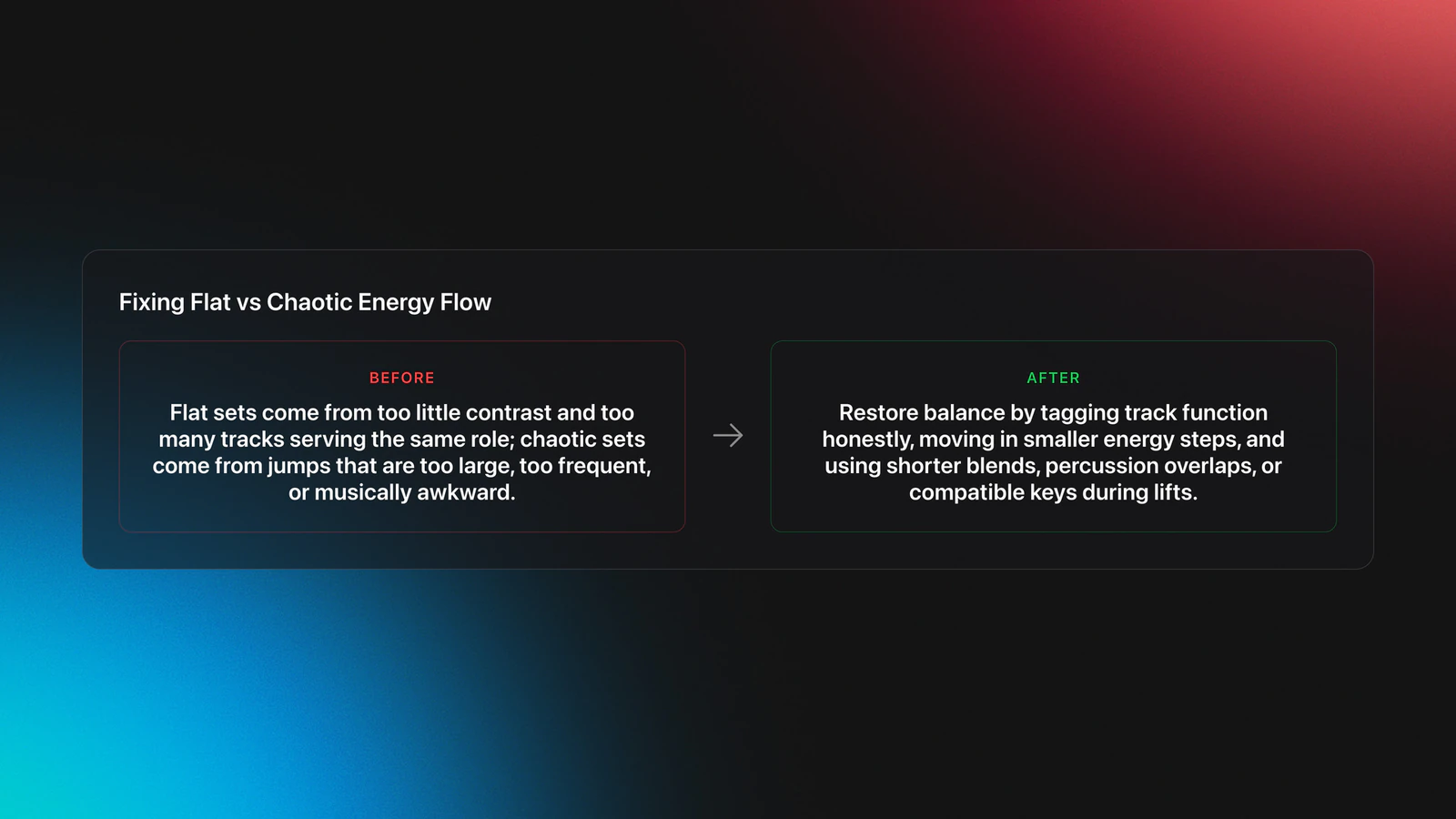
If your sets feel flat, you probably need more contrast. If they feel chaotic, you probably need more continuity. Energy-Based Mixing is the balance between those two forces.
A flat set usually means too many tracks share the same role. Fix that by tagging function more honestly. If every record is marked peak, none of them are.
A chaotic set usually means your jumps are too large or too frequent. Tighten the path. Move from low to medium, medium to high, then high to peak. Let the room feel the staircase.
If transitions sound musically awkward during lifts, test a shorter blend, a percussion-only overlap, or a compatible key move. The DJ.Studio compatible keys tutorial and Serato Pitch 'n Time DJ documentation both point to practical ways DJs reduce clashes while preserving movement.
If you want more dramatic control after the basics feel stable, explore power block mixing once your flow is stable. It is a more aggressive form of sequencing and contrast.
Safety and Monitoring
Safe monitoring matters because energy judgment gets worse when your ears are fatigued. The CDC notes that NIOSH recommends limiting occupational exposure to 85 dBA over an 8-hour day, and hearing damage risk increases with louder and longer exposure.
That matters for DJs because club booths, headphones, and long practice sessions can push volume high. The CDC NIOSH noise and hearing guidance recommends precautions at or above 85 dBA, and official OSHA guidance uses the same level as a hearing-conservation trigger in workplaces.
Use isolating earplugs, keep booth monitors as low as workable, and avoid turning headphones up to fight room noise. Better hearing leads to better decisions.
How Long Does Energy-Based Mixing Take to Learn?
Most DJs can learn the basics of Energy-Based Mixing in 2 to 4 weeks of focused practice, but strong live judgment takes longer. The technical side develops first. The crowd-reading side develops through repetition.
A realistic first milestone is hearing the difference between a build track and a peak track without looking at labels. The next is sequencing 4 to 6 records so the set rises and resets on purpose.
After that, the progression becomes clearer. You start combining function, phrasing, and key choice into one decision instead of treating them as separate tasks.
Energy management across a full set
Energy management in a DJ set is the same decision system stretched across an entire slot. One build, lift, peak, reset arc covers 4 to 8 tracks. A full hour holds several of those arcs, and the set only works if they add up to one shape: where the room starts, where the biggest peak lands, and how the night resolves.
Place peaks late enough to be earned. Peaking in the first 20 minutes leaves the room nowhere to go, so save at least two clear peak records for the later phases of your slot and add a bridge or reset roughly every three to five tracks to keep contrast alive.
Treat dips as part of the design, not as failures. A controlled valley is preparation for the next lift: reduce density while keeping the pulse, hold the groove for a track or two, and the following rise feels bigger for it. If a selection misses, steer back within the next two records. Sets rarely fail because of one bad choice. They fail when the DJ cannot recover.
The right energy also depends on the job. A warm-up set should prepare the room, not dominate it, so learn warm-up DJing discipline if restraint is a weak spot. A peak-time slot supports bigger waves and faster payoffs. Long or closing sets need more patience and deeper emotional release, because relentless pressure turns one-dimensional over hours.
Two extra roles matter at set scale: bridges, which link two moods or subgenres through a shared rhythm feel, and closers, which end the night with a purposeful final statement. Roles also shift with the clock. The same rolling track can act as a lift at 10:30 PM and a reset at 1:30 AM. So plan direction, not an exact sequence: if the plan stops fitting the room, change the tracks but keep knowing whether you are building, holding, or resetting.
Energy-Based Mixing Summary
Energy-Based Mixing gives your DJ sets shape. Instead of relying on BPM or taste alone, you control how tension builds, when release hits, and how the room recovers for the next push. That is what makes a set feel guided rather than random.
Key takeaways:
- Rate tracks by function, not just genre or BPM
- Use build, hold, peak, and reset as practical sequence roles
- Practice short arcs repeatedly until the pacing feels intentional
Start with a three-track arc today: one builder, one payoff, one reset. Once that feels natural, combine it with use harmonic mixing to support energy lifts or shape transitions with controlled EQ mixing for more precision.
The visual way to organize your DJ library
Tag tracks by vibe. See everything at once. Export to any DJ software.
14-day free trial. Full access, no strings attached.
or see how it works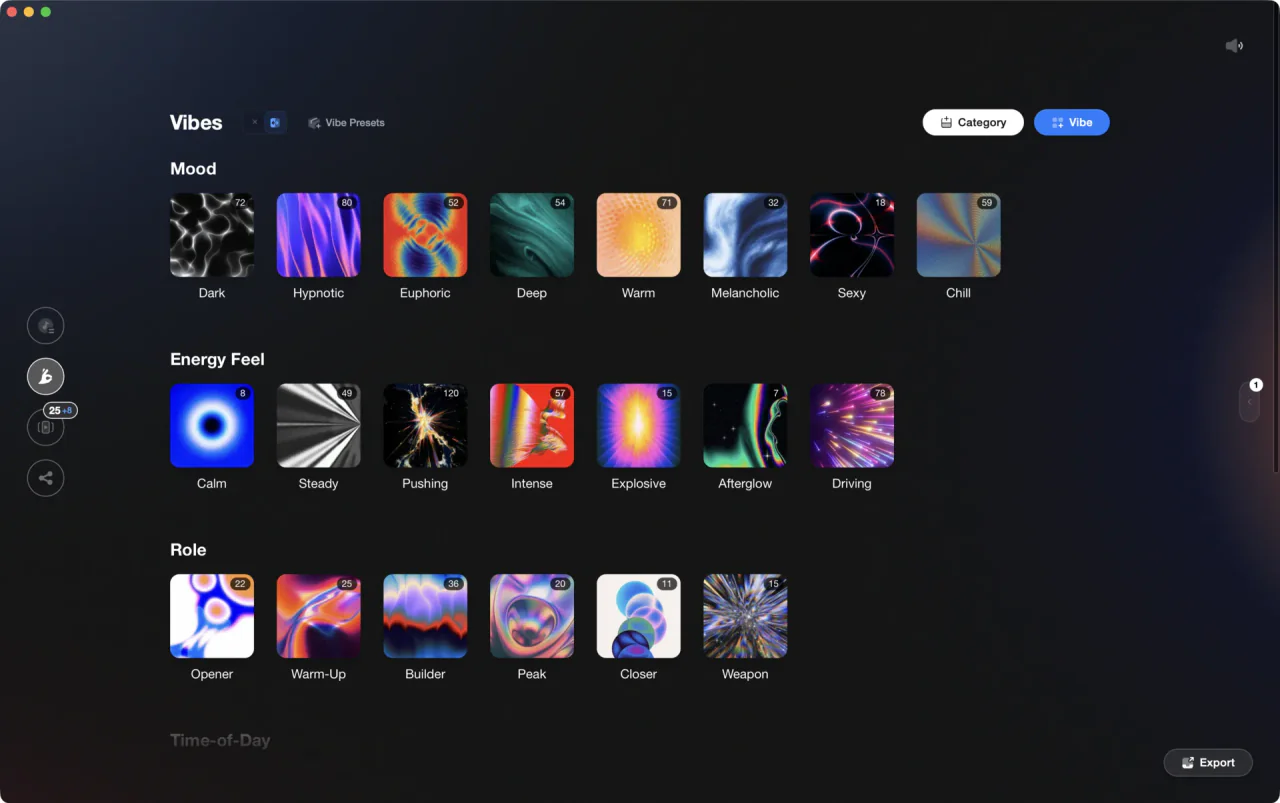
Equipment You'll Need
VirtualDJ
optionalDJ software for Windows and macOS that handles audio mixing, video mixing, karaoke, stems, and broad hardware support.
Serato DJ Pro
optionalProfessional DJ software for mixing, performance, library management, recording, and hardware-integrated club workflows.
Mixed In Key 11
optionalStandalone harmonic-mixing and library-prep software that detects keys, energy levels, cue points, and tags for DJ sets.
rekordbox DJ
optionalCloud-connected DJ software for music management, performance, export prep, and club-standard hardware integration.
AlphaTheta rekordbox
optionalProfessional DJ software for library management, USB export, cloud sync, and live performance tightly integrated with Pioneer DJ/AlphaTheta hardware.
VirtualDJ 7
optionalA legacy DJ software platform for audio and video mixing, controller mapping, and DVS playback on Windows and Mac.
Frequently Asked Questions

Hey, it's Ben Modigell 👋
I DJ and produce as so I so: downtempo, minimal, dub house, tech house, and techno (releases on Spotify and SoundCloud, links above). Everything I write here comes from my own gigs, studio sessions, and library cleanups: the rules I follow, the failure modes I have actually hit, and the workflow I use when nobody is watching. If a technique did not earn its place in my own sets, it does not make it into a tutorial.