Energy Analysis
Energy analysis helps DJs judge and organize how intense, driving, or spacious tracks feel so sets rise, settle, and peak with control.
Energy Analysis Tutorials

Energy Analysis is the DJ practice of judging how intense a track feels, then using that judgment to shape the rise and fall of a set. If you have ever played two technically compatible tracks that still felt wrong together, energy analysis is usually the missing layer. It helps you choose not just what mixes, but what moves the room in the right direction.
For beginners, Energy Analysis gives structure to track selection. For experienced DJs, it sharpens pacing, recovery, tension, and release. You stop thinking only in BPM or key and start hearing momentum, density, lift, and emotional weight.
That matters because tempo alone does not define intensity. Digital DJ Tips notes that software-based dancefloor energy scoring is not necessarily tied to BPM, and DJ TechTools makes the same broader point from the performance side: a track's true effect depends on context, structure, and how it lands on the floor. Educational resources like Digital DJ Tips breakdown of dancefloor energy analysis and the DJ TechTools guide on organizing playlists by energy both support treating energy as a practical decision layer, not a fixed truth.
What Is Energy Analysis?
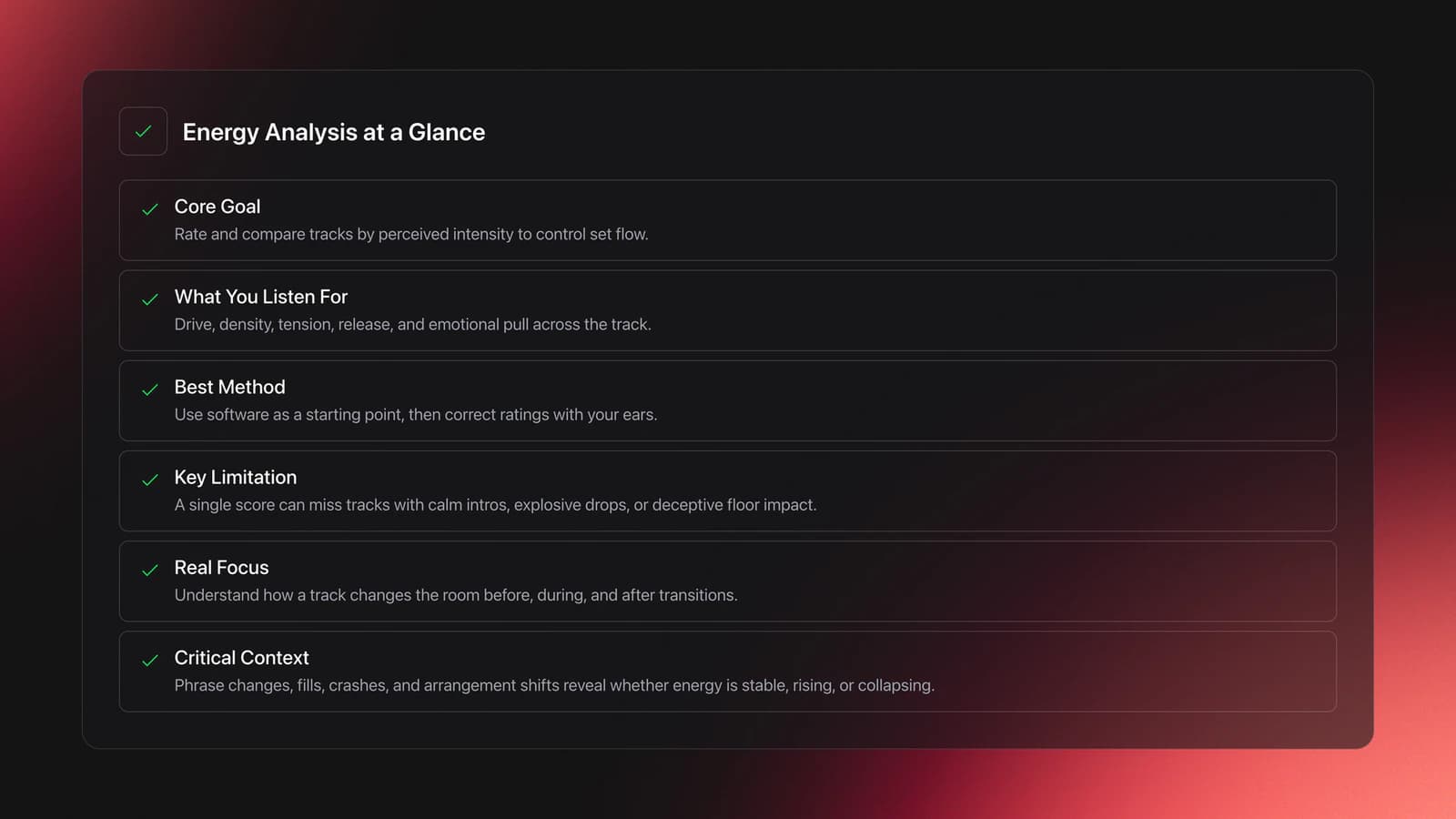
Energy Analysis is the process of rating and comparing tracks by perceived intensity so you can control set flow. In practice, you listen for drive, density, tension, release, and emotional pull, then sort music by how it behaves before, during, and after transitions.
Some DJs do this manually. Others use software that writes an energy field into track metadata. Mixed In Key has long offered energy ratings, and Lexicon documents an Energy field based on audio scanning, but both sources also imply a limit: analysis is useful for sorting, not a replacement for knowing your music.
This is why Energy Analysis works best as a hybrid method. Let software suggest a starting point, then correct it with your ears. A track with a calm intro and explosive drop may confuse a simple score, while a hypnotic roller may feel stronger on a real floor than its waveform suggests.
In other words, Energy Analysis is less about labeling songs as high or low forever. It is about understanding how each track changes the room.
To make that judgment more accurate, you also need section awareness. Phrasing guides from Crossfader phrasing tutorial and the DJ TechTools guide to phrasing both stress that tracks reveal change through phrases, fills, crashes, and arrangement shifts. Those same signals are what make energy feel stable, rising, or collapsing.
Why Energy Analysis Matters
Energy Analysis matters because it turns track selection into intentional programming. Instead of guessing what should come next, you create a clearer path between warm-up, lift, peak, reset, and rebuild.
That improves more than smoothness. It improves confidence. When your library is energy-tagged well, you can recover faster after a risky transition, build pressure across several tracks, or ease a room down without sounding like you lost direction.
- It helps you raise intensity without sudden, awkward jumps.
- It makes resets and breathers feel intentional, not accidental.
- It improves freestyle track choice under live pressure.
- It gives your library structure beyond genre, BPM, and key.
- It supports better mini-set planning and recovery options.
Experienced practitioners typically find that Energy Analysis becomes most useful in open-format and longer club sets. Genre labels get you close, but energy tags help you move between records that share function rather than style.
Equipment and Metadata Setup
You do not need special gear to start Energy Analysis. You need a sortable library, reliable monitoring, and a simple rating system you will actually maintain.
A practical setup is one library field for energy, one field for notes, and playlists or crates that group tracks by function. Serato's Serato Smart Crates support article shows how rule-based crates can auto-update from library tags. Rekordbox and similar platforms also support tag-based browsing, which makes this technique easier to use in performance.
If you want software help, Mixed In Key and Lexicon can provide energy values. The Lexicon analyzer documentation explains that its energy system is absolute-based and may not always reflect structure correctly. That is a useful reminder: automated analysis saves time, but manual correction is still standard practice.
This is one area where Vibes can fit naturally. If you build categories such as Warm-Up, Steady Drive, Lift, Peak, and Reset, you create a repeatable practice library instead of a vague pile of tracks. That makes drills faster because you can compare records that serve the same function across genres.
How to Do Energy Analysis
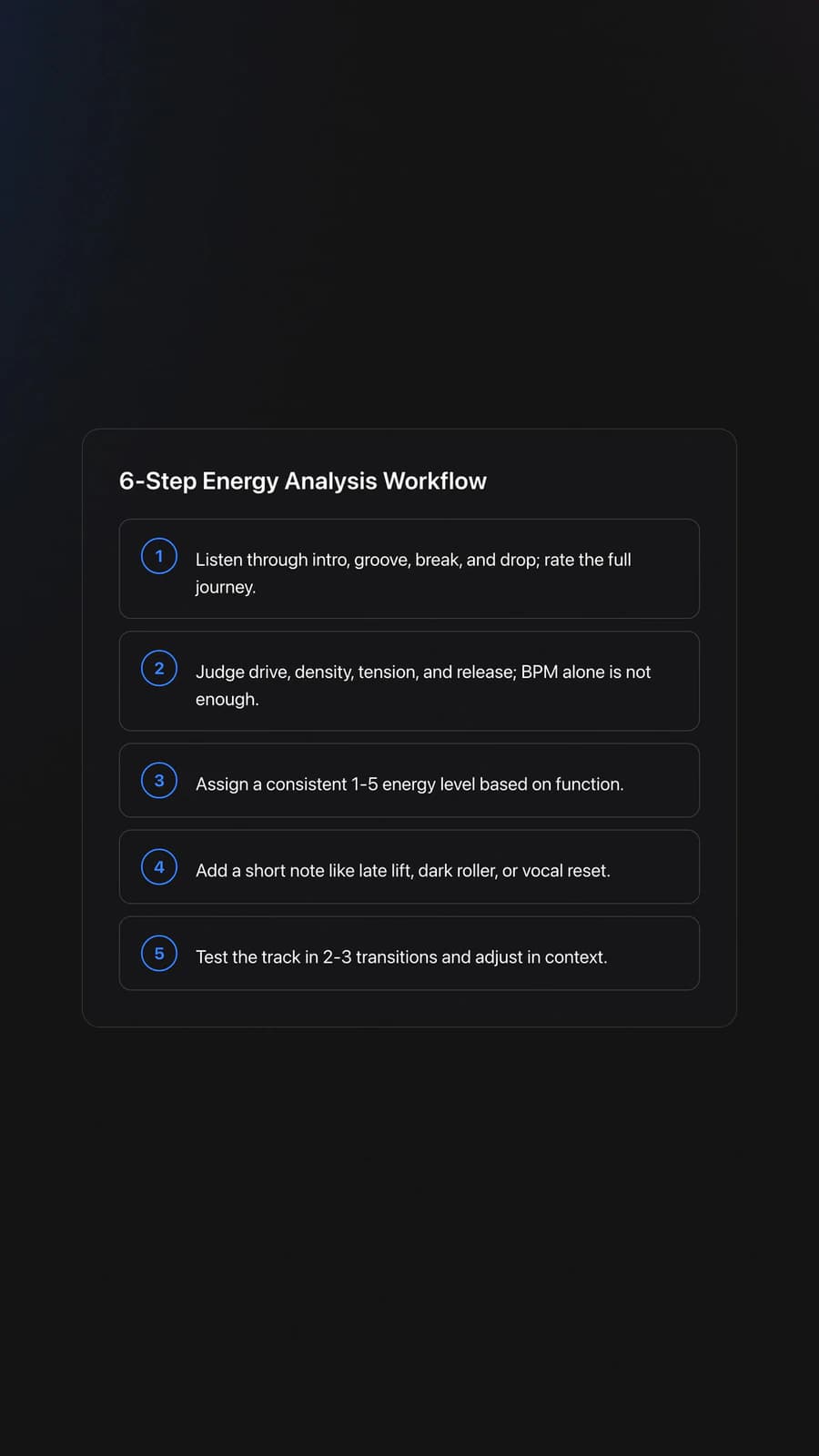
The fastest way to do Energy Analysis is to rate tracks by function, not by personal love for the song. Ask one question first: what does this track do to momentum when played at the right moment?
Start with a five-level system if you are new. Level 1 is spacious or ambient. Level 2 is warm-up. Level 3 is steady and danceable. Level 4 lifts the room. Level 5 is peak-time pressure. A ten-level system can come later, but five levels are easier to hear consistently.
| Step | Action | Key Point |
|---|---|---|
| 1 | Listen through intro, groove, break, and drop | Rate the whole journey, not one moment |
| 2 | Judge drive, density, tension, and release | BPM alone is not the answer |
| 3 | Assign a simple energy level | Use the same scale every time |
| 4 | Add a short functional note | Example: late lift, vocal reset, dark roller |
| 5 | Test it in two or three transitions | Adjust after hearing it in context |
| 6 | Group similar tracks into crates or playlists | Make live selection faster |
Next, separate absolute energy from transition energy. A track may be a Level 3 on its own but act like a lift if it follows something sparse. Another may be a strong Level 4 record that kills momentum because its intro strips too much percussion.
This is where learn phrase mixing structure becomes essential. You are not only rating tracks. You are rating where their energy changes happen and whether those changes line up well with the outgoing record.
Keep your notes brief. One or two words are enough. Try tags like rolling, euphoric, percussive, hands-up, moody, vocal-heavy, fake peak, or slow-burn. These LSI-style descriptors make Energy Analysis more useful than a number alone. In Traktor, you can auto-tag tracks to speed up that labeling pass.
Do not forget basic mechanics. Even perfect energy choices fail if the transition drifts or clashes. You still need to lock in beat matching basics and use harmonic mixing to tighten track choices when melodies overlap.
A Reliable Rating Framework
A reliable Energy Analysis framework should be easy to repeat. If your ratings change wildly every week, the system is too vague.
Use four listening lenses. First, rhythm density. How busy and urgent are the drums? Second, tonal intensity. Do chords, stabs, or vocals add tension? Third, arrangement pressure. Does the track keep building, or does it open space? Fourth, crowd effect. Does it push bodies forward, hold them steady, or invite a reset?
This means a lower-BPM song can rate higher than a faster one. Digital DJ Tips explicitly notes that energy scoring is not necessarily associated with BPM, and DJ TechTools argues that only real listening reveals how a track performs on a dancefloor. That combination is the clearest standard-practice takeaway.
If two tracks seem hard to rank, compare them in sequence. Which one would you trust to follow a strong drop? Which one would you use to keep movement alive at 2 a.m.? Relative comparison is often more accurate than isolated listening.
Common Mistakes in Energy Analysis
Most mistakes happen when DJs confuse taste with function. A favorite record is not automatically a peak-time record.
| Mistake | Why It Happens | Fix |
|---|---|---|
| Rating by BPM | Tempo is easy to see, so it dominates judgment | Listen for density, tension, and arrangement changes |
| Rating only the drop | The loudest moment feels most memorable | Judge intro, body, breakdown, and exit |
| Trusting software blindly | Automatic tags feel objective | Use software as a draft, then correct by ear |
| Using too many levels too soon | Granularity feels more advanced | Start with 5 levels and expand later |
| Ignoring context | Tracks are rated in isolation | Test tracks in short transition chains |
Another common mistake is trying to solve weak programming with clever transitions. Technique can hide a mismatch for a few seconds, but it rarely fixes a poor energy decision for long.
If you want more aggressive programming later, explore power block mixing for fast peaks. But first, make sure your energy labels are trustworthy enough to support faster choices.
Practice Drills for Energy Analysis
Practice should be short, repeatable, and measurable. In practice, focused comparison drills build faster judgment than marathon tagging sessions. Your ears stay fresher, and your criteria stay more consistent.
Drill one is the three-track ladder. Pick three tracks you believe should rise in intensity. Mix them in order. If the middle record feels redundant or the third track does not clearly lift, revise the ratings.
Drill two is the reset test. Build to a strong track, then choose one record that lowers pressure without draining the room. This teaches the difference between relief and collapse.
Drill three is blind comparison. Hide ratings, load two candidates, and decide which one creates more forward motion over 32 bars. Then check whether your tags match what you heard.
Drill four is scenario sorting. Build mini crates for opening, warm room, peak room, and closing room. DJ TechTools recommends practicing with different imaginary settings, and that is especially effective here because Energy Analysis is context-sensitive.
A second useful workflow is to keep a dedicated practice folder in Vibes with tracks tagged by function rather than genre. That lets you rehearse transitions like warm-up to lift or peak to reset without rebuilding crates every session.
The result is better transfer to real gigs. Short, repeated sessions are easier to maintain, and they mirror how set decisions happen under pressure.
Measurable Signs You Are Improving
You are improving at Energy Analysis when your tags help you choose faster and miss less often. The key metric is not perfect labeling. It is better programming under time pressure.
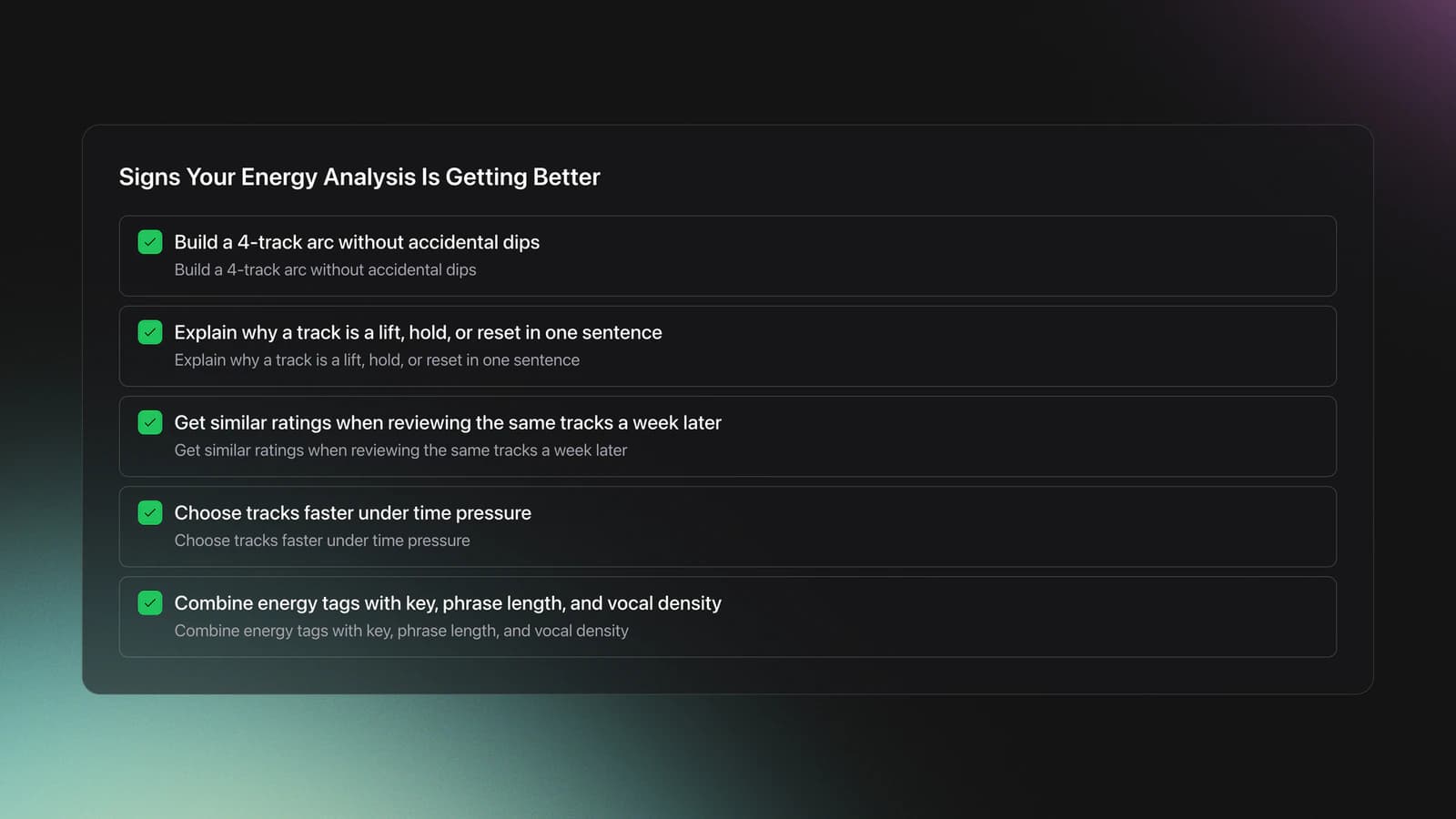
Look for three signs. First, you can build a four-track arc without accidental dips. Second, you can explain why a track is a lift, hold, or reset in one sentence. Third, your ratings stay stable when you review the same tracks a week later.
Once that becomes reliable, start combining Energy Analysis with key, phrase length, and vocal density. That is where the technique stops being library admin and starts becoming performance strategy.
Energy Analysis in Real Sets
In a real set, Energy Analysis helps you choose whether to escalate, stabilize, or release pressure. That decision often matters more than choosing the mathematically most compatible next track.
For example, a house DJ may hold a room with several rolling Level 3 tracks before using one brighter Level 4 record as a clear lift. An open-format DJ may jump BPM but preserve crowd momentum by choosing records with similar impact. Software scores can help surface options, but the final call stays contextual.
This is also why energy notes should mention function. Terms like bridge track, fake closer, vocal breather, or tension builder are often more useful than precise numbers during performance.
Key Takeaways and Next Step
Energy Analysis gives DJs a practical way to shape momentum, not just sort music. When you rate tracks by function, listen across full arrangements, and test tags in real transitions, your sets become easier to steer and harder to derail.
Keep these points in mind:
- Rate tracks by effect on momentum, not just BPM or personal preference.
- Use software analysis as a starting point, then correct by ear.
- Practice short transition chains until your labels become dependable.
Start with a five-level system and tag 20 familiar tracks this week. Then build one short rising mini-set and one reset mini-set. From there, the progression becomes clear.
The visual way to organize your DJ library
Tag tracks by vibe. See everything at once. Export to rekordbox, Serato, Traktor or Engine DJ.
14-day free trial. Full access, no strings attached.
or see how it works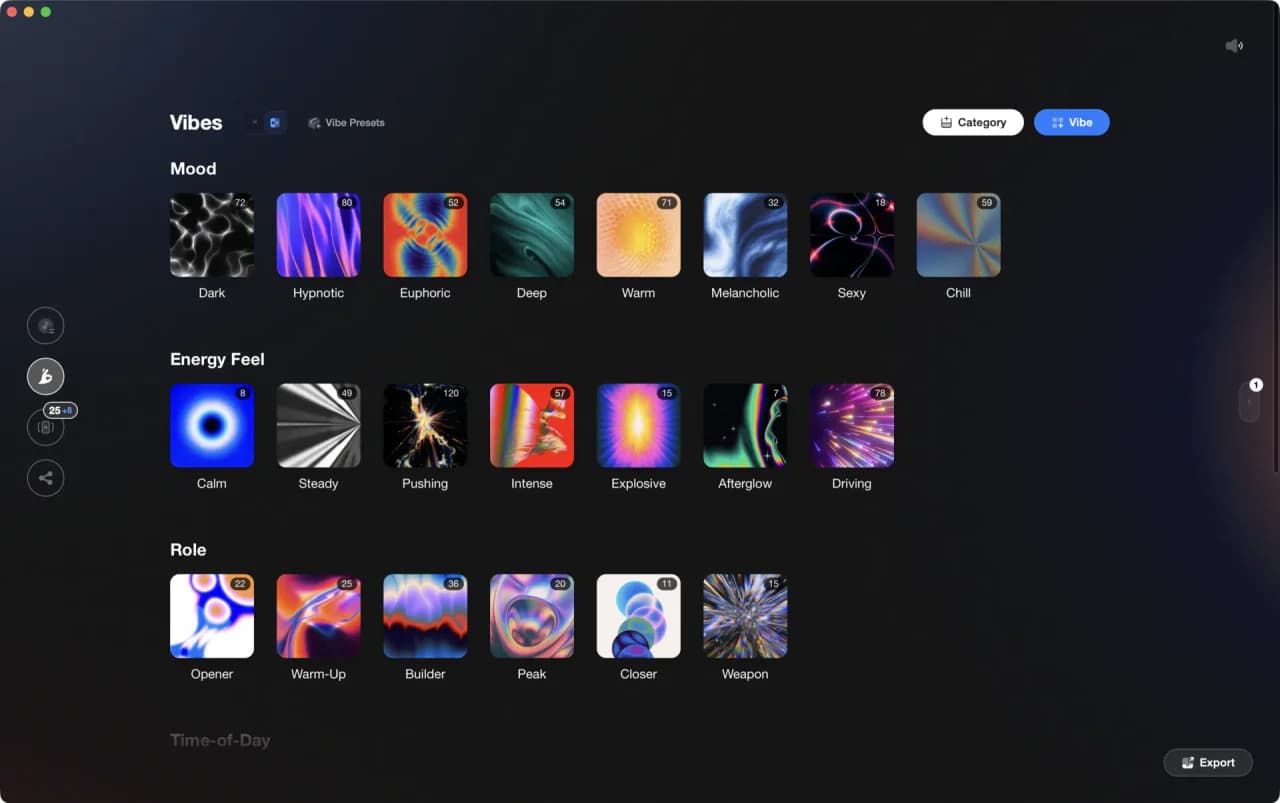
More Tutorials
Equipment You'll Need
Roland TR-808
optionalThe Roland TR-808 is an analog drum machine whose punchy kick, snappy hats, and step-sequencing workflow helped define hip-hop, electro, pop, and modern electronic music.
Ableton Live
optionalAbleton Live is the go-to DAW for hybrid DJ sets and live electronic performance. Session View enables non-linear clip launching perfect for DJs transitioning from decks. Use it alongside CDJs, with controllers like Push and Launchpad, or as your complete performance rig.
VirtualDJ
optionalDJ software for Windows and macOS that handles audio mixing, video mixing, karaoke, stems, and broad hardware support.
Serato DJ Pro
optionalProfessional DJ software for mixing, performance, library management, recording, and hardware-integrated club workflows.
VirtualDJ 7
optionalA legacy DJ software platform for audio and video mixing, controller mapping, and DVS playback on Windows and Mac.
Pioneer DJ DDJ-1000
optionalA 4-channel rekordbox DJ controller with full-size jog wheels, onboard displays, and club-style mixer controls.
Mixed In Key 11
optionalStandalone harmonic-mixing and library-prep software that detects keys, energy levels, cue points, and tags for DJ sets.
Platinum Notes 10
optionalPlatinum Notes 10 evens loudness, repairs clipped peaks, and prepares DJ files for more consistent playback in Serato, rekordbox, and Traktor.
rekordbox
optionalCloud-connected DJ software for music management, performance, export prep, and club-standard hardware integration.
Pioneer DJ DDJ-400
optionalA compact 2-channel USB DJ controller built for rekordbox with a club-style layout aimed at new and progressing DJs.
Fruity Delay 3
optionalA stock FL Studio delay effect that combines tempo-synced echoes, filtering, modulation, diffusion, and feedback distortion in one plugin.
Tiptop Audio CYMBL909
optionalA dual-voice Eurorack drum module that recreates the TR-909 crash and ride cymbal circuits with added CV control and hot modular-level outputs.
Traxsource
optionalTraxsource is a digital music download store focused on house and underground dance music for DJs.
Frequently Asked Questions

Hey, it's Ben Modigell 👋
I DJ and produce as so I so: downtempo, minimal, dub house, tech house, and techno (releases on Spotify and SoundCloud, links above). Everything I write here comes from my own gigs, studio sessions, and library cleanups: the rules I follow, the failure modes I have actually hit, and the workflow I use when nobody is watching. If a technique did not earn its place in my own sets, it does not make it into a tutorial.