
Watch Channel 4’s tutorial above (138K views on YouTube).
This guide is for listeners, DJs, and newer selectors trying to tell one type of house music from another without relying on vague labels. If you keep hearing "deep," "acid," "tech," or "progressive" and they all blur together, this will fix that. After reading, you will be able to hear each subgenre's core traits and sort tracks by function instead of guesswork.
The fastest way to understand any type of house music is to listen for five signals, in order:
- Hear the kick and hi-hats. Are they warm, sharp, busy, or stripped back?
- Follow the bassline. Is it rolling, squelchy, static, or melodic?
- Check the harmony. Are there lush chords, piano stabs, or barely any chords?
- Note the vocal role. Full song, chopped phrase, spoken hook, or no vocal?
- Ask what it does in a set. Warm-up, lock-in groove, peak, or release?
For the broader question of what house music is and where it came from, start with house music basics. The rest of this page is about telling the branches apart.
Deep House vs Acid House: How to Tell Them Apart
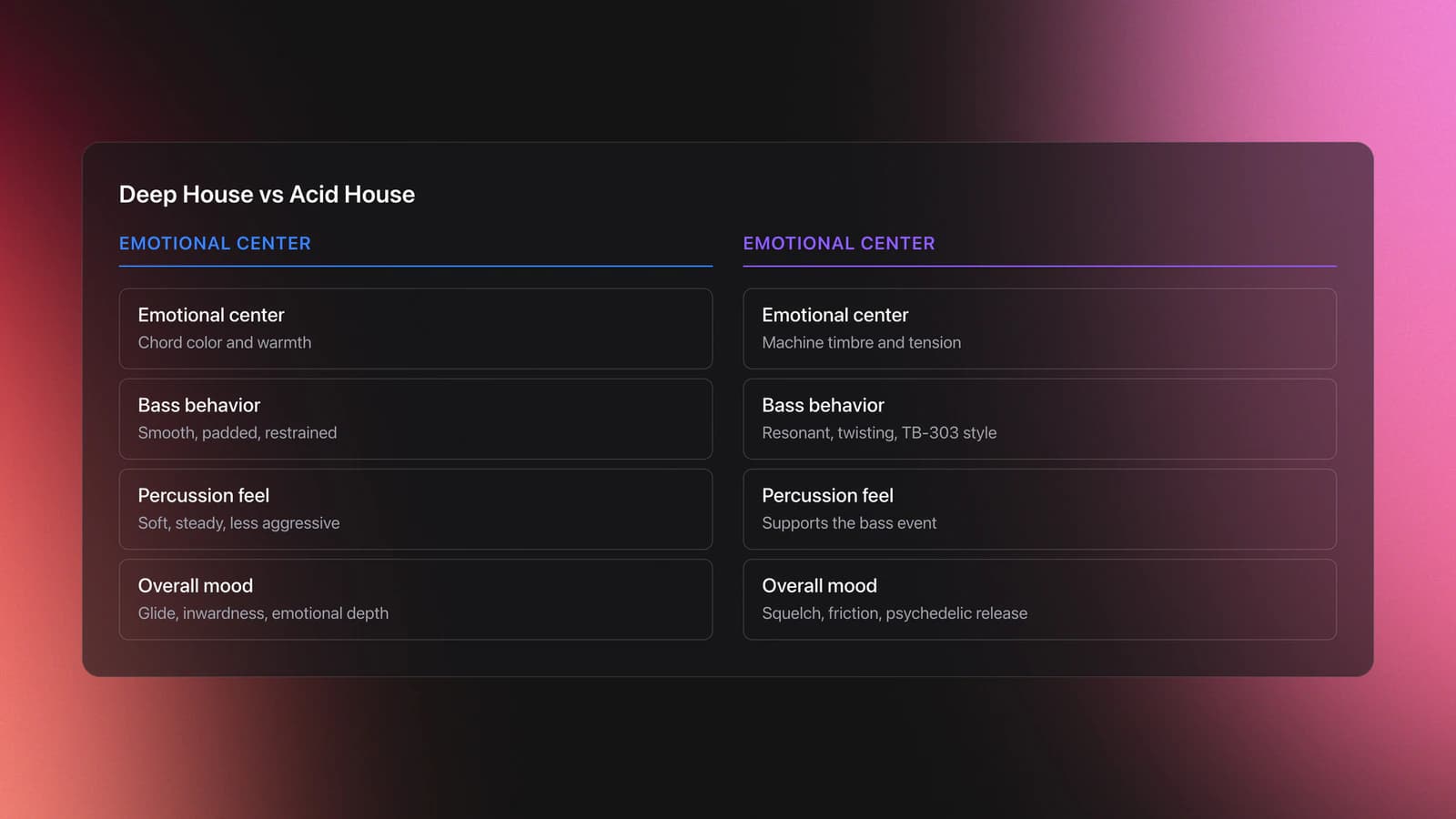
Deep house and acid house get confused because both can be repetitive, hypnotic, and rooted in early club culture. Under the hood, they solve different musical problems. Deep house adds emotional richness without losing house discipline. Acid house pushes machine character to the front and uses timbre itself as the hook.
Start with deep house. The center of gravity is usually chord color, bass smoothness, and restraint. It tends to feel warmer, rounder, and more inward.
Typical deep house signals:
- Jazzier or more soulful chords.
- Soft but steady low end.
- Less aggressive percussion.
- Longer blends and smoother transitions.
- A mood of glide rather than attack.
Worked example one. A 122 BPM track with Rhodes-style chords, a padded bassline, light vocal texture, and brushed percussion accents will usually land in deep house territory because harmony and tone do more of the emotional work than raw drum aggression.
Worked example two. A stripped groove with a rolling sub-bass and almost no melodic hook may still be deep house if the space feels warm and the track breathes rather than bites. Deep does not require obvious chords in every bar. It requires a deeper emotional center.
Now acid house. The defining clue is the bassline behavior. A resonant, twisting, squelching line becomes the track's identity. That sound came from the Roland TB-303, a 1981 computerized bass machine that producers drove far beyond its intended role until the squelch itself became the genre. That is why acid house often feels less like "a song with a bassline" and more like "a bassline becoming the song."
Typical acid house signals:
- Resonant TB-303 style bassline.
- Noticeable filter movement.
- Manic or psychedelic tension.
- Drums that support the bass event.
- A club reaction driven by texture as much as groove.
Worked example three. If a track at 124 BPM has simple drums but a constantly mutating bassline that sounds wet, rubbery, and unstable, it is probably acid house or acid-influenced house, even if the rest of the arrangement is minimal.
Worked example four. If the same BPM range comes with soft chords, a smooth bassline, and emotional drift, it is more likely deep house. Similar tempo does not mean similar subtype.
Failure mode. People often tag any repetitive electronic track with a squelchy synth as acid. The symptom is overemphasis on one weird sound. True acid identity usually comes from the central role of the 303-style line in the groove, not a brief effect layered on top.
You will know you can separate deep from acid when you can answer one question fast. Is the emotional weight coming from chord atmosphere or from the bassline's machine behavior?
House reference tracks
A starting crate of house, pulled from our DJ track index with live BPM and Camelot keys (these run roughly 120-136 BPM). Beatmatch to each track's tempo, use the long intros and outros to blend, and swap on the phrase. Click any row to open its full sonic profile.









Tech House vs Progressive House: How to Tell Them Apart
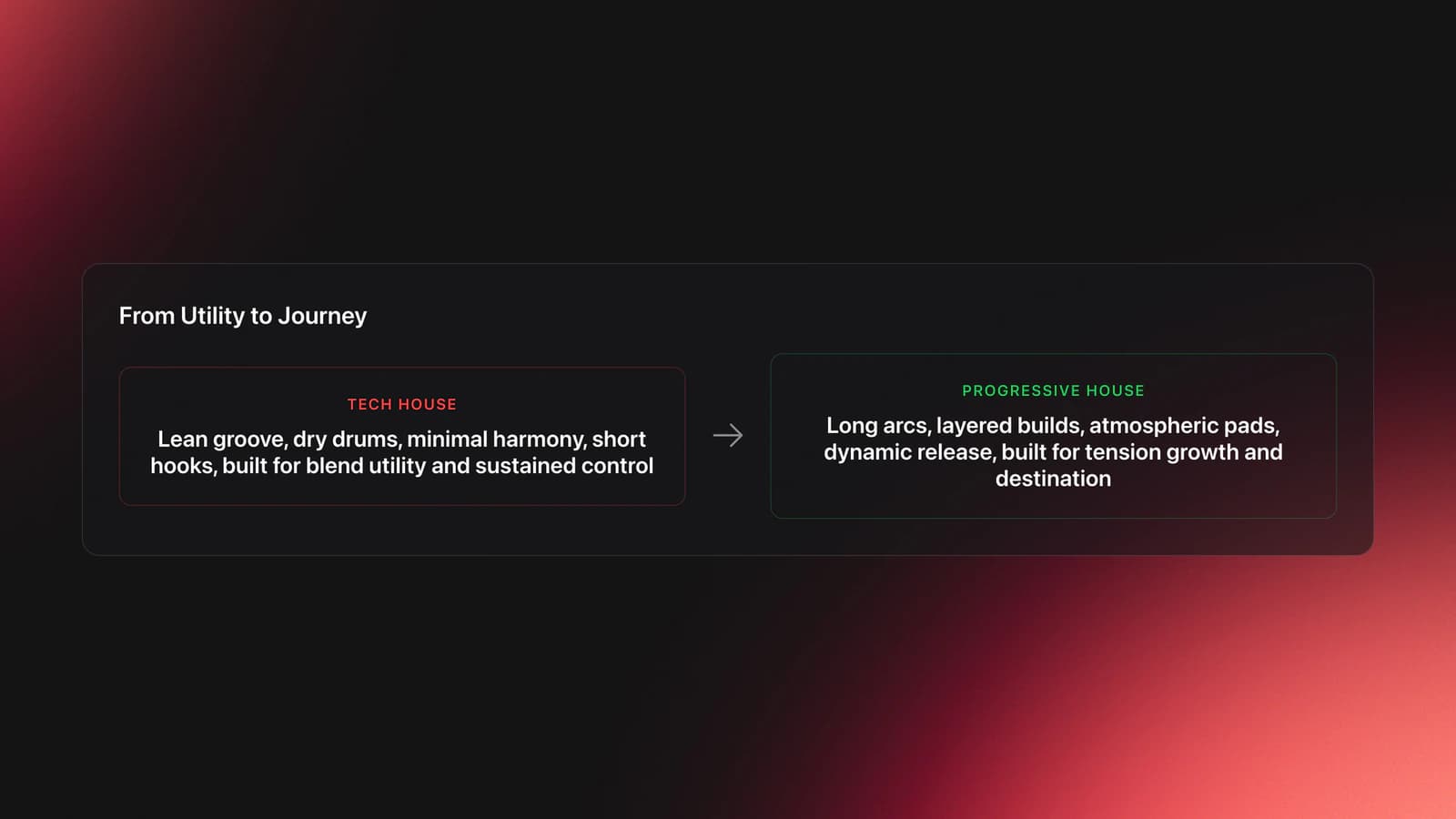
Tech house and progressive house are often grouped together by newer listeners because both appear in modern club contexts and both may sound more polished than early Chicago records. Their internal logic is different. Tech house values efficiency. Progressive house values journey.
Tech house usually strips the groove down to what a DJ needs. The low end is controlled. The percussion is tight. Hooks are often short and practical.
Typical tech house signals:
- Dry, punchy drums.
- Minimal harmonic content.
- Short vocal chops or spoken phrases.
- Strong blend utility for mixing.
- A focus on groove precision over emotional bloom.
Worked example one. A 126 BPM track with a thick kick, percussive top loop, one repeating stab, and a spoken hook every 16 bars is likely tech house if the groove feels engineered for seamless layering and late-night control.
Worked example two. A track can have funky bass and still be tech house if the arrangement stays lean and the musical goal is sustained club pressure, not chord-led expression.
Progressive house tends to take longer to reveal itself. The arrangement matters more. Atmosphere matters more. Layers build over time, and release often arrives through scale rather than raw drum density. Britannica identifies progressive house as one of the later British mutations of the Chicago sound, built on production choices that create a hypnotic quality. Progressive house often feels architectural. It builds rooms inside the track.
Typical progressive house signals:
- Long intros and outros.
- Layered build structure.
- Atmospheric pads and melodic progression.
- Large dynamic arcs.
- A sense of destination.
Worked example three. A 124 BPM track opens with percussion only, adds bass after 32 bars, introduces a pad texture, then slowly stacks melodic layers before a long release. That is progressive logic even if the drums remain house-based.
Worked example four. Another track may share the same BPM but keep all elements present from the first minute, vary them slightly, and aim for relentless groove management. That points back toward tech house.
Failure mode. People often call any modern, polished house track "progressive" because it sounds big. The symptom is confusing production quality with arrangement philosophy. Progressive house is not just cleaner. It thinks in long arcs.
You will know you are hearing the difference when you can predict the track's next move. Tech house usually asks, "How long can this groove stay useful?" Progressive house asks, "How long can tension keep growing?"
Deep House vs Tropical House: How to Tell Them Apart
Deep house and tropical house get confused constantly in playlists and search results because both can sound smooth, melodic, and accessible. The split becomes clearer when you focus on frequency balance and emotional tone.
Deep house lives lower. The bass and lower-mid content do more of the emotional work, while higher-frequency elements frame the groove instead of dominating it. That gives deep house a muted, classy, and sometimes brooding feel. Pads, space, and restraint matter as much as the hook.
Tropical house, by contrast, spreads the energy more evenly across the spectrum. It keeps the house pulse, but the sonic identity comes from light plucks, marimba-like tones, airy percussion, lush reverb, and a more summery emotional palette.
Here is the practical shortcut. If the low end feels like the center of gravity, start with deep house. If the melodic top layers carry the personality and the track feels beach-lit rather than late-night, start with tropical house.
Worked example one. A track opens with soft pads, a muted bassline, and carefully placed drums. Nothing jumps out in the highs. The mix breathes. That is a deep house profile.
Worked example two. Another track uses bright plucks, delicate vocals, reverb-heavy percussion, and a gentler emotional lift. Even if the tempo is relaxed, those cues push it toward tropical house.
Failure mode. A common mistake is assuming tropical house must always be slow and passive. Many pop-facing tracks borrow tropical plucks and percussion while keeping the arrangement upbeat. Another mistake is treating deep house as only bass-heavy. It is not just more bass. It is bass plus restraint, space, and a particular kind of muted elegance.
You will know you can tell these apart when you can explain not just which genre a track resembles, but why. Name the bass role, the top-end role, and the mood in one sentence.
Electro House and Future House: The Louder Branches
Electro house, tech house, and future house often collide in recommendation feeds because all three can sound modern, club-ready, and more aggressive than classic house. Tech house you already know from the section above: it is driven by percussion. The clean way to separate the other two is to ask what drives the track, weight or stylized bass design.
Electro house is driven by weight. It tends to run at higher tempos and uses thicker, brighter, often distorted bass and synth layers. The texture is crowded on purpose. Even sparse electro house tracks usually rely on sounds that feel fat and forceful on their own.
Worked example. You hear a buzzing bass, a dense lead stack, and a drop that feels engineered for impact rather than subtle movement. That is electro house behavior.
Future house sits in a more ambiguous spot. It grew from deep house roots, but many tracks evolved brighter, harder, and more synthetic over time. What often gives future house away is the bass design. It feels more metallic, more dissonant, and more deliberately shaped than classic deep house bass. In other words, future house often sounds like deep house pushed through a more stylized modern lens.
Failure mode. Calling any modern bass-forward house record future house. You still need that specific modulated character, plus a design language that separates it from straight electro aggression or pure deep house restraint.
You will know you can sort these three when you can say one sentence for each: electro house hits with mass, tech house moves with drums, future house flexes through stylized bass design.
How to Tell House Subgenres Apart Fast
If you are listening to an unfamiliar track, do not start with artist reputation or playlist label. Start with a repeatable checklist. Classification gets easier when you move from sound to behavior.
Use this quick sequence:
- Set the tempo aside first. BPM alone misleads.
- Identify the main hook source. Drums, bass, chords, vocal, or atmosphere.
- Judge the arrangement length. Functional loop, medium arc, or long build.
- Note the emotional register. Raw, warm, tense, sleek, or expansive.
- Place the track by dance-floor role. Warm-up, builder, lock-in, peak, or release.
In practice, classification usually becomes clear by step three. A bassline-led, resonant, unstable groove points toward acid. Warm harmonic depth points toward deep. Dry utility and tight percussion suggest tech house. Long scene-setting arrangement suggests progressive.
Behind that checklist sits the lens I actually use, what I call the groove-first map. Every type of house music sits somewhere along four axes:
- Groove: how much the rhythm drives the track.
- Soul: how much harmony and feeling lead.
- Texture: how much the machines define the experience.
- Scale: whether it suits intimate rooms or larger, more dramatic builds.
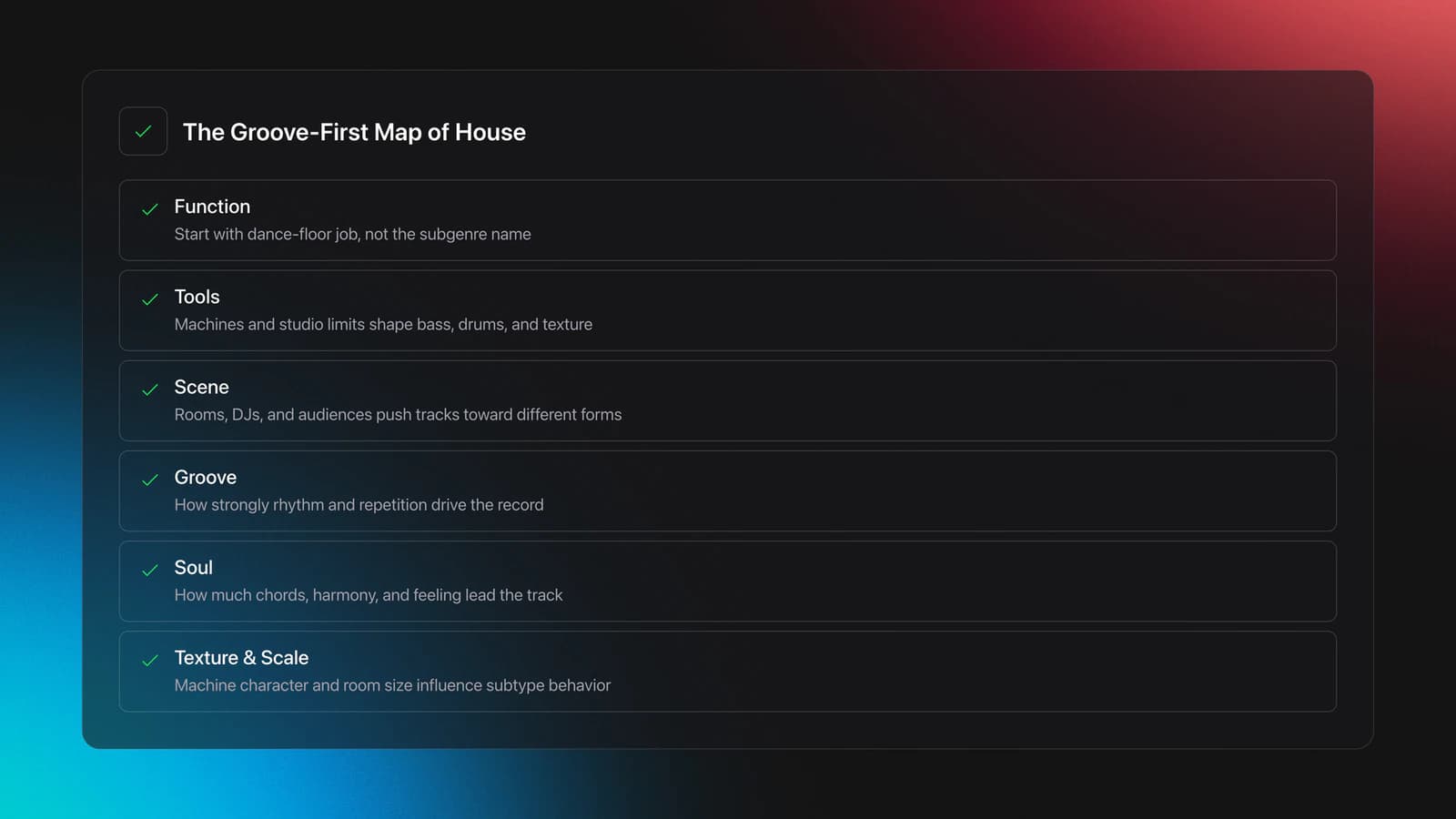
Plot a track on those four and the label usually names itself. Tech house leans groove and texture, deep house leans soul, progressive leans scale. The map also stops you from classifying by surface detail alone, since a piano or a spoken vocal can behave differently depending on the groove and arrangement around it.
As you start sorting your own collection this way, keeping subgenre and energy tags on each track in a library tool like Vibes turns this listening exercise into something you can actually pull from when you build a set, instead of re-guessing every track each time.
Ear training sharpens this faster than memorizing genre charts. You hear what works, what blends, and what changes a crowd's posture. The labels become useful only after the physical effect becomes obvious. The branches I gravitate to most when I play are dub house, tech house, and minimal, and I read them by behavior in the room long before I reach for the name.
| Mistake | Why It Happens | How to Avoid |
|---|---|---|
| Using BPM as the main label | Many house subgenres overlap in tempo | Classify by hook source, harmony, and arrangement |
| Calling all older tracks deep house | Age gets confused with mood | Listen for warmth and harmonic depth, not release era |
| Calling any squelchy sound acid | One effect gets mistaken for the full style | Check whether the 303-style bassline drives the whole track |
| Confusing polished with progressive | Production quality masks arrangement logic | Ask whether the track builds a long arc or just holds a groove |
| Tagging everything as house only | Broad folders feel easier at first | Add subgenre plus function, mood, and energy tags |
Common classification mistakes when sorting a type of house music
Why House Split Into Subgenres
House split into subgenres because the tools and scenes kept changing. A new machine changed the bass sound. A new room changed how much space the drums needed. A new audience changed how long tension could hold. For the full origin story of how house started in Chicago, see house music basics.
The core mental model for any type of house music is the same: do not start with names. Start with function, tools, and scene. A piano does not automatically mean one subtype. A spoken vocal does not automatically mean another. The same element can behave differently depending on groove and arrangement.
Core Type of House Music Categories
If you need a usable starting set, learn six core categories. They cover most listening and DJ situations. Everything else is either a branch, a hybrid, or a regional naming habit.
- Classic house: drum-machine groove, simple arrangement, jacking energy, club-first function.
- Deep house: warmer chords, smoother basslines, more space, more emotional subtlety.
- Acid house: TB-303 bassline movement, resonant squelch, repetitive tension, psychedelic drive.
- Tech house: stripped drums, tight low end, minimal hooks, DJ utility, modern club efficiency.
- Progressive house: longer builds, larger atmosphere, layered arrangement, narrative pacing.
- Soulful or piano house: vocal lift, gospel or disco inheritance, chord-led release, communal feel.
Classic House Traits and Identification
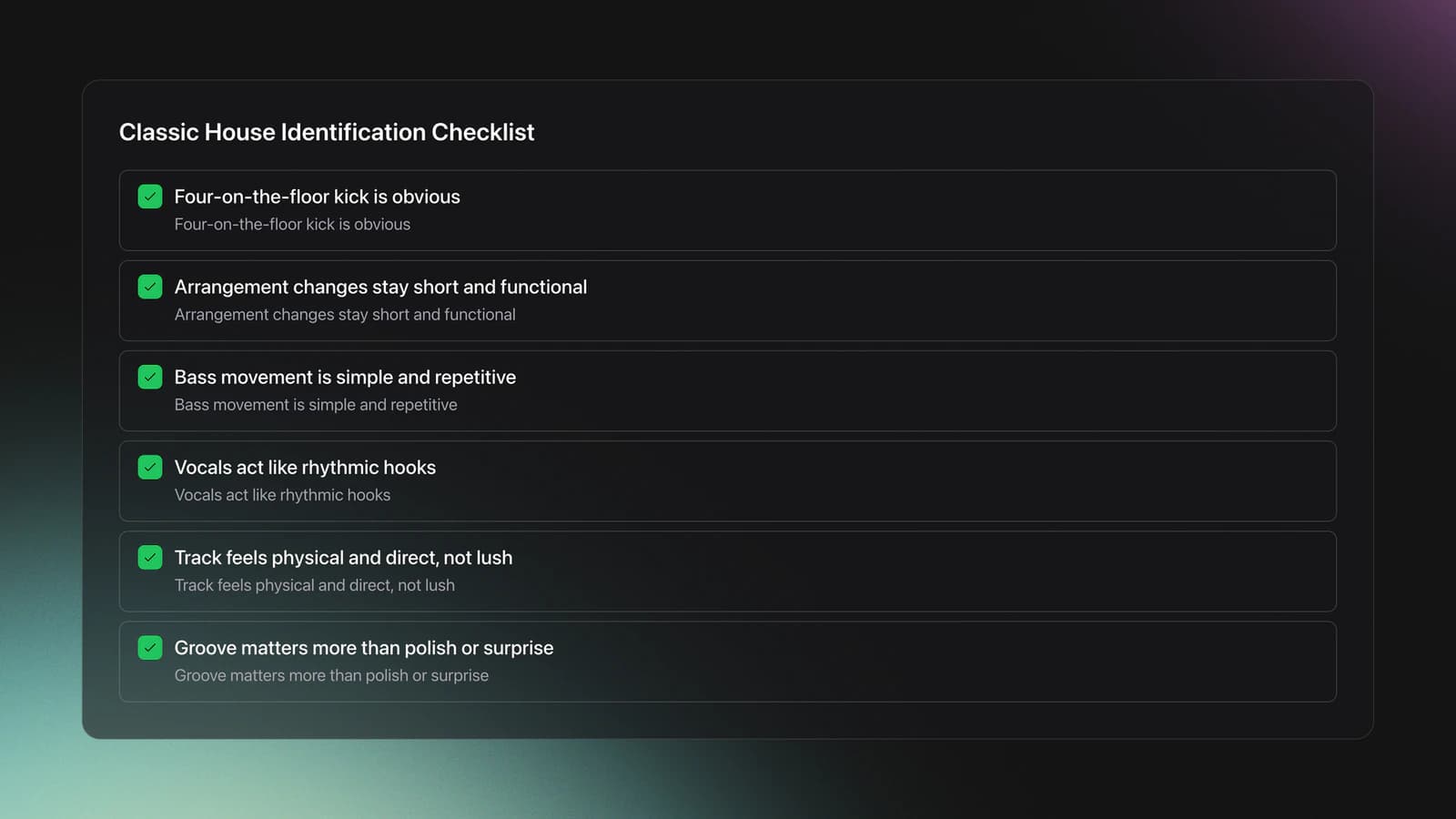
Classic house is the best reference point because every later type of house music either extends it, strips it back, or warps one of its core parts. You hear the steady four-on-the-floor kick, direct drum-machine programming, loop logic, and a groove built to keep bodies moving rather than impress musicians.
This is why classic house often feels blunt in the best way. It values momentum over polish. It values repetition over surprise.
Typical signals include:
- Obvious kick pattern.
- Short, functional arrangement changes.
- Simple bass movement.
- Vocal phrases used like rhythmic hooks.
- An immediate sense of physical motion.
Worked example one. A track at 122 BPM with a dry kick, open hi-hat on the offbeat, one repeating bass note pattern, and a callout vocal repeated every eight bars is likely closer to classic house than deep or progressive house because the arrangement is built around direct jacking energy.
Worked example two. A track with a piano riff, snare claps, and a church-like lift, but a short club-functional structure rather than a cinematic one, may still sit in classic or piano house rather than progressive house because the main job is dance-floor release, not long-form tension.
Failure mode. Many listeners hear any older drum-machine house track and label it "deep house." The symptom is that they use "deep" to mean old, warm, or respected. That collapses useful distinctions. If the track feels more physical than lush, more direct than immersive, and more loop-led than chord-led, it probably is not deep house.
You will know you are identifying classic house well when you can explain the track's engine in one sentence. For example: "This works because the groove is obvious, the drums are front and center, and the arrangement never distracts from the floor."
Newer subgenres still borrow this skeleton. If you cannot hear the skeleton, every later variation sounds more mysterious than it is.
House Music Genre Tree in Practice
A genre tree is useful only if it stays practical. Too broad, and it tells you nothing. Too detailed, and you spend more time arguing than listening.
For most readers, a working house music genre tree looks like this:
- House
- Classic house
- Deep house
- Acid house
- Tech house
- Progressive house
- Soulful or piano house
- Later hybrids and regional variations
That last branch matters because real scenes produce hybrids constantly. A track can be deep and techy. Another can be progressive with acid elements. The point is not forcing purity. The point is hearing the dominant behavior.
If you need more granularity, split by one extra layer only. For example, put soulful and piano under a chord-led branch, and put acid and tech under a machine-led branch. Past that, most people stop gaining useful clarity.
Validation Check
Afro House: The Modern Branch Worth Knowing
One regional variation has grown too large to leave inside the catch-all branch: Afro house. It now sits alongside tech house and deep house as one of the most played house styles, so it earns its own identification note. Afro house blends the deeper, soulful side of house with percussion and rhythmic ideas rooted in African music, with strong roots in the Southern Africa scene and influences from Kwaito.
How to tell it apart by ear:
- Dense, organic percussion layers, often log drums, shakers, and hand-drum textures.
- A rolling, hypnotic groove that leans tribal rather than four-on-the-floor-rigid.
- Soulful or chant-style vocals used as texture and call-and-response.
- Earthy, warm tone rather than the dry utility of tech house.
Worked example. A 120 to 124 BPM track built on a deep log-drum bassline, layered hand percussion, and a repeated vocal chant, with chords kept sparse, points to Afro house rather than deep or tech house, because the rhythm and percussion carry the identity while harmony stays minimal.
Place it on the groove-first map and Afro house leans hard on groove and texture, with soul close behind, which is why it can feel adjacent to deep house while reading as its own thing on the floor.
Conclusion: The Simplest Way to Hear House Subgenres
The cleanest way to understand any type of house music is to stop treating subgenres like trivia. Treat them like functional differences in groove design. Hear what leads the track. Hear how tension is built. Hear what the room is supposed to do.
Three takeaways matter most:
- Classic house gives you the base language.
- Deep, acid, tech, and progressive differ by hook source, texture, and arrangement logic.
- Useful classification always connects sound to dance-floor function.
From here, test your ear on real tracks and sort them by behavior, not prestige. If you want to go deeper, learn DJ set flow or study house artists by subgenre.
The visual way to organize your DJ library
Tag tracks by vibe. See everything at once. Export to rekordbox, Serato, Traktor or Engine DJ.
14-day free trial. Full access, no strings attached.
or see how it works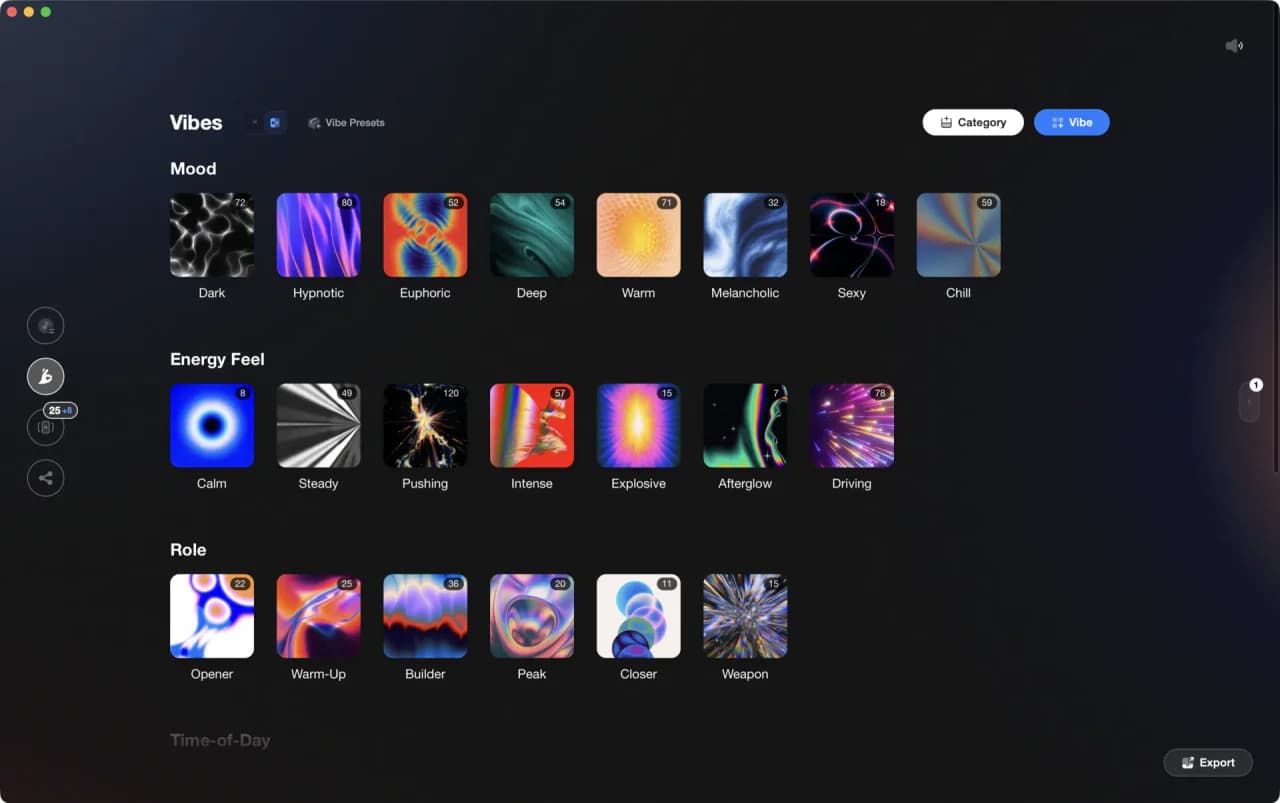
Techniques Covered

Equipment & Software
Documentation
Continue Your Learning Journey
Start Here First




Related Content
House Music Explained
intermediate
Tech House: How to Build the Core Sound
intermediate
Progressive House Music: How It Works
intermediate
90s House Music: Origins, Sound, Key Tracks
intermediate
House Trance: Sound, Structure, Mixing
intermediate
Frankie Knuckles: House Music Pioneer
intermediate
DJ Transitions: The Three-Layer Handoff for Beginners
intermediate
DJ Record Pool Guide for Working DJs
intermediate
How To Mix In Key Live: Worked Transitions And Failure Fixes
intermediateFrequently Asked Questions

Hey, it's Ben Modigell 👋
I DJ and produce as so I so: downtempo, minimal, dub house, tech house, and techno (releases on Spotify and SoundCloud, links above). Everything I write here comes from my own gigs, studio sessions, and library cleanups: the rules I follow, the failure modes I have actually hit, and the workflow I use when nobody is watching. If a technique did not earn its place in my own sets, it does not make it into a tutorial.