Classic House Music: Key Tracks and Style
Watch FL Studio’s tutorial above (264K views on YouTube).
This is for DJs, collectors, and electronic music fans trying to understand what classic house music actually is, which tracks define it, and how to build a useful listening base. By the end, you will know the sound, the core records, the main eras, and how to turn that knowledge into a better classic house music playlist.
A lot of people use classic house music as a loose label for any older dance track. That is too broad. The useful definition is narrower: late-1980s through mid-1990s house rooted in Chicago, New York, and related club scenes, with drum-machine grooves, repeating basslines, soulful vocals, piano stabs, and DJ-friendly arrangement.
If you are still mapping the genre, start with house music history, then compare this sound with deep house essentials and Chicago house tracks. That gives you a cleaner frame than jumping straight into random playlists.
The visual way to organize your DJ library. Tag by vibe, export to any DJ app.
Classic House Music: Definition and Context
Classic house music comes from a club-first tradition. The point was movement, tension, release, and repetition that stayed useful in a DJ set.
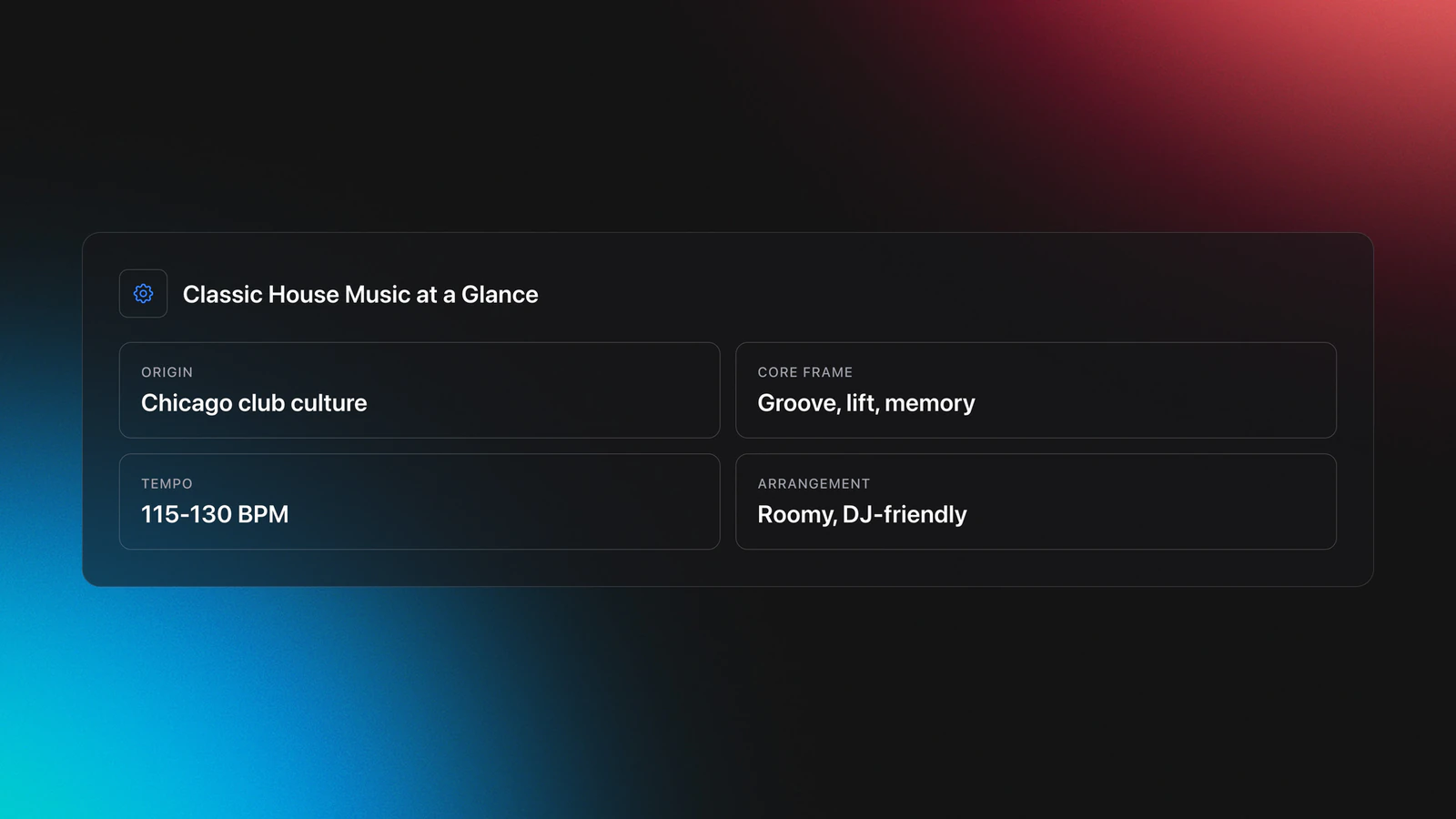
Chicago is the key starting point. Choose Chicago notes that The Warehouse became the birthplace of house music, and Britannica traces the genre to club culture built from disco, electronic rhythm tools, and stripped-down dance arrangements.
That history matters because it explains the sound. Classic house is usually less about huge drops and more about groove discipline. The kick stays steady. The bass loops tightly. Small changes do the real work.
I use a simple frame here: groove, lift, and memory. Groove is the drum and bass engine. Lift is the piano, vocal, chord, or filter movement that opens the track up. Memory is the hook that makes the record stick after one play.
Most classic house songs balance all three. If one is missing, the track may still work, but it usually feels more functional than timeless.
Tempo sits in a practical dance range. House commonly lands around 115 to 130 BPM, with many enduring classics sitting near the middle because that range keeps the groove relaxed without losing drive.
This also explains why classic house music still works in modern sets. The arrangements leave room. You can layer, blend, extend, or cut without fighting overcrowded production.
If you DJ from a large local library, this is where categorization starts paying off. Instead of one vague old-school folder, you need separations like piano house, vocal house, jackin tracks, warm-up rollers, and peak-time anthems. Some DJs do that in playlists alone. Others use tools like Vibes to build custom hierarchical categories and keep those distinctions usable across prep and export.
Classic House Music Origins and Core Traits
Why does this matter for your listening and DJ workflow? Because once you know the traits, you stop mistaking every older four-on-the-floor record for house.
The roots are disco, soul, gospel, synth pop, and early drum-machine experimentation. In practice, classic house stripped those influences down into something more repetitive and more DJ-functional.
You hear that in the drum design first. A steady kick usually anchors the record. Snares and claps mark the backbeat. Hats add motion, often with just enough swing to make the groove feel human.
The bassline is usually simple but deliberate. It rarely tries to dominate the mix. Its job is to lock with the kick and keep the body moving.
Then come the identity markers. In classic house tracks, that could be a piano riff, a diva vocal, a sampled phrase, an organ stab, or a short synth line repeated with surgical patience.
Example one: a piano-house anthem often uses a plain kick pattern, a direct bass loop, and a bright chord riff that lifts the whole record. Example two: a darker Chicago cut may remove the bright piano entirely and rely on jackin percussion, raw drum machines, and one hypnotic vocal phrase.
Both are classic house music. They just solve the dancefloor problem differently.
A common failure mode is overvaluing production polish. Some foundational records sound rough by current standards. That roughness is not a flaw to correct. It is often part of the energy.
You will know you are hearing the real thing when the track feels effective before it feels impressive. Classic house songs tend to make sense in the body first and the analysis second.
That is also why producers still study them. The transcript behind this article is about building a house track from included tools, focusing on kick placement, syncopated bass, swing, energy gradients, and transition devices. Those same mechanics explain why classic house album songs and singles still hold up. The production language is direct.
If you want to go deeper on arrangement thinking, DJ set energy flow and how to organize DJ playlists are the next useful reads.
What Are Some Classic House Songs?
The shortest useful answer is this: start with records that shaped the genre, crossed scenes, or still get referenced by DJs decades later. That includes tracks tied to Chicago foundations, vocal crossover records, and piano-led anthems that still work in clubs.
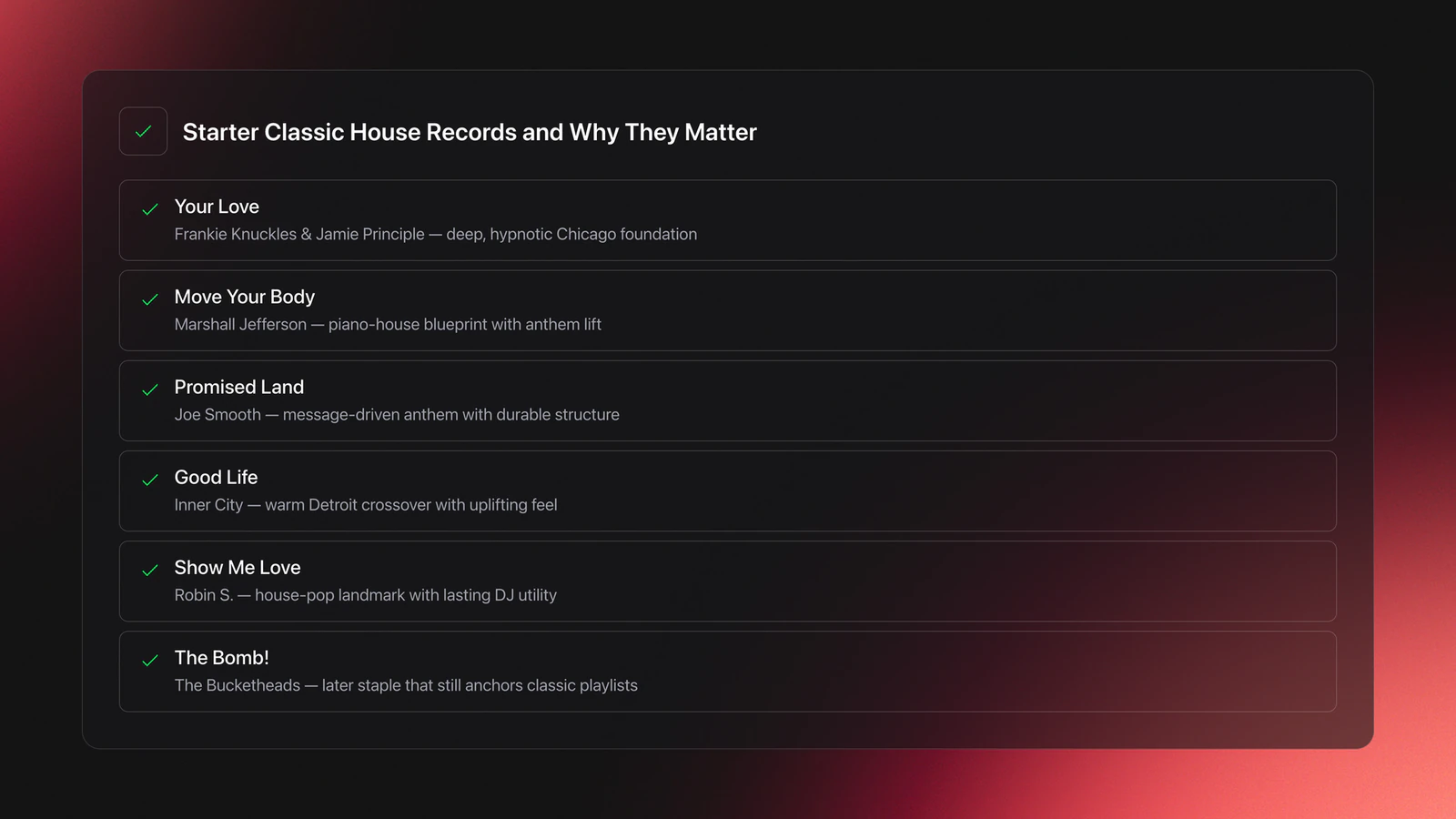
A practical starter list includes Frankie Knuckles and Jamie Principle's “Your Love,” Marshall Jefferson's “Move Your Body,” Joe Smooth's “Promised Land,” Inner City's “Good Life,” and Robin S.'s “Show Me Love.” Different publications rank them differently, but these titles show up again and again because each defines a durable part of the sound.
Start with records that are both historically important and still playable. That overlap matters more than any one ranking.
- “Your Love” by Frankie Knuckles and Jamie Principle. Deep, hypnotic, foundational.
- “Move Your Body” by Marshall Jefferson. Piano-house blueprint and festival-level lift.
- “Promised Land” by Joe Smooth. House with a clear message and anthem structure.
- “Good Life” by Inner City. Detroit crossover with warmth and uplift.
- “Show Me Love” by Robin S. A house-pop landmark with lasting DJ value.
- “The Bomb! (These Sounds Fall Into My Mind)” by The Bucketheads. Later than the first wave, but still a staple in classic house playlists.
Here is why these work as anchors. “Your Love” is widely treated as a foundational 1986 to 1987-era house record, and Apple Music's Frankie Knuckles artist notes still place it among his defining early tracks. “Move Your Body” is often cited as a house anthem. “Show Me Love” and “Good Life” were later crossover peaks that pushed house into wider public view.
Do not read this as a fixed canon. A serious classic house music playlist will branch quickly into labels, cities, and sub-styles.
Example one: if you love “Move Your Body,” follow the piano-house line toward bigger chord-led records. Example two: if “Your Love” hits harder, go deeper into stripped, hypnotic Chicago material and late-night vocal cuts.
A common failure mode here is building a playlist from only obvious crossover hits. That gives you familiarity, but not range.
Validation is simple. If your starter set can move from raw Chicago groove to vocal uplift to piano drive without sounding like three separate genres, you have the right foundation.
Classic House Songs by Era, Mood, and Function
The easiest way to learn classic house music is not by date alone. Use three filters at once: era, mood, and function.
Era tells you where the record sits historically. Mood tells you how it feels. Function tells you what job it does in a set.
Start with era. The late 1980s gave you many of the foundational Chicago and Detroit records. The early 1990s broadened the palette with more vocal house, piano house, and crossover appeal. The mid-1990s added polished club records that still overlap with what many listeners call classic house tracks.
Now add mood. Some records are warm and soulful. Some are raw and tracky. Some are ecstatic. Some are head-down tools with one killer hook.
Then add function. Does the track open a set, settle the room, raise tension, peak the floor, or reset energy after a vocal anthem?
This is the difference between collecting and curating. A folder of files is not a usable system.
For DJs, the most practical structure is something like this:
- Warm-up classics
- Soulful vocal cuts
- Piano-house anthems
- Jackin and raw Chicago tools
- Crossover crowd-recognition records
- Closing or sunrise classics
Worked example one. You have a 90-minute opening slot. You probably do not want to start with your biggest vocal classic. Begin with lower-pressure rollers, then move into melodic records with more lift, then hold your known anthem until the room is ready.
Worked example two. You are playing after a harder house or techno DJ. In that case, a raw, percussive classic house track can bridge the energy better than an immediate soulful vocal record.
The failure mode is using only fame as your selection rule. Famous tracks can still clear a floor if their function is wrong for the moment.
You will know your system works when you can name at least two possible follow-ups for any record in your library. That means the track is no longer isolated. It has context.
This is exactly where library structure becomes performance structure. A dedicated prep workflow matters because classic house often wins on small sequencing decisions, not huge genre shifts. Some DJs still manage this with comments and memory cues. Others use a prep tool like Vibes to create custom categories for mood, function, and energy, then export that hierarchy into performance software without flattening the logic.
The product angle only matters if it solves real friction. Here, the friction is obvious: once your classic house music playlist grows past a few dozen tracks, memory stops being reliable.
Classic House Music Playlist Building
A strong classic house music playlist is not just a list of favorites. It is a listening and performance tool.
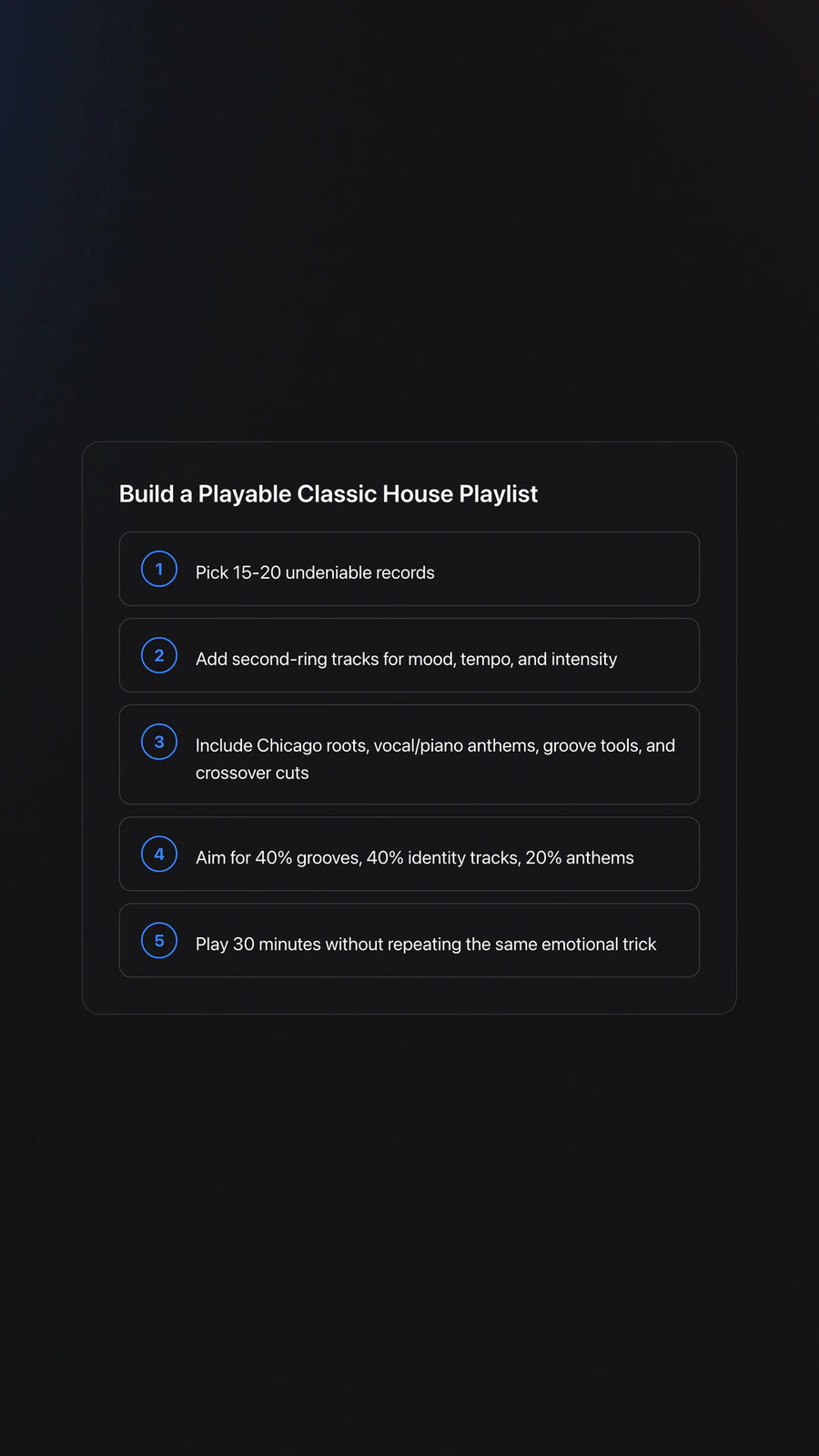
Use a layered method. First build a core list of 15 to 20 undeniable records. Then add second-ring tracks that cover gaps in mood, tempo, and intensity. Finally add personal picks that make the list yours.
Your core layer should answer four needs:
- At least three foundational Chicago records
- At least three vocal or piano-led anthems
- At least three lower-key groove tools
- At least three crossover records people recognize quickly
Then pressure-test the list. If every track aims for peak emotion, the playlist becomes tiring. If every track is minimal, the playlist lacks landmarks.
A useful ratio for many DJs is roughly 40% functional grooves, 40% strong identity tracks, and 20% unmistakable anthems. That keeps the set moving without sounding like a greatest-hits compilation.
Worked example one. Suppose your playlist starts with “Your Love,” “Good Life,” and “Show Me Love.” You already have deep hypnosis, uplifting crossover warmth, and a vocal anthem. What is missing? Probably rawer percussion and a tougher tool for transitions.
Worked example two. Suppose your crate leans hard into 1990s vocal house. Add at least a few earlier Chicago cuts or stripped instrumental classics so the playlist can breathe.
A common mistake is stuffing the crate with tracks you respect more than tracks you will actually play. Respect matters. Utility matters more.
Validation Check
What Is the Most Popular House Music?
Popular house music and classic house music overlap, but they are not the same thing. Popular house means broad recognition. Classic house means lasting importance inside the genre.
Some tracks are both. Robin S.'s “Show Me Love” is the obvious example. It became a mainstream crossover hit and is still treated as a major dance record decades later.
Inner City's “Good Life” works similarly. It crossed beyond club culture while keeping strong house identity. That is rare.
But many foundational records were never the biggest mainstream songs. They mattered because DJs played them, producers copied them, and scenes built around them.
So if someone asks for the most popular house music, give them two answers. One answer is public recognition. The other is scene-level influence.
That distinction helps you avoid a shallow playlist. Big records pull listeners in. Deeper records explain why the big ones exist.
What Is the Biggest House Song of All Time?
There is no single objective winner. The answer changes depending on whether you mean chart reach, DJ use, cultural memory, or genre influence.
If you mean crossover visibility, “Show Me Love” is one of the safest answers. If you mean foundational importance, many DJs would argue for “Your Love” or “Move Your Body.” If you mean emotional anthem status, “Promised Land” belongs in the conversation.
The practical takeaway is better than the ranking debate. Learn three kinds of giants: the foundational giant, the crossover giant, and the anthem giant.
That gives you better ears and better crates than chasing one definitive winner.
Classic House Music for DJs and Producers
Classic house music is not only a listening archive. It is also a production and arrangement textbook.
The transcript behind this brief started from production. It breaks house down into kick placement, syncopated bass, swing, sidechain space, energy gradients, and selective layering. That is useful because it gives you a structural way to hear old records.
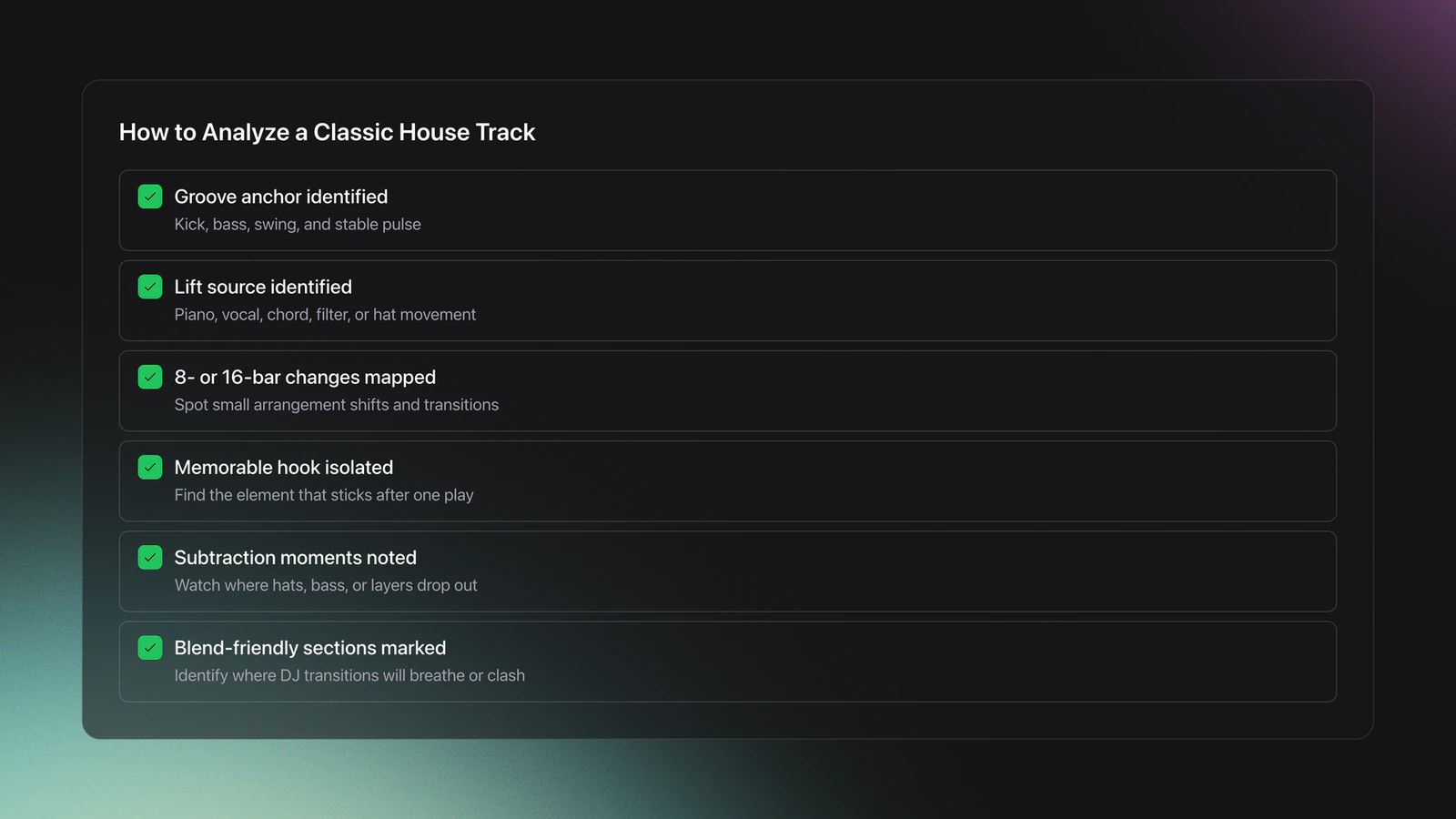
Listen to a classic house track and ask four questions:
- What keeps the groove stable?
- What creates lift?
- What changes every eight or sixteen bars?
- What makes the track memorable after one play?
That method helps both DJs and producers. DJs hear function more clearly. Producers hear arrangement economy.
A production background sharpens this fast. Producing teaches you why a simple hat change, chord stab, or reverb automation can move the room more than adding another layer. That creator perspective is one reason classic house tracks often look sparse on paper but feel complete in practice.
You will also notice that many classics progress by subtraction as much as addition. Remove hats for eight bars. Strip the bass before the vocal lands. Let one fill create the whole transition.
That is useful DJ knowledge too. It tells you where blends will breathe and where they will fight.
Common Mistakes With Classic House Music
| Mistake | Why It Happens | How to Avoid |
|---|---|---|
| Calling every old dance record classic house | Age gets confused with genre | Check for house-specific groove, bass function, and arrangement logic |
| Building playlists from hits only | Recognition feels safer than curation | Mix crossover records with deeper functional cuts |
| Ignoring track function | Selection is based on taste alone | Tag records by warm-up, lift, peak, reset, or close |
| Overvaluing modern polish | Older production can sound rough by current standards | Judge movement, tension, and memorability before sonic sheen |
| Sorting without a system | Memory works at first, then collapses | Use consistent categories for mood, energy, and use case |
The most common ways listeners and DJs misread classic house music.
Classic House Music: Key Takeaways
Classic house music is best understood as a functional club language, not just a nostalgia label. The records last because they solve groove, lift, and memory with unusual efficiency.
Keep these points in mind:
- Start with foundational records before hunting obscure favorites.
- Sort by era, mood, and function, not date alone.
- Build playlists that balance tools, identity tracks, and anthems.
- Study arrangement discipline. It is part of why the genre still works.
From there, the next step is simple. Pick ten classic house songs, sort them by function, and test them in sequence. Once you can explain why each track belongs where it does, you are no longer just collecting. You are curating.
If you want to keep going, pair this with best house music artists and how to prepare DJ sets.
The visual way to organize your DJ library
Tag tracks by vibe. See everything at once. Export to any DJ software.
A visual system for organizing your DJ library.
Techniques Covered
Equipment & Software
Featured Gear
Documentation
Continue Your Learning Journey
Start Here First


Related Content
House Music Explained
intermediate
90s House Music: Origins, Sound, Key Tracks
intermediate
1980s House Music: Origins, Tracks, DJs
intermediate
Best House Music Songs for DJ Sets: Tracks That Work
intermediate
Tech House: How to Build the Core Sound
intermediate
Progressive House Music: How It Works
intermediate
House Trance: Sound, Structure, Mixing
intermediate
Frankie Knuckles: House Music Pioneer
intermediate
Top Techno Songs That Still Work
intermediate
DJing in Key for Better Transitions
intermediate
Mix and Key: Practical Guide to Melodic DJ Mixing
intermediate
How To Mix In Key Live: Worked Transitions And Failure Fixes
intermediate
DJ Record Pool Guide for Working DJs
intermediate
DJ Library Organization System: Tags, Crates, Keys
intermediateFrequently Asked Questions

Hey, it's Ben Modigell 👋
I DJ and produce as so I so — downtempo, minimal, dub house, tech house, and techno (releases on Spotify and SoundCloud, links above). Everything I write here comes from my own gigs, studio sessions, and library cleanups: the rules I follow, the failure modes I've actually hit, and the workflow I use when nobody's watching. If a technique didn't earn its place in my own sets, it doesn't make it into a tutorial.