Downlifters
Downlifters are transition effects that release tension and signal the move into a new section of a track or DJ edit.
Downlifters are one of the simplest ways to make a transition feel intentional. If your drops, breakdowns, and section changes feel abrupt, downlifters help glue them together. In music production and DJ edits, downlifters release tension instead of building it, which makes the next phrase feel earned. Learning downlifters gives you better control over energy, pacing, and contrast.
That matters whether you are arranging a club track, preparing edits, or building cleaner transitions for live sets. A good downlifter can signal, "this section is ending," without shouting over the music. It is the opposite of a riser, and that contrast is exactly why the technique works.
Most beginners hear downlifters all the time but do not name them. They show up as falling sweeps, filtered noise tails, reverse-like washouts, and effects that cool the mix down after tension. Sources from Native Instruments, MusicRadar, EDMProd, and Point Blank all describe this same transition role, even when they use slightly different terms such as falls, downers, or downsweeps.
What Are Downlifters?
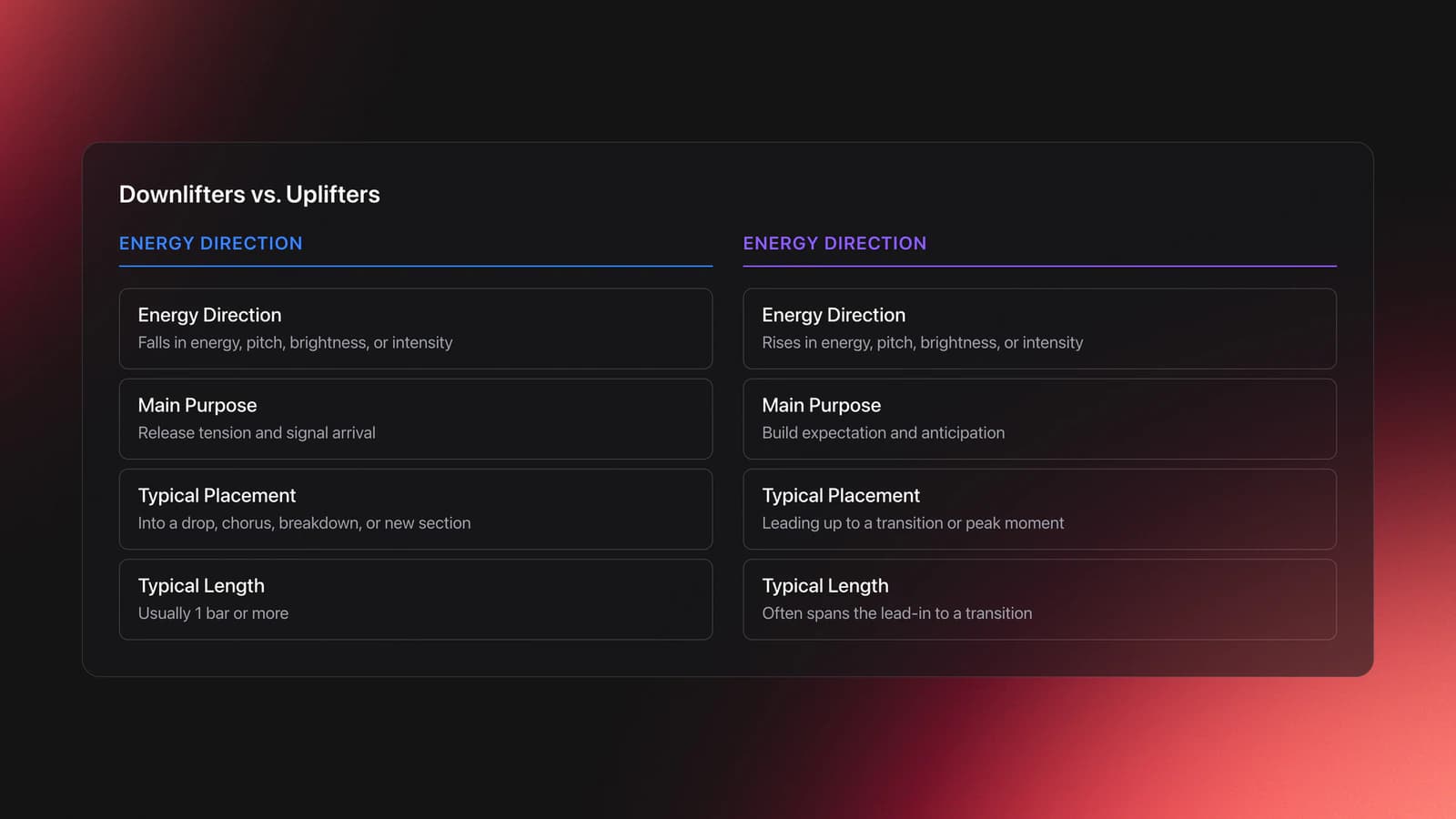
Downlifters are transition effects that fall in energy, pitch, brightness, or intensity to mark the end of a build or the move into a new section. In practice, they usually last one bar or more and help release sonic tension rather than increase it.
Native Instruments defines a downlifter as the opposite of an uplifter, with volume ramping down instead of up. MusicRadar describes downers as sweep effects used to release tension around a drop, chorus, or breakdown. EDMProd also frames a downlifter as a medium-to-long FX sound that lowers energy or signals the end of built tension.
In other words, downlifters do not exist to impress on their own. They exist to shape the listener's sense of arrival. Used well, they make transitions feel natural, controlled, and musical.
If you already compare uplifters and release effects, the relationship becomes clear. Uplifters create expectation. Downlifters create release.
Why Downlifters Matter
Downlifters matter because transitions need contrast, not just volume. Point Blank emphasizes that a strong drop depends on the difference between what comes before and what follows. A downlifter helps create that contrast by cooling the space around the transition.
They also solve a practical problem. Without a release effect, one section can stop and the next can simply appear. That feels mechanical. A downlifter gives the ear a short bridge between phrases.
For DJs, this is useful beyond production. If you make edits, intros, outros, or transition tools, downlifters help a set feel more coherent. They are especially effective when paired with lock in phrase alignment basics, because the best release effects land on phrase boundaries, not random beats.
How to Use Downlifters
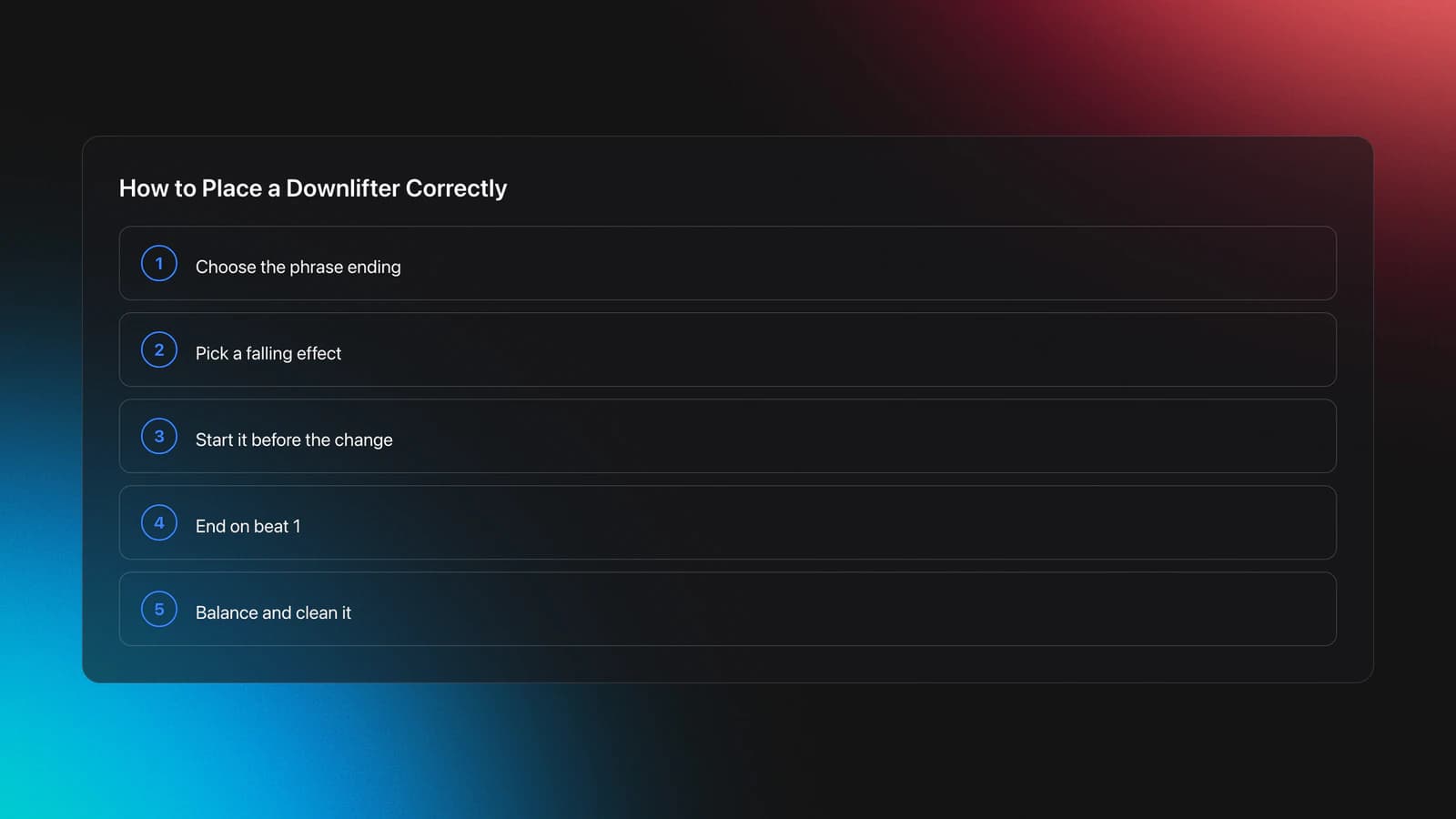
Use downlifters by placing them at the end of a phrase so they guide the ear into the next section. The core job is simple: start the effect early enough to be felt, then end it exactly where the new section begins.
- Choose a phrase ending, usually 1, 2, or 4 bars long.
- Pick a falling sweep, downer, or filtered noise tail.
- Set the start point before the section change.
- Make the effect end on beat 1 of arrival.
- Balance level so it supports, not dominates.
- Trim highs or lows if the sweep masks key elements.
The timing is more important than the sound itself. A basic white-noise downlifter placed correctly will usually work better than an expensive sample dropped at the wrong point.
Start by counting bars. In dance music, transitions usually happen in 8, 16, or 32 bar groups. Place the downlifter so its tail resolves into the first kick, chord, or vocal of the new section. If it finishes late, the transition sounds messy. If it finishes too early, the energy drops before the arrival.
Keep the frequency balance in mind. EDMProd notes that transition FX often use white noise, filtering, reverb, and delay. That means downlifters can easily fill too much midrange or top end. Cut what you do not need.
Genre matters too. EDMProd's house guide notes that energetic styles often use bigger, louder FX, while deeper styles use subtle background sweeps with reverb and delay. That is a useful rule of thumb: bigger genre, bigger gesture.
| Situation | Typical Length | What the Downlifter Should Do |
|---|---|---|
| Small phrase change | 1 bar | Signal movement without stealing focus |
| Drop into groove | 1–2 bars | Release build tension and clear space |
| Breakdown entry | 2–4 bars | Lower intensity and smooth the handoff |
| Outro or DJ edit | 2–4 bars | Wind energy down and support the exit |
Sound Design for Downlifters
Most downlifters are built from simple ingredients. MusicRadar points to noise sources, filters, envelopes, and automation as the basis of sweep effects. EDMProd similarly describes upsweeps and downsweeps as filtered white noise that can be shaped to fit the track.
The easiest version starts with white noise. From there, automate a low-pass filter downward, reduce volume over time, and add reverb or delay for width. That gives you a classic falling wash.
A second option is to resample part of your mix, then reverse, filter, or pitch it down. EDMProd recommends rendering short sections and processing them for turnarounds, including reverse and pitch effects. This often creates more character than a generic sample because it already matches your track.
You can also build downlifters from cymbal tails, vocal breaths, impact tails, synth chords, or field noise. The best source is often the one that already shares the same tone as the track.
If you want more control, use filter sweeps with intent instead of relying only on canned samples. Manual automation lets you match the exact phrase length, brightness, and decay shape you need.
Sample libraries still have a place. Splice maintains large collections of downers and downlifters across EDM, house, trance, techno, trap, and cinematic styles, which makes them useful for fast sketching or DJ edit work.
Common Mistakes With Downlifters
Most downlifter problems come from timing, level, or frequency masking. The fix is usually small. You rarely need a new sample. You need better placement.
| Mistake | Why It Happens | Fix |
|---|---|---|
| Ending late | The tail overlaps the next section | Shorten decay or move the start earlier |
| Too loud | The effect competes with the drop or vocal | Lower gain and trim midrange |
| Wrong phrase length | The sweep ignores the song structure | Match it to 1, 2, or 4 bar transitions |
| Using the same sample everywhere | Every transition starts to feel generic | Rotate sources and resample your own material |
Why do most beginners struggle with this? Because downlifters feel decorative, so they get placed by instinct instead of by phrase count. That usually leads to clutter.
Another mistake is over-designing the effect. A complex transition can work, but only if the arrangement has room for it. In deep house, tech house, and more restrained styles, subtle sweeps often work better than dramatic, midrange-heavy falls.
Practice Drills for Downlifters
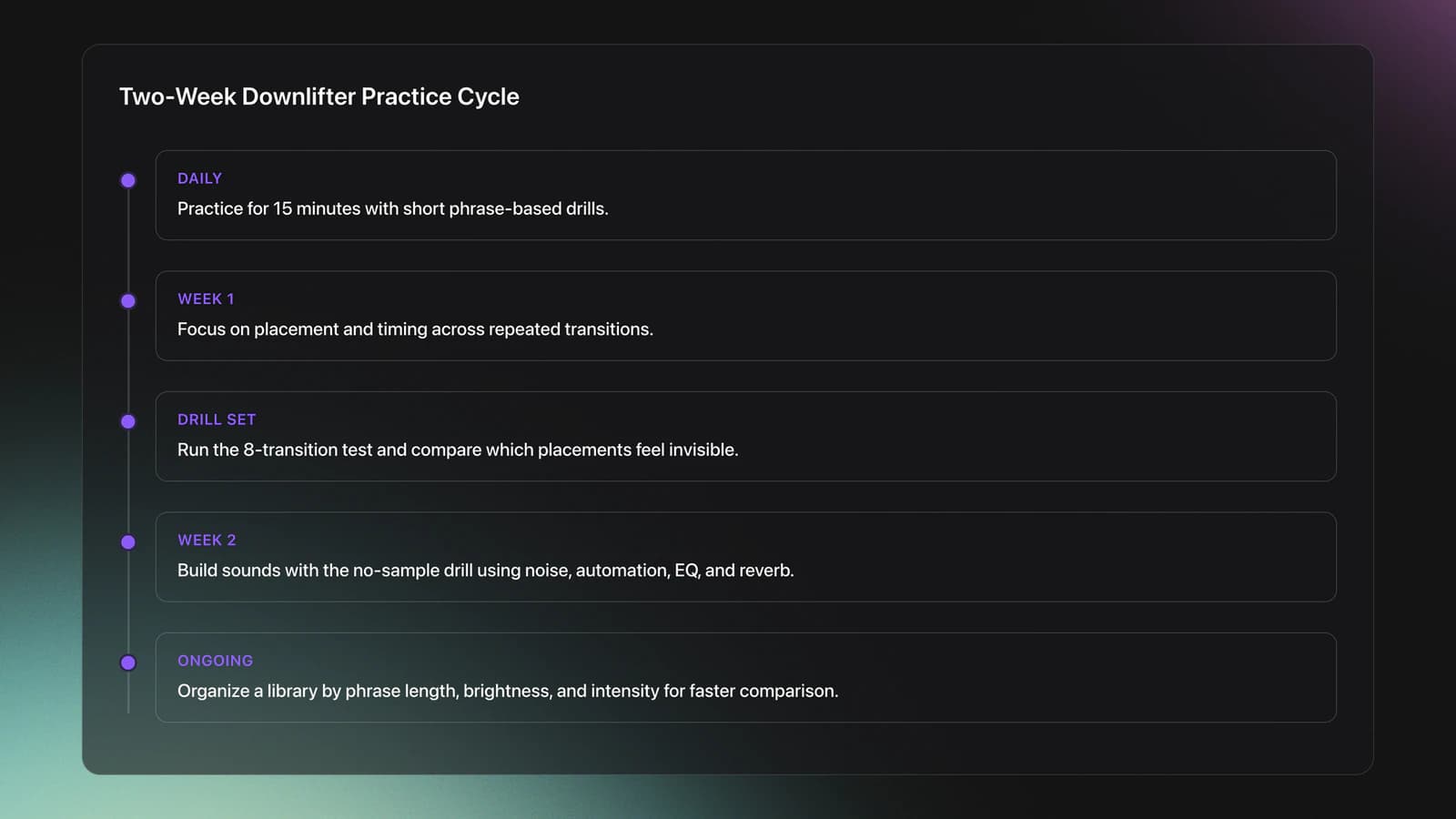
Practice downlifters by training timing first, then sound choice. The fastest improvement comes from repeating short phrase-based drills, not from endlessly browsing samples.
In practice, short transition drills build better judgment than marathon editing sessions. A two-week cycle works well: one week for placement, one week for sound design and refinement.
A useful beginner drill is the 8-transition test. Take one track or edit session and mark eight phrase endings. Add a different downlifter to each. Then listen back without looking at the screen and note which ones feel invisible in a good way.
A second drill is the no-sample drill. Build three downlifters using only white noise, automation, EQ, and reverb. This teaches what actually creates the effect: filter movement, volume shape, and timing.
If you prepare DJ edits regularly, an organized practice library helps. In Vibes, you could group transition tools by phrase length, brightness, and intensity so you can compare one-bar, two-bar, and four-bar release effects quickly instead of guessing from file names.
Before layering release FX into transitions between tracks, tighten beat matching before layering FX. If the handoff is rhythmically unstable, even a well-placed downlifter will not hide it.
Where Downlifters Work Best
Downlifters work best anywhere a section needs to land with control. Native Instruments highlights their role in moving from one section to the next. EDMProd and Point Blank both reinforce the wider principle: transitions feel stronger when tension and release are clearly shaped.
In production, the most obvious spots are pre-drop release, breakdown entry, and outro wind-down. In DJ edits, they are useful for intro tools, phrase handoffs, and tension resets before a new groove.
They also pair well with silence. Point Blank notes that micro-pauses and space before a drop can increase impact. A short downlifter into a brief gap is a classic way to make the arrival feel larger without actually pushing the limiter harder.
Equipment and File Choices
You do not need much gear to learn downlifters. A DAW or DJ editing environment, reliable monitoring, and a few good source sounds are enough.
Essential tools are simple: audio playback, automation, EQ, and reverb. Optional tools such as samplers, synths, and transition-focused plugins speed up the process, but they are not required.
File choice matters more than brand choice. Keep a small set of downlifters sorted by length and character: clean noise falls, darker filtered tails, wide reverb falls, and aggressive impact-downlifter hybrids. That will cover most real use cases.
Downlifters in Practice
Downlifters are simple, but their value is structural. They tell the listener that tension is over, the next phrase is starting, and the track is still under control.
Keep these takeaways in mind:
- Place downlifters by phrase count, not by guesswork.
- Shape release with timing, filtering, and level before adding complexity.
- Use subtle versions in restrained genres and bigger versions in high-energy styles.
Start with one-bar and two-bar transitions first. Once those feel natural, move on to custom resampling and more advanced transition chains. From there, the next logical skill is combining release tools with risers, silence, and arrangement contrast.
The visual way to organize your DJ library
Tag tracks by vibe. See everything at once. Export to rekordbox, Serato, Traktor or Engine DJ.
14-day free trial. Full access, no strings attached.
or see how it works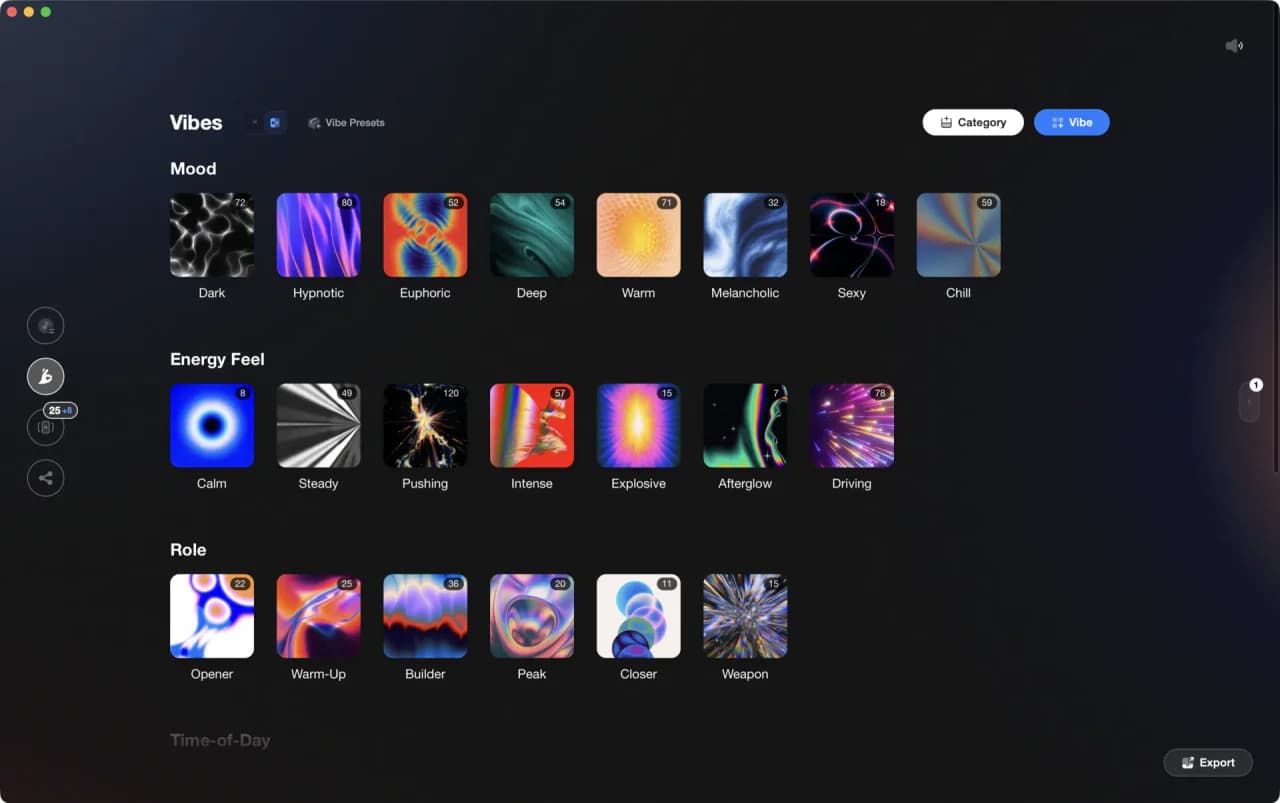
Equipment You'll Need
Fruity Delay 3
optionalA stock FL Studio delay effect that combines tempo-synced echoes, filtering, modulation, diffusion, and feedback distortion in one plugin.
Traxsource
optionalTraxsource is a digital music download store focused on house and underground dance music for DJs.
Tiptop Audio CYMBL909
optionalA dual-voice Eurorack drum module that recreates the TR-909 crash and ride cymbal circuits with added CV control and hot modular-level outputs.
Frequently Asked Questions

Hey, it's Ben Modigell 👋
I DJ and produce as so I so: downtempo, minimal, dub house, tech house, and techno (releases on Spotify and SoundCloud, links above). Everything I write here comes from my own gigs, studio sessions, and library cleanups: the rules I follow, the failure modes I have actually hit, and the workflow I use when nobody is watching. If a technique did not earn its place in my own sets, it does not make it into a tutorial.