Key and Energy Arrangement
Key and Energy Arrangement is the practice of ordering tracks so harmonic compatibility and crowd energy rise, fall, and resolve with intention across a DJ set.
Key and Energy Arrangement Tutorials

Virtual DJ Library Setup That Sticks
Key and Energy Arrangement is the DJ practice of ordering tracks so the mix feels harmonically smooth and emotionally intentional. If you already know how to learn harmonic mixing fundamentals, Key and Energy Arrangement is what turns isolated transitions into a full set that rises, breathes, and lands with purpose.
This matters because a DJ set can fail in two different ways. It can sound clean but emotionally flat, or exciting but messy. Key and Energy Arrangement helps you avoid both by choosing tracks that fit each other musically while also controlling tension, release, brightness, and impact across time.
For most DJs, Key and Energy Arrangement unlocks better warm-ups, more convincing peak-time lifts, and fewer panic decisions in the booth. It also makes practice more efficient, because you stop judging tracks one by one and start hearing how each record behaves in a larger sequence.
The visual way to organize your DJ library. Tag by vibe, export to any DJ app.
What Is Key and Energy Arrangement?
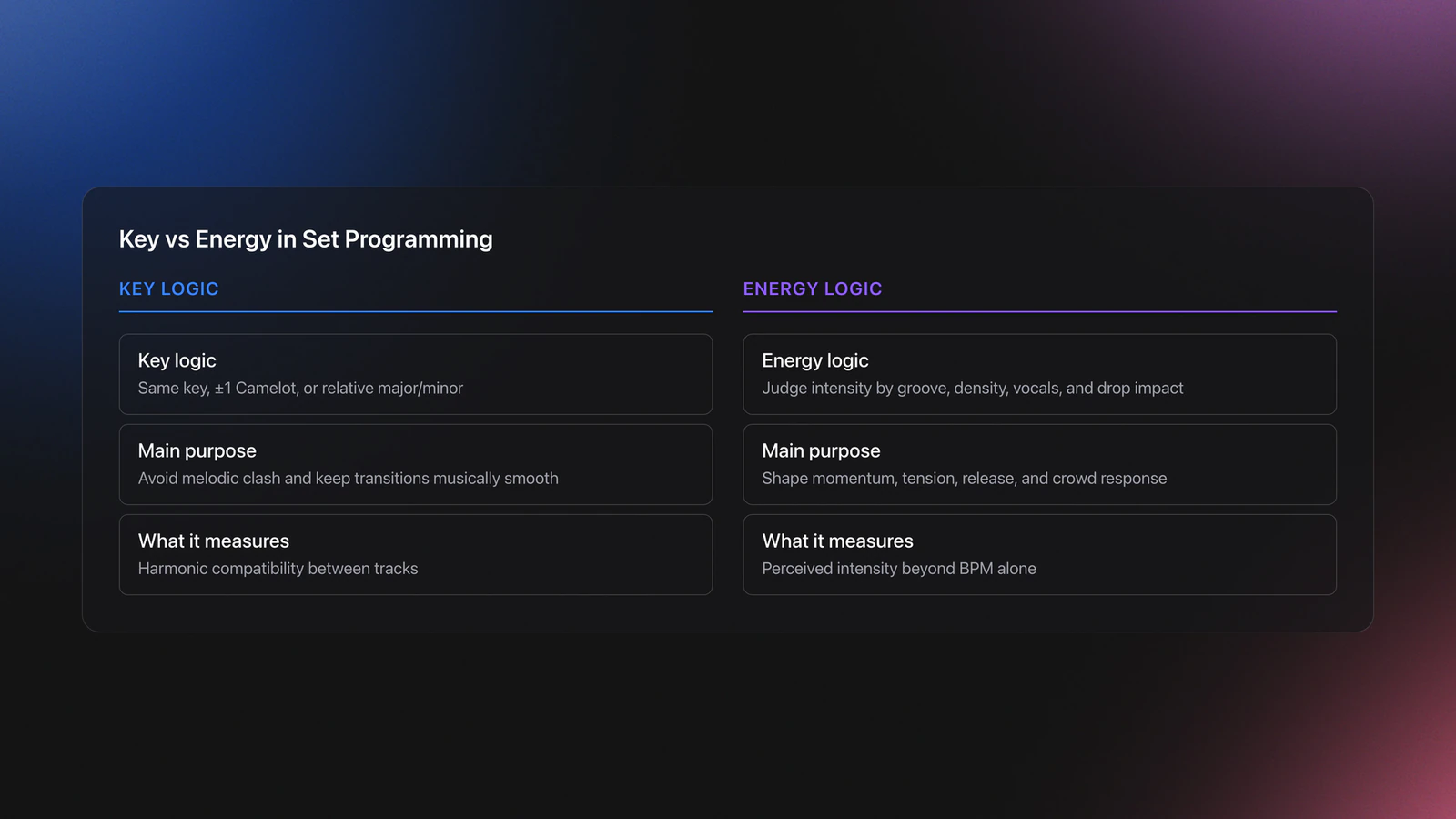
Key and Energy Arrangement is the process of sequencing tracks by both harmonic relationship and perceived intensity so a DJ set feels coherent, dynamic, and purposeful. In practice, that means balancing key compatibility, mood, arrangement density, and crowd energy instead of relying on BPM alone.
The key side comes from harmonic mixing. Mixed In Key explains the basic Camelot logic as same key, plus one, minus one, or relative major and minor changes. VirtualDJ describes the same idea as mixing tracks in the same or similar key to avoid clashing melodies and make transitions smoother. Educational resources like the Mixed In Key harmonic mixing guide and the VirtualDJ harmonic mixing overview cover those baseline rules.
The energy side is broader. BPM affects pace, but arrangement, sound design, groove density, vocal weight, and drop impact shape how intense a track actually feels. The Mixgraph DJ set planning guide and Mixgraph Camelot wheel guide both stress that key is only one dimension of a good transition.
That is why Key and Energy Arrangement is best treated as a programming technique, not a strict rule system. The goal is not perfect theory on every transition. The goal is to make the next record feel inevitable.
Why DJs Use It
DJs use Key and Energy Arrangement because it improves set flow, reduces clashing transitions, and gives more control over emotional pacing. It is especially useful in melodic genres, long blends, and sets where storytelling matters as much as technical cleanliness.
- Creates smoother melodic and vocal transitions
- Helps build tension without random jumps
- Makes warm-up, peak, and closing phases clearer
- Improves confidence when selecting the next track
- Turns key data and energy labels into practical decisions
It also solves a common beginner problem. Many DJs sort by BPM and call it planning. That can work for simple blends, but once melodies overlap, vocals stack, or the room needs a more deliberate lift, BPM alone stops being enough.
How to Build Key and Energy Arrangement
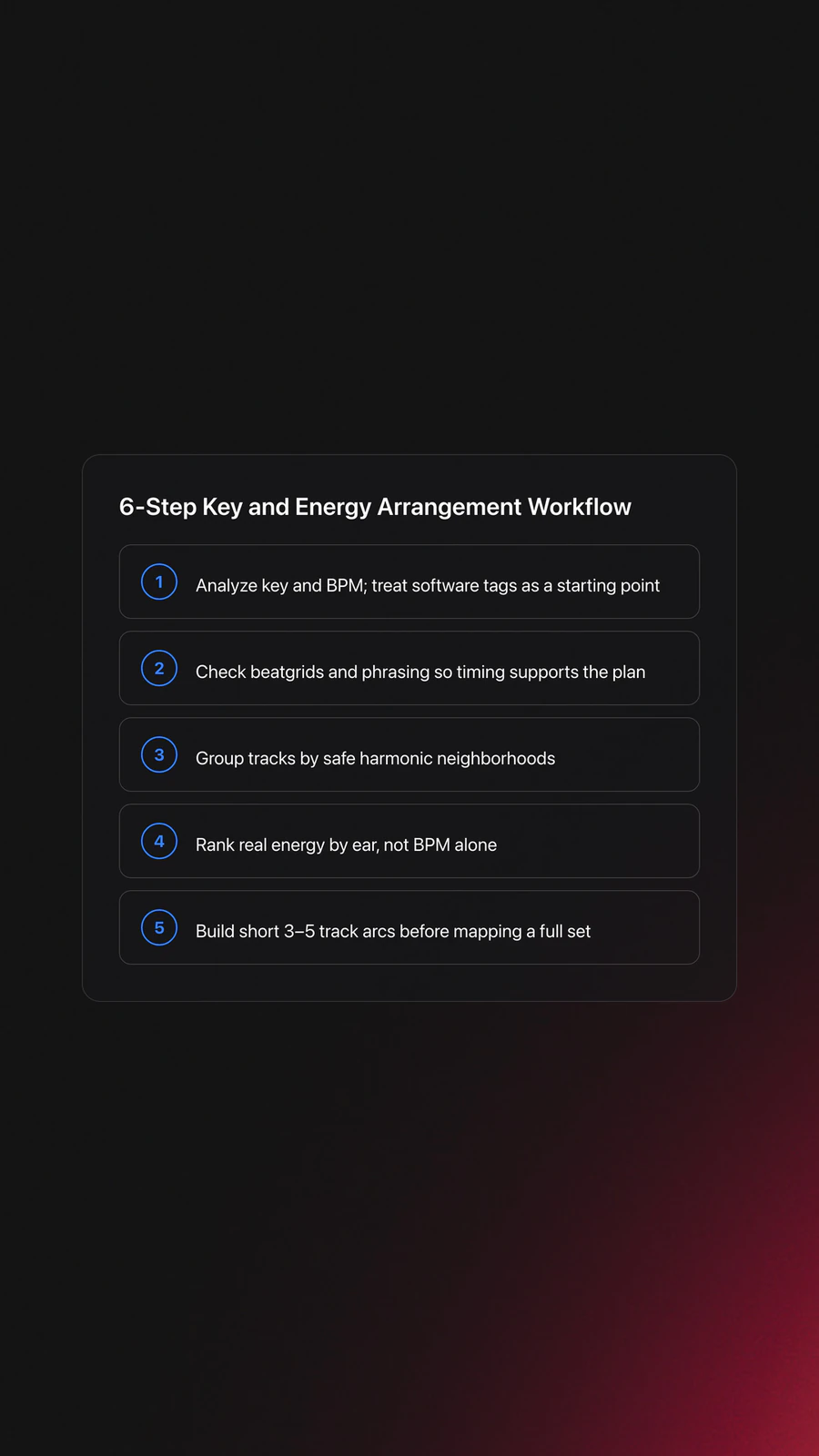
To build Key and Energy Arrangement, first analyze your tracks, then group them by harmonic compatibility, rank their real energy, and finally test transition paths in phrases. The method is simple, but the quality comes from honest listening.
| Step | Action | Key Point |
|---|---|---|
| 1 | Analyze key and BPM | Use software data as a starting point, not the final truth |
| 2 | Check beatgrids and phrasing | Bad timing ruins good programming |
| 3 | Group by compatible keys | Same key, adjacent key, and relative major or minor are safest |
| 4 | Rank tracks by felt energy | Judge groove, arrangement, and impact, not BPM alone |
| 5 | Build short 3–5 track arcs | Think mini-story before full set |
| 6 | Test transitions in context | A good pair can still fail inside the wrong sequence |
Start with accurate library data. Serato recommends analyzing tracks as they are added to the library so key, BPM, and beatgrid information are ready before use. See the Serato file analysis documentation for the current workflow.
Next, sort tracks into harmonic neighborhoods. Basic Camelot practice is conservative for a reason. Same key works. Plus one and minus one usually work. Relative major and minor changes can shift mood while staying musically connected. If you still need the foundation, use the Camelot wheel with confidence before trying more expressive arrangement decisions.
Then rank energy by ear. A sparse 130 BPM roller can feel lower than a dense 124 BPM anthem. Listen for drum weight, bass pressure, vocal urgency, brightness, breakdown length, and how hard the drop re-enters.
After that, build small chains. Instead of planning an hour at once, test three tracks that hold level, three that lift, or three that intentionally dip before a peak. This is where it clicks.
Finally, rehearse transitions with tight phrase matching skills. A brilliant key move can still sound wrong if the outgoing breakdown and incoming phrase land in the wrong places. Timing and programming are inseparable.
Reading Key Changes Without Overthinking
You do not need to treat the Camelot wheel like law. You need to treat it like a map. Safe moves protect long blends, while riskier moves create contrast, lift, or reset when used with intention.
The safest arrangements usually stay in the same key or move one step around the wheel. The Mixed In Key harmonic mixing guide presents these as the core moves, and the Mixgraph Camelot wheel guide explains why they matter most during longer melodic overlaps.
A same-number A to B or B to A switch changes emotional color more than structural stability. Minor often feels darker or tenser. Major often feels brighter or more open. That makes these switches useful when you want a lift without a huge change in groove.
More aggressive moves exist too. The DJ TechTools advanced key mixing guide describes energy boost ideas and major-minor flips that can create strong effect in short transitions. These are creative tools, not default settings.
In other words, use safe harmonic moves for stability and expressive moves for punctuation. If every transition tries to be clever, the set loses shape.
Shaping Energy Across a Set
Shaping energy means deciding when to hold, lift, dip, and peak so the crowd experiences motion instead of a flat line. The best Key and Energy Arrangement usually feels dynamic, not constantly maximal.
A useful starting model is low, build, release, rebuild, peak, resolve. That pattern works in club sets because people need contrast to feel the peak. Continuous intensity becomes background after a while.
This does not mean every set must look the same. Warm-up slots need restraint. Opening tracks should leave room. Peak-time sequences can climb faster. Closing sets often use deeper harmonic movement and more emotional release.
Most instructors now frame set planning as an interaction between BPM, key, and energy rather than a single metric. The Mixgraph DJ set planning guide makes that explicit by showing that one variable can rise while another stays steady.
If you want to go deeper on that layer, map energy flow across a set. Key and Energy Arrangement becomes much easier once you can hear where a set should breathe.
Practice Drills for Key and Energy Arrangement
The fastest way to improve Key and Energy Arrangement is with short, repeatable drills. Through daily 15-minute practice sessions over several years, I found that small sequence drills build judgment faster than marathon library sorting, because you hear cause and effect immediately.
Start with one genre and one tempo window. Pick 12 tracks. Analyze them, then assign each an energy score from 1 to 5 based on how they feel in the room, not how loud they look on screen.
Now build three mini-sets. First, a stable arc with no obvious energy jump. Second, a rising arc that peaks by track five. Third, a wave arc that intentionally dips after track three before climbing again.
Record each version. Listen back the next day. You are not judging mixing polish yet. You are judging whether the sequence feels natural, rushed, static, or confused.
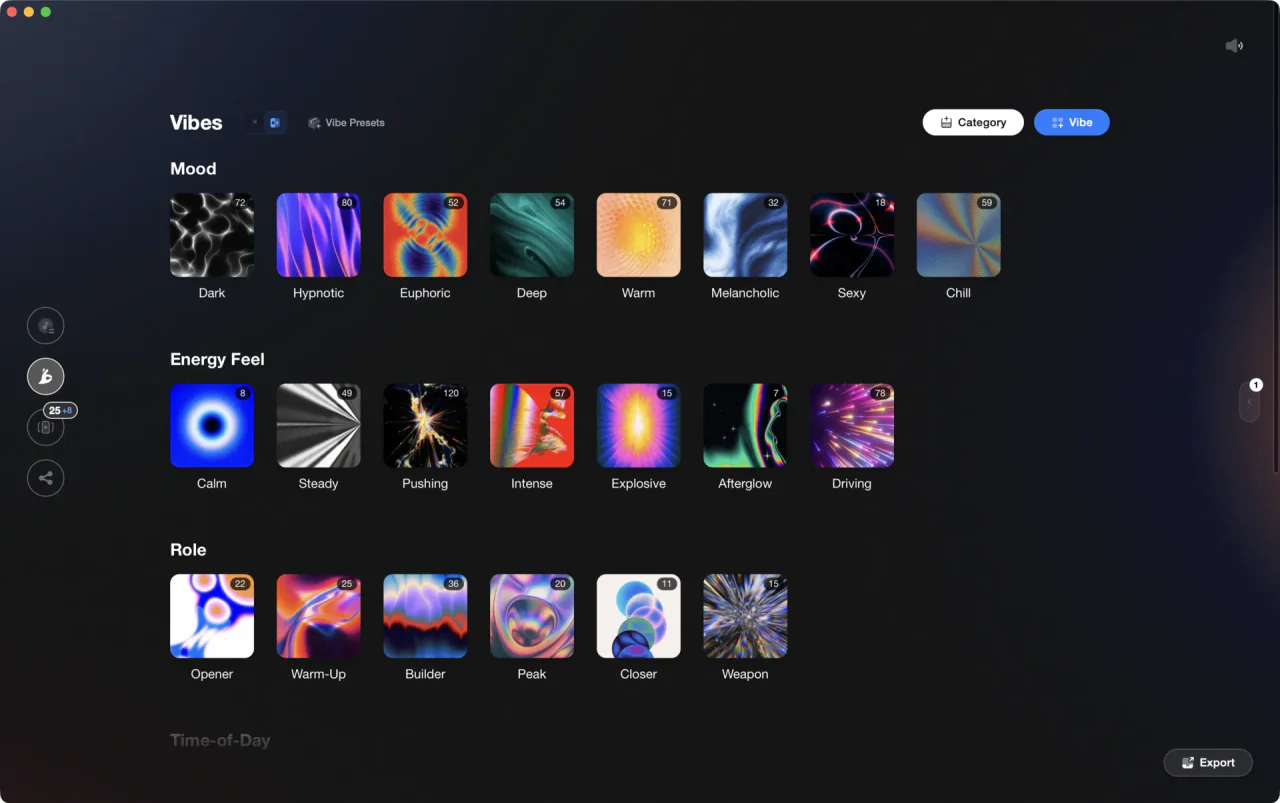
For repeatability, keep your practice folders organized by key family, mood, and intensity. In Vibes, that can mean building practice collections that separate low-energy openers, bridge tracks, and peak-time tools, so your arrangement drills stay consistent instead of turning into random digging.
A solid progression target is simple. Hold a coherent 5-track run within compatible keys, keep the energy direction intentional, and avoid one transition that feels out of character. Once you can do that reliably, practice longer melodic blends.
Common Mistakes
Most Key and Energy Arrangement mistakes come from trusting metadata too much or treating theory like a shortcut. The technique works best when analysis data supports listening, not replaces it.
| Mistake | Why It Happens | Fix |
|---|---|---|
| Sorting only by BPM | Tempo is easy to see, energy is harder to judge | Score tracks by felt intensity and arrangement density |
| Trusting key detection blindly | Software can misread ambiguous intros or modal tracks | Audition melodic overlap before committing |
| Staying in one key too long | Safe transitions feel comfortable | Use relative major-minor or adjacent moves to add motion |
| Using energy boost tricks too often | Big lifts feel exciting in isolation | Reserve bold jumps for short, intentional moments |
| Ignoring phrase structure | Programming feels correct on paper | Test every transition with real phrase timing |
Why do most beginners struggle here? Because sequencing feels less objective than beatmatching. You can see whether two kick drums align. It takes longer to hear whether five tracks tell one emotional story.
That is normal. Keep your ears on the crowd outcome. If the next record sounds compatible but kills momentum, it was still the wrong choice.
Troubleshooting Flat or Messy Sequences
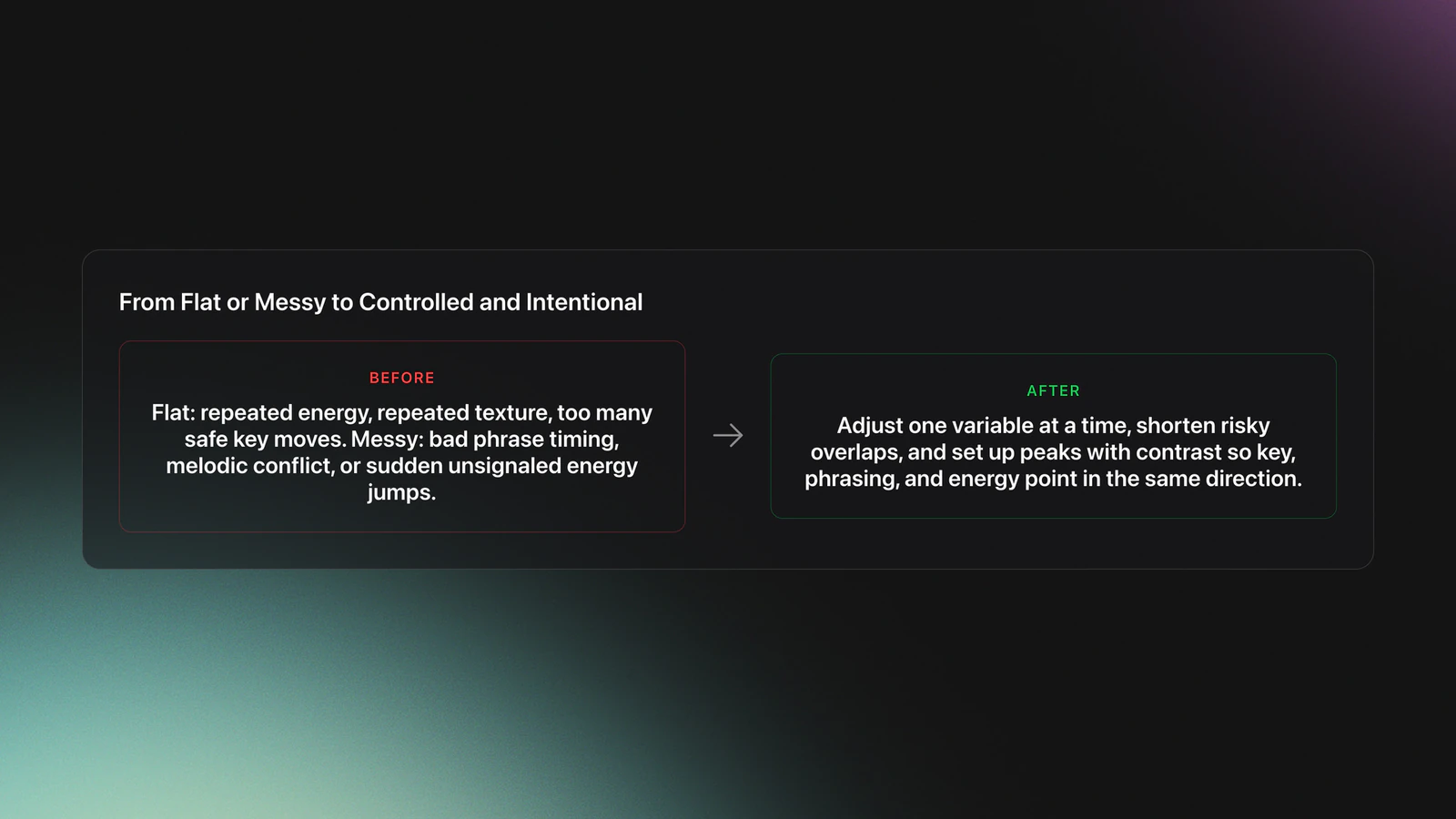
If a sequence feels flat, the issue is usually repeated energy level, repeated texture, or too many safe harmonic moves in a row. If it feels messy, the issue is usually phrase timing, conflicting melody, or an energy jump that arrived without setup.
Flat sequences often improve when you change only one variable. Keep BPM steady, but brighten the key. Or keep the key close, but raise the drum density. Small controlled moves usually sound more professional than random leaps.
Messy sequences often improve when you shorten the overlap. The DJ TechTools advanced key mixing guide notes that more adventurous key moves are safer in shorter transitions. That principle applies broadly.
If a planned peak does not land, check what came before it. Peaks fail when the crowd was already saturated, when the bridge track was too similar, or when the lift changed key and energy in conflicting directions.
Equipment and Library Setup
You do not need special hardware for Key and Energy Arrangement, but you do need reliable track analysis and an organized library. Good preparation matters more than expensive gear.
Essential setup includes DJ software that shows key and BPM, accurate beatgrids, headphones for cueing, and enough time to review transitions critically. Serato documents current analysis features, including key and BPM detection during import, in the Serato file analysis documentation.
Optional tools help when the library gets large. Camelot tagging, color coding, comments for energy notes, and smart crates or playlists all reduce decision load. This is especially useful if you are building genre-specific arrangement drills or separate warm-up and peak-time libraries.
If your tracks are not cleanly analyzed, fix that before blaming your programming. Bad beatgrids and unreliable key tags create fake problems.
How to Know You Are Improving
You are improving at Key and Energy Arrangement when your sets need fewer rescue moves, your transitions sound more intentional, and your 5-track sequences hold one emotional direction without drift. Improvement shows up in consistency before it shows up in flair.
A practical checkpoint is this: build a 5-track arc in one genre, stay within compatible keys, and create either a steady rise or a controlled wave without one awkward handbrake moment. Repeat that across three different crates.
A stronger checkpoint is being able to swap one middle track and preserve the arc. That proves you understand function, not just memorized one lucky order.
Closing Thoughts
Key and Energy Arrangement is what makes track selection feel like storytelling instead of filing. It combines harmonic awareness with crowd psychology, then turns both into practical sequencing choices you can trust under pressure.
Keep these takeaways in mind:
- Use key data to guide choices, but let your ears make the final call
- Judge energy by feel, arrangement, and impact, not BPM alone
- Practice in short sequence drills before building full-set arcs
Start with a 5-track progression in one genre, then refine it until every transition has a clear role. After that, branch into map energy flow across a set or more advanced harmonic movement. This is where strong programming starts to sound effortless.
The visual way to organize your DJ library
Tag tracks by vibe. See everything at once. Export to any DJ software.
A visual system for organizing your DJ library.
Frequently Asked Questions

Hey, it's Ben Modigell 👋
I DJ and produce as so I so — downtempo, minimal, dub house, tech house, and techno (releases on Spotify and SoundCloud, links above). Everything I write here comes from my own gigs, studio sessions, and library cleanups: the rules I follow, the failure modes I've actually hit, and the workflow I use when nobody's watching. If a technique didn't earn its place in my own sets, it doesn't make it into a tutorial.