
How Many Songs Are in a DJ Set
Most DJ sets run 10 to 20 tracks an hour, because a track normally holds the floor for three to five minutes before the next one comes in, not for its full length. Divide 60 by that play time and you have your own number for any set length.
Quick Answer
Play time, not track length, sets the count
A six minute track almost never gets six minutes of airtime. You bring the next one in over the outro, so the number that decides everything is how long each track holds the floor on its own. Call that its play time. Sixty divided by your average play time is your tracks per hour, and the rest of this page is that one sum applied to different set lengths.
The spread between DJs is real. Search how many songs in a DJ set Reddit and you will see working DJs quote anything from six tracks an hour to more than fifty, and almost all of them are right for their own room. Genre, tempo, and how hard you cut decide which end you sit on.
| Style | Typical track length | Play time per track | Tracks per hour |
|---|---|---|---|
| House, tech house | 6 to 7 minutes | 4 to 5 minutes | 12 to 15 |
| Techno | 6 to 8 minutes | 3 to 5 minutes | 12 to 18 |
| Trance, progressive | 7 to 9 minutes | 5 to 7 minutes | 8 to 12 |
| Drum and bass | 5 to 6 minutes | 2 to 3 minutes | 20 to 30 |
| Hip hop, open format | 3 to 4 minutes | 1 to 2 minutes | 30 to 50 |
| Wedding, party | 3 to 4 minutes | 2 to 3 minutes | 20 to 25 |
Planning estimates for a first pass. Measure one of your own sets and replace them.
Track counts by set length
Once you know your play time, every set length is the same sum. If you are asking how many songs in a 30 minute DJ set, six to eight covers it with long blends and twelve to eighteen with quick cuts. How many songs in a 45 minute DJ set works out at nine to eleven or eighteen to twenty-five on those same two styles.
| Set length | Long blends: house, techno, trance | Quick cuts: open format, hip hop |
|---|---|---|
| 30 minutes | 6 to 8 | 12 to 18 |
| 45 minutes | 9 to 11 | 18 to 25 |
| 1 hour | 12 to 15 | 25 to 40 |
| 2 hours | 24 to 30 | 50 to 80 |
| 3 hours | 36 to 45 | 75 to 120 |
| 4 hours | 48 to 60 | 100 to 160 |
| 5 hours | 60 to 75 | 125 to 200 |
Tracks you will actually play. Load about double.
Always prepare more than you play
Every honest answer to this question comes with the same caveat: bring roughly double. The room will not follow your plan, the promoter will ask for one more, and two of your picks will not work on that system.
- Plan the set at your realistic tracks per hour, then load twice that many.
- Split the shortlist into warm-up, peak, and closing groups so you can jump between them.
- Keep six to ten safe tracks you know land, in every tempo you might need.
- Add a few tracks a step above and below your target tempo in case the room drags or races.
- Do not take the whole collection. A shortlist you can read at two in the morning beats a library you have to search.
Measure your own tracks per hour
Averages get you close. One measured set gets you the real number, and your DJ app already recorded it.
- 1
Play one honest hour
Play a full hour the way you would at the gig: same genre, same energy, same mixing style. A number taken from a practice mix you cut short will not survive a real room.
- 2
Read the play log
Serato DJ Pro keeps a complete log of every session in the History panel, with a Start Time, an End Time, and a Playtime for each track, so you can see exactly how long each one held the floor. In rekordbox, the Histories list in the Media Browser collects the tracks that played for one minute or more in PERFORMANCE mode or LINK EXPORT, filed by date.
- 3
Divide sixty by the average
Add up the play times, divide by the number of tracks, then divide 60 by that average. Forty tracks across a two hour session is twenty an hour and an average play time of three minutes.
- 4
Build the next shortlist at double
Multiply your rate by the set length, then double it. In Serato you can gather candidates in the Prepare panel, but that panel is cleared when you quit, so drag the selection onto the Make New Crate button to keep it.
- 5
Let a rule top up the list
A rekordbox Intelligent Playlist filters your collection with conditions such as greater than, less than, and is in the range, and can match all or any of them, so a tempo band or a recent-additions window fills the gaps without hand-picking every track.
- 6
Recount after a few gigs
Your rate changes with the genre and the slot. Recheck the log after a warm-up set and after a peak-time set, and keep two numbers rather than one average that fits neither.
Where Vibes fits
Vibes does not play the set. It is a library prep app for files you own, so its job is the part before the gig: getting a shortlist that is the right size and in the right order.
Import Wizard reads a rekordbox, Serato, Traktor, Engine DJ, or Apple Music library, or a plain folder, and Smart Import detects which app it came from. Set Designer sorts a shortlist by Energy Flow, ascending, descending, or an arc, and Find Compatible pulls harmonic Camelot neighbors inside a BPM window when a slot still needs filling. When the list is the size you want, Vibes exports it back to rekordbox, Serato, Traktor, or Engine DJ as a folder tree, with optional Camelot key or BPM sub-folders.
What it does not do: no decks, no mixing, no recording, no streaming import, and no playback to hardware. The set still runs in your DJ app.
Continue readingSet DesignerOrder a shortlist by energy or key path, then export it back to your DJ app.The visual way to organize your DJ library
Tag tracks by vibe. See everything at once. Export to rekordbox, Serato, Traktor or Engine DJ.
14-day free trial. Full access, no strings attached.
or see how it works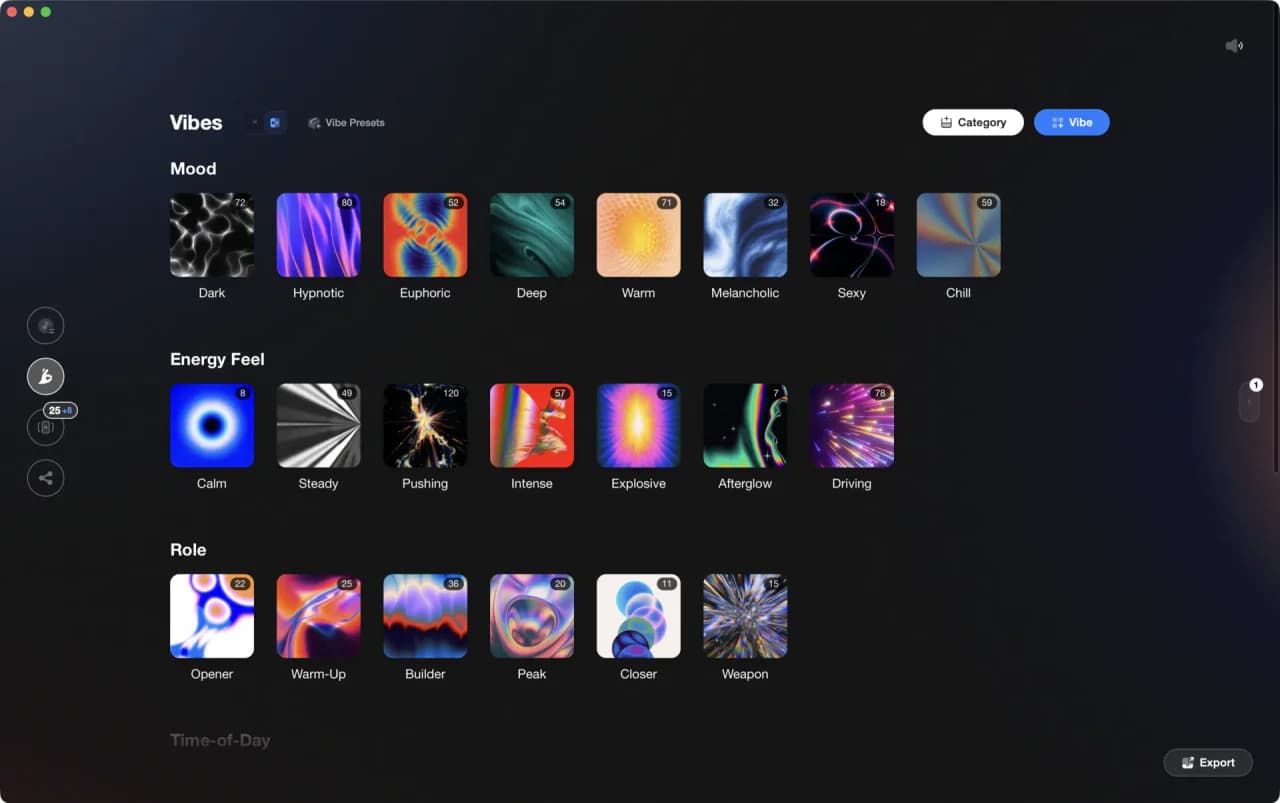
Frequently Asked Questions
Hey, it's Ben Modigell 👋
I DJ and produce as so I so: downtempo, minimal, dub house, tech house, and techno (releases on Spotify and SoundCloud, links above). Everything I write here comes from my own gigs, studio sessions, and library cleanups: the rules I follow, the failure modes I have actually hit, and the workflow I use when nobody is watching. If a technique did not earn its place in my own sets, it does not make it into a tutorial.