
How Many Tracks Does a DJ Need
Track count is a planning number, not a bragging number. This guide sizes three separate things: the tracks a set uses, the tracks you carry to the gig, and the library sitting behind both.
Quick Answer
Set Size, Gig Size, Library Size
Three different numbers get mixed up in this question. When people ask how many songs does a DJ need, they usually mean one of three things, and the honest answer is different for each.
- Set size: what the crowd hears. Roughly 15 to 25 tracks per hour for most club styles.
- Gig size: what you carry as options. Two to three times set size, so you can react instead of read out a list.
- Library size: everything you own, know and can call up on demand. This is the number that grows for years.
Set size is fixed by the clock. Gig size is a judgment call about how much room you want to move. Library size is the only one that is genuinely open ended, and it is also the one where most DJs overspend attention.
How Many Tracks You Play Per Hour
Track count per hour follows your mixing style far more than your genre. The longer you blend, the fewer tracks you get through.
| Mixing style | Time on each track | Tracks per hour |
|---|---|---|
| Long blends, house and techno | four to five minutes | 12 to 15 |
| Standard club mixing | three to four minutes | 15 to 20 |
| Open format and top 40 | two to three minutes | 20 to 30 |
| Quick cut party sets | under 90 seconds | 40 or more |
Typical tracks per hour by mixing style
Pick the row that matches how you actually play, not the one you admire. If you are working out the exact count for one booking, the per set math lives on how many songs for a DJ set.
Size The Library For The Gig You Have
Work backwards from the booking. The number falls out of five short steps, and you only have to do this once per type of gig you play.
- 1
Take the set length in hours
Use the paid time, not the time you hope to play. A four hour wedding reception is four hours even if an hour of it is dinner volume.
- 2
Multiply by your tracks per hour
Use the table above. Four hours of standard club mixing is about 60 to 80 tracks of music that will actually be heard.
- 3
Multiply that by two or three
You are buying options, not filler. Two and a half times the set is enough to change direction twice without repeating yourself.
- 4
Subtract what you cannot find fast
A track you own but cannot locate under pressure does not count. Only tracks with a correct BPM, key and a tag you trust belong in the total.
- 5
Fill the gaps by role, not by volume
List the roles the night needs: openers, floor fillers, one or two safety records, closers. Buy for the empty roles instead of buying more of what you already have.
Starter, Gigging And Resident Libraries
| Stage | Playable tracks | What it covers |
|---|---|---|
| Practice and open decks | 100 to 150 | one or two hours inside a single style |
| First paid bookings | 200 to 300 | a full four hour night with room to react |
| Regular resident | 500 to 1,000 | several rooms, several crowds, an audience that returns |
| Long collection | 3,000 and up | an archive, of which only a slice is ever gig ready |
Library size by stage of a DJ career
Notice how slowly the useful number grows. Going from 300 to 3,000 tracks does not make a night ten times better. It mostly makes searching ten times slower unless the collection is organized as it grows.
Why A Bigger Library Stops Helping
There is a ceiling, and most DJs hit it somewhere in the low thousands. After that, the limit is not what you own, it is what you can recall in the eight seconds before the current track runs out.
- Unheard tracks. If you have never listened past the first 30 seconds, you cannot mix out of it.
- Duplicates. The same record in two formats splits your ratings and your history across two entries.
- Missing analysis. No key, no BPM, no energy value means no shortlist and no fast decision.
- Dead genres. Folders from a style you stopped playing three years ago still slow down every search.
How Many New Tracks To Add Each Month
Ten to thirty new tracks a month keeps a set moving without flooding the library. The rule that matters is not the quantity, it is the deadline: whatever you buy this week gets analyzed, tagged and rated this week, or it never enters rotation at all.
Two habits make that stick. Process new music in one weekly batch, and delete or archive anything you have skipped over three gigs running.
Where Vibes Fits
Vibes is a library prep app, not a DJ app. It has no decks, it does not mix or record, and it works on the audio files you already own rather than on streaming catalogs. What it does is make the difference between owning tracks and having a gig ready set of them.
- Import Wizard, with Smart Import auto-detecting rekordbox, Serato, Traktor, Engine DJ, an Apple Music or iTunes Library.xml, or plain folders.
- Track analysis for BPM, key, energy curve and sections, so a shortlist can be built on numbers instead of memory.
- Auto-Tagging, Vibe Sort and Combinations to get every track into a vibe you can search by.
- The duplicate finder with exact, metadata and audio-similarity layers, plus watched folders for new arrivals.
- Set Designer with Energy Flow sorting, then export back to rekordbox, Serato, Traktor or Engine DJ as a folder tree.
The playing is still yours. See the library features for what the prep side covers.
The visual way to organize your DJ library
Tag tracks by vibe. See everything at once. Export to rekordbox, Serato, Traktor or Engine DJ.
14-day free trial. Full access, no strings attached.
or see how it works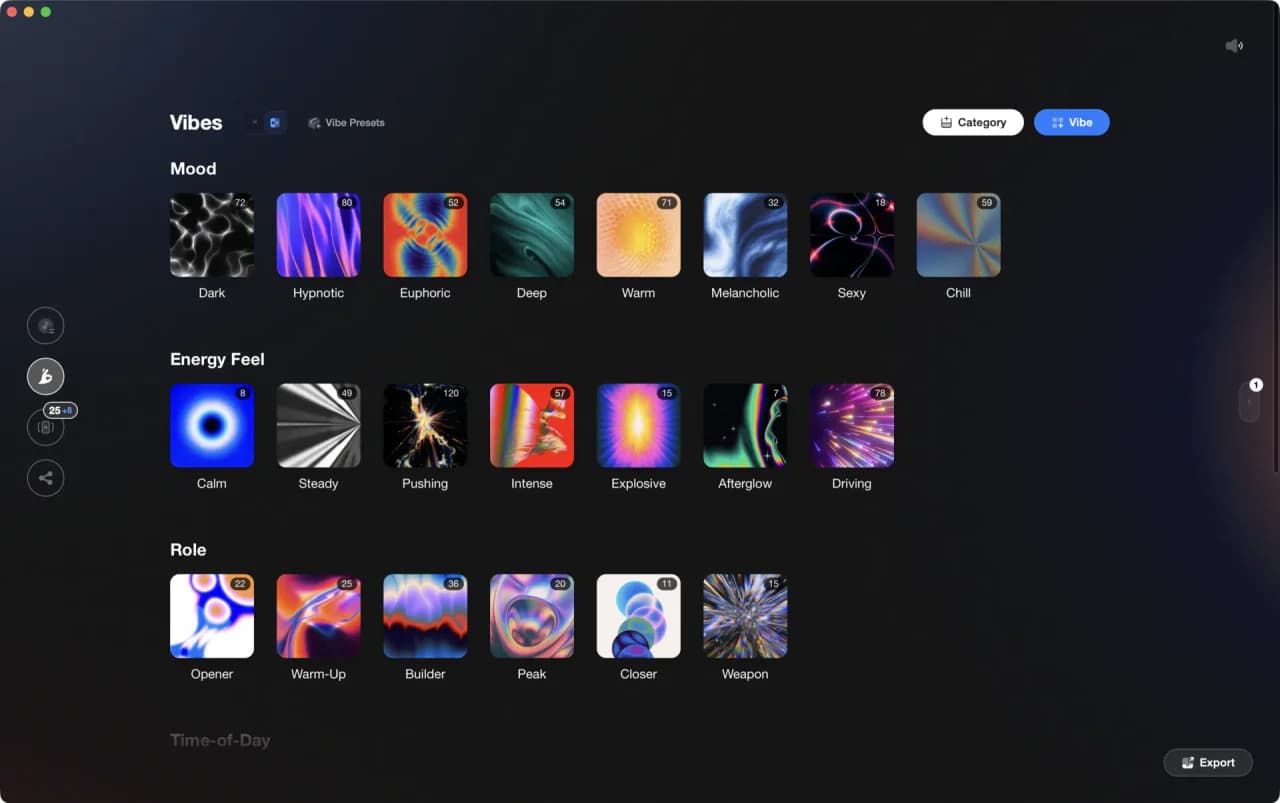
Frequently Asked Questions

Hey, it's Ben Modigell 👋
I DJ and produce as so I so: downtempo, minimal, dub house, tech house, and techno (releases on Spotify and SoundCloud, links above). Everything I write here comes from my own gigs, studio sessions, and library cleanups: the rules I follow, the failure modes I have actually hit, and the workflow I use when nobody is watching. If a technique did not earn its place in my own sets, it does not make it into a tutorial.