
Warm-Up DJ Set Structure
A warm-up set is the opening slot: you fill the room, fix the tempo and mood of the night, and hand the next DJ a floor that still has somewhere to go. The craft is restraint, which in practice means choosing tracks that groove without peaking and holding an energy ceiling for the whole slot.
Quick Answer
What the opening slot is actually for
The hardest hour in DJing is the first one, because the room gives you almost nothing back. Your job is to fill the floor, fix the tempo and the mood of the night, and hand over a crowd that still has somewhere to go. For most of that hour you are DJing music people talk over, and that is the job working, not the job failing.
An opener who empties the tank early costs the whole night. Every big record you spend at 10pm is a record the headliner cannot use at 1am, and promoters notice that faster than they notice good mixing.
Your energy ceiling, hour by hour
Score your tracks 1 to 10 for how hard they push a floor, then decide the highest number you are allowed to play tonight. That ceiling is the whole discipline. Building a set by energy covers the scoring itself; the table below is the opener's slice of it.
| Where you are in the slot | What the room looks like | Energy band | What you keep out |
|---|---|---|---|
| First third | Doors open, people at the bar, nobody dancing | 2 to 4 | Anything with a big drop, anything with a famous hook |
| Middle third | First groups of dancers, floor a third full | 4 to 5 | Vocals that demand attention, tempo jumps |
| Final third | Floor filling, room clearly warm | 5 to 6 | Your best three records, and the headliner's obvious tracks |
| Last two tracks | Handover | 6, and no higher | Peaking. Leave the climb to the next DJ |
The bands are relative to the room you play. A 6 in a small bar is not a 6 at a festival, but the shape holds either way.
How to build a DJ warm up set playlist
Prepare the shape and the shortlist, not a fixed running order. The night decides the order; you decide what is allowed in the box.
- 1
Get the handover facts first
Start time, end time, who plays before you, who plays after, and what they usually open on. Write the numbers down. Everything else on this list depends on them, and none of it can be guessed from home.
- 2
Fix your ceiling and refuse to cross it
Pick the highest energy score you will play tonight, two or three points under where the next DJ starts. Say it out loud before the gig. In the booth, at 1am, with a good record in your hand, it is the only thing that will stop you.
- 3
Pull three times what you need, then cut
Filter the library down to everything in your band, then throw out anything with a drop the room already knows. Dubs, instrumentals, edits, older tracks nobody has heard for years: that is the material an opener actually lives on. Picking the songs goes deeper on the selection pass.
- 4
Order by energy, not by tempo
Sort the shortlist so the score rises one step at a time across the slot. Sorting by BPM first produces something that mixes beautifully and goes nowhere, because tempo and energy are not the same thing.
- 5
Lock the first three tracks only
You need certainty for the opening ten minutes and nothing after that. Choose an opener a couple of points below your first target and two follow-ups that hold the same level, then leave the rest of the list loose.
- 6
Add sideways spares at every level
Two or three alternates per score, all at the same height. Sideways spares let you change direction when the room is not moving, without lifting the energy early, which is the mistake that ruins most opening sets.
- 7
Check key and tempo last
Now look at whether the order is mixable and fix the joins that clash. Long blends at low volume expose a bad key match far more than a full floor does, so this pass matters more for an opener than for a peak hour.
- 8
Save it where the gear can read it
Put the shortlist in one playlist named for the night, export it to the format the booth needs, and carry it on two USB sticks. Then run through preparing for the gig so the night does not turn on a file that will not load.
If you want the whole plan on one page you can fill in beforehand, use the set planning template. When you are handing over rather than being handed to, how to play a peak time set shows what the next DJ is expecting from you.
Playing the opening slot on club gear
A warm-up is the one slot where DJ equipment for beginners is genuinely enough. Nothing you play needs four decks, stems or effects, and whichever DJing software is on the laptop, the opening hour asks for load, blend, EQ and patience.
The club's own gear
- Most opening slots are played on whatever the venue owns: a pair of players with a Pioneer DJ mixer in the middle, or an all-in-one unit.
- The Pioneer XDJ-RX3 is one of those: its maker describes it as a two channel performance all-in-one system that loads music straight from USB storage with no laptop in the booth, and it can also control Serato DJ Pro.
- Turn up with two prepared sticks and you never have to touch the house DJ setup.
Your own controller
- -A two channel DJ controller is plenty for an opening hour, and some shops and forums still call one a DJ board.
- -The [Pioneer DJ DDJ-FLX4](/learn/gear/ddj-flx4) is a two channel entry-level model its maker lists as free to use with djay, Serato DJ Lite and Traktor Play, while the older [DDJ-400](/learn/gear/ddj-400) copies the layout of a professional booth so the club feels familiar later.
- -Ask the promoter before you bring it: a gear swap mid-night is what makes a handover ugly.
Whatever you play on, park the shortlist somewhere the app can hold it. In Serato DJ software that is the Prepare panel, which Serato describes as an area for holding tracks, much like lifting records partially out of your record bag; control and P adds a track to it, and dragging the contents onto Make New Crate saves the selection for the night.
Practising an opening hour without a booking
You do not need a gig to rehearse restraint. A free DJ app on a laptop, or a DJing app on a tablet, will play two tracks against each other, and a browser mixer, which people search for as a mixer DJ online, does the same with nothing to install. Record one full hour, listen back the next day, and count how many times you reached upward too early.
Most of what an opener needs is phrasing and self-control, and both are covered by free DJing online, so paid DJing classes are not the gate. Learning to hear the eight bar and thirty two beat blocks in a track is the single skill that pays back fastest: see phrasing.
What gets an opener booked again
- You started under the room and let it come to you, instead of announcing yourself in the first ten minutes.
- You played in the genre the night is about, even when your own taste sits elsewhere.
- You held the tempo steady, so the next DJ knew exactly where to come in.
- You finished on a track that lifts slightly and resolves, not on a drop the headliner has to follow.
- You kept the volume where the sound engineer set it, all night.
- You stayed off the microphone and let the room fill on its own.
The faster way: sort the opening hour by energy
Finding an hour of tracks that groove without peaking is a filtering job, and by hand it is slow. Vibes does that pass across your library. Import Wizard pulls it in from rekordbox, Serato, Traktor, Engine DJ, an Apple Music or iTunes Library.xml, or plain folders, and Smart Import detects which app it came from.
Analysis gives every track a BPM, a key in Camelot, musical or Open Key notation, an energy curve and its sections: intro, buildup, drop, breakdown, outro. Every track then carries an energy value from 1 to 10, so Set Designer can sort a shortlist by Energy Flow ascending, which is the exact shape an opening slot needs. Find Compatible pulls the harmonic Camelot neighbours inside a BPM window, half and double time aware, so your sideways spares at each level are already picked out. When the order is right, export it back to rekordbox, Serato, Traktor or Engine DJ as a folder tree, with optional Camelot key or BPM sub-folders.
The visual way to organize your DJ library
Tag tracks by vibe. See everything at once. Export to rekordbox, Serato, Traktor or Engine DJ.
14-day free trial. Full access, no strings attached.
or see how it works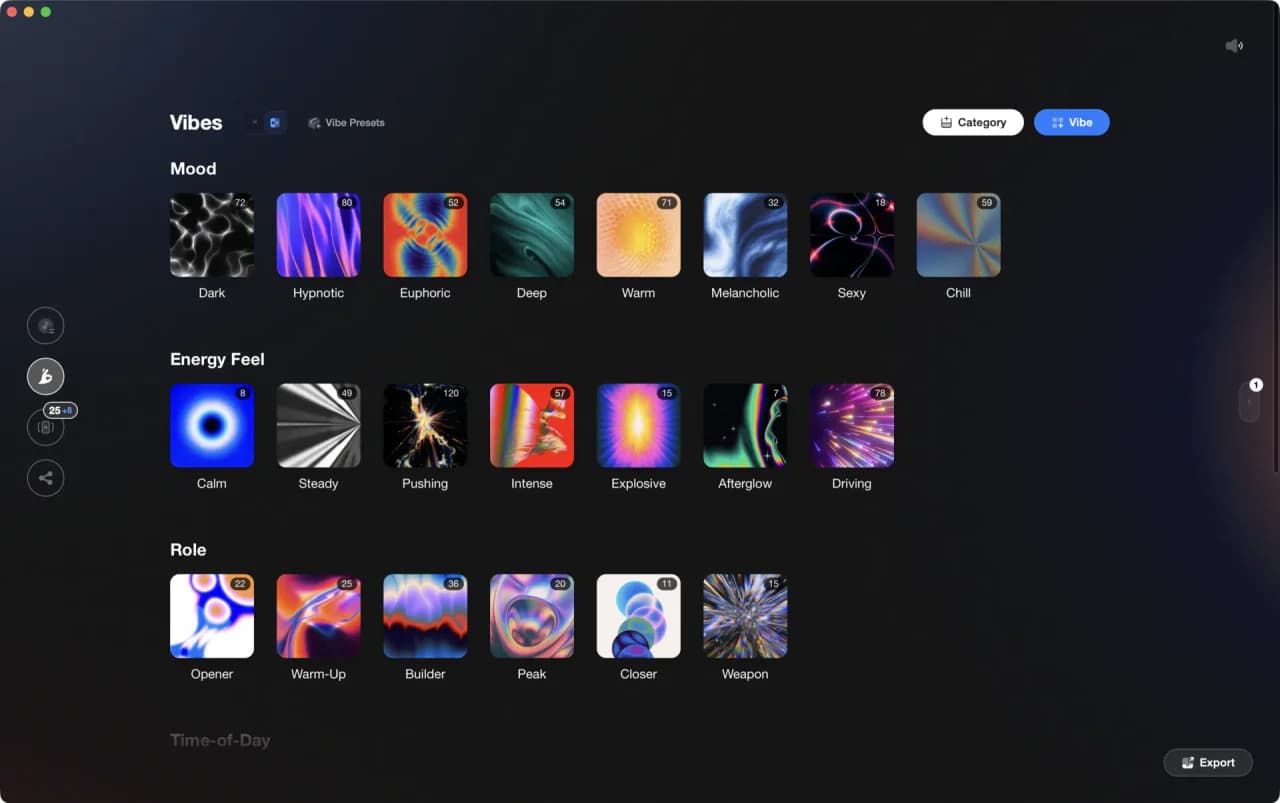
Frequently Asked Questions

Hey, it's Ben Modigell 👋
I DJ and produce as so I so: downtempo, minimal, dub house, tech house, and techno (releases on Spotify and SoundCloud, links above). Everything I write here comes from my own gigs, studio sessions, and library cleanups: the rules I follow, the failure modes I have actually hit, and the workflow I use when nobody is watching. If a technique did not earn its place in my own sets, it does not make it into a tutorial.