
DJ Set Planning Template
A set plan is a grid, not a tracklist: one row per slot, holding the clock time, the tempo band, an energy target, a key, the record and a backup. Here is the grid, the math that sizes it, and how to fill it inside rekordbox, Serato DJ, Traktor or Engine DJ.
Quick Answer
The Grid: One Row Per Slot
A tracklist is a list of songs. A plan is a grid, and the difference is the columns. Each row is one slot in the set, and the columns hold the decisions you do not want to make in a dark booth: where you are on the clock, what tempo the room is at, how hard the record hits, what key it sits in, and what you play instead if the floor says no.
| Column | What it holds | How to fill it |
|---|---|---|
| Slot | The position in the set, numbered from the first record. | Number the rows before you have any music. |
| Clock | The wall time this slot lands on, for example 23:40. | Work backward from your set times, never forward from zero. |
| Block | Warm up, build, peak, or close. | Assign blocks first. They set the energy band for the row. |
| BPM band | A range rather than a number, for example 122 to 126 BPM. | Widen the band in the warm up, tighten it at peak. |
| Energy | A rating from 1 to 10 for how hard the record hits. | Rate it against the room, not against your taste. |
| Key | The Camelot code, for example 8A. | Fill this after energy so key never overrules the arc. |
| Track | The record you intend to play. | One per row, chosen last. |
| Backup | An alternate in the same block, band and key. | Every row gets one. Peak rows get two. |
| Notes | Mix in point, mix out point, anything gig specific. | A few words you can read at a glance. |
Nine columns. The first four are shape, the last five are music.
Two columns do most of the work. The block says what a row is for, and the energy rating stops you filing by genre when what you actually need is a record that takes the room down half a step. Everything else is bookkeeping.
Size the Grid Before You Pick Tracks
Row count is arithmetic, not instinct. Take the set length in minutes and divide by the time you actually spend on a record, which is shorter than the track length because you mix out early. Long blends in house or techno leave you around four minutes per record. Quick cuts in open format can drop that below three.
| Set length | At four minutes per track | At three minutes per track | At two minutes per track |
|---|---|---|---|
| 60 minutes | 15 slots | 20 slots | 30 slots |
| 90 minutes | 23 slots | 30 slots | 45 slots |
| 2 hours | 30 slots | 40 slots | 60 slots |
| 3 hours | 45 slots | 60 slots | 90 slots |
| 4 hours | 60 slots | 80 slots | 120 slots |
Slots, not records. Multiply the slot count by about one and a half to get how many records to prepare.
Prepare more than you plan. Roughly one and a half records per slot gives every row its backup without dragging your whole collection into the staging list. For a two hour club set that is about 45 to 60 records ready and 30 of them named in the grid.
The Four Blocks and What Each Row Owes You
Blocks are how the grid keeps its shape. Assign one to every row before you name a track, and the energy column almost writes itself.
| Block | Share of the clock | Energy band | What the row has to do |
|---|---|---|---|
| Warm up | First quarter | 2 to 4 | Set the tempo and the tone. Leave headroom above you. |
| Build | Second quarter | 4 to 7 | Climb in small steps. No row jumps more than two points. |
| Peak | Middle to late third | 7 to 9 | Your strongest records, back to back, shortest blends. |
| Close | Final stretch | 4 to 6 | Come down without emptying the floor. End on something they know. |
A starting split. Shares move with the slot you were booked for.
Read the blocks off the booking, not off a rule. An opening slot is warm up and build with the peak stripped out. A closing slot begins wherever the DJ before you left the room, so its first rows inherit their energy target from what you heard, not from what you wrote a week ago.
Continue readingHow to build a set by energyThe energy column in more detail: rating records, spacing the climb, and where the arc usually breaks.Fill the Grid Inside Your DJ App
The grid lives on paper or in a spreadsheet, but the music lives in your DJ app, and the two have to agree before you leave the house. These steps work the same whichever app you prepare in. The exact menu paths below come from the current rekordbox, Serato DJ, Traktor and Engine DJ documentation.
- 1
Make a staging list for the gig
In Traktor, right-click a playlist in the Browser Tree and choose Select as Preparation List, then right-click tracks in the Track List and choose Append to Preparation Playlist. In Serato DJ, click Prepare to open the Prepare panel and use control plus P to add tracks. In rekordbox or Engine DJ, make a plain playlist named for the date and the venue.
- 2
Tag every candidate with its job
Genre does not tell you what a record is for. In rekordbox, click the icon on the right of the screen to open the My Tag configuration window, add tags under names you choose, then tick the My Tag checkboxes on each track. To read them in the track list, open Preferences, go to the Advanced category, the Browse tab, My Tag, and select Add My Tag to the Comments.
- 3
Fill the energy and key columns
Analyze first and read the numbers off the app instead of guessing. rekordbox analyzes BPM and grid, key, phrase and vocal. Engine DJ can sort a list by BPM, Key, Rating, Comment, Genre, Length and more. The energy value is the one column no analyzer can fill for you, because it depends on the room you are playing.
- 4
Filter the collection down to one row at a time
In rekordbox, click the icon on the left of the search filter to open the Track Filter, which narrows by My Tag plus BPM, KEY, RATING and COLOR. In Engine DJ, build a Smartlist instead: BPM is in the range of, Key is compatible with, Rating is greater than, with the match all rules box checked so every condition has to hold.
- 5
Let the app propose the backup
rekordbox has a RELATED TRACKS window that lists tracks related to the loaded one, with the relation set from BPM, Key, Matching, tracks in the same genre, Ratings and My Tag. Use it to fill a backup rather than to fill the plan. It knows what is compatible. It does not know what the room needs at that minute.
- 6
Freeze the order and export it
Copy the finished order into a plain playlist named for the gig. Serato's Prepare panel is temporary, so select its contents and drag them onto the Make New Crate button to save the selection. rekordbox writes drives in EXPORT mode, and Engine DJ moves playlists, smartlists and performance data onto an external drive through the Sync Manager.
Common Ways a Set Plan Fails
Almost every set that dies on the night died at the planning desk. These are the six that show up again and again.
| Mistake | What it looks like on the night | The fix |
|---|---|---|
| Opening at peak energy | Twenty good minutes, then a flat hour with nowhere left to go. | Cap the warm up block at an energy of 4 and hold to it. |
| A locked record by record order | One track does not land and the rest of the plan is dead. | Plan blocks and anchors. Leave the rows between them as shortlists. |
| All new music | Nothing in the set has ever been tested on a floor. | Two proven records per block, minimum. |
| Key chosen before energy | Harmonically perfect and emotionally flat. | Fill energy first. Key is the tiebreaker between two candidates. |
| No backup column | You freeze, because the row offers you exactly one option. | Every row carries an alternate in the same block and tempo band. |
| Analysis you never checked | A beatgrid drifts and the blend collapses halfway through. | Check grid and key on every planned track, in the app you will play from. |
Rehearse the Plan, Then Break It
A plan you have never played is a guess with columns. Run it once before the gig, standing up, at the tempo you will actually play.
- Play the transitions, not the tracks. Mix out at the point written in the notes column and confirm the next record lands where you expected.
- Time the blocks against a clock. A build that runs long puts the peak in the room after the room has already left.
- Try every backup at least once, so the alternate is a decision you already made rather than one you make under pressure.
- Mark the two rows you trust least and prepare a third option for each of them.
Then leave the paper in your bag. On the night you need the shape in your head and the staged list in the app. The grid is a preparation tool, and a DJ reading a spreadsheet is a DJ not reading the floor.
The Faster Way: Build the Grid in Vibes
The slow part of this is never the layout. It is the three columns you cannot read off a filename: energy, key, and what actually mixes into what.
Vibes does that pass on the library first. The Import Wizard reads an existing rekordbox, Serato, Traktor, Engine DJ or Apple Music library, or a plain folder of files, and Smart Import detects which app it came from. Track analysis gives every file a BPM, a key shown in Camelot, musical or Open Key notation, an energy curve, sections for intro, buildup, drop, breakdown and outro, and lead or vocal regions. Auto-Tagging fills in the vibe tags, or you tag by hand in Vibe Sort with hotkeys.
Set Designer is the grid itself. Drop the candidates in, then sort by Energy Flow ascending, descending or as an arc, or sort along a key path instead. Find Compatible fills a row for you with harmonic Camelot neighbours inside a BPM window, half and double time aware. Star ratings and an energy value from 1 to 10 stay on the track in the Track Inspector, so the next set starts with those columns already filled. When the order is settled, Vibes exports the playlists and vibes back into rekordbox, Serato, Traktor or Engine DJ as a folder tree, with optional Camelot key or BPM sub-folders.
What it does not do is play. Vibes has no decks, no mixing and no recording, it does not send audio to DJ hardware, and it works on files you own rather than on streaming libraries. Every export goes back through your DJ app, which is still the thing that writes the USB and plays the gig.
Continue readingSet DesignerEnergy Flow and key path sorting for the set you are planning.The visual way to organize your DJ library
Tag tracks by vibe. See everything at once. Export to rekordbox, Serato, Traktor or Engine DJ.
14-day free trial. Full access, no strings attached.
or see how it works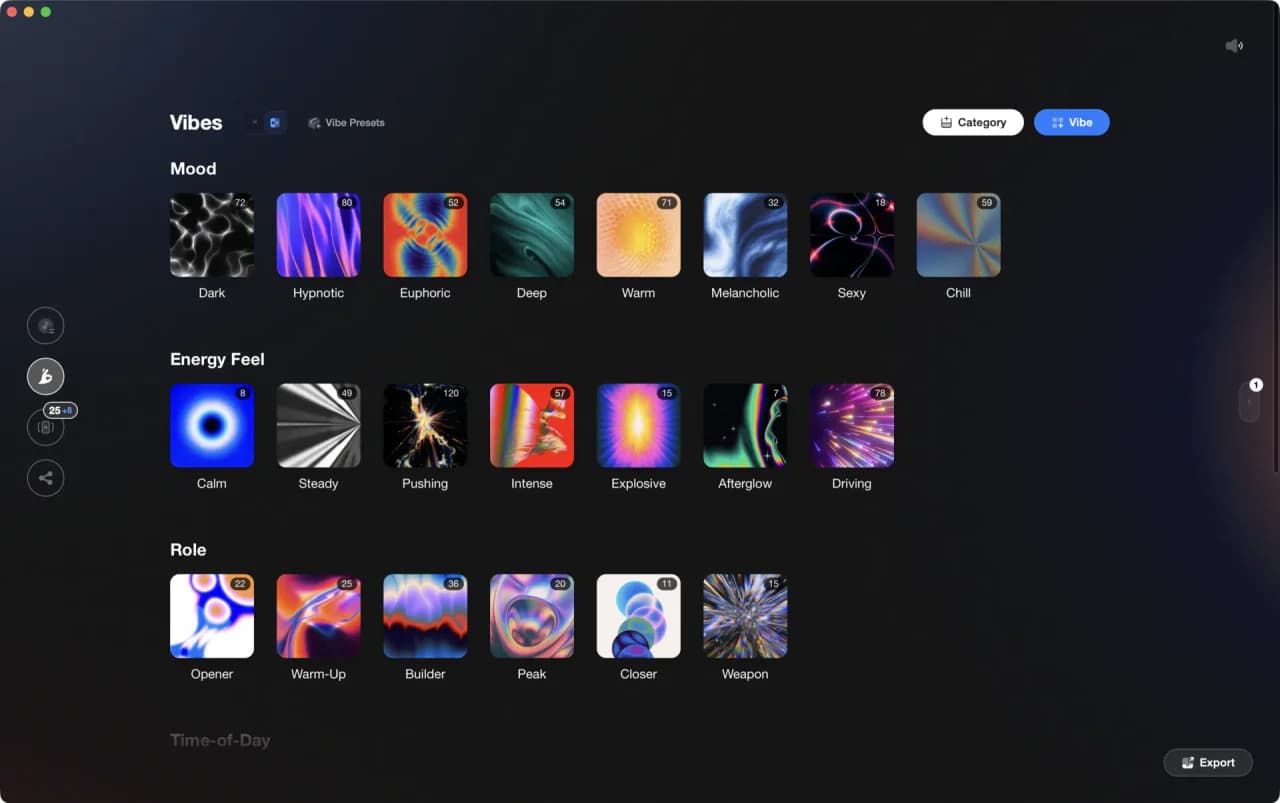
Frequently Asked Questions

Hey, it's Ben Modigell 👋
I DJ and produce as so I so: downtempo, minimal, dub house, tech house, and techno (releases on Spotify and SoundCloud, links above). Everything I write here comes from my own gigs, studio sessions, and library cleanups: the rules I follow, the failure modes I have actually hit, and the workflow I use when nobody is watching. If a technique did not earn its place in my own sets, it does not make it into a tutorial.