
Peak Time DJ Set
Peak time is the busiest stretch of a night, and the slot is held with a plateau rather than a climb. This page covers the shape of the hour, which tracks belong in it, how to prepare the window in your DJ app, and the mistakes that empty a full floor.
Quick Answer
What counts as peak time
Peak time is defined by the floor, not by the clock. It is the window where the room is fullest, where nobody is deciding whether to stay, and where the crowd wants confirmation rather than discovery. In a club night that is usually the slot between the warm-up and the last hour. At a festival it can be the first ten minutes of your set, because the crowd arrived at peak already.
Musically the window is high tempo for the genre, heavy on drums, short on ambiguity. In club techno and house it tends to sit in the upper end of the usual tempo band rather than at the extremes, and download stores have leaned on the label hard enough that Peak Time is filed as a genre of its own next to driving techno. That label is a shopping shortcut, not a rule: a track counts as peak time in your set if it works when the room is already full and loud.
The shape of the slot
A headline hour has a shape of its own, and it is not the same rising line as a full-night journey. It starts high, stays high, and earns its biggest moment by dropping once.
| Segment | Roughly when | What it does |
|---|---|---|
| The handover | First 10 minutes | Start one step above where the last DJ left off. Same tempo, same room, your sound. Do not reset the floor to prove a point. |
| The first lift | 10 to 20 minutes in | One clear step up, on a track people can hold on to. This is where the room decides you are worth staying for. |
| The plateau | The middle half | Eight to twelve tracks at your top two levels. Vary the texture, not the pressure: swap vocals for drums, rolling for stabby, but keep the weight constant. |
| The release | About two thirds in | One track that drops two or three levels. It buys back the room's ears and makes the next climb land. |
| The final climb | Last 15 minutes | Back up in two moves, into the single biggest record you own for this room. |
| The handover out | Last track | Finish on something the next DJ can follow. Ending at your absolute ceiling hands them an impossible start. |
Timings scale to the slot. A 60 minute headline hour and a 2 hour peak slot use the same six segments with different plateau lengths.
That shape is the peak time variant of a wider planning job. If you want the underlying method for scoring and ordering tracks, see DJ set energy levels. The slots either side of yours work on opposite rules: how to play a warm-up set is about deliberately not peaking, and how to play a closing set is about walking the room back down.
Which tracks belong in the window
A peak time track is not simply a loud one. The window rewards records that make sense fast and stay legible at high volume in a room full of people talking over the top of them.
- A hook inside the first 30 seconds. Long hypnotic intros belong earlier in the night, when there is time to spare.
- Drums that carry on their own. If the track collapses when the bass is filtered out, the transition will collapse with it.
- A drop the room can predict. Peak time is not the moment for a structure nobody recognizes.
- Roughly a third familiar. All unknown records and the floor stops singing; all anthems and you sound like a playlist.
- Spares at the same level. Two or three alternates per plateau slot, so you can swap sideways without losing height.
- One ceiling track. The single biggest record you own for this room, held back until the final climb.
Picking those from a large library is its own job: how to pick songs for a DJ set covers the shortlist pass, and how many songs for a DJ set gives the count you need for your slot length.
Play the slot, step by step
- 1
Fix the slot before you pick music
Length, start time, who is before you, who is after you. Ask the DJ before you where they plan to finish, in tempo and in feel. Your first track is decided by their last one.
- 2
Choose the ceiling track first
Pick the biggest record you will play, then build backwards from it. Everything else is either a step towards that moment or a recovery from it.
- 3
Mark the plateau
Decide how many tracks sit at the top and where the single dip falls. Write the two numbers down. Without them the plateau turns into a climb and you run out of room halfway through.
- 4
Build a shortlist about twice the size of the slot
Enough material to play the whole window twice over, all of it at plateau level or one step below. You will use half of it and be glad of the other half.
- 5
Set entry and exit cues on every candidate
Know where each track starts for you and where you will leave it. In a busy hour you should never be searching for a mix point while a record is playing.
- 6
Open one step above the handover
Match the tempo you were handed, lift the energy by a single level, and let two or three tracks pass before you take the room anywhere new.
- 7
Hold the pressure, change the texture
On the plateau, change what the tracks are made of rather than how hard they hit. Vocal, then drums, then a melodic hook, all at the same weight.
- 8
Take the dip on purpose
About two thirds in, play one track two or three levels down while the floor is still packed. It resets the room's ear so the final climb sounds new instead of merely louder.
- 9
Land the ceiling track, then hand over
Play your biggest record in the last 15 minutes, then step back one level so the next DJ has somewhere to go. Ending at your absolute maximum is a gift to nobody.
Prepare the window in your DJ app
The peak window is worth its own playlist or crate, separate from the rest of the night, ordered the way you intend to play it, with the spares parked next to it. Most DJ apps also give you a temporary holding area for a set in progress, which is where the shortlist lives while you are still deciding. In Serato DJ Pro that is the Prepare panel: it holds tracks the way you would lift records part way out of a bag, control and P adds the selected track, and you can drag the panel's contents onto Make New Crate to save the shortlist as a real crate before you leave the house.
Whatever the app, do the ordering at home and the reordering in the club. The full gig checklist, including exports and backups, is in how to prepare for a DJ gig, and if you want to know how many tracks a slot of a given length swallows, the DJ set time calculator does the arithmetic.
Following a warm-up DJ
- You are being handed a room that is deliberately below the ceiling.
- Take the tempo you are given, go up one level, and spend your first three tracks proving the room was right to stay.
- Jumping straight to your top level throws away the runway the opener built for you.
Following another peak DJ
- -You are being handed a room that is already at the top.
- -There is no lift available, so you change the flavour instead: same weight, different drums, different mood.
- -Then take your dip earlier than usual, because the only way to climb again is to come down first.
The mistakes that empty a full floor
- Peaking in the first ten minutes. Your three biggest records up front leaves 50 minutes of anticlimax.
- Climbing all the way through. Constant escalation with no dip means the last track lands on ears that stopped noticing 20 minutes ago.
- Mistaking loud for high. Turning the mixer up is not an energy step. The room hears volume as fatigue, not excitement.
- Sawtoothing. Up, down, up, down every second track. Nobody commits to a floor that keeps changing its mind.
- Resetting the tempo on the handover. A ten beat jump at the first transition tells a full room that something has changed for the worse.
- No spares at plateau level. When a planned track lands flat, the only recovery is a sideways swap, and you need one ready.
- Playing the whole slot with your head down. The plan is a route, not a script. Look up, and change the next track, not the shape.
Most of those are transition problems in disguise. Energy-based mixing covers what happens between the tracks once the order is decided.
The faster way: build the window before you get there
The slow part of all this is finding which of your tracks actually belong at the top, and which ones sit one step below as spares. Vibes does that pass across the whole library. Import Wizard pulls it in from rekordbox, Serato, Traktor, Engine DJ, an Apple Music or iTunes Library.xml, or plain folders, and Smart Import detects which app it came from. Analysis gives every track its BPM, its key in Camelot, musical or Open Key notation, an energy curve, and the sections inside it: intro, buildup, drop, breakdown, outro. That last part is what tells you at a glance whether a record makes its point in the first 30 seconds.
From there you build the shape rather than the tracklist. Set Designer sorts a selection by Energy Flow, ascending, descending or as an arc, with key-path sorting when you want the harmonic route too, so the plateau and the dip become an order you can see. Find Compatible pulls the Camelot neighbours inside a BPM window, half and double time aware, which is how the sideways spares at plateau level get picked. Auto-Tagging fills in vibes across the library so you can grab a level and a mood together, and Track Inspector lets you correct energy, rating and metadata by hand. When the order is right, export it back to rekordbox, Serato, Traktor or Engine DJ as a folder tree, with optional Camelot key or BPM sub-folders.
The visual way to organize your DJ library
Tag tracks by vibe. See everything at once. Export to rekordbox, Serato, Traktor or Engine DJ.
14-day free trial. Full access, no strings attached.
or see how it works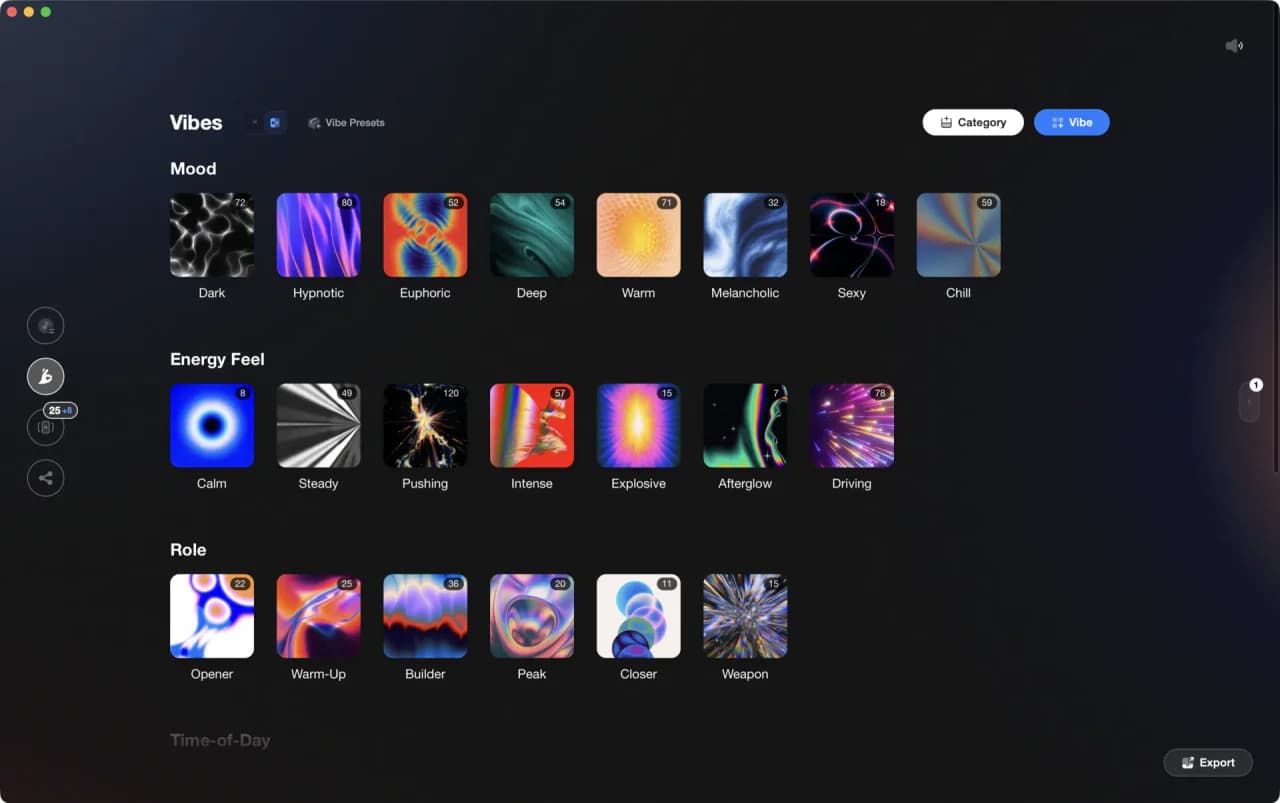
Frequently Asked Questions

Hey, it's Ben Modigell 👋
I DJ and produce as so I so: downtempo, minimal, dub house, tech house, and techno (releases on Spotify and SoundCloud, links above). Everything I write here comes from my own gigs, studio sessions, and library cleanups: the rules I follow, the failure modes I have actually hit, and the workflow I use when nobody is watching. If a technique did not earn its place in my own sets, it does not make it into a tutorial.